
When it comes to kitchen safety, the way you lower the temperature of your leftovers is just as critical as the cooking process itself. Choosing between a rapid cool down and a natural cool down isn't just a matter of convenience; it is a race against the "Danger Zone"-the temperature range between 40°F and 140°F where harmful bacteria can double every 20 minutes. While letting a pot sit on the counter for a natural cool down might seem harmless, professional food safety standards emphasize rapid cooling techniques, such as ice baths or shallow containers, to bypass bacterial growth windows. Understanding the mechanics of these two methods ensures your meal prep remains delicious and, most importantly, safe for your family to consume.
| Feature | Rapid Cool Down | Natural Cool Down (Ambient) |
|---|---|---|
| Time to Safe Temp | < 2 Hours (target < 40°F) | 4-6+ Hours (often inconsistent) |
| Bacterial Risk | Minimal; bypasses "Danger Zone" quickly | High; prolonged exposure to pathogens |
| Food Quality | Preserves texture; prevents overcooking | Risk of "carry-over" cooking and sogginess |
| Best Application | Stews, soups, thick sauces, large meats | Thin items, breads, or low-moisture foods |
| Primary Method | Ice baths, blast chillers, shallow pans | Countertop resting, room temperature air |
| Safety Verdict | Recommended (HACCP Gold Standard) | Not Recommended for perishable goods |
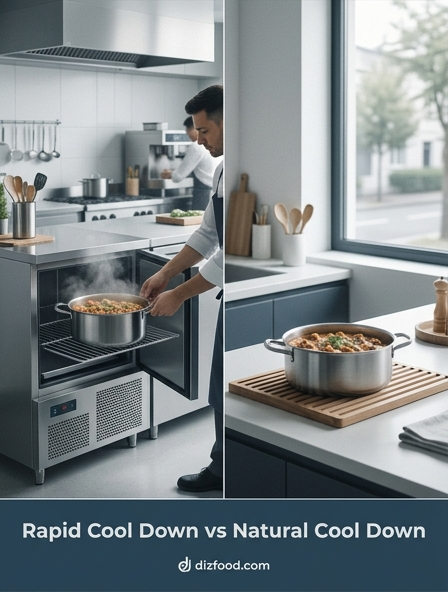
Rapid Cool Down vs Natural Cool Down Comparison
The debate between rapid and natural cooling methods centers on the physiological transition from a high-intensity state to a resting state. Rapid cooling typically involves external interventions such as ice baths, cold showers, or cryotherapy chambers designed to strip heat from the body quickly. This approach focuses on immediate vasoconstriction and the reduction of metabolic activity in the peripheral tissues. Conversely, a natural cool down involves a gradual reduction in activity levels, such as walking or light stretching, allowing the body's internal thermoregulatory systems to stabilize at their own pace.
| Feature | Rapid Cool Down | Natural Cool Down |
|---|---|---|
| Primary Mechanism | Conductive/Convective Heat Loss | Evaporative/Internal Regulation |
| Vascular Response | Immediate Vasoconstriction | Gradual Vasodilation Reduction |
| Primary Goal | Inflammation Suppression | Metabolic Homeostasis |
| Risk Level | High (Thermal Shock) | Low (Standard Recovery) |
Choosing between these methods often depends on the specific goals of the individual. Rapid cooling is frequently favored in multi-day competition formats where the window for recovery is extremely narrow. Natural cooling is often preferred in hypertrophy-focused training cycles where the inflammatory response is a necessary signal for muscle growth. Understanding the trade-offs between these two philosophies is essential for optimizing long-term physical development and immediate comfort.
Science Behind Post Workout Temperature Regulation
Post-workout temperature regulation is governed by the hypothalamus, which acts as the body's thermostat. During exercise, muscle contractions generate significant thermal energy, raising the core temperature. To dissipate this heat, the body initiates vasodilation, shunting blood to the skin's surface where heat can be lost through sweat evaporation. When the workout ends, the body must transition from heat dissipation to maintaining a stable core temperature, a process influenced heavily by the environment and recovery protocol.
The science of cooling involves three primary mechanisms:
- Conduction: The direct transfer of heat through physical contact, such as sitting in cold water.
- Convection: The movement of air or water across the skin to carry heat away.
- Evaporation: The cooling effect produced when sweat turns into vapor on the skin's surface.
If cooling occurs too rapidly, the body may trigger a shivering response, which is a counter-productive attempt to generate heat through involuntary muscle contractions. If cooling is too slow, the sustained high core temperature can lead to prolonged oxidative stress and delayed recovery. Effective temperature regulation requires a balance that supports the removal of heat without inducing a systemic shock that interrupts the body's natural repair signals and hormonal balance.
Benefits of Rapid Cooling for Muscle Recovery
Rapid cooling is a cornerstone of modern sports medicine, primarily valued for its ability to mitigate Delayed Onset Muscle Soreness (DOMS). By inducing rapid vasoconstriction, cold exposure limits the amount of fluid that can accumulate in the muscle tissues following micro-trauma. This reduction in localized edema decreases the pressure on nerve endings, providing immediate analgesic effects and allowing athletes to maintain a higher degree of mobility in the hours following intense exertion.
Furthermore, rapid cooling helps in the clearance of metabolic byproducts. When the body is subjected to cold, blood is redirected toward the core. Upon re-warming, fresh oxygenated blood flushes back into the extremities, a process often referred to as "the pump" or "flushing." This cycle can accelerate the delivery of nutrients necessary for cellular repair. For athletes facing multiple sessions in a single day, the psychological benefit of feeling "refreshed" rather than "heavy" can be just as impactful as the physiological changes. By suppressing the acute inflammatory phase, rapid cooling ensures that the secondary damage caused by prolonged swelling is kept to a minimum, preserving tissue integrity for subsequent bouts of physical activity.
Why Natural Cool Down is Safer for Heart Health
A natural cool down provides a gentle bridge for the cardiovascular system, which is under significant stress during high-intensity training. During exercise, the heart pumps large volumes of blood to the working muscles. A sudden cessation of movement, especially when combined with extreme cold, can cause "blood pooling" in the extremities. This happens because the skeletal muscle pump, which helps return blood to the heart, stops abruptly. A natural cool down involving low-intensity movement ensures that the venous return remains steady while the heart rate gradually declines.
From a heart health perspective, the risks of rapid temperature shifts include:
- Arrhythmia: Sudden cold shock can trigger irregular heartbeats in susceptible individuals.
- Blood Pressure Spikes: Rapid vasoconstriction causes an immediate increase in peripheral resistance, forcing the heart to work harder against higher pressure.
- Vagal Tone Recovery: Natural cooling allows for a more controlled reactivation of the parasympathetic nervous system.
By opting for a gradual return to baseline, the heart is not forced to adapt to two conflicting signals simultaneously: the need to stay warm against external cold and the need to slow down after exertion. This measured approach reduces the likelihood of syncopal episodes (fainting) and ensures that the autonomic nervous system transitions smoothly from a sympathetic (fight or flight) state to a parasympathetic (rest and digest) state without unnecessary cardiovascular strain.
Rapid vs Gradual Cooling Effects on Inflammation
Inflammation is a dual-edged sword in the context of physical training. It is both the mechanism of repair and the cause of discomfort. Rapid cooling is highly effective at suppressing acute inflammation by inhibiting the activity of pro-inflammatory cytokines and reducing the permeability of capillary walls. This is beneficial when the goal is to reduce pain and swelling immediately. However, some research suggests that chronic use of rapid cooling may blunt the long-term adaptations to exercise, as the inflammatory signal is what triggers muscle hypertrophy and mitochondrial biogenesis.
Gradual cooling, on the other hand, allows the inflammatory process to run its natural course. While this may result in more significant soreness over the following 24 to 48 hours, it ensures that the body's signaling pathways for growth and strengthening are fully activated. The choice between rapid and gradual cooling often comes down to the phase of training. During a competitive season, rapid cooling to manage inflammation is often prioritized. During an off-season or "gains" phase, gradual cooling is preferred to maximize the physiological "damage and repair" cycle. By understanding how temperature dictates the inflammatory timeline, individuals can better manipulate their recovery to meet their specific performance or aesthetic goals.
How Cooling Speed Impacts Exercise Performance
The speed at which an athlete cools down can have a profound impact on their performance in subsequent sessions. Rapid cooling is often superior for "repeat performance" scenarios. For example, a tournament player who must compete again in four hours will benefit from an ice bath because it lowers core temperature faster, reducing the thermal strain on the body and preserving glycogen stores. The quicker the core returns to a homeostatic level, the sooner the body can refocus energy on replenishing ATP and clearing lactate.
However, if the "performance" goal is long-term strength gain, cooling too quickly might be detrimental. The "mTOR" signaling pathway, which is critical for muscle protein synthesis, can be dampened by extreme cold. Therefore, an athlete who cools down naturally might see better strength outcomes over a six-month period compared to one who uses cryotherapy after every session. In endurance sports, rapid cooling can help maintain plasma volume, which is essential for cardiovascular efficiency. The decision-making process for cooling speed must therefore be aligned with the specific performance metric being targeted-whether that is immediate output, endurance capacity, or long-term structural adaptation.
Best Cooling Methods for Professional Athletes
Professional athletes utilize a variety of sophisticated cooling methods that go beyond simple ice packs. These methods are chosen based on the sport's demands, the environment, and the recovery window available. The goal is to maximize the efficiency of heat removal while minimizing the discomfort and potential side effects of the cooling process.
Common professional methods include:
- Contrast Water Therapy: Alternating between hot and cold water to create a "vasomotor pump" effect.
- Phase Change Materials (PCMs): Cooling vests that maintain a specific temperature for longer durations than ice.
- Cold Water Immersion (CWI): The standard ice bath, usually kept between 10-15 degrees Celsius.
- Game Ready Systems: Units that combine active compression with cold circulation to treat specific limbs.
The selection of these methods is often data-driven, using core temperature sensors or heart rate variability (HRV) scores to determine the athlete's current state of fatigue. Professional teams often employ "active recovery" sessions immediately followed by these cooling modalities to ensure that metabolic waste is cleared before the cooling-induced vasoconstriction begins. This hybrid approach leverages the benefits of both natural and rapid cooling to create a comprehensive recovery profile that keeps athletes at the peak of their physical capabilities throughout a grueling season.
Risks of Immediate Cold Exposure After Training
While the benefits of rapid cooling are well-documented, immediate exposure to extreme cold after training is not without its risks. The most significant concern is the "Cold Shock Response." When a body that is overheated and has a high heart rate is suddenly submerged in cold water, it can trigger a gasp reflex, hyperventilation, and a massive surge in heart rate. This creates a conflicting "push-pull" effect on the heart: the "diving reflex" tells the heart to slow down, while the cold shock response tells it to speed up, which can lead to autonomic conflict and potential cardiac events.
Another risk involves the blunting of the "training effect." Because cold exposure reduces the blood flow and the metabolic activity in the muscle, it can interfere with the natural hypertrophic response. For those focusing on building muscle mass, immediate cold exposure might actually slow down their progress. Additionally, cold exposure can mask injuries. The numbing effect of ice or cold water can lead an athlete to believe they are recovered and ready to train again, when in reality, they may have a soft tissue injury that requires rest. This can lead to a cycle of overtraining and increased injury risk if not managed with professional oversight.
Natural Recovery vs Cryotherapy Efficiency
Cryotherapy has gained popularity as a high-tech alternative to traditional recovery, promising faster results in a fraction of the time. A typical cryotherapy session lasts only three minutes, whereas a natural recovery period or a traditional ice bath can take anywhere from twenty minutes to several hours. The efficiency of cryotherapy lies in its ability to trigger a systemic hormonal response through extreme cold (often below -100 degrees Celsius), which is much colder than any water-based method.
| Metric | Natural Recovery | Cryotherapy |
|---|---|---|
| Time Required | 30-60 Minutes | 3 Minutes |
| Equipment Cost | Zero | High |
| Systemic Impact | Local/Gradual | Systemic/Immediate |
| Accessibility | Universal | Specialized Centers |
However, "efficiency" does not always equate to "effectiveness." While cryotherapy is faster, it lacks the hydrostatic pressure benefit found in water immersion, which helps in reducing edema. Natural recovery remains the most cost-effective and accessible method, requiring no special equipment or financial investment. For the average gym-goer, the incremental gains in efficiency provided by cryotherapy may not justify the cost, whereas for a professional athlete whose time is highly valued and whose recovery needs are extreme, cryotherapy represents a vital tool in their performance kit.
Choosing the Right Cool Down Strategy for Results
Selecting the optimal cool down strategy requires an assessment of your primary fitness goals, your current health status, and your schedule. There is no one-size-fits-all approach, and the most successful athletes often vary their strategy based on the specific type of training they performed that day. A strategic approach ensures that you are not accidentally working against your own training goals through improper recovery techniques.
Consider the following guidelines when choosing your strategy:
- Strength & Hypertrophy: Prioritize natural cooling. Avoid ice baths or cryotherapy immediately after lifting to allow the inflammatory signals to promote muscle growth.
- Endurance & Heat Acclimation: Use gradual cooling to help the body adapt to thermal stress, but use rapid cooling if you have another session scheduled soon.
- Injury Management: Use rapid cooling locally (ice packs) on specific joints or tendons that are prone to inflammation, while allowing the rest of the body to cool naturally.
- High-Frequency Competition: Utilize rapid cooling (ice baths or cryotherapy) to minimize soreness and maintain performance across consecutive days.
Ultimately, the best strategy is one that you can perform consistently. A natural cool down is always better than skipping recovery entirely, and rapid cooling should be viewed as a specialized tool for specific circumstances rather than a daily requirement. By listening to your body's feedback and adjusting your cooling speed accordingly, you can maximize your results and minimize your risk of injury.


Comments