
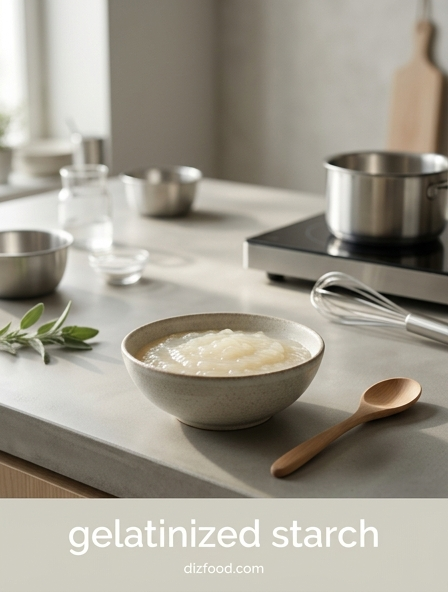
The Science of Starch Gelatinization
Starch gelatinization is a fundamental physiochemical transformation that occurs when starch granules are heated in the presence of water. This process is essential for the digestibility and texture of various kitchen staples, from bread to sauces. As the temperature rises, the thermal energy weakens the hydrogen bonds holding the starch granules together, allowing water molecules to penetrate and swell the structure. This leads to the irreversible loss of the starch's native semi-crystalline arrangement.
The transition typically follows a specific progression of physical changes:
- Swelling: Granules absorb water and expand significantly in volume.
- Leaching: Linear amylose molecules escape the granules into the surrounding liquid.
- Viscosity Increase: The mixture thickens as the swollen granules and leached amylose create a dense network.
- Clarity: The opaque suspension becomes translucent as the light-scattering crystalline regions dissolve.
Understanding this science allows cooks to manipulate the thickness and mouthfeel of dishes by controlling heat and hydration levels. The exact temperature at which gelatinization begins varies depending on the botanical source of the starch.
Optimal Boiling Temperatures for Texture
The temperature at which starch gelatinizes is not universal; it is highly dependent on the type of starch and the desired final texture. For most culinary applications involving tubers and grains, maintaining a temperature within a specific range ensures that the starch granules swell sufficiently without rupturing prematurely, which can lead to a gluey consistency.
| Starch Source | Gelatinization Range (°C) | Texture Result |
|---|---|---|
| Potato | 58 - 66 | Fluffy and soft |
| Wheat | 52 - 85 | Firm and structured |
| Corn | 62 - 80 | Heavy and viscous |
| Tapioca | 52 - 65 | Clear and elastic |
If a liquid is kept at a rolling boil for too long, the mechanical agitation combined with high heat causes the swollen starch granules to fragment. This fragmentation releases an excess of amylose and amylopectin, thinning the sauce and creating a sticky, undesirable mouthfeel. Precise temperature management is therefore critical for achieving a velvety finish in starches.
Choosing the Right Root Vegetable Variety
In the kitchen, the ratio of amylose to amylopectin within a root vegetable dictates its behavior during cooking. Root vegetables are generally categorized into two functional groups: floury (mealy) and waxy. Selecting the incorrect variety can lead to structural failure in specific recipes, such as potato salad or gnocchi.
- Floury Varieties: High in starch (specifically amylose) and low in moisture. When cooked, the starch granules swell and separate, creating a dry, light texture. These are ideal for baking, frying, and light mashes.
- Waxy Varieties: High in moisture and sugar, but lower in starch (specifically amylopectin). The granules stay together during the cooking process, allowing the vegetable to maintain its shape even after boiling. These are best for soups, stews, and salads.
The density of the starch within the cells also influences how the vegetable absorbs fats and liquids. Floury vegetables act like sponges, pulling in butter and cream, whereas waxy vegetables resist absorption, preserving their internal moisture and providing a firmer bite.
The Role of pH in Starch Breakdown
The acidity or alkalinity of a cooking medium plays a significant role in the structural integrity of gelatinized starch. pH levels influence both the rate of gelatinization and the subsequent stability of the starch gel. In highly acidic environments, such as those involving lemon juice, vinegar, or wine, the long chains of glucose that make up starch are susceptible to acid hydrolysis.
This hydrolysis breaks the large starch molecules into smaller dextrins, which possess significantly less thickening power than the original polymers. Consequently, adding acid too early in the cooking process can result in a thin, watery sauce. Conversely, an alkaline environment, created by ingredients like baking soda, can accelerate the breakdown of cell walls (hemicellulose), leading to a faster softening of the vegetable but potentially causing a mushy exterior before the interior is fully gelatinized. Cooks often balance these effects by adding acidic components only after the primary starch gelatinization phase is complete to preserve the desired viscosity and structure.
Pre-cooking Techniques for Retrogradation
Retrogradation is the process whereby gelatinized starch molecules realign themselves into an ordered structure as they cool. This phenomenon is often viewed as "staling" in bread, but it can be leveraged in the kitchen to improve the texture of root vegetables. By utilizing a pre-cooking technique, chefs can manipulate the starch to ensure firmness during secondary cooking stages.
- Blanching: Cook the vegetable at a moderate temperature (around 60°C to 70°C) to initiate partial gelatinization.
- Cooling: Shock the vegetable in ice water or refrigerate it. This encourages amylose molecules to form a crystalline network.
- Resting: Allow time for the retrograded starch to stabilize, which increases the vegetable's structural integrity.
- Final Cooking: Roast or fry the vegetable; the retrograded starch resists further breakdown, resulting in a superior crust.
This technique is essential for making the perfect French fry or roasted potato, as it prevents the interior from becoming hollow while allowing the exterior to develop a rigid, crispy shell that remains stable over time.
Enzymatic Activation for Natural Sweetness
Starchy vegetables contain endogenous enzymes, primarily alpha-amylase and beta-amylase, which are capable of converting tasteless starch into sweet maltose. Harnessing these enzymes requires precise temperature control during the initial stages of cooking. Unlike boiling, which rapidly denatures these enzymes, slow-cooking methods allow them to remain active for an extended period.
The "sweet spot" for enzymatic activation usually falls between 135°F and 170°F (57°C to 77°C). During this window, the enzymes act as biological scissors, snipping long-chain polysaccharides into shorter sugar molecules. This is most evident in sweet potatoes and yams; a slow-roasted sweet potato will be significantly sweeter than one that has been microwaved or boiled quickly. In industrial and high-end culinary applications, this enzymatic window is carefully managed to maximize the natural sweetness of the ingredient, reducing the need for added sugars while simultaneously altering the starch's viscosity to create a creamier, more decadent mouthfeel in the finished dish.
Managing Surface Starch Through Rinsing
When starchy vegetables or grains are cut, processed, or polished, starch granules are released from the ruptured cells and accumulate on the surface as a fine powder. This surface starch, if not managed, can negatively impact the final dish by creating a sticky, gummy film. Rinsing is the most effective mechanical method for removing this excess material before heat is applied.
For items like white rice or cut potatoes intended for frying, thorough rinsing in cold water removes the free amylose that would otherwise gelatinize instantly upon contact with heat. In rice, this results in distinct, individual grains rather than a clumped mass. In the case of potatoes, removing surface starch prevents the pieces from sticking to one another in the pan and allows for a cleaner, crispier exterior. However, in certain dishes like risotto or specific pasta sauces, this surface starch is intentionally preserved and utilized. In these contexts, the starch leaches into the cooking liquid to create a creamy, emulsified sauce without the need for additional thickeners.
Mechanical Processing and Starch Granules
The method used to mash or purée cooked starchy vegetables determines the final consistency by affecting the integrity of the starch granules. When starch is fully gelatinized, the granules are swollen and fragile. Excessive mechanical force can rupture these granules, releasing a flood of amylose into the surrounding environment, which creates a glue-like, elastic texture.
| Tool | Mechanical Action | Starch Impact |
|---|---|---|
| Ricer | Compression | Minimal rupture; fluffy texture |
| Food Mill | Shearing/Sifting | Low rupture; smooth texture |
| Masher | Crushing | Moderate rupture; rustic texture |
| Blender | High-speed blade | Massive rupture; gummy/gluey texture |
To achieve a light, airy mash, one must minimize the work done on the starch. Using a ricer ensures that the cells are separated rather than torn. Conversely, if a sticky or highly cohesive texture is desired-such as in certain traditional doughs-high-shear mechanical processing is intentionally applied to maximize the release of the starchy "glue."
Salt Concentration and Hydration Rates
Sodium chloride is more than a seasoning; it is a functional ingredient that alters the hydration and gelatinization of starch. Salt influences the osmotic pressure in the cooking water, which in turn affects how quickly water molecules can move into the starch granules. Interestingly, high concentrations of salt can actually increase the temperature required for gelatinization.
This occurs because salt ions compete with the starch molecules for the available water, effectively "tightening" the water structure and making it less available for the starch to absorb. In practical kitchen terms, salting the water for pasta or potatoes not only flavors the food from within but also ensures that the exterior of the starch does not over-gelatinize and become mushy before the center is cooked. Furthermore, salt helps to stabilize the pectin in the cell walls of vegetables, providing a firmer bite. Proper salt management allows for a more even cooking rate, ensuring that the transition from raw starch to a fully gelatinized state happens uniformly throughout the ingredient.
Emulsifying Fats into Gelatinized Starch
The interaction between lipids and gelatinized starch is a cornerstone of sauce-making and vegetable purées. When fats such as butter, oil, or cream are introduced to a starch-thickened liquid, the starch molecules act as a physical stabilizer. The long-chain polysaccharides and swollen granules interfere with the movement of fat droplets, preventing them from coalescing and separating from the water phase.
This relationship creates a creamy, smooth mouthfeel. In mashed potatoes, the starch provides the structural framework, while the fat coats the granules, providing lubrication and richness. This interaction can be enhanced by specific techniques:
- Temperature Control: Adding cold fat to warm starch helps create a stable emulsion.
- Agitation: Whisking breaks the fat into smaller droplets, which are then trapped by the starch network.
- Starch Type: High-amylopectin starches are particularly effective at holding fats in suspension.
This synergy is why "beating in" butter at the end of a starch-based recipe results in a glossy, homogenous finish that feels significantly richer than the sum of its parts.

Comments