
When upgrading your culinary workspace, the choice between digital and analog controls often marks the line between high-tech precision and time-tested reliability. Digital interfaces excel in modern kitchens by offering pinpoint accuracy-essential for delicate tasks like sous-vide or technical baking-alongside programmable presets and sleek, easy-to-clean touch surfaces. Conversely, analog controls remain the gold standard for many professional chefs due to their tactile feedback, instant response, and legendary durability in high-heat, high-moisture environments. Choosing the best interface requires balancing your need for granular data and automated convenience against the desire for a "set-it-and-forget-it" mechanical simplicity that can withstand the rigors of daily heavy-duty cooking.
| Feature | Digital Interface | Analog Controls |
|---|---|---|
| Accuracy | Pinpoint; exact to 1° increments | Approximate; relies on visual markers |
| Durability | Sensitive to heat/moisture ingress | High resistance to extreme kitchen heat |
| User Feedback | Visual displays and auditory alerts | Tactile resistance and physical positioning |
| Repairability | Requires specialized circuit board replacement | Often repairable via simple mechanical parts |
| Functionality | Multi-step programming and timers | Single-function manual adjustments |
| Best Application | Convection ovens, sous-vide, air fryers | Gas ranges, heavy-duty mixers, charbroilers |
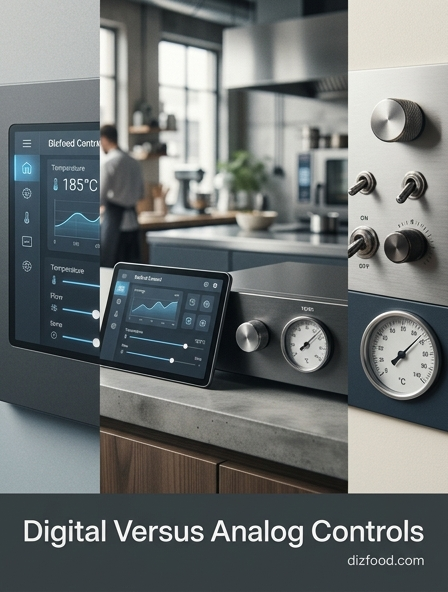
Defining Digital and Analog Control Systems
In the modern kitchen, the distinction between digital and analog control systems defines the user experience and the appliance's fundamental operation. Analog controls are characterized by continuous physical movement, typically through a potentiometer or a mechanical switch. When a chef turns a dial on a classic gas range, they are interacting with an analog system where the flow of fuel is modulated by the physical position of the valve. This represents a direct, linear relationship between the input device and the mechanical output.
Digital systems, conversely, rely on discrete values and binary logic. These systems utilize microprocessors to interpret user input-often via touchscreens or membrane buttons-into specific numerical data. A digital oven does not merely "open a valve" more; it calculates the necessary duty cycle for heating elements to reach a precise integer value stored in its memory. This transition from physical modulation to algorithmic calculation marks the primary shift in kitchen technology over the last three decades.
- Analog Examples: Rotary toaster timers, gas burner valves, spring-loaded kitchen scales, and manual egg beaters.
- Digital Examples: Induction cooktops with touch sliders, programmable pressure cookers, smart refrigerators, and LED-display microwaves.
Understanding these definitions is crucial for assessing how a kitchen functions. While analog systems offer a tangible sense of control through mechanical resistance, digital systems provide a layer of abstraction that allows for complex automation and precise repetition of tasks across various culinary applications.
The Mechanics of Continuous Signal Processing
Analog kitchen appliances operate through the mechanics of continuous signal processing. This involves a hardware-level manipulation of electricity or gas without the intervention of a computer chip. In an analog stand mixer, for example, the speed control often utilizes a rheostat to vary the voltage delivered to the motor. As the lever moves, the resistance changes smoothly, allowing for an infinite number of speed variations within the device's operational range. This continuity is a hallmark of the analog experience, where there are no "steps" between settings.
The physics of these signals means that changes are reflected in real-time through the medium itself. In a traditional gas oven, the thermostat is often a copper bulb filled with fluid that expands as it heats, physically pushing a diaphragm to throttle the gas. There is no software to crash or sensor data to "packetize." This mechanical feedback loop ensures that the signal-temperature-is processed directly into a mechanical response. The following table illustrates the differences in how signals are handled:
| Feature | Analog Processing | Digital Processing |
|---|---|---|
| Signal State | Continuous wave | Discrete pulses (0 and 1) |
| Adjustability | Infinite gradations | Fixed increments |
| Hardware | Cams, valves, resistors | Microprocessors, oscillators |
While this method lacks the programmable sophistication of modern electronics, it offers a directness that many professional chefs prefer. The continuous nature of the signal means there is no quantization error, which in digital terms refers to the rounding of a value to the nearest available step.
Precision and Calibration in Digital Interfaces
Digital interfaces have revolutionized the kitchen by providing a level of precision that analog components struggle to match over time. In a digital sous-vide circulator, the system can maintain a temperature within a tenth of a degree. This is achieved through a Proportional-Integral-Derivative (PID) controller, a digital algorithm that constantly monitors the variance between the current temperature and the target setpoint, adjusting power in millisecond bursts.
Calibration in digital systems is often more stable than in their analog counterparts. Analog components are subject to "drift" caused by environmental factors such as humidity or the physical wear of springs and gears. A digital scale, once calibrated at the factory, uses a load cell to convert weight into an electrical signal that is then converted to a specific number. As long as the sensor remains functional, the digital logic ensures that "500g" is displayed consistently every time. This precision is vital for pastry work and molecular gastronomy where exact ratios are the difference between success and failure.
- Repeatability: Users can save specific programs, ensuring that a recipe performs identically every time.
- Granularity: Digital displays allow for specific settings, such as 37% power or exactly 112 degrees.
- Auto-Correction: Modern sensors can detect deviations and recalibrate the system logic on the fly.
However, this precision relies entirely on the quality of the sensors. While the digital logic is perfect, if the thermistor or probe providing data to the chip is inaccurate, the digital interface will simply provide a very precise reading of an incorrect temperature.
Tactile Feedback and the Analog Experience
The "feel" of a kitchen is often dictated by the tactile feedback of its controls. Analog interfaces provide a sensory connection that digital touchscreens often lack. When a cook turns a heavy, knurled knob on a high-end range, they receive immediate physical feedback through the tension of the spring and the sound of the gas igniting. This allows for "blind" operation; a chef can adjust the heat while keeping their eyes on the pan, gauging the adjustment by the degree of the turn and the resistance of the dial.
Digital controls, particularly capacitive touch surfaces, often require visual confirmation. Without a physical detent or a mechanical click, the user must look at a screen to ensure the command was registered. While some digital manufacturers attempt to mimic this with haptic vibrations or audible beeps, it rarely replicates the intuitive nature of mechanical hardware. For many, the analog experience is more ergonomic, especially in a messy kitchen environment where wet or flour-covered hands may fail to trigger a touchscreen but can easily grasp a robust plastic or metal knob.
Furthermore, the physical arc of a dial provides a spatial representation of power. Halfway through the rotation clearly indicates 50% power. In digital menus, this information is often buried behind "up" and "down" arrows or sub-menus, which can slow down the cooking process. The analog experience is not just about the technology; it is about the physical harmony between the tool and the operator, emphasizing the "craft" aspect of cooking over the "programming" aspect.
Durability and Longevity of Control Hardware
When considering the lifespan of kitchen equipment, the durability of control hardware is a primary concern. Analog systems are generally comprised of heavy-duty mechanical parts-brass valves, ceramic switches, and steel levers. These components are designed to withstand the harsh environment of a kitchen, characterized by extreme heat, steam, and airborne grease. If an analog knob breaks, it is often a simple mechanical failure that can be diagnosed visually and repaired with basic tools.
Digital controls, while sleek, introduce vulnerabilities. Printed Circuit Boards (PCBs) are sensitive to heat and moisture. Over time, the capacitors on a control board may dry out, or solder joints may crack due to thermal expansion and contraction. Unlike a mechanical valve, a failed microchip cannot be repaired; it must be replaced. This often leads to "planned obsolescence," where a perfectly functional oven becomes e-waste because a specific digital display is no longer manufactured.
- Heat Tolerance: Mechanical dials can operate at higher ambient temperatures than sensitive silicon chips.
- Environmental Sealing: Touchscreens are prone to "ghost touches" if steam or oil accumulates on the surface.
- Repairability: Analog systems are modular and often use standardized parts like universal potentiometers.
- Failure Modes: Analog parts usually degrade slowly, giving warning, whereas digital parts often fail catastrophically.
In professional settings, longevity is often equated with simplicity. The more complex the digital control system, the more points of failure exist. For a home user, this translates to a trade-off between the modern features of a digital interface and the multi-decade reliability of a traditional analog appliance.
Comparing Response Times and Latency
Response time refers to the interval between a user's input and the machine's reaction. In an analog system, this latency is virtually zero. When you turn the dial on a gas stovetop, the physical aperture opens immediately, and the flame responds instantly. This immediate feedback loop is critical for techniques like flambéing or sautéing, where heat must be modulated in real-time to prevent burning. The physics of the system provides the "processing speed."
Digital systems, however, introduce a layer of computational latency. When a user presses a button on a digital induction cooktop, the signal must be debounced by the software, interpreted by the CPU, and then sent to the power inverter. While this often happens in milliseconds, some poorly designed appliances exhibit "input lag," where the display takes a moment to update or the heating element stutters. Smart appliances that rely on cloud processing for certain features can suffer from even greater latency if the local network is congested.
Additionally, the "boot time" of digital appliances is a factor. An analog toaster is ready the moment you push the lever. A high-end "smart" oven may require several seconds to initialize its operating system and connect to Wi-Fi before the user can even set a temperature. For a busy chef, these seconds of latency can be an annoyance. While digital systems offer superior accuracy, they often sacrifice the raw, instantaneous responsiveness that defines traditional mechanical kitchen tools.
Integration with Modern Internet of Things
The rise of the Internet of Things (IoT) has made digital control systems indispensable in the modern "smart kitchen." Analog controls are inherently isolated; they cannot communicate with other devices or be accessed remotely. Digital systems, however, utilize communication protocols like Wi-Fi, Bluetooth, and Zigbee to integrate into a wider home ecosystem. This allows a refrigerator to monitor inventory, a coffee machine to start brewing via a smartphone app, or an oven to download specific cooking profiles for a branded meal kit.
This integration provides several functional advantages that are impossible with analog hardware:
- Remote Monitoring: Checking if the oven was left on or receiving a notification when a timer expires.
- Firmware Updates: Improving the performance or adding new features to a dishwasher after it has been installed.
- Energy Management: Appliances can communicate with the power grid to run during off-peak hours to save money.
- Diagnostics: Error codes can be sent directly to service technicians, identifying a broken part before they arrive.
While IoT integration adds significant convenience and functionality, it also introduces concerns regarding cybersecurity and data privacy. A digital, connected kitchen is a node on a network, making it susceptible to software bugs and hacking, a reality that analog kitchen users never have to face. The value of this integration depends on whether the user prioritizes connectivity and data-driven cooking over simplicity and isolation.
Cost Efficiency in System Implementation
Cost efficiency in kitchen controls is a nuanced comparison between initial manufacturing costs and long-term ownership costs. From a manufacturing perspective, digital controls have become increasingly cheaper to implement. A single mass-produced microchip and a plastic membrane keypad can replace a complex assembly of metal gears, springs, and heavy-gauge wiring. This is why entry-level microwaves and coffee makers are almost exclusively digital; it is simply more cost-effective to print a circuit board than to manufacture mechanical timing components.
However, from the consumer's perspective, cost efficiency looks different. Analog appliances often have a lower "total cost of ownership" because they are easier to fix. A replacement knob or a standard heating element is inexpensive. In contrast, if the digital control board of a modern refrigerator fails, the replacement cost can often exceed 50% of the appliance's original price. This often leads to the replacement of the entire unit, which is inefficient both financially and environmentally.
| Expense Category | Analog Trend | Digital Trend |
|---|---|---|
| Initial Purchase | Higher for premium mechanical | Lower for mass-market electronic |
| Energy Usage | Higher (less precise control) | Lower (optimized power cycles) |
| Repair Costs | Low (individual parts) | High (full board replacement) |
While digital systems save money on the factory floor and can reduce utility bills through efficient power management, they can be more expensive over a ten-year horizon if the electronics fail outside of the warranty period.
Maintenance Requirements for Electronic Circuits
Maintaining a digital kitchen requires a different skill set and environment than an analog one. Electronic circuits are the primary enemies of moisture and heat-two things found in abundance in any kitchen. Maintenance for digital systems is largely preventative. It involves ensuring adequate ventilation for cooling fans and checking that seals are intact to prevent steam from infiltrating the control housing. Once a circuit board is contaminated by "kitchen gunk"-a mix of grease and dust-it can cause short circuits or overheating that leads to permanent failure.
Analog maintenance is more hands-on and mechanical. It might involve lubricating a stiff hinge, cleaning the carbon deposits off an igniter, or tightening a loose screw on a handle. These tasks are intuitive and can often be performed by the homeowner. Analog systems are also more "forgiving" of poor maintenance; a slightly dirty gas valve will still function, albeit less efficiently, whereas a slightly corroded trace on a digital PCB will cause the entire appliance to display an error code and refuse to operate.
To maximize the life of digital kitchen electronics, users should:
- Avoid using dripping wet cloths on touchscreens or control panels.
- Ensure appliances have the recommended clearance from walls to allow heat dissipation.
- Use high-quality surge protectors for expensive smart appliances to prevent circuit fry-outs.
- Regularly check for software updates that may patch bugs affecting hardware efficiency.
Ultimately, the maintenance of digital systems is about protection, while the maintenance of analog systems is about restoration.
Selecting the Optimal Control Architecture
Choosing between digital and analog controls depends on the specific needs of the cook and the intended use of the kitchen. For professional environments where high-volume production and extreme durability are required, analog controls are often preferred. The ability to quickly "slam" a dial to high heat and the reliability of mechanical parts under 12-hour-a-day stress are invaluable. Professional ranges often eschew digital screens because they cannot withstand the ambient heat of a commercial line.
For the home enthusiast or the "smart home" early adopter, digital architecture is usually the superior choice. The precision offered by digital interfaces allows for foolproof cooking results, and the integration with apps and timers simplifies the management of a busy household. If the goal is to bake bread with professional-grade consistency or to slow-cook meat to a specific internal temperature, the granular control of digital sensors is unmatched.
The optimal kitchen often utilizes a hybrid approach. This might include a heavy-duty gas range with analog knobs for searing and boiling, paired with a digital convection oven for precise baking and a digital scale for ingredient measurement. By understanding the strengths of each-the durability and tactile immediacy of analog versus the precision and connectivity of digital-users can curate a kitchen environment that balances the best of both technological worlds. Selecting the right architecture is not about choosing the newest technology, but about choosing the most appropriate tool for the culinary task at hand.

Comments