
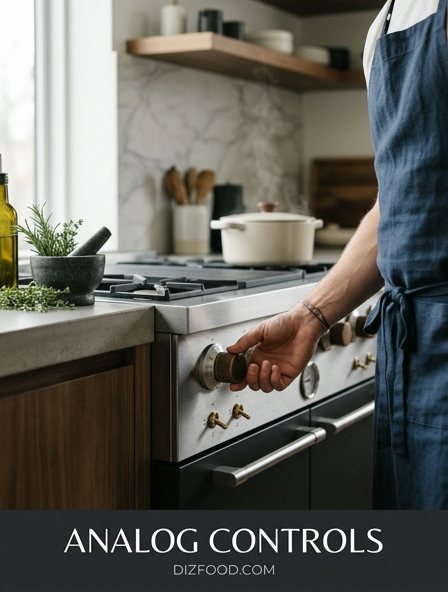
Heat Resistance and Control Resilience
In the high-intensity environment of a commercial kitchen, ambient temperatures near ranges and ovens can fluctuate dramatically. Analog controls are specifically engineered to withstand these thermal extremes without the risk of circuit failure or screen desensitization. Unlike digital interfaces that may lag or malfunction when exposed to high heat, mechanical knobs and heavy-duty switches utilize heat-resistant materials like phenolic resins and die-cast metals. This resilience ensures that the equipment remains operational even during the most demanding service periods.
The structural integrity of analog systems offers a significant advantage in heavy-duty cooking zones. While internal electronic components in digital systems can suffer from thermal expansion and solder joint fatigue, mechanical linkages remain stable. This physical robustness is essential for equipment located directly above or adjacent to high-BTU burners. The following materials are commonly used to ensure control resilience:
- Reinforced Bakelite for superior insulation and grip.
- Stainless steel shafts to prevent warping under thermal stress.
- High-temperature silicone gaskets to protect internal gears.
- Heavy-gauge aluminum housings for heat dissipation.
Tactile Feedback for Culinary Precision
Precision in the kitchen often relies on a chef's ability to make instantaneous adjustments without diverting their attention from the food. Analog controls provide immediate tactile feedback, allowing operators to feel the "click" of a setting or the resistance of a valve. This physical connection fosters a level of intuition that digital touchpads cannot replicate. By utilizing muscle memory, a cook can adjust a flame or a timer while simultaneously managing multiple pans, increasing overall efficiency and safety.
The sensory engagement provided by mechanical dials is critical for fine-tuning temperatures. Small, incremental movements allow for a granular level of control that feels natural and responsive. This haptic interface is particularly beneficial in fast-paced environments where visual confirmation of a digital screen might be obscured by steam or distance. Operators generally follow a specific workflow when utilizing these tactile systems:
- Initial engagement of the dial to activate the heating element.
- Incremental rotation to find the "sweet spot" based on physical resistance.
- Final adjustment through sensory confirmation of the flame height or vibration.
Mechanical Reliability vs Digital Complexity
The debate between mechanical reliability and digital complexity often highlights the "less is more" philosophy in professional culinary settings. Analog controls operate on simple physics-levers, gears, and cams-which are inherently less prone to the software glitches and firmware errors that plague modern digital appliances. When a digital control board fails, the entire machine often becomes a "brick" until an expensive proprietary component is replaced. In contrast, mechanical systems are transparent in their operation and failure points.
This simplicity translates directly to uptime. In a busy kitchen, the fewer points of failure a machine has, the more dependable it becomes. While digital systems offer programmable cycles, they introduce sensitivity to power surges and electromagnetic interference. The following table illustrates the core differences between these two control philosophies:
| Feature | Analog Mechanical | Digital Electronic |
|---|---|---|
| Failure Mode | Gradual Wear | Sudden Failure |
| Repairability | High (Modular) | Low (Component Level) |
| Power Sensitivity | Immune to Surges | Highly Sensitive |
| User Interface | Tactile Knobs | Touchscreens/Buttons |
Withstanding Grease and Moisture Exposure
Kitchen environments are notoriously harsh, characterized by airborne grease, high humidity, and frequent liquid splashes. Analog controls excel in these conditions because their sealed mechanical designs are less susceptible to the ingress of contaminants. A physical knob can be designed with an overlapping skirt that sheds liquids away from the internal components, whereas a touchscreen or membrane switch can easily be compromised by a single drop of oil or a puff of steam, leading to "ghost touches" or total unresponsive behavior.
Maintaining hygiene is also more straightforward with analog interfaces. Most commercial-grade knobs are designed to be removable, allowing for deep cleaning of both the control and the mounting surface. This prevents the buildup of organic matter that can lead to sanitation issues. The resilience against moisture ensures that the equipment can be wiped down or even sprayed during standard closing procedures without fearing an electrical short. Key protective features include:
- Gasketed bezels that create a water-tight seal.
- Non-porous metal surfaces that resist grease adhesion.
- Drip-proof orientations for vertical mounting.
Maintenance and Repair Cost Benefits
From a financial perspective, analog controls offer significant long-term savings regarding maintenance and repair. Because mechanical parts are often standardized, sourcing replacements is faster and more cost-effective than ordering specialized digital motherboards. A technician can often diagnose a faulty thermostat or a broken potentiometer using basic tools, whereas digital systems require specialized diagnostic software and expensive hardware swaps. This reduces the hourly labor cost and the total price of parts.
The cost disparity becomes even more evident as equipment ages. As digital models are phased out, manufacturers often stop producing the specific control boards needed for repairs, rendering the appliance obsolete. Analog components, however, remain largely unchanged for decades, ensuring that a twenty-year-old oven can be repaired for a fraction of the cost of a new unit. The table below outlines typical cost comparisons for common repairs:
| Repair Task | Analog Estimated Cost | Digital Estimated Cost |
|---|---|---|
| Switch Replacement | $20 - $60 | $150 - $400 |
| Thermostat Calib. | Manual Adjustment | Software Flash |
| Dial/Button Fix | $15 - $30 | $200+ (Full Panel) |
Simplified Training and Operational Speed
The intuitive nature of analog controls significantly reduces the time required to train new kitchen staff. In an industry with high turnover rates, the ability for a new hire to walk up to a piece of equipment and immediately understand how to operate it is invaluable. There are no sub-menus to navigate, no "hold for three seconds" locks to memorize, and no confusing icons to interpret. The direct relationship between turning a knob and the resulting change in temperature or speed is universal across cultures and languages.
Operational speed is further enhanced by the "instant-on" capability of mechanical controls. While digital displays may require a boot-up sequence or several taps to reach a desired setting, an analog dial can be set to the exact position in a single fluid motion. This efficiency is critical during "the rush," where every second saved contributes to faster ticket times. The training process typically follows a simple progression:
- Identification of the control icon (e.g., flame or clock).
- Physical rotation to the desired visual marker.
- Observation of the immediate mechanical response.
Durability Standards for Busy Kitchens
Commercial kitchens require equipment that can withstand physical abuse, and analog controls are built for this reality. In the heat of service, knobs are often turned with greasy hands, bumped by heavy pots, or operated with significant force. Manufacturers of analog equipment design these components to meet rigorous durability standards, often testing them for tens of thousands of cycles. Unlike fragile LCD screens that can crack upon impact, a metal knob is virtually indestructible under normal-and even abnormal-working conditions.
The "industrial grade" nature of these controls ensures they do not degrade over time. The materials selected for analog interfaces are chosen for their impact resistance and tensile strength. This focus on physical longevity means the equipment can handle the rough-and-tumble environment of a high-volume restaurant. Common durability features found in these systems include:
- Heavy-duty detents that prevent accidental setting changes.
- Shatterproof materials for all user-facing components.
- Reinforced mounting plates to prevent dial wobbling.
- Corrosion-resistant plating for all internal mechanical links.
Minimizing Downtime During Peak Hours
Downtime is the enemy of profitability in the food service industry. Analog controls contribute to higher uptime because they lack the delicate "brain" that can be confused by power flickers or minor hardware errors. If a digital fryer experiences a sensor error, it may lock the operator out entirely. An analog fryer, however, will typically continue to function, or at the very least, allow for a manual override. The "fail-soft" nature of mechanical systems means that even if a component begins to wear out, it often provides warning signs rather than failing catastrophically.
In many cases, a skilled operator can temporarily circumvent a minor mechanical issue to finish a shift. For instance, if a knob handle breaks, the underlying shaft can still be turned. This level of emergency flexibility is non-existent with touch-sensitive panels. To ensure minimal downtime, kitchens often rely on these operational strategies:
- Daily visual inspections of dial alignment and resistance.
- Immediate replacement of loose knobs before they affect the shaft.
- Manual calibration checks using external thermometers.
Analog Longevity in Commercial Environments
The lifespan of a commercial appliance is often dictated by its most fragile component. In many cases, the heating elements and chassis of an oven can last for thirty years, but the digital controls may fail after five. Analog controls bridge this gap, offering a lifespan that matches the heavy iron and steel of the machine itself. This longevity makes analog-equipped appliances a superior long-term investment for business owners who want to avoid the constant cycle of equipment replacement dictated by planned digital obsolescence.
The timeless nature of mechanical design also means that the equipment does not feel "dated" as technology evolves. A classic gas range with simple valves is as functional today as it was forty years ago. This enduring utility is why many high-end professional ranges continue to feature analog controls as a premium choice. The benefits of this longevity include:
- Higher resale value for used kitchen equipment.
- Consistency in cook times over decades of use.
- Reduction in electronic waste and environmental impact.
- Simplified inventory for multi-unit operators using the same models.
Precision Flame Management for Consistent Results
For chefs working with gas, analog valves provide a level of infinite adjustment that is difficult to achieve with stepped digital controls. Precision flame management involves fine-tuning the gas flow to achieve the perfect simmer or a blistering sear. Because an analog valve is a needle-based mechanical system, it allows for microscopic changes in the gas-to-oxygen ratio. This granularity is essential for delicate tasks like melting chocolate or reducing a complex sauce where even a few degrees can make a difference.
Consistency in culinary results is achieved through this direct, uninterrupted control over the energy source. Digital systems often operate in "pulses" or predefined increments (e.g., levels 1 through 10), which can lead to hot spots or uneven cooking. An analog system allows the chef to find the exact flow rate required for a specific vessel. The following table highlights how analog valves facilitate this precision:
| Action | Analog Benefit | Result |
|---|---|---|
| Simmering | Infinite low-end adjustment | No scorching or breaking |
| Sautéing | Instant heat recovery | Consistent pan temperature |
| Wok Cooking | High-flow manual bypass | Authentic "Wok Hei" flavor |



Comments