
Choosing the right bakeware is the secret to a professional presentation, and the battle between the springform pan and the Bundt pan often comes down to the structural needs of your recipe. If you're tackling delicate desserts like creamy cheesecakes or fragile fruit tortes, the springform pan's latch-and-release sides are indispensable for a clean break without the need for inverting. Conversely, the Bundt pan is the ultimate choice for dense, sturdy cakes that require a beautiful, sculpted aesthetic, utilizing its signature central tube to bake heavy batters evenly from the inside out. Matching the pan to your cake's specific texture ensures a flawless release and a "wow" factor that makes your home-baked creations truly shine.
| Feature | Springform Pan | Bundt Pan |
|---|---|---|
| Primary Use | Delicate cakes (Cheesecake, Torte) | Dense cakes (Pound, Coffee cake) |
| Design | Two-piece with expandable side latch | Heavy-walled with central chimney tube |
| Release Style | Sides lift off; cake stays on base | Inverted (flipped) onto a cooling rack |
| Batter Type | Wet, thin, or creamy textures | Thick, sturdy, and structure-heavy |
| Heat Flow | Standard exterior-to-interior bake | Central tube cooks middle faster |
| Aesthetic | Smooth, vertical, clean edges | Intricate, fluted, and decorative shapes |
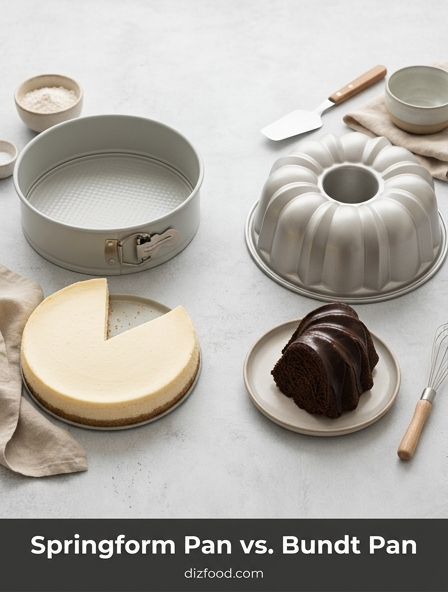
Springform Pan vs Bundt Pan Key Differences
The primary distinction between a springform pan and a Bundt pan lies in their structural engineering and their intended outcome for the baked good. A springform pan is characterized by its two-piece construction, featuring a removable cylindrical wall that expands and contracts via a spring-loaded latch and a separate flat base. In contrast, a Bundt pan is a single-piece, heavy-walled vessel defined by its distinctive fluted or decorative shape and a central hollow tube, often referred to as a chimney. While both are essential in a baker's arsenal, they serve vastly different functional purposes based on the fragility of the dessert being prepared.
| Feature | Springform Pan | Bundt Pan |
|---|---|---|
| Construction | Two-piece (removable sides) | Single-piece (solid mold) |
| Primary Shape | Flat, circular, and smooth | Fluted, ornate, with a center tube |
| Release Method | Sides expand and lift away | Inversion (flipping upside down) |
| Best For | Delicate, creamy cakes | Dense, moist, sculpted cakes |
The choice between the two often comes down to whether the cake can survive being flipped over. Because the springform pan allows the baker to remove the sides without disturbing the cake's structure, it is the gold standard for items that are too soft or sticky to be inverted. The Bundt pan, however, relies on the cake's structural integrity to maintain its intricate design once it is turned out onto a serving plate.
Understanding the Design of a Springform Pan
The springform pan is a marvel of functional kitchen design, specifically engineered to solve the problem of extracting delicate cakes from deep pans. The design consists of a base-which can be smooth or dimpled-and a high collar equipped with a heavy-duty spring latch. When the latch is closed, the collar tightens securely around the base, creating a seal that is generally tight enough to hold thick batters. When the latch is released, the collar expands, allowing it to be lifted straight up and away from the cake, leaving the dessert perfectly intact on the base.
The materials used in springform pans vary, influencing how they perform in the oven. Most professional-grade pans are made from the following materials:
- Anodized Aluminum: Offers excellent heat distribution and prevents over-browning.
- Silicone Sides: A modern variation that uses a glass base and flexible walls for an even easier release.
- Ice Cream Cakes: Allows for easy layering of softened ice cream and cookie crumbles that can be frozen solid and released cleanly.
- Mousse Cakes: Perfect for delicate, gelatin-set desserts that are built in layers and require smooth, vertical sides.
- Tortellini Pie and Deep-Dish Pizza: Useful for savory applications where height and presentation are key.
- Fruit-Topped Tortes: Ideal for cakes with heavy fruit arrangements on top that would be ruined by inversion.
- Monkey Bread: The pull-apart dough balls and caramel sauce thrive in the circular, enclosed environment of the fluted pan.
- Rum or Boiled Cider Cakes: These cakes are often soaked in syrup while still in the pan; the heavy walls help the cake absorb the liquid without falling apart.
- Decorative Gelatin Molds: The intricate designs of a Bundt pan make for beautiful chilled salads or dessert jellies.
- Savory Stuffing or Meatloaf: For a unique holiday presentation, savory dishes can be baked in a Bundt pan to create a "ring" that can be filled with gravy or vegetables in the center.
- Check the Base Orientation: Many springform bases have a lip. Ensure the lip is facing downward (or upward, depending on the brand's design) to create the tightest possible mechanical seal with the ring.
- The Parchment Paper Buffer: Place a circle of parchment paper over the base before locking the ring. The paper acts as a slight gasket, filling tiny gaps in the seal.
- The "Slow Pour" Test: Before adding your expensive batter, pour a small amount of water into the locked pan. If it drips out instantly, your ring may be warped and needs manual adjustment.
- Use a Silicone Sleeve: Some companies now sell reusable silicone protectors that fit over the bottom of 9-inch springform pans, providing a perfect waterproof barrier.
- Cool for Exactly 10-15 Minutes: This allows the cake to firm up while the steam still provides a slight lubrication between the cake and the pan.
- The "Jiggle" Test: Gently shake the pan horizontally. You should feel the cake move as a single unit, indicating it has released from the sides.
- Use Plastic Tools: If a section is stuck, use a thin plastic spatula to gently loosen the edge. Never use metal, as it can scratch the non-stick coating and make future sticking worse.
- The Inversion: Place your cooling rack or serving plate over the top of the pan, then flip the whole assembly in one confident motion.
- Does the cake need to be flipped? (Bundt = Yes, Springform = No)
- Is the batter very thin or liquid? (Bundt is safer, Springform needs foil)
- Does the cake have a delicate topping? (Springform is better)
- Is it a dense pound cake or coffee cake? (Bundt is better)
-
Because the sides are removable, the springform pan is not restricted to baking alone. It is frequently used for chilled or "no-bake" desserts where the structure relies on refrigeration rather than the setting of flour and eggs. The depth of the walls, usually around 2.5 to 3 inches, also makes it an ideal choice for multi-layered savory dishes like deep-dish pizzas or tiered savory pies that require vertical support during the assembly process.
The Unique Shape and Function of Bundt Pans
The Bundt pan is recognizable by its sculptural, fluted edges and its central "chimney" or tube. While the aesthetic appeal is undeniable, the design is rooted in the physics of heat distribution. Heavy, dense cakes-such as pound cakes or fruitcakes-often struggle to bake evenly in the center before the edges burn. The central tube of a Bundt pan solves this by allowing hot air to circulate through the middle of the pan, effectively baking the cake from both the inside and the outside simultaneously. This ensures a consistent crumb and prevents a raw or "gummy" center.
Structurally, Bundt pans are typically made from cast aluminum or heavy-gauge steel. This thickness is intentional; it provides a thermal mass that protects the sugar-heavy batters from the direct intensity of the oven's heating elements. The ornate designs, ranging from classic ridges to modern geometric patterns, serve a dual purpose. They increase the surface area of the cake, which leads to more delicious, caramelized crust, and they provide a built-in decoration that requires nothing more than a light dusting of powdered sugar or a simple glaze to look professional.
Because these pans are molded from a single piece of metal, there is no risk of leaking, even with very thin or liquid-heavy batters. This makes them significantly more reliable for recipes that incorporate large amounts of butter, oil, or fruit purees. However, the complexity of the design requires meticulous preparation to ensure that the cake does not stick to the many crevices of the mold during the final release.
Best Uses for Springform Pans in Your Kitchen
The springform pan is the undisputed champion of the cheesecake. Because cheesecake is essentially a baked custard, it is extremely fragile and lacks the structural "bounce" of a traditional sponge cake. Attempting to flip a cheesecake out of a standard cake pan would result in a collapsed mess. The springform pan avoids this by allowing the baker to simply peel away the outer ring. Beyond the classic New York cheesecake, this pan is essential for several other specialized kitchen tasks:
One of the hidden benefits of the springform pan is its versatility as a serving vessel. Many bakers choose to leave the cake directly on the metal base of the pan, placing the base on a decorative platter rather than risking a transfer to another surface. This is particularly useful for crumb-crusted desserts, like those made with graham crackers or crushed chocolate cookies, which can be prone to cracking if moved. The high walls also make it an excellent choice for "naked" cakes that require sharp, clean edges without the need for heavy frosting to hide imperfections.
When to Reach for a Bundt Pan for Baking
A Bundt pan should be your first choice when you are aiming for a dessert that is both visually stunning and physically substantial. These pans are designed for "sturdy" cakes that can withstand the force of gravity when being flipped. The most common candidate for a Bundt pan is the pound cake, which benefits from the pan's ability to cook through its dense, buttery interior. Similarly, coffee cakes with thick ribbons of cinnamon sugar or nuts are perfect for Bundt baking, as the pan creates a high ratio of crunchy exterior to soft interior.
You should also reach for a Bundt pan when making the following items:
The Bundt pan is also the ideal choice for "dump cakes" or recipes that involve mixing ingredients directly in the pan (though this is rare). Its primary advantage remains the "wow factor." Because the pan does the work of shaping the cake, it is the perfect tool for novice bakers who want to produce a dessert that looks like it came from a professional bakery without requiring advanced piping or frosting skills.
Can You Substitute a Springform Pan for a Bundt Pan
Substitution between these two pans is possible, but it requires careful consideration of volume and heat dynamics. Generally, a standard 10-inch springform pan has a capacity of about 10 to 12 cups, which is roughly equivalent to a standard Bundt pan. However, the lack of a central chimney in the springform pan means that the cake will take much longer to bake in the center. If you pour a Bundt cake recipe into a springform pan, you run a high risk of the edges becoming dry and overbaked while the middle remains liquid.
To successfully use a springform pan as a substitute, you may need to implement a "hack" to mimic the Bundt's central tube. You can place a clean, empty tin can (weighted with dried beans) in the center of the springform pan before pouring in the batter. This creates the hollow center and helps distribute heat more evenly. If you choose not to use a central insert, you must lower the oven temperature by about 25 degrees Fahrenheit and increase the baking time significantly, checking for doneness with a long skewer in the very center of the cake.
Conversely, substituting a Bundt pan for a springform pan is much more difficult and usually discouraged for delicate recipes. You cannot bake a cheesecake in a Bundt pan; it is impossible to remove without the cake falling apart, and the intricate ridges would make cleaning the pan a nightmare. Only use a Bundt pan for springform recipes that result in a sturdy, sponge-like cake that you are comfortable inverting and potentially losing some of the topping or crust definition.
Comparing Bake Times and Heat Distribution
The physics of heat distribution is where these two pans diverge most sharply. A Bundt pan is a high-convection vessel. Because the center is hollow, the heat from the oven reaches the batter from the outside rim and the inside tube simultaneously. This creates a shorter distance for the heat to travel to the "thermal center" of the batter. Consequently, Bundt cakes often bake faster than their solid counterparts of the same volume. This rapid, even heating is why the exterior of a Bundt cake develops that signature golden-brown, slightly thick crust that many people find irresistible.
The springform pan, being a wide, open cylinder, relies on heat moving from the outer edge toward the center in a single direction. This means the center of the cake is the last part to set. For a dense batter, this creates a temperature gradient where the outside might reach 200°F while the inside is still at 140°F. This is why springform recipes often call for lower temperatures or water baths (bain-marie) to slow down the cooking of the exterior, allowing the center time to catch up without the edges curdling or burning.
Material also plays a role in this comparison. Bundt pans are almost always made of thick cast metal, which retains heat and provides a steady, radiant cook. Springform pans are often thinner to allow for the flexibility of the latch mechanism. This makes springform pans more responsive to temperature changes, which is beneficial for delicate custards but can lead to unevenness if the oven has "hot spots." When using a springform pan, it is often helpful to use light-colored metal to prevent the base from over-browning the bottom of the cake.
Essential Tips for Leak Proof Springform Baking
One of the most common frustrations with springform pans is their tendency to leak, especially when using thin batters or when placed in a water bath. Because the pan is two pieces, the seal is rarely 100% watertight. To prevent oven messes or soggy crusts, bakers must employ specific techniques to "waterproof" the pan. The most effective method is the heavy-duty aluminum foil wrap. Using wide, professional-grade foil, place the pan in the center and fold the foil up the sides, ensuring there are no seams below the water line.
Beyond foil, there are several other steps you can take to ensure a leak-proof experience:
If you are baking a cheesecake in a water bath and are still worried about leaks, you can place the foiled springform pan inside a slightly larger cake pan, then place that larger pan into the water bath. This "pan-in-pan" method provides a secondary fail-safe that guarantees no water will touch your crust, even if the foil has a microscopic tear.
How to Achieve the Perfect Bundt Cake Release
The "moment of truth" for any Bundt cake is the flip. Because of the intricate designs and high sugar content of the recipes, the cake can easily bond to the metal, leading to a "broken" cake where the top remains stuck in the pan. Success starts long before the cake goes into the oven. Proper greasing is mandatory. While many use non-stick sprays, professional bakers often recommend a "cake goop" (a mixture of equal parts flour, oil, and shortening) brushed thoroughly into every nook and cranny with a pastry brush.
Once the cake is baked, the cooling process is the next critical stage. You should never attempt to unmold a Bundt cake immediately after it leaves the oven. The structure is still too soft and will likely collapse. Follow these steps for a clean release:
If the cake won't budge, try the "hot towel" method. Invert the pan onto the plate and drape a towel soaked in hot water over the bottom of the pan. The steam created inside the pan can often help release the stubborn sugar bonds, allowing the cake to drop cleanly onto the plate after a few minutes.
Choosing the Right Pan for Your Next Dessert
Deciding between a springform and a Bundt pan ultimately depends on the specific texture and presentation goals of your recipe. If your goal is a dessert that is creamy, layered, or has a delicate top-like a fruit-heavy tart or a chocolate mousse cake-the springform pan is your only logical choice. Its ability to release the sides without disturbing the surface is essential for maintaining the "clean" look of professional desserts. Furthermore, if the recipe requires a crumb crust (like graham crackers or Oreo cookies), the springform pan is superior as it allows you to press the crust firmly against the sides and base.
On the other hand, choose a Bundt pan when you want a "centerpiece" cake that requires minimal effort to decorate. The Bundt pan is the workhorse for heavy, moist, and flavorful cakes that are meant to be sliced and shared at room temperature. It is also the better choice for cakes that involve a lot of inclusions, like chocolate chips, nuts, or chunks of fruit, as the sturdy walls and central tube ensure these heavy ingredients don't result in an undercooked center.
Consider the following quick checklist before you start:
By matching the pan to the physics of the recipe, you ensure not only a successful bake but also a beautiful presentation that honors the effort you put into the ingredients.

Comments