
Whether you're whisking up a delicate pavlova or prepping a silky buttercream, understanding the structural differences between French and Italian meringue is a game-changer for any home baker. French meringue is the quintessential "entry-level" technique, prized for its effortless volume and airy lightness achieved by beating fine sugar into raw egg whites. However, if you're chasing the "perfect peak" that won't weep or collapse under pressure, the Italian method is the professional gold standard. By drizzling hot sugar syrup into the whites, you create a cooked, ultra-stable, and glossy foam that holds its shape beautifully. Choosing the right technique depends entirely on your final goal: the crisp, melt-in-your-mouth snap of a baked French shell or the dense, marshmallow-like resilience of a stabilized Italian topping.
| Feature | French Meringue | Italian Meringue |
|---|---|---|
| Preparation | Raw sugar whisked into cold whites. | Hot sugar syrup (240°F) streamed into whites. |
| Stability | Low; loses volume quickly and "weeps." | Highest; structurally sound and heat-stable. |
| Texture | Light, airy, and crisp when baked. | Dense, silky, glossy, and marshmallow-like. |
| Difficulty | Beginner; requires only a whisk/mixer. | Advanced; requires a candy thermometer. |
| Food Safety | Must be baked (contains raw eggs). | Safe to eat raw (syrup pasteurizes eggs). |
| Best Use | Soufflés, Pavlovas, and meringue cookies. | Buttercreams, macarons, and pie toppings. |
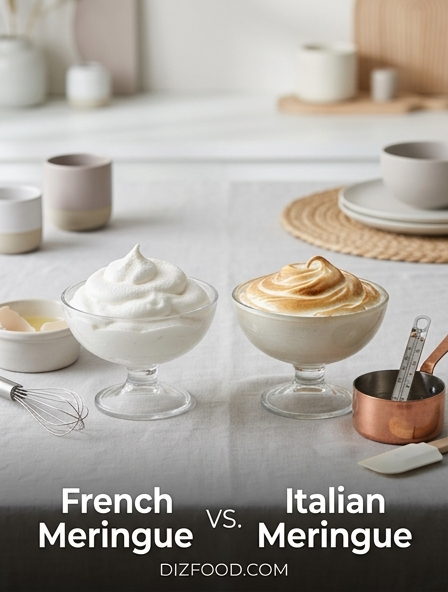
Understanding the Basics of French and Italian Meringue
In the culinary world, meringue serves as the foundational architecture for countless desserts, ranging from airy soufflés to decadent buttercreams. While all meringues are essentially an emulsion of egg whites and sugar, the method of preparation dictates the final structure, stability, and use. French meringue is often considered the most elementary form, created by whisking granulated sugar directly into raw egg whites until stiff peaks form. It is appreciated for its simplicity and lightness, though it remains the most fragile of the meringue family. Because the sugar is not dissolved in a liquid beforehand, it relies on the mechanical action of the whisk to incorporate air and slowly dissolve the crystals.
In contrast, Italian meringue is a more sophisticated and stable variation that involves a "cooked" process. Instead of adding dry sugar, a hot sugar syrup-heated to the soft-ball stage-is slowly drizzled into the egg whites as they are being whipped. This process effectively cooks the proteins, creating a dense, glossy, and marshmallow-like consistency that does not collapse easily. Understanding these basic differences is crucial for any pastry chef, as the choice between them affects both the workflow and the final texture of the dish. Below are the primary characteristics that distinguish the two:
- French Meringue: Quick to prepare, light texture, requires baking to be safe and stable.
- Italian Meringue: Highly stable, safe to eat without further baking, silky and dense texture.
- Sugar Incorporation: French uses raw granulated sugar; Italian uses 240°F (115°C) sugar syrup.
- Difficulty Level: French is beginner-friendly; Italian requires precise temperature control and timing.
The Science of French Meringue and Cold Whisking
The creation of a French meringue is a study in protein denaturation and aeration. When egg whites are whisked, the tightly coiled proteins begin to unfold and bond together, trapping air bubbles in a network. This cold whisking method relies on the gradual addition of sugar to stabilize these fragile walls. As sugar dissolves into the water content of the egg whites, it creates a viscous film around the air bubbles, preventing them from popping or coalescing. However, because the sugar is added in its crystalline form, it takes a significant amount of mechanical energy to ensure the granules are fully integrated without overbeating the proteins.
One of the scientific challenges of the French method is the risk of "over-whisking," where the protein bonds become too tight and squeeze out the moisture, resulting in a dry, clumpy mess. To prevent this, acids such as cream of tartar or lemon juice are often added to help delay the bonding process, allowing for more air to be trapped before the structure sets. This style of meringue is chemically active until it is placed in an oven. The heat causes the air trapped in the bubbles to expand while the proteins coagulate and set, turning a soft foam into a crisp, solid structure. To achieve the best results, bakers should follow these steps:
- Start with room temperature egg whites to ensure maximum volume.
- Whisk until soft peaks form before adding any sugar.
- Add sugar one tablespoon at a time to ensure even dissolution.
- Continue whisking until the mixture is glossy and no longer feels gritty between your fingers.
Mastering Italian Meringue with Hot Sugar Syrup
Mastering Italian meringue requires a blend of confectionery skill and precise timing. The process begins with the preparation of a sugar syrup, typically composed of sugar and a small amount of water. This mixture must be heated to the soft-ball stage, which is between 235°F and 240°F (113°C to 115°C). While the syrup reaches this critical temperature, the egg whites are whipped to soft peaks. The magic happens when the boiling syrup is poured in a slow, steady stream into the whites while the mixer is running. This technique performs two simultaneous functions: it dissolves the sugar perfectly and uses residual heat to pasteurize and "set" the egg proteins.
The result is a meringue that is significantly more robust than its French counterpart. The heat from the syrup causes the egg proteins to stretch and coagulate instantly, creating a structure that can hold its shape for hours or even days. Because the sugar is already in liquid form, the resulting foam is incredibly smooth, with a brilliant sheen that resembles polished porcelain. It is the preferred method for items that will not be baked, as the heat from the syrup makes the whites safe for consumption. Achieving the perfect Italian meringue involves several key technical considerations:
- Syrup Placement: Aim the syrup between the side of the bowl and the whisk to avoid splashing.
- Temperature Monitoring: Use a digital candy thermometer to ensure the syrup is exactly at the soft-ball stage.
- Cooling Time: Continue whisking the meringue after the syrup is added until the bowl feels cool to the touch.
- Speed Control: Maintain a medium-high speed to ensure the syrup is incorporated before it cools and hardens.
Structural Stability Comparison Between Meringue Styles
Stability is the primary factor that determines which meringue is appropriate for a specific culinary application. French meringue is notoriously unstable; it begins to weep (release moisture) and collapse shortly after it is made if it is not immediately baked. This is because the cold-processed protein bonds are relatively weak and the sugar is not fully integrated into a syrup-like state within the foam. In contrast, Italian meringue is the "gold standard" for stability. The cooking process creates a permanent change in the protein structure, allowing it to withstand being folded into heavy creams or sitting at room temperature without losing volume.
This difference in structural integrity is most apparent when considering the "hold" time of the foam. A French meringue must go from the mixing bowl to the oven in minutes. An Italian meringue, however, can be used to frost a cake and will maintain its peaks and swirls without melting. This makes the Italian method essential for professional pastry work where presentation and longevity are paramount. The following table summarizes the structural differences between the two styles:
| Feature | French Meringue | Italian Meringue |
|---|---|---|
| Structural Rigidity | Low - collapses easily | High - holds shape well |
| Texture | Light and airy | Dense and marshmallow-like |
| Longevity | Must be used immediately | Stable for several hours |
| Heat Resistance | Requires baking to set | Heat-stable during assembly |
Food Safety Differences in Raw versus Cooked Egg Whites
Food safety is a critical concern in the kitchen, particularly when working with eggs. French meringue is essentially a raw product. Although the high concentration of sugar acts as a mild preservative, it does not eliminate the risk of Salmonella. Therefore, French meringue should never be consumed without being thoroughly baked. The baking process raises the internal temperature of the meringue to a level that kills harmful bacteria. This limits its use to items like cookies, pavlovas, and cake layers that undergo significant heat treatment in the oven.
Italian meringue offers a significant safety advantage. The addition of sugar syrup heated to 240°F (115°C) effectively pasteurizes the egg whites during the mixing process. As the hot syrup is whisked into the whites, it raises the temperature of the entire mass to approximately 160°F (71°C), which is the threshold for egg safety. This makes Italian meringue the ideal choice for "no-bake" applications, such as mousses, semifreddos, and frostings. Chefs can confidently serve Italian meringue-based desserts to high-risk populations, such as children or the elderly, without the fear associated with raw egg consumption. Key safety points include:
- Pasteurization: Italian meringue is self-pasteurizing; French is not.
- Baking Requirement: French meringue must reach an internal temp of 160°F in the oven.
- Cross-Contamination: Always use clean, sanitized equipment for both methods to prevent bacterial growth.
- Storage: Even though Italian meringue is "cooked," the finished dessert should still be refrigerated if it contains other perishable ingredients.
Best Culinary Uses for French Meringue Techniques
Despite its fragility, French meringue is indispensable for specific textures that cannot be replicated by other methods. Its primary role is as a leavening agent or a structural component in baked goods. When a French meringue is folded into a batter, such as in a soufflé or a sponge cake, the air bubbles expand in the oven, providing the "lift" necessary for a light and fluffy crumb. Additionally, the French method is the traditional choice for making meringue "kisses" or pavlovas. When baked at a low temperature for a long duration, the exterior becomes crisp and brittle while the interior remains slightly chewy.
Another classic use for French meringue is in the preparation of dacquoise or succès-nut-based meringue layers used in French layer cakes. The raw sugar in the French method provides a specific crunch when baked that the smoother Italian version lacks. It is also the preferred base for Macarons (the French method variation), where the egg whites are folded with almond flour and powdered sugar to create the iconic footed cookie. Because French meringue is easy to overbeat, it is rarely used for decorative piping that needs to sit out, but it excels in the following areas:
- Pavlovas: The large, pillowy nests that serve as a base for fruit and cream.
- Soufflés: Providing the essential vertical lift during baking.
- Meringue Cookies: Simple, sweet, and crunchy treats.
- Angel Food Cake: Creating the signature airy and fat-free texture.
Top Applications for Stable Italian Meringue Frostings
Italian meringue is the workhorse of the professional pastry kitchen, primarily due to its incredible versatility and temperature resistance. Its most famous application is in Italian Meringue Buttercream (IMBC). By whisking softened butter into a cooled Italian meringue, chefs create a frosting that is silky, buttery, and far less sweet than American buttercream. Unlike other frostings, IMBC remains stable at room temperature and provides a perfectly smooth surface for cake decorating. The stability of the meringue ensures the buttercream doesn't "break" or become grainy.
Beyond buttercream, Italian meringue is the standard choice for topping pies, such as Lemon Meringue Pie. Because it is already cooked by the syrup, it can be piped onto the tart and simply browned with a kitchen torch or under a broiler for aesthetic effect, without needing to be fully baked through. This prevents the filling from overcooking or the meringue from weeping onto the curd. It is also frequently used to lighten heavy bases in mousses and bavarians. Common applications include:
- Baked Alaska: The meringue acts as an insulator for the ice cream while being torched.
- Marshmallow Fluff: A base for homemade confections and spreads.
- Semifreddo: Providing a light, frozen texture that doesn't turn into a solid ice block.
- Decorative Piping: Creating sharp, defined borders on high-end pastries.
Texture and Consistency Variations Explained
The texture of a meringue is a direct result of how the sugar molecules interact with the egg protein network. In a French meringue, the texture is often described as "aerated" and "crystalline." If the sugar is not added slowly enough, the resulting meringue can feel slightly gritty or grainy. Once baked, the texture becomes bone-dry and snaps easily. This makes it perfect for dishes where a "crunch" is desired. However, if left unbaked, the texture is thin and watery compared to other styles, lacking the body needed for decorative work.
Italian meringue, on the other hand, possesses a "velvety" and "elastic" consistency. The use of hot syrup creates a micro-bubble structure that is much smaller and more uniform than that of French meringue. This results in a mouthfeel that is often compared to marshmallows-creamy, dense, and substantial. Even when torched or lightly baked, Italian meringue retains a soft, succulent interior. It does not "snap" like a French meringue cookie; instead, it offers a gentle resistance. Understanding these nuances helps a chef match the meringue to the desired sensory experience of the dessert:
- French: Brittle, light, dry, and crunchy (post-baking).
- Italian: Smooth, creamy, dense, and glossy (pre and post-baking).
- Graininess: Higher risk in French; virtually non-existent in Italian.
- Visuals: French appears matte; Italian appears satiny and reflective.
Essential Equipment for French and Italian Methods
To achieve success with either meringue, the right tools are non-negotiable. For both methods, the most critical rule is that all equipment must be "fat-free." Even a microscopic trace of egg yolk or residual oil in the bowl can prevent the egg whites from foaming, as fat interferes with the protein bonds. Stainless steel or glass bowls are preferred over plastic, as plastic can retain a thin film of oil even after washing. A stand mixer is highly recommended, especially for the Italian method, as it allows the baker to have their hands free to manage the hot sugar syrup while the whites are being whipped at high speed.
The Italian method requires additional specialized tools that the French method does not. A high-quality candy thermometer or an infrared thermometer is essential for tracking the sugar syrup's progress. Furthermore, a small saucepan with a heavy bottom is necessary to ensure even heat distribution and prevent the sugar from burning. For the French method, a balloon whisk attachment is usually sufficient. Here is a checklist of essential equipment:
- Stand Mixer: Necessary for the sustained high-speed whisking required for volume.
- Candy Thermometer: Critical for Italian meringue to reach the 240°F mark.
- Stainless Steel Bowl: The ideal vessel for temperature conduction and cleanliness.
- Copper Bowl (Optional): Traditionally used for French meringue to stabilize ions, though less common today.
- Kitchen Torch: Used to finish Italian meringue toppings without an oven.
Choosing the Right Meringue for Your Specific Dessert
Selecting the appropriate meringue style is a strategic decision based on the final goal of the dessert. If the priority is speed and the meringue will be fully baked-such as in a simple batch of cookies or a folded-in cake leavener-the French method is the most efficient choice. Its ability to provide airiness and a crisp finish makes it the king of baked textures. However, if the dessert requires a component that is safe to eat "raw," needs to hold a complex piped shape, or will be used as a base for a rich buttercream, the Italian method is the only professional choice.
Chefs also consider the environment in which the dessert will be served. In humid climates, French meringue absorbs moisture from the air and turns soft and sticky almost immediately. Italian meringue, thanks to its cooked sugar structure, is slightly more resilient to humidity, although still sensitive. When deciding between the two, consider the following decision matrix:
| If you are making... | Use this method: | Because: |
|---|---|---|
| Macarons or Pavlova | French | Provides the necessary bake-stable structure. |
| Cake Frosting (Buttercream) | Italian | Offers superior stability and a silky mouthfeel. |
| Lemon Meringue Pie | Italian | Eliminates weeping and ensures food safety. |
| Soufflé or Sponge Cake | French | Maximizes air incorporation for volume. |

Comments