
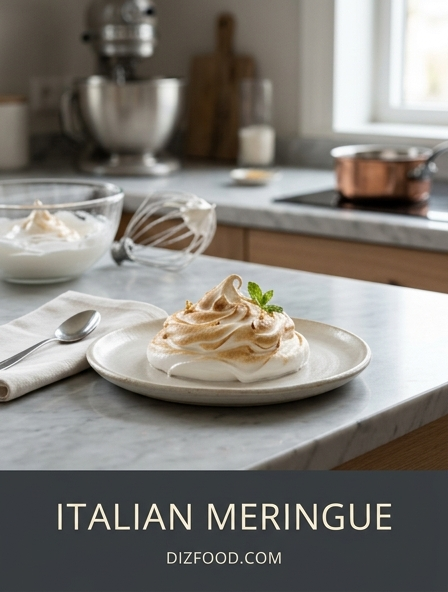
Sugar temperature and egg protein stability
Achieving the perfect Italian meringue requires a precise understanding of the relationship between sugar syrup temperature and egg white protein behavior. When sugar is heated to the "soft ball" stage, typically between 115°C and 121°C, it possesses the specific kinetic energy required to modify the albumin structure without causing immediate coagulation. As this hot syrup is slowly incorporated into whipped egg whites, the heat initiates a controlled unfolding of the protein chains. This process, known as partial denaturation, allows the proteins to realign and form a reinforced network around the air bubbles trapped during the initial whipping phase.
The stability of this foam is significantly higher than that of cold-process meringues. The concentrated sugar solution acts as a stabilizing agent that prevents the proteins from over-coagulating or collapsing under their own weight. This thermal interaction results in a foam that is both resilient and elastic, maintaining its volume even when subjected to further culinary manipulation or temperature changes. The following factors influence protein stability during this phase:
- Peak temperature of the sugar syrup at the moment of contact.
- The speed of the whisking attachment during syrup integration.
- The acidity levels of the egg whites, often adjusted with cream of tartar.
- The ratio of sucrose to the total mass of the egg protein.
Structural differences in cold and hot methods
The fundamental distinction between cold and hot meringue methods lies in the mechanism of protein stabilization and the resulting molecular architecture. The cold method, synonymous with French meringue, relies almost exclusively on mechanical shear force. Whisking unravels egg proteins, which then trap air through hydrophobic and hydrophilic interactions. Because there is no heat applied during the mixing process, the structure remains fragile and prone to syneresis, or weeping, if not baked immediately. This method produces a light, airy foam that is highly porous but structurally inconsistent over time.
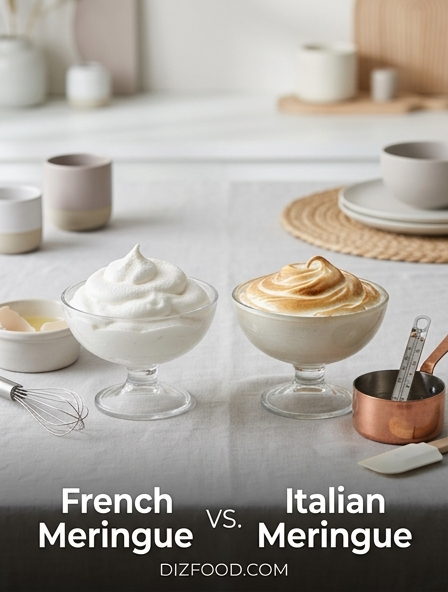
In contrast, hot methods like the Italian and Swiss techniques introduce thermal energy to create a permanent change in the protein matrix. The Italian method is particularly distinct because it utilizes a pre-heated sugar syrup rather than heating the whites directly over a bain-marie. This results in a cooked foam that is biologically safe and mechanically robust. The structural differences are often categorized by their industrial applications and physical properties as shown below:
| Feature | French (Cold) | Italian (Hot) |
|---|---|---|
| Stability | Low / Temporary | High / Permanent |
| Sugar Integration | Granular / Raw | Dissolved / Syrup |
| Texture | Grainy / Crisp | Smooth / Satiny |
| Primary Use | Soufflés / Pavlovas | Buttercreams / Toppings |
The science of Italian meringue silkiness
The hallmark silkiness of Italian meringue is a direct result of the microscopic uniformity of its air bubbles and the high concentration of dissolved sugar. When the 121°C syrup is streamed into the egg whites, it creates a highly viscous environment that prevents the air bubbles from coalescing into larger, irregular pockets. The resulting foam consists of millions of tiny, uniform spheres coated in a thin, flexible layer of cooked protein and sugar. This uniformity is what the human tongue perceives as a "silky" or "velvety" texture, rather than the "foamy" sensation associated with French variations.
Furthermore, the high sugar-to-water ratio ensures that the liquid phase of the meringue remains in a glassy, amorphous state as it cools. This prevents the formation of sugar crystals, which would otherwise introduce a gritty mouthfeel. The reflective properties of the meringue are also enhanced by this micro-structure; the smooth surface of the tiny bubbles reflects light more evenly, giving the product its characteristic brilliant white sheen. This aesthetic and tactile quality is essential for high-end patisserie where visual perfection is as critical as flavor balance.
French meringue aeration and crispness
French meringue is prized for its superior aeration and its ability to transform into a brittle, crisp confection when baked. Because the sugar is added gradually in its dry form to the whipping whites, it does not immediately weigh down the protein structure. This allows for a maximum expansion of air cells, resulting in a volume that can be significantly larger than that of Italian meringue. However, this volume is deceptive, as the lack of heat during the mixing phase means the protein bonds are weak and rely entirely on the subsequent baking process to solidify.
During baking at low temperatures, the water content slowly evaporates, leaving behind a delicate skeleton of proteins and sugar crystals. This creates a highly porous and "short" texture that shatters upon impact. The crispness is a function of the moisture removal; if any residual water remains, the meringue will be chewy rather than crunchy. To ensure the highest quality of crispness, pastry chefs often follow a specific sequence of sugar addition:
- Whisk whites to soft peaks to establish a primary bubble structure.
- Gradually rain in superfine sugar to provide mechanical stability.
- Continue whisking until the sugar is dissolved but the foam remains airy.
- Bake at temperatures below 100°C to dehydrate without browning.
Moisture retention and shelf life impact
Italian meringue excels in moisture retention, a property that significantly extends the shelf life of the desserts it inhabits. The cooked sugar syrup acts as a humectant, effectively binding water molecules and preventing them from migrating out of the foam or into the surrounding pastry layers. This resistance to syneresis is crucial for cakes and tarts that must be refrigerated or stored for several days. While a French meringue would quickly collapse or "leak" liquid, the Italian version maintains its volume and structural integrity due to the reinforced protein-sugar lattice.
From a shelf-life perspective, the Italian method also offers a degree of microbial stability. The high temperature of the sugar syrup effectively pasteurizes the egg whites, reducing the risk of salmonella and inhibiting the growth of spoilage organisms. This makes it the preferred choice for frostings and fillings that are not subjected to further cooking. When used as a component in complex desserts, the moisture-retaining properties ensure that the meringue does not draw water from fruit fillings or become rubbery when exposed to the dry environment of a professional display fridge.
Thermal denaturation of egg whites
The process of thermal denaturation is the scientific core of the Italian meringue technique. Egg whites are composed of approximately 90% water and 10% proteins, primarily ovalbumin, conalbumin, and ovomucoid. In their native state, these proteins are tightly folded into globular shapes. When the hot sugar syrup is introduced, the thermal energy breaks the weak hydrogen bonds holding these proteins together. As the proteins unfold, their hydrophobic regions are exposed, causing them to bond with one another and form a complex, three-dimensional web that traps both air and moisture.
This denaturation is irreversible, meaning that once the Italian meringue is formed and cooled, it cannot return to a liquid state. This provides the structural permanence required for decorative piping and stable mousses. The temperature of the syrup must be monitored carefully; if the syrup is too hot, it may cause the proteins to aggregate too quickly, leading to a lumpy or "scrambled" texture. Conversely, if the syrup is too cool, it will fail to denature the proteins sufficiently, resulting in a weak foam that lacks the necessary viscosity for professional applications.
Comparing density for professional piping
In the context of professional pastry work, the density of a meringue dictates its suitability for various piping techniques. Density is measured by the ratio of weight to volume, often referred to as specific gravity. Italian meringue is notably denser and heavier than French meringue because of the high concentration of sugar syrup and the relative stability of its bubbles. This higher density is actually an advantage for intricate piping, as it allows the meringue to hold sharp, defined edges and withstand the pressure of being squeezed through fine decorative tips.
A French meringue, being lighter and more fragile, often loses its shape when piped through small nozzles or when handled excessively. Professional chefs choose the meringue type based on the required visual outcome and the duration the decoration must last. For instance, the sharp ridges of a "Saint-Honoré" or the smooth globes on a lemon tart require the structural "memory" that only a denser, cooked meringue can provide. The following table illustrates the typical density-related performance of the three main meringue types:
| Type | Specific Gravity | Shape Retention | Ease of Piping |
|---|---|---|---|
| French | Lowest | Poor | Difficult |
| Swiss | Medium | Good | Moderate |
| Italian | Highest | Excellent | Easy |
Sugar syrup integration and molecular bonding
The integration of sugar syrup into whipping egg whites is a delicate exercise in fluid dynamics and molecular bonding. As the 121°C syrup enters the foam, it must be distributed instantly to avoid localized "cooking" of the whites. The rapid movement of the whisk disperses the syrup into microscopic droplets. At the molecular level, the sucrose molecules in the syrup form strong hydrogen bonds with the water molecules and the side chains of the unfolded proteins. This creates a cohesive matrix that is far more stable than the simple mechanical mixture found in a cold-processed meringue.
This bonding process is enhanced by the presence of water in the syrup, which acts as a plasticizer, giving the meringue its characteristic elasticity. The sugar does not just sit between the bubbles; it becomes an integral part of the bubble walls. This molecular reinforcement prevents the air from escaping and the liquid from draining, which is why Italian meringue does not shrink or weep. The precision required during this integration phase is why the speed of the mixer and the temperature of the sugar must be perfectly synchronized to achieve the desired culinary result.
Texture profiles in high-end pastry design
In high-end pastry design, texture is used to create contrast and sensory engagement. Italian meringue offers a unique texture profile characterized by a "clean" melt-in-the-mouth sensation and a lack of residual grittiness. Its elasticity allows it to be folded into heavy fats, such as butter or nut pastes, without losing its aerated structure. This makes it the essential base for Italian Buttercream, which is prized for its lightness and stability in warm environments compared to the denser American buttercream. The texture is often described as "marshmallow-like" but with a more refined and less chewy finish.
Architecturally, the texture of Italian meringue allows it to function as both a decorative topping and a structural component. It can be torched to create a thin, caramelized crust that protects the soft, aerated interior, providing a dual texture experience of smoky crispness followed by cool creaminess. Designers often leverage its high gloss to create modern, minimalist aesthetic shapes that appear metallic or porcelain-like under kitchen lights. This versatility in texture and appearance makes it a foundational element in the repertoire of any professional pastry chef aiming for sophisticated, multi-layered dessert compositions.
Choosing the right meringue for stability
Selecting the appropriate meringue for a specific culinary application requires an evaluation of the required stability, safety, and final texture. Italian meringue is the gold standard for stability because the proteins are fully cooked and the sugar is perfectly integrated into a syrup. It is the best choice for items that will not be baked further, such as baked Alaska, mousses, and frostings. Its ability to withstand ambient temperatures without collapsing makes it indispensable for catering and large-scale events where desserts may sit out for extended periods.
However, when the goal is a lightweight, dry, and crunchy texture, French meringue is the superior choice, despite its inherent instability before baking. Swiss meringue serves as a middle ground, offering more stability than French but slightly less volume and silkiness than Italian. When deciding which meringue to use, chefs typically consider the following criteria:
- Whether the final product will be consumed "raw" or baked.
- The need for intricate, long-lasting decorative piping.
- The environmental conditions, such as high humidity or heat.
- The required mouthfeel, ranging from brittle-crisp to satiny-smooth.

Comments