
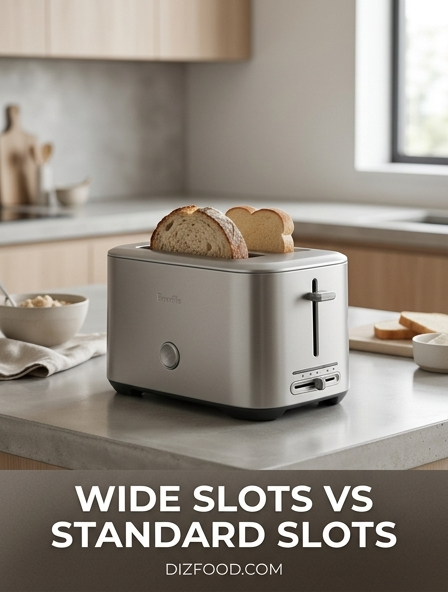
Finding the perfect crunch for your morning toast often comes down to the simple geometry of your toaster's slots. If you're a fan of artisanal sourdough, chunky bagels, or hand-cut brioche, you've likely faced the frustration of a standard slot that simply won't budge, often resulting in torn edges or uneven charring. While standard slots remain the reliable, space-saving choice for uniform sandwich bread, wide-slot models-typically boasting a 1.5-inch clearance-provide the essential breathing room for gourmet slices to toast without being squeezed. Choosing the right fit depends on your breakfast habits; wide slots offer unparalleled versatility for thick-cut lovers, whereas standard slots excel at high-speed, consistent browning for thinner, traditional slices.
| Feature | Standard Slots (~1.0") | Wide Slots (1.5"+) |
|---|---|---|
| Best Bread Types | Pre-sliced sandwich bread, waffles. | Bagels, sourdough, Texas toast, crumpets. |
| Toasting Uniformity | High; elements are closer to the bread. | Variable; requires self-centering racks. |
| Airflow & Texture | Traps steam; softer interior. | Better airflow; crispier exterior crust. |
| Risk of Jamming | High for artisanal or hand-cut items. | Low; ample clearance for thick items. |
| Heating Efficiency | Fast; optimized for thin, dry slices. | Adjustable; handles high-moisture dough. |
| Kitchen Footprint | Compact; ideal for small counters. | Bulky; wider chassis required for slots. |
Wide vs Standard Slots Key Differences
The primary distinction between wide and standard slots in kitchen toasters lies in their physical architecture and intended utility. Standard slots are traditionally designed to accommodate mass-produced, pre-sliced sandwich bread. These slots usually measure approximately 1 inch in width, providing a snug fit that keeps thin slices upright and close to the heating elements. In contrast, wide slots, often referred to as extra-wide, typically measure 1.5 inches or more. This additional clearance is engineered to house denser, hand-cut, or specialty bakery items that would otherwise suffer compression or structural damage in a narrower opening.
| Feature | Standard Slots | Wide Slots |
|---|---|---|
| Average Width | 1.0 Inch | 1.5+ Inches |
| Primary Use | Sliced White/Wheat Bread | Bagels, Artisan Loaves |
| Self-Centering | Basic or Fixed | Advanced Spring-Loaded |
| Heat Proximity | High (Very Close) | Variable (Adjustable) |
Beyond width, the internal mechanics often differ. Wide-slot toasters almost exclusively feature self-centering guides. These internal wire cages adjust to the thickness of the item, ensuring that even a thin slice is held equidistant from the heating filaments. Standard slots may lack these sophisticated guides, relying instead on the narrowness of the slot itself to keep the bread vertical. This difference affects not only what you can toast but also the consistency of the browning across different bread geometries.
Benefits of Choosing Wide Slots
Opting for wide slots introduces a level of culinary flexibility that standard models cannot match. The most significant advantage is the ability to toast non-traditional items without the risk of them becoming lodged inside the appliance. When a piece of bread is too large for a slot, forcing it in can lead to uneven charring or even electrical fires if the bread makes direct contact with the heating coils. Wide slots eliminate this friction, allowing for a safer and more versatile kitchen experience.
- Bagel Compatibility: Easily accommodates thick-cut bagel halves without crushing the doughy center.
- Artisan Breads: Ideal for sourdough, ciabatta, or boule slices that are often unevenly shaped.
- Pastry Warming: Provides enough space for toaster pastries and thick Belgian waffles.
- Texas Toast: Specifically designed to handle extra-thick sandwich bread favored in Southern cuisine.
- Sandwich Cages: Many wide-slot models allow for the use of metal inserts to toast assembled sandwiches.
Furthermore, wide slots tend to be paired with more powerful heating elements to account for the increased volume of the food items. This means that despite the larger space, the toaster can still achieve a crisp exterior while maintaining a moist interior. For households that enjoy a variety of bakery goods beyond standard loaf bread, the wide slot serves as an essential multi-purpose tool that prevents the frustration of "stuck" toast.
When Standard Slots Are More Efficient
While wide slots offer versatility, standard slots remain a staple in many kitchens due to their efficiency and footprint. For the consumer who strictly consumes standard pre-sliced loaves, a standard-slot toaster is often the more pragmatic choice. Because the heating elements are positioned closer to the bread surface, these toasters can often reach the desired level of "crunch" faster and with less energy consumption than their wider counterparts. The narrow cavity traps heat more effectively around thin slices, preventing heat loss into dead air space.
From a design perspective, standard-slot toasters are generally more compact. In urban kitchens where counter space is at a premium, the reduced width of the appliance allows for easier storage and more room for other essential gadgets. Additionally, standard slots are often found on more budget-friendly models. Since the internal mechanics do not require complex self-centering cages to hold thin bread upright, the manufacturing cost is lower, making them an economical choice for students, small families, or those with minimalist culinary needs.
Another efficiency factor is the uniformity of the toast. Because standard slots are tailored for a specific thickness, the browning is often more predictable. There is less "drift" in the bread's position, meaning you are less likely to encounter a slice that is burnt on one side and underdone on the other. For those who value a quick, consistent morning routine involving basic toast, the standard slot provides a streamlined, no-frills performance that wide slots sometimes overcomplicate.
Versatility Comparison Wide vs Standard
Versatility is the primary metric where the two slot sizes diverge. A toaster with wide slots can effectively perform the duties of a standard toaster, but the reverse is not true. This makes wide slots the superior choice for "future-proofing" a kitchen. If your household habits change-perhaps you begin baking your own bread or start buying specialty items from a local bakery-a wide-slot toaster will adapt to those changes without requiring a new purchase. Standard slots are inherently limited by their rigid dimensions.
- Thin Slices: Both perform well, though wide slots require self-centering guides to avoid leaning.
- Hand-Cut Bread: Wide slots accommodate the inevitable thickness variations of manual slicing.
- Frozen Goods: Wide slots allow for thicker frozen waffles and pancakes that might expand when heated.
- English Muffins: Both handle these well, though wide slots make retrieval easier if the muffin is oversized.
- Gourmet Items: Items like crumpets or thick fruit bread are exclusive to the wide-slot domain.
In a head-to-head comparison, the wide slot wins on variety, while the standard slot wins on specialized focus. If you view your toaster as a dedicated tool for one specific task-toasting sandwich bread-the standard slot's lack of versatility is actually a benefit, as it removes variables. However, for the creative cook, the wide slot acts as a bridge to a broader range of breakfast and snack options, facilitating the preparation of everything from dense rye bread to fluffy brioche without mechanical interference.
Understanding Slot Dimensions and Capacity
When evaluating toaster specifications, it is important to understand that "wide" is not a regulated industry term, though most manufacturers adhere to certain informal standards. A standard slot is typically 0.8 to 1.1 inches wide and about 5 inches long. This fits a standard 4.5-inch square slice of bread comfortably. Wide slots increase the width to 1.4 or 1.6 inches. Some "long-slot" toasters combine width with extra length (up to 10 inches), allowing for two standard slices or one long slice of baguette or sourdough.
| Dimension Type | Standard Specification | Wide Specification |
|---|---|---|
| Slot Width | ~1.0 inch | 1.5 to 1.75 inches |
| Slot Length | 5.0 to 5.5 inches | 5.5 to 6.5 inches |
| Internal Depth | ~4.5 inches | ~5.0 inches |
| Max Capacity | 2 Standard Slices | 2 Bagels or Thick Cuts |
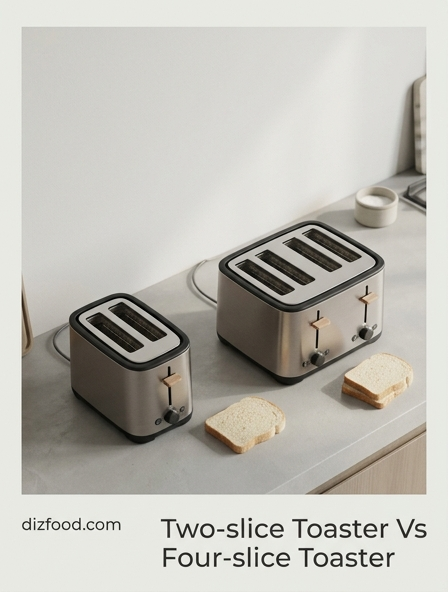
Capacity is not just about the number of slots, but the volume each slot can handle. A 2-slot wide toaster can often handle more "food weight" than a 4-slot standard toaster if the items are dense. When choosing, consider not just the width but the depth as well. Taller artisan loaves may stick out of a shallow standard slot, leading to an untoasted top edge. Wide-slot models frequently feature "high-lift" levers, which are essential for retrieving smaller, thick items like English muffins that might otherwise get lost in the deep, wide cavity.
Heat Distribution in Wide vs Standard Slots
Heat distribution is governed by the Inverse Square Law in physics; the further the bread is from the heating element, the less intense the radiant heat. In a standard slot, the bread is held very close to the mica plates or quartz elements. This results in rapid browning and a high-contrast toast-crispy on the outside while the inside remains largely unchanged. This is the ideal "sear" for thin white bread. However, it can lead to burning if the bread is even slightly thicker than expected.
Wide slots face the challenge of a larger air gap. To compensate, high-quality wide-slot toasters use sophisticated self-centering cages that move the bread toward the center of the slot, ensuring equal distance from both heating walls. If a wide-slot toaster lacks these guides, a thin slice might lean against one side, resulting in one charred side and one pale side. However, the advantage of the wider cavity is better airflow. This allows for more even convection heating, which is preferable for thicker items like bagels, where you want the heat to penetrate the dense dough without scorching the exterior sugar or flour.
Modern wide-slot toasters often include "Bagel Mode," which adjusts heat distribution by turning off the outer heating elements and intensifying the inner ones. This toasts the cut side of the bagel while gently warming the crust. This level of thermal control is rarely found in standard-slot models, which typically apply uniform heat to both sides regardless of the item's orientation or composition.
Best Uses for Extra Wide Slots
Extra-wide slots are the workhorses of a diverse kitchen, particularly for those who move beyond the bread aisle. Their utility shines when dealing with items that have high moisture content or irregular shapes. Because these slots provide more "breathing room," steam can escape more efficiently, preventing the bread from becoming soggy during the toasting process. This is particularly important for frozen items that release significant moisture upon thawing.
- Gourmet Bagels: Thick, New York-style bagels that are often too bulky for standard appliances.
- Homemade Loaves: Bread sliced by hand often has varying thicknesses that wide slots accommodate easily.
- Buns and Rolls: Perfect for toasting burger buns or brioche rolls for sandwiches.
- Waffle Variety: Large, thick Belgian-style frozen waffles fit without breaking off the edges.
- Reheating Pizza: Some users use wide slots with toaster bags to reheat pizza slices, maintaining a crisp crust.
Another excellent use for extra-wide slots is the preparation of "toasted sandwiches" using reusable toaster bags. These bags hold a cheese sandwich together while it toasts vertically. A standard slot is rarely wide enough to hold the bag plus the sandwich, but an extra-wide slot handles it with ease. This expands the toaster's role from a simple bread-browner to a versatile tool for making quick, hot lunches. For families with varied tastes, the wide slot ensures that no one is limited by the physical dimensions of their breakfast choice.
Standard Slot Advantages for Thin Slices
There is a specific culinary perfection found in a thin slice of golden-brown toast that is difficult to replicate in a wide-slot machine. Standard slots are optimized for this specific experience. Because the cavity is narrow, the bread cannot warp or curl as easily as it heats. In a wide slot, a very thin slice may twist under the heat, leading to uneven browning. Standard slots provide a physical "track" that keeps the slice perfectly planar, ensuring the heating elements strike the surface at a consistent 90-degree angle.
Energy efficiency is another notable advantage. Small-slot toasters require less time to preheat the air inside the chamber. When you push the lever down, the bread is immediately enveloped in high-intensity radiant heat. This speed is a significant benefit during busy morning rushes. Furthermore, because there is less "empty space," these toasters often run cooler on the outside, as less heat is being redirected toward the exterior housing. This makes them slightly safer in households with small children who might accidentally touch the appliance while it is in operation.
Finally, there is the issue of "flop." Very soft, thin breads can lose their structural integrity when heated. In a wide slot, if the centering guides are too loose, the bread might sag or fold over itself. Standard slots keep these delicate slices upright through sheer proximity. For fans of classic "melba toast" or very thin diet breads, the standard slot offers a level of support and reliability that wide-slot models, with their heavy-duty springs and wide gaps, often struggle to provide.
Choosing the Right Slot Size for Your Needs
Deciding between wide and standard slots requires an honest assessment of your grocery shopping habits and kitchen space. If your pantry is exclusively stocked with pre-sliced loaves from the supermarket, the standard slot will save you money and counter space while providing faster results. It is the specialist's choice for the "perfect slice of toast." However, if you find yourself frequently using a knife to cut bread, or if you enjoy the variety found in the bakery section, the wide slot is the only logical choice.
- Evaluate Your Bread: Measure the thickest item you regularly eat. If it exceeds 1 inch, go wide.
- Assess Your Counter: Compact kitchens benefit from the smaller footprint of standard models.
- Check Features: If choosing wide, ensure it has "self-centering guides" to handle thin slices too.
- Consider Frequency: For heavy daily use with varied items, the durability of wide-slot machines is usually higher.
- Budget: Standard slots are cheaper; wide slots are an investment in versatility.
For most modern households, the wide-slot toaster has become the default recommendation. The slight increase in size and price is usually offset by the elimination of the "stuck bread" problem. There is nothing more frustrating than having to unplug a toaster to fish out a charred bagel with a wooden chopstick. By choosing a wide-slot model, you effectively gain a 2-in-1 appliance that handles the delicate needs of thin white bread and the robust requirements of a hearty sourdough loaf with equal capability.
Wide vs Standard Slots Performance Review
In terms of long-term performance, wide-slot toasters often outlast standard models, primarily because they are built to handle more mechanical stress. The inclusion of adjustable guides means the internal components are designed for movement and resilience. However, performance is not just about longevity; it is about the quality of the end product. In performance testing, standard toasters consistently win on "speed to toast," often finishing 15-20% faster than wide-slot models when toasting identical thin slices.
Wide-slot toasters, conversely, win on "thermal consistency." Because they are designed to heat larger masses, their thermal management systems are often more robust. They tend to have more even heat distribution across the entire surface area of the heating element, which prevents the "hot spots" often seen in cheaper, standard-slot models. This results in a more professional, "edge-to-edge" brown that is aesthetically pleasing and culinarily superior for thicker breads.
Ultimately, the performance gap has narrowed in recent years. High-end wide-slot toasters now feature sensors that detect bread thickness and adjust the heating cycle accordingly, effectively mimicking the speed of a standard toaster when a thin slice is detected. For the average user, the "performance" of a wide-slot toaster is defined by its lack of limitations. While the standard slot performs one task exceptionally well, the wide slot performs a dozen tasks with high proficiency, making it the more adaptable and high-performing choice for the contemporary kitchen.

Comments