
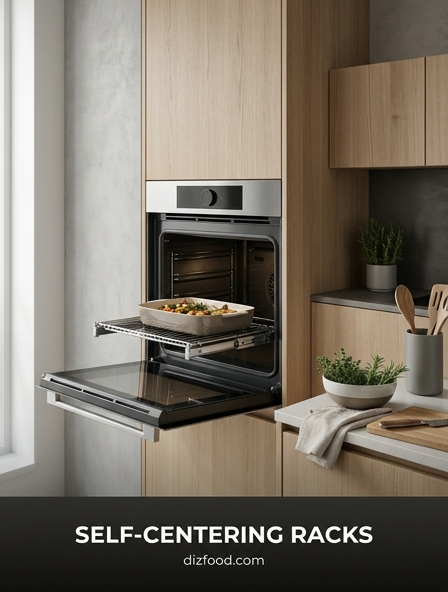
Mechanics of Self-Centering Rack Technology
The core of self-centering rack technology lies in a synchronized mechanical linkage system designed to stabilize food items regardless of their thickness. When the user depresses the toaster lever, a series of internal springs and metal guides are activated. These guides, typically made of thin, heat-resistant wire, move inward from the sides of the slot toward the center. Because the motion is symmetrical, the item is squeezed gently from both sides, ensuring it sits exactly equidistant from the heating elements located on the slot walls.
The mechanical efficiency of these racks depends on the following components:
- Tension Springs: Provide the necessary force to pull the guides inward.
- Pivot Points: Allow the guides to move smoothly without binding during high-heat cycles.
- Carriage Plate: Acts as the foundation that triggers the centering movement upon descent.
- Internal Cams: Direct the lateral movement of the racks based on the vertical position of the carriage.
This automated adjustment eliminates the need for manual positioning, preventing the bread from leaning or falling over. By maintaining a vertical orientation, the technology ensures that every square inch of the bread surface receives an identical amount of radiant energy, which is the foundational requirement for a consistent toast profile.
Heat Distribution in Wide Slot Toasters
Wide slot toasters are prized for their ability to accommodate artisanal breads, bagels, and thick-cut Texas toast. However, the increased volume of the slot creates a challenge for standard heat distribution. Without self-centering racks, a thin slice of bread would likely lean toward one side, placing it significantly closer to one heating element than the other. This proximity imbalance leads to localized overheating and inefficient energy use.
| Feature | Impact on Heat Distribution |
|---|---|
| Wide Slot Volume | Allows for more airflow but increases the distance heat must travel. |
| Centering Guides | Normalizes the distance between the bread surface and the nichrome wires. |
| Radiant Consistency | Ensures both sides of the bread reach the Maillard reaction point simultaneously. |
By centering the food, the toaster optimizes the radiant heat transfer. In a wide slot environment, maintaining the slice at the geometric center ensures that the air buffer on both sides is identical. This uniformity prevents the formation of "hot spots" where the air might otherwise stagnate and cause burning, while also ensuring that the moisture inside the bread evaporates at a steady, predictable rate across the entire surface area.
Solving the Uneven Browning Problem
Uneven browning is the most common frustration in kitchen toasting, usually characterized by a slice that is charred on the bottom while remainly pale and soft at the top. Self-centering racks solve this by addressing the spatial relationship between the bread and the heating filaments. When a slice is held perfectly upright and centered, the infrared radiation emitted by the heating elements strikes the surface at a perpendicular angle. This maximizes energy absorption and ensures a uniform chemical transformation of the starches into sugars.
The process of achieving even browning generally follows these stages:
- The bread is lowered and the centering racks lock it into a vertical plane.
- Heating elements reach peak temperature, radiating energy across the uniform gap.
- Moisture is driven out of the surface layer evenly across the slice.
- Caramelization occurs at the same rate on both the left and right sides.
Without these racks, a tilted slice would experience an intensity gradient, where the side closer to the element browns rapidly while the further side remains undercooked. The mechanical centering ensures that the thermal intensity is mirrored, resulting in a professional-grade finish that is visually appealing and texturally consistent from edge to edge.
Centering Thin Slices for Better Results
Thinly sliced sandwich bread or delicate pastries often lack the structural integrity to stand upright in a standard toaster slot. Without the support of self-centering racks, these items tend to flop against the internal guards, placing them in direct contact with the heating wires or very close to them. This proximity causes the bread to burn almost instantly, often before the internal moisture has had a chance to escape. Self-centering technology acts as a supportive cage that provides the necessary stability for these thinner items.
The racks apply a calibrated amount of pressure-enough to hold the slice vertical but not so much that it crushes the soft crumb. This is particularly important for gluten-free breads, which can be more brittle or prone to breaking. By keeping the slice perfectly centered, the toaster allows for a rapid "flash" toast that crisps the exterior while keeping the interior tender. The result is a better mouthfeel and a more reliable toasting cycle for even the flimsiest of grocery-store loaves, proving that precision alignment is just as important for thin slices as it is for bulky ones.
Proximity to Heating Elements and Toasting Speed
The speed of toasting is directly influenced by the distance between the bread and the heat source, a relationship governed by the inverse-square law of radiation. Even a deviation of a few millimeters can significantly alter the time required to reach the desired shade of brown. Self-centering racks maintain a fixed, optimal distance that allows the toaster's internal timer or browning sensor to operate with high accuracy. When the distance is consistent, the manufacturer can calibrate the heat cycles with greater precision.
- Reduced Pre-heat Time: Optimal positioning allows the bread to absorb heat the moment the elements glow.
- Thermal Efficiency: Less energy is wasted heating the air when the bread is positioned to capture maximum radiation.
- Predictable Cycles: Users can rely on the same setting for consistent results every morning.
If the bread is off-center, the closer side toasts too fast, often triggering a "cancel" response from the user before the second side is even warm. By standardizing the proximity, self-centering racks ensure that the toasting speed is maximized without sacrificing the quality of the finish, making the appliance more efficient and user-friendly for busy households.
Versatility for Thick and Thin Breads
A modern kitchen requires appliances that can handle a diverse range of breakfast items, from thin rye bread to thick, hand-cut sourdough and split bagels. Self-centering racks are the primary feature that enables this versatility. The "one size fits all" approach of older toasters often led to thick items getting stuck or thin items being destroyed. Modern centering mechanisms are designed with a wide range of motion, allowing the wire guides to retract fully for a chunky bagel or close tightly for a wafer-thin cracker.
This adaptability is achieved through a dynamic spring-loading system. As the item is inserted, the racks sense the resistance and stop at the appropriate width. This creates a custom-fit environment for every toast cycle. Users no longer have to choose between a toaster dedicated to bagels and one dedicated to standard loaf bread. The self-centering rack bridges the gap, providing a secure grip and perfect alignment for any artisan bread, ensuring that the kitchen remains equipped for any culinary preference without needing multiple specialized devices.
Preventing Scorched Edges and Cold Centers
One of the hallmark signs of a low-quality toaster is a slice of bread with black, scorched edges and a pale, cold center. This occurs when the slice is not properly aligned with the heating element's radiant field. If the bread is tilted, the top or bottom edges may be pushed into a zone of extreme heat, while the center of the slice remains in a thermal "valley." Self-centering racks mitigate this by ensuring the bread surface is perfectly parallel to the element array.
Proper alignment provides several benefits for thermal uniformity:
- Uniform Infrared Absorption: The center of the slice receives the same energy density as the crust.
- Moisture Migration: Water vapor escapes evenly, preventing soggy patches in the middle.
- Structural Integrity: Even heating prevents the bread from curling or warping during the cycle.
By preventing the "leaning" effect, these racks ensure that the heat penetrates the bread evenly. The crust becomes crispy without becoming carbonized, and the center reaches a pleasant temperature that melts butter effectively. This balance is the difference between a mediocre breakfast and a perfectly prepared meal, highlighting the importance of mechanical alignment in thermal dynamics.
The Role of Internal Guides in Consistency
Internal guides within a self-centering system serve as the physical interface between the appliance and the food. These guides are usually constructed from high-grade stainless steel or nickel-plated wire to withstand thousands of heating and cooling cycles without warping. Their design is critical; they must be thin enough to avoid shielding the bread from the heat, yet strong enough to maintain a rigid vertical hold. The spacing of the wires in the guide is carefully engineered to provide maximum support while allowing the infrared waves to pass through unimpeded.
Consistency in toasting is a byproduct of mechanical repeatability. Because the guides return to the exact same centered position every time the lever is pushed, the environment inside the toaster remains a constant variable. This allows the electronic control board to accurately predict the browning level based on the selected setting. Without these guides, the position of the bread would be a random variable, making it impossible for the toaster to deliver the same result twice in a row. The guides transform the toaster from a simple heating box into a precision instrument.
Optimizing Airflow for Even Texture
Toasting is as much about airflow and moisture removal as it is about raw heat. For a piece of bread to achieve a crisp texture, the steam escaping from the crumb must be allowed to dissipate quickly. Self-centering racks play a vital role in this by maintaining a clear air gap on both sides of the bread. If a slice were to rest against the side of the toaster, steam would become trapped against the surface, resulting in a rubbery or "steamed" texture rather than a toasted one.
| Factor | Role of Centering Racks |
|---|---|
| Steam Escape | Maintains an open channel for moisture to rise and exit the top. |
| Convection Currents | Ensures hot air can circulate around the entire perimeter of the bread. |
| Surface Crispness | Prevents "wet spots" caused by contact with metal surfaces. |
By keeping the bread in the center of the slot, the racks facilitate natural convection. Hot air rises evenly along both sides of the slice, carrying away the moisture that is driven out by the heating elements. This optimized airflow ensures that the final product has the characteristic "crunch" that consumers expect, with a uniform texture that extends through the entire thickness of the toast.
Why Modern Toasters Prioritize Rack Alignment
In the competitive market of kitchen appliances, performance consistency is a primary driver of consumer satisfaction. Modern manufacturers prioritize rack alignment because it is the most effective way to guarantee results across a wide range of variables. As consumers increasingly experiment with diverse types of bread-including gluten-free, keto, and artisanal varieties-the toaster must be able to adapt without sacrificing quality. Self-centering racks provide the mechanical intelligence needed to handle these variations automatically.
The shift toward rack alignment is driven by three main factors:
- Consumer Expectations: Modern users demand "set it and forget it" convenience.
- Safety Standards: Centered bread is less likely to catch fire or jam the carriage mechanism.
- Brand Reputation: Even browning is the benchmark by which all toasters are reviewed and rated.
Ultimately, the inclusion of self-centering technology is a reflection of the industry's move toward precision engineering. By solving the fundamental problem of bread placement, manufacturers can offer more complex browning algorithms and specialized settings, knowing that the physical foundation of the toasting process is secure. It is a small mechanical detail that makes a massive difference in the daily kitchen experience.

Comments