
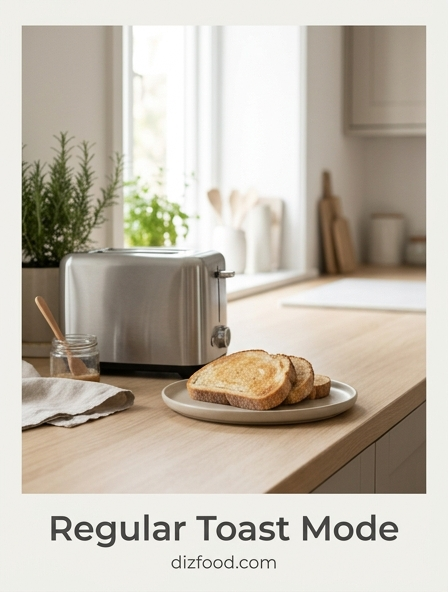
When you're aiming for that quintessential crunch on both sides of your sandwich bread, standard toast mode is your best friend. This setting activates heating elements on both sides of the toaster slot, ensuring even heat distribution that transforms a soft slice into a golden, sturdy foundation for your favorite toppings. It's the go-to choice for sourdough, rye, or basic white bread where you want a satisfying snap and uniform texture throughout. By applying consistent heat to every millimeter of the surface, you eliminate soggy centers and achieve a perfect, all-around crisp. Understanding these subtle nuances helps you decide between Bagel Mode vs Regular Toast to ensure your breakfast always hits the spot.
Understanding the Standard Toast Cycle
The standard toast cycle is the fundamental operating procedure of most countertop toasters, designed to apply equal intensity to both faces of a bread slice simultaneously. Unlike specialized settings that might toggle specific heating elements, the regular mode activates all internal wires to create a balanced thermal environment. This cycle is typically governed by either a mechanical timer or a thermal sensor that monitors the internal temperature of the device. As the bread descends into the slots, the proximity to the glowing nichrome wires initiates a rapid dehydration process on the surface.
Understanding this cycle is crucial for consistent breakfast results, as it establishes the baseline for how different types of flour and moisture levels will react. The duration of this cycle is controlled by the browning dial, which adjusts the exposure time rather than the actual temperature of the elements. Most users rely on this mode for its predictability and efficiency, making it the most frequently utilized function in the modern kitchen. By mastering the timing of this standard operation, one can ensure that various bread products achieve a reliable level of toasted perfection without the risk of uneven charring or undercooked centers.
The Mechanics of Even Heat Distribution
Effective toasting in regular mode relies heavily on the physics of infrared radiation. When the heating elements are engaged, they emit electromagnetic waves that penetrate the surface of the bread. To ensure that the heat is distributed evenly across the entire surface area, manufacturers design the internal cage and wire layout with specific geometric precision. This prevents "hot spots" where the bread might burn while other sections remain soft and white.
- Reflective internal shields help bounce heat back toward the center of the slot.
- Calibrated wire spacing ensures the top and bottom edges receive equal energy.
- Self-centering guides keep the bread at an equidistant point between the elements.
- Open-air venting prevents steam buildup that could lead to soggy patches.
Achieving Maximum Snap and Texture
The hallmark of a perfectly executed regular toast cycle is the "snap"-that distinct auditory and tactile response when biting into the crust. This texture is achieved through a specific balance of high-intensity surface heat and brief duration. The goal is to dehydrate the outermost layer of the bread to create a rigid, crystalline structure while preserving a hint of the original crumb softness in the very center. If the heat is too low, the bread dries out entirely, turning into a crouton rather than toast. Conversely, if the heat is too high, the surface burns before the structural snap can form.
To maximize this effect, the regular mode uses a dual-sided approach. By attacking the moisture from both sides at once, the toaster creates a structural "envelope." This process requires the bread to be of a certain thickness; slices that are too thin often lack the internal moisture needed to provide a contrast to the crispy exterior. Maintaining a clean toaster environment is also essential, as accumulated crumbs can interfere with the radiant heat flow, leading to localized steaming instead of crisping.
Why Symmetry Matters for Sliced Bread
In the world of regular toast mode, symmetry is the primary objective. For standard sandwich loaves, having one side darker than the other is often considered a failure of the appliance or the technique. Symmetry ensures that when butter or jam is applied, the structural integrity of the slice remains consistent across the entire surface. If one side is under-toasted, the bread may collapse or become soggy once toppings are added. The regular mode is specifically engineered to avoid this by firing all elements at a 1:1 power ratio.
This symmetry is particularly important for those who use toast as a base for heavy ingredients like avocado or poached eggs. A balanced toast cycle creates a level of reinforcement that prevents the bread from bowing under weight. Furthermore, symmetrical browning is aesthetically pleasing, indicating a professional level of kitchen management. Achieving this requires the user to ensure the bread is placed vertically and that the toaster's internal spring-loaded cages are functioning correctly to hold the slice in a perfectly upright position between the glowing wires.
Regular Mode vs Specialized Functions
While modern toasters offer an array of buttons for bagels, defrosting, and reheating, the regular mode remains the gold standard for standard sliced bread. The primary difference lies in the power distribution and the logic of the heating elements. In specialized modes, the toaster often alters the duty cycle or shuts down specific elements to accommodate the unique geometry of the food item. Regular mode, however, maintains a constant, unyielding output on all surfaces to provide a quick and uniform finish.
| Function | Element Activity | Ideal Use Case |
|---|---|---|
| Regular Mode | 100% All Elements | Standard Sliced Bread |
| Bagel Mode | 50-100% Inner Only | Sliced Bagels/English Muffins |
| Defrost Mode | Extended Low Heat | Frozen Loaves |
Optimizing Heat for Sourdough and White Loaves
Not all bread reacts to regular toast mode in the same way. White bread, which typically contains higher levels of sugar and a more open, aerated structure, browns very quickly. In contrast, sourdough is denser and possesses a different chemical makeup due to the fermentation process. To optimize the regular mode for these variations, one must adjust the browning dial to account for density rather than just thickness. A dense sourdough loaf requires more time for the heat to penetrate the outer crust, whereas a light brioche might burn in seconds.
- For white bread, use a lower setting (2-3) to prevent rapid sugar carbonization.
- For sourdough, a medium-high setting (4-5) is necessary to penetrate the thick crust.
- Multigrain loaves require a middle ground to toast the seeds without scorching the flour.
- Always check the moisture content; fresher bread needs a longer cycle than older bread.
The Science of the Maillard Reaction
The primary scientific driver behind the regular toast mode is the Maillard reaction. This is a chemical reaction between amino acids and reducing sugars that gives browned food its distinctive flavor and aroma. When the toaster's heating elements reach their peak temperature, they trigger this reaction on the surface of the bread. This isn't just about changing the color to brown; it is about creating hundreds of different flavor compounds that didn't exist in the raw bread. These compounds provide the savory, nutty, and slightly sweet notes associated with high-quality toast.
The regular mode is designed to facilitate this reaction quickly enough to prevent the interior from becoming brittle. Because the Maillard reaction occurs most effectively between 140°C and 165°C, the toaster must rapidly elevate the surface temperature. If the process is too slow, the moisture evaporates before the reaction can fully develop, resulting in a "baked" rather than "toasted" flavor. Understanding this chemistry allows a user to appreciate why the high-intensity heat of a standard cycle is necessary for flavor development.
Managing Moisture for Consistent Browning
Moisture is the enemy of consistency in the regular toast cycle. Every slice of bread contains a specific percentage of water, which must be evaporated before the browning process can begin. This is why the first batch of toast in a cold toaster often takes longer or looks lighter than the second batch. In the second round, the toaster is already preheated, and the residual heat begins evaporating moisture the moment the bread is lowered. For the most consistent results, users should be aware of how their bread is stored.
Bread stored in the refrigerator will have a different moisture profile than bread stored in a room-temperature bread box. Furthermore, "stale" bread, which has already lost much of its internal moisture, will toast significantly faster and may require a lower setting on the dial. To achieve professional results, it is often helpful to allow refrigerated bread to reach room temperature before toasting, or to adjust the dial down by half a point for subsequent batches to account for the thermal momentum of the appliance.
When Uniformity is the Priority
Uniformity is the hallmark of a high-quality toaster operating in its regular mode. This is particularly important for commercial settings or for those preparing multi-layer sandwiches where each slice must match. Uniformity depends on the consistent performance of the heating elements and the lack of interference from external factors. When uniformity is the priority, the user should avoid "overloading" the toaster or trying to toast slices that are too large for the slots, as this can cause the bread to bend and touch the elements.
To ensure the highest level of uniformity, it is recommended to:
- Always use slices of equal thickness from the same loaf.
- Allow the toaster thirty seconds of "cool down" between batches if precision is required.
- Ensure the crumb tray is emptied daily to prevent uneven heat reflection.
- Avoid using bread with large "holey" structures like ciabatta if a perfectly even brown is the goal.
Mastering the Classic Golden Toast Finish
The classic golden finish is the visual indicator of a successful toast cycle. Achieving this requires a fine-tuned approach to the browning dial and an understanding of the bread's sugar content. A golden-brown color signifies that the Maillard reaction has reached its peak without transitioning into carbonization, which produces a bitter, burnt taste. To master this finish, start with a medium setting and observe the results. Most toasters have a "sweet spot" that produces the ideal gold across a variety of standard loaves.
Once the toast pops up, it should be removed immediately. Leaving the toast in the slots, even after the heat has turned off, subjects it to "carryover cooking" from the residual heat of the elements and the metal housing. This can turn a perfect golden slice into a dry, over-browned one in a matter of seconds. For the best experience, place the finished toast on a wire rack for five seconds to allow steam to escape the bottom before buttering. This ensures the golden crust remains crisp rather than becoming softened by trapped moisture on the plate.



Comments