
Choosing between a two-slice and a four-slice toaster essentially comes down to a balancing act between your morning momentum and your available counter real estate. If you are navigating a compact apartment or typically toast for one, a sleek two-slice model offers an energy-efficient, space-saving solution that handles your daily bagel or sourdough with ease. However, for bustling households or those who host weekend brunches, a four-slice powerhouse is a total game-changer; it eliminates the "breakfast bottleneck" by delivering multiple servings simultaneously and often features dual independent controls to satisfy different browning preferences at once. Ultimately, your decision should align with your household size and how much "toast traffic" your kitchen experiences during the morning rush.
| Feature | Two-Slice Toaster | Four-Slice Toaster |
|---|---|---|
| Capacity | 2 slices; best for singles/couples. | 4 slices; ideal for families/groups. |
| Footprint | Compact (approx. 5-7" wide). | Bulky (approx. 10-12" wide). |
| Customization | Single control interface. | Dual independent heating zones. |
| Power Usage | Lower (800W - 1000W). | Higher (1400W - 1800W). |
| Average Price | $20 - $60 (Budget-friendly). | $50 - $150 (Investment piece). |
| Best For | Small kitchens & minimalists. | High-volume use & large counters. |
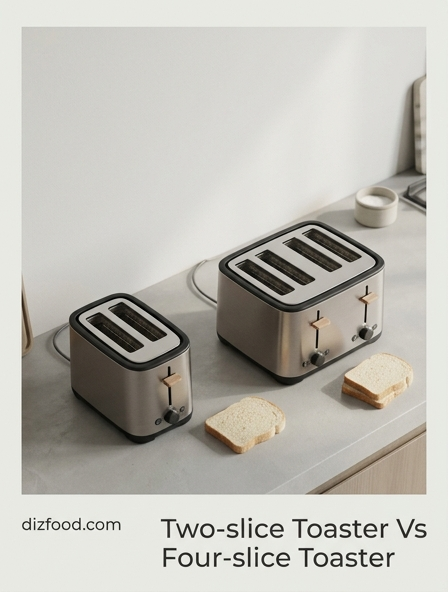
Toaster Capacity Comparison for Your Kitchen
When selecting a new toaster, the most fundamental decision revolves around capacity: whether a two-slice or a four-slice model best serves your daily needs. The capacity of a toaster dictates how many pieces of bread, bagels, or English muffins can be toasted simultaneously. This choice fundamentally alters your morning workflow, especially during the high-pressure breakfast hours. A two-slice toaster is the standard for many households, providing a compact solution for individuals or couples who rarely find themselves needing to toast more than two items at once. Conversely, a four-slice toaster effectively doubles the output, making it a powerhouse for larger groups or families who eat together.
| Feature | Two-Slice Toaster | Four-Slice Toaster |
|---|---|---|
| Standard Capacity | 2 Slices | 4 Slices |
| Typical Width | 5-7 Inches | 9-12 Inches |
| Best For | Singles/Couples | Families/Entertaining |
| Batch Speed | Moderate | High |
While the physical difference seems simple, the capacity affects more than just the number of bread slices. It influences the internal volume of the heating chambers and the overall time spent standing in the kitchen. For those who frequently toast thick artisan breads or multiple rounds of bagels, the capacity comparison is less about the count and more about the efficiency of volume. If you find yourself waiting for the first round of toast to pop so you can start the second, the capacity bottleneck of a two-slice unit becomes immediately apparent.
Space Saving Benefits of Two Slice Toasters
In modern kitchens where counter space is often at a premium, the two-slice toaster remains a champion of efficiency and minimalist design. These units are specifically engineered to occupy a small physical footprint, making them ideal for urban apartments, dorm rooms, or kitchens with limited prep areas. Because they are typically half the width of their four-slice counterparts, they can easily tuck away into corners or fit inside standard cabinetry when not in use. This portability is a significant advantage for those who prefer a "clean counter" aesthetic and only bring out appliances as needed.
- Reduced Width: Allows for more room for coffee makers or cutting boards.
- Vertical Storage: Easier to fit on narrow pantry shelves.
- Lightweight Design: Effortless to move for cleaning or repositioning.
- Minimalist Visuals: Less visual clutter in a small kitchen layout.
Beyond the physical dimensions, the space-saving nature of a two-slice toaster also extends to the electrical footprint. With a shorter cord and lower power requirements, it doesn't dominate a kitchen's electrical zone or create a tangle of wires. For a single professional or a student, the trade-off of capacity for extra workspace is almost always a winning bargain. Even in larger kitchens, many homeowners choose a two-slice model as a secondary unit or simply to keep their main workstations clear for complex meal preparation, prioritizing a streamlined environment over high-volume toasting capabilities.
Efficiency Advantages of Four Slice Models
Efficiency in a kitchen is often measured by the speed at which a meal can be served to everyone at the table. Four-slice toasters offer a significant advantage in this regard, particularly when synchronizing breakfast for multiple people. Instead of the staggered delivery common with two-slice models-where the first person's toast is cold by the time the last person's is ready-a four-slice unit allows for a unified mealtime. This throughput is essential for busy mornings where every minute counts before school or work commutes begin. By processing four items at once, you effectively halve the time spent supervising the toasting process.
Furthermore, the efficiency of four-slice models is often enhanced by the presence of longer slots or wider apertures. Many four-slice units are designed as "long-slot" toasters, which can accommodate oversized sourdough slices or four standard pieces of sandwich bread. This versatility means you aren't limited by the shape of your loaf. When you consider the cumulative time saved over a year of breakfast preparation, the four-slice toaster emerges as a productivity tool rather than just a simple heating element. It eliminates the repetitive cycle of loading and unloading, allowing the cook to focus on other tasks like brewing coffee or frying eggs while the toast handles itself in a single, efficient batch.
Energy Consumption Differences Explained
Energy consumption is a common concern when comparing these two appliance sizes. At first glance, it might seem that a four-slice toaster is inherently more wasteful, but the reality depends heavily on usage patterns. A standard two-slice toaster typically operates at a wattage ranging from 800 to 1,000 watts. Because it only heats a small chamber, it reaches toasting temperature quickly. However, if you have to run two back-to-back cycles to get four pieces of toast, you are drawing power for twice as long, and heat is lost during the transition between cycles. This can lead to a less efficient use of electricity compared to a single four-slice cycle.
- Wattage Rating: Four-slice models usually range from 1,500 to 1,800 watts.
- Dual Heating Elements: Many four-slice units allow you to power only one side if you are only toasting two slices.
- Thermal Retention: Larger units may take slightly longer to preheat but retain heat better across multiple batches.
- Idle Draw: Both units have negligible standby power, but the primary cost is active heating time.
The key to energy efficiency is matching the appliance to your habit. If you consistently toast four slices, the higher wattage of the four-slice model is used more effectively than running a smaller toaster twice. However, if you only toast a single slice of bread most mornings, a four-slice unit can be inefficient if it doesn't feature independent controls. Heating four elements to toast one piece of bread results in significant energy waste through heat dissipation into the empty slots. Therefore, understanding the internal circuitry-specifically whether the toaster allows for isolated side operation-is crucial for eco-conscious consumers.
Cost Comparison and Long Term Value
When analyzing the cost of a toaster, you must consider both the initial purchase price and the long-term value provided by the appliance's durability. Generally, two-slice toasters are more budget-friendly. You can find basic, reliable two-slice models for a fraction of the cost of a high-end four-slice unit. For those on a strict budget or for a temporary living situation, the lower entry price of a two-slice model makes it an easy choice. However, the lower price point can sometimes coincide with cheaper plastic components and shorter warranties, which may lead to more frequent replacements over a decade.
Four-slice toasters represent a higher upfront investment, often costing 50% to 100% more than their smaller counterparts. This price increase is attributed to the extra heating elements, larger chassis, and the inclusion of more complex control systems, such as dual browning dials. Despite the higher cost, the long-term value can be superior for a household that uses the toaster daily. These units are often built with more robust materials, like stainless steel, and are designed to handle the thermal stress of high-volume use. When you divide the cost over the lifespan of the appliance, a durable four-slice model might actually cost less per year of service than a succession of cheap two-slice units. Value is not just about the sticker price; it is about how well the appliance meets your needs without requiring constant repair or replacement.
Kitchen Counter Footprint and Layout
The physical layout of your kitchen often dictates which appliances are feasible. The "footprint" refers to the literal square inches of counter space a toaster occupies. A two-slice toaster usually has a footprint of roughly 60 to 80 square inches. This small size allows it to be placed in tight corners, under low-hanging cabinets, or alongside other small appliances without creating a sense of overcrowding. For many, this is a matter of ergonomics; having more open counter space makes food preparation safer and more enjoyable.
In contrast, a four-slice toaster can occupy 120 to 160 square inches or more. This requires a dedicated "toasting station" in the kitchen layout. When planning your kitchen zones, you must consider the depth of the toaster as well as its width. Some four-slice models are "chunky" and square, which might push other items forward toward the edge of the counter. Others are long and thin, designed to sit against the backsplash. If your kitchen features an island, a four-slice toaster can act as a central hub for breakfast. However, if you are working with a galley-style kitchen with limited runs of counter, the bulk of a four-slice unit can become a hindrance. It is essential to measure your available space and consider the "swing" of the cord and the clearance needed for heat dissipation before making a final selection.
Ideal Toaster Sizes for Large Families
For large families, the breakfast table can be a chaotic environment. In this context, a two-slice toaster is rarely sufficient. The primary issue is the "toast bottleneck," where the speed of consumption far outpaces the speed of production. A family of five or six would require three full cycles of a two-slice toaster to provide everyone with just one piece of toast. By the time the final slices are ready, the first set has likely become cold and unappealing. A four-slice toaster solves this by delivering larger batches of hot toast simultaneously, ensuring that everyone can start their meal together.
Beyond simple volume, large families often have diverse dietary needs. A four-slice toaster allows for different types of items to be toasted at the same time. One side can be dedicated to gluten-free bread to prevent cross-contamination (if using toast bags or dedicated slots), while the other side handles regular wheat bread. Or, the kids can have their waffles toasting on one side while the parents toast bagels on the other. This multi-tasking capability reduces the total time spent in the kitchen and helps the morning routine run more smoothly. In the high-demand environment of a family home, the extra capacity is not a luxury-it is a functional necessity that contributes to a more organized and peaceful start to the day.
Dual Control Features in Four Slice Units
One of the most significant technological advantages of a four-slice toaster is the inclusion of dual independent controls. Most high-quality four-slice units are essentially two two-slice toasters joined in a single housing. This means they feature two separate levers and two sets of browning dials. This functionality is a game-changer for households where people have different preferences for how dark their toast should be. One person may prefer a light, barely-golden sear, while another may want a dark, crunchy finish. With dual controls, both can be achieved in a single cycle.
- Independent Browning: Set different darkness levels for each pair of slots.
- Function Customization: Use the "Bagel" setting on one side and "Defrost" on the other.
- Staggered Starts: You don't have to push both levers down at once; you can start two slices and add two more later.
- Resource Management: Only heat the side you are actually using to save on wear and tear.
This level of control also accommodates different bread thicknesses and types. Dense rye bread requires a longer, more intense heat than a thin slice of white bread. Dual controls allow you to calibrate the heat specifically for the item in the slot. In a two-slice toaster, you are forced to choose a single setting for both slots, which often leads to one side being overdone or underdone if the items aren't identical. The dual-control feature of the four-slice model provides a level of precision and "customized toasting" that smaller units simply cannot match.
Toasting Speed and Performance Consistency
The performance of a toaster is measured by its ability to brown bread evenly across its entire surface and to do so consistently cycle after cycle. In a two-slice toaster, the heating elements are closer together, which can sometimes lead to faster toasting times but also carries the risk of "hot spots" if the design is poor. Because the chamber is smaller, the heat is more concentrated. This is excellent for quick, single-person use, but as the unit heats up over multiple consecutive uses, the internal thermostat may trigger earlier, leading to inconsistent browning levels between the first and third rounds of toast.
Four-slice toasters are generally built with more substantial heating elements and better airflow to manage the increased heat output. Because they are designed for higher volume, they often have better thermal regulation systems to ensure that the fourth slice is just as toasted as the first. Some high-end four-slice models utilize convection fans or advanced quartz elements to distribute heat more evenly than the nichrome wires found in basic models. While a four-slice toaster might take a few seconds longer to reach its peak temperature due to the larger internal volume, the resulting consistency across a large batch of bread is usually superior. For the perfectionist who wants every corner of their toast to be the exact same shade of brown, the robust engineering of a premium four-slice unit often delivers more reliable results.
Finding the Best Toaster for Your Lifestyle
Ultimately, the choice between a two-slice and a four-slice toaster depends on a realistic assessment of your daily habits, your kitchen's physical constraints, and your aesthetic preferences. There is no "one size fits all" answer, as the best appliance is the one that integrates seamlessly into your life without causing frustration. If you live alone or in a small household and value an uncluttered kitchen, a high-quality two-slice toaster is likely your best companion. It provides everything you need with a minimal footprint and lower cost, allowing you to invest your money in other kitchen gadgets or higher-quality ingredients.
However, if you frequently entertain guests, have a growing family, or simply enjoy the convenience of toasting different items simultaneously, the four-slice toaster is worth the extra counter space and investment. The ability to customize browning levels and serve everyone at once drastically improves the breakfast experience. Before buying, consider not just your current situation but also your future needs. A toaster is an appliance that can last for many years; choosing one that can grow with your lifestyle ensures that you won't be looking for an upgrade in a year's time. By weighing the benefits of capacity, control, and space, you can select the perfect tool to ensure your mornings are always off to a crisp and delicious start.

Comments