
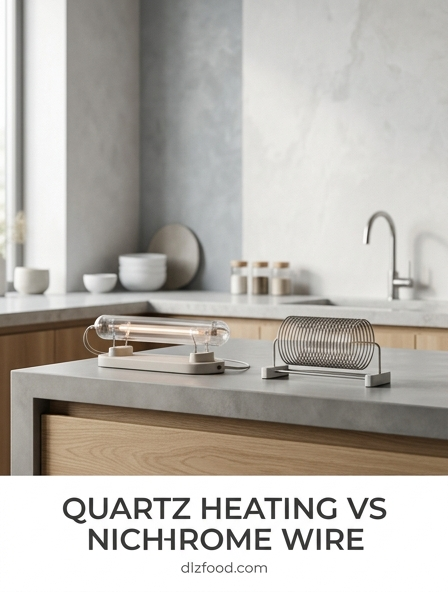
When it comes to boosting your kitchen's performance, selecting the right heating element is a game-changer for both speed and energy savings. Quartz heating elements are the sprinters of the culinary world, utilizing infrared technology to provide near-instant radiant heat that is perfect for precision tasks like toasting and flash-broiling. In contrast, Nichrome wire-a durable alloy of nickel and chromium-serves as the reliable marathon runner, offering exceptional structural integrity and consistent heat distribution for heavy-duty baking and long-term cooking. By understanding the trade-offs between the rapid responsiveness of quartz and the rugged versatility of nichrome, you can better tailor your appliance choices to match your specific cooking style and efficiency goals.
| Feature | Quartz Heating Element | Nichrome Wire Element |
|---|---|---|
| Heat-up Speed | Near-instant; reaches peak temp in seconds. | Slower; requires pre-heating time. |
| Heat Transfer | Direct radiant/infrared energy. | Conduction and convection. |
| Durability | Fragile; glass tubing can crack if bumped. | Highly durable; resists physical impact. |
| Energy Efficiency | High; converts more energy to direct heat. | Moderate; loses some heat to the surroundings. |
| Lifespan | Shorter; sensitive to oils and thermal shock. | Very long; withstands thousands of heat cycles. |
| Best Used For | Toaster ovens, rapid grills, and salamanders. | Standard ovens, ranges, and slow cookers. |
Understanding Quartz and Nichrome Heating
In the modern kitchen environment, heat generation is primarily achieved through two distinct technologies: quartz heating elements and nichrome wire coils. Quartz elements consist of a coiled heating filament, usually made of tungsten or nichrome, encased within a high-purity silica glass tube. This design is engineered to facilitate the emission of infrared energy while protecting the internal filament from oxidation and environmental contaminants like grease or moisture.
Nichrome wire, conversely, is an alloy composed of approximately 80% nickel and 20% chromium. It is used as an "open" or "sheathed" heating element without the requirement for a glass enclosure. When an electric current passes through this high-resistance wire, it generates heat through Joule heating. While both technologies serve the same ultimate purpose-cooking or warming food-they utilize fundamentally different physical principles to transfer that thermal energy to the target object.
- Quartz Components: Sealed glass tube, internal inert gas, and a resistive filament.
- Nichrome Components: Exposed or ceramic-embedded alloy wire, often coiled to increase surface area.
- Primary Medium: Quartz relies heavily on electromagnetic radiation, while Nichrome focuses on conduction and convection.
Understanding these differences is essential for culinary professionals and appliance manufacturers alike. The choice between them dictates not only the speed of the cooking process but also the texture and quality of the final food product, as the penetration depth of the heat varies significantly between the two methods.
Quartz vs Nichrome Efficiency Comparison
Efficiency in kitchen appliances is measured by how effectively electrical energy is converted into usable heat that reaches the food. Quartz heating elements are generally considered more energy-efficient for specific tasks because they convert a higher percentage of input power into radiant infrared energy. This radiation travels directly to the food surface without the need to extensively heat the surrounding air, reducing energy waste during short cooking cycles.
Nichrome wire, while highly efficient at converting electricity into heat, often loses a significant portion of that energy to the air via convection or to the body of the appliance via conduction. In a standard toaster or oven, the nichrome must heat up its own mass and the surrounding air before the food begins to cook. This leads to a longer "pre-heating" phase which consumes additional kilowatt-hours without providing immediate results.
| Feature | Quartz Elements | Nichrome Wire |
|---|---|---|
| Energy Conversion | High Infrared Output | High Thermal Convection |
| Pre-heat Waste | Minimal | Significant |
| Directional Heating | Excellent | Diffuse |
For long-duration tasks like roasting a turkey, the efficiency gap narrows as the ambient temperature within the appliance stabilizes. However, for rapid-fire kitchen tasks such as browning bread or melting cheese, quartz elements provide a clear advantage in energy conservation and operational costs over the lifespan of the device.
Speed of Heat Delivery Analysis
The speed at which an element reaches its operating temperature is a critical factor in kitchen throughput. Quartz elements are often referred to as "instant-on" heaters. Because the filament is protected in a vacuum or inert gas within a thin glass tube, it can reach peak infrared emission temperatures in a matter of seconds. This allows for immediate heat transfer to the food, eliminating the need for lengthy pre-heating cycles typical in traditional convection ovens.
Nichrome wire has a higher thermal mass, especially when it is wrapped around mica sheets or embedded in ceramic blocks. This mass acts as a heat sink, requiring time to absorb enough energy to glow and begin radiating effectively. In a practical kitchen scenario, this means a nichrome-based broiler may take several minutes to reach the desired intensity, whereas a quartz broiler is ready almost the moment the switch is flipped.
- Phase 1: Activation - Quartz reaches 100% output in < 2 seconds; Nichrome takes 30-60 seconds.
- Phase 2: Stabilization - Quartz maintains a constant radiant flux; Nichrome may fluctuate based on airflow.
- Phase 3: Cool Down - Quartz cools rapidly due to low mass; Nichrome retains residual heat for several minutes.
This rapid response makes quartz ideal for "flash" applications where precision timing is required. However, the slower heat-up and cool-down of nichrome can be beneficial in certain baking scenarios where a more gradual increase in temperature prevents the exterior of the food from burning before the interior is properly cooked.
Durability and Lifespan Benchmarks
When considering the longevity of kitchen equipment, nichrome wire typically outperforms quartz in terms of physical robustness. Nichrome is a metal alloy that is resistant to mechanical shock; if a pot or pan accidentally strikes an exposed nichrome coil, the wire may bend but will rarely fail. Furthermore, nichrome is highly resistant to thermal shock, meaning it can handle rapid temperature fluctuations without structural degradation.
Quartz elements, being made of glass, are inherently fragile. They are susceptible to cracking if struck and can shatter if cold liquids are splashed onto the hot surface. Additionally, the lifespan of a quartz tube can be shortened by "devitrification," a process where the silica glass changes structure over time due to high heat, eventually becoming brittle and opaque. While quartz provides superior performance, it requires a much more controlled environment to match the service life of nichrome.
- Nichrome Lifespan: Often exceeds 10,000 hours of active use; resistant to vibration.
- Quartz Lifespan: Generally ranges from 5,000 to 8,000 hours; sensitive to handling and oils.
- Environmental Sensitivity: Quartz tubes can be damaged by skin oils if touched during installation.
In heavy-duty commercial kitchens where equipment is subject to rough handling and frequent cleaning, nichrome is often the preferred choice for its "set it and forget it" reliability. Quartz is better suited for high-end consumer appliances or specialized commercial stations where speed and precision are prioritized over sheer physical toughness.
Infrared Radiation vs Convection Heating
The culinary results produced by quartz and nichrome differ because of the way they move energy. Quartz heating is synonymous with short-wave infrared radiation. This wavelength is highly energetic and can penetrate the surface of food more deeply than air-driven heat. This results in faster cooking times and a unique "searing" effect that locks in moisture while crisping the exterior, making it excellent for toasting and broiling.
Nichrome wire primarily heats the air surrounding it, which then moves via natural or forced convection to the food. This convection heating is more "gentle" and uniform, surrounding the food with a warm envelope. While nichrome does emit some long-wave infrared, it is not as concentrated as the output from a quartz element. This makes nichrome the superior choice for baking delicate items like cakes or soufflés, where aggressive radiant heat might cause the top to burn before the center sets.
- Radiant Heat (Quartz): Direct line-of-sight energy; mimics charcoal grilling.
- Convection Heat (Nichrome): Indirect energy; relies on air circulation for uniformity.
- Moisture Retention: Infrared tends to sear faster, potentially retaining more internal juices in meats.
Understanding these heat transfer mechanisms allows chefs to choose the right tool for the job. A quartz-based salamander is perfect for finishing a dish with a browned crust, while a nichrome-based oven provides the steady, ambient heat necessary for consistent, large-batch baking.
Safety Standards and Operating Risks
Safety is a paramount concern in any kitchen, and both heating methods present unique risks. Nichrome wire elements, particularly in older or cheaper appliances, are often exposed. This creates a risk of electric shock if a metal utensil comes into contact with the live wire. Additionally, because nichrome stays hot for a long time after being turned off, it poses a prolonged burn hazard to kitchen staff and users.
Quartz elements eliminate the risk of direct contact with a live electrical filament because the wire is sealed inside the silica tube. However, the glass itself reaches extremely high temperatures and can cause severe burns. The primary safety risk with quartz is the potential for glass breakage. If a tube shatters over food, the entire batch must be discarded due to glass contamination. Modern quartz appliances often include protective metal grates to mitigate this risk.
| Risk Factor | Quartz Element | Nichrome Wire |
|---|---|---|
| Electrical Shock | Low (Enclosed) | Moderate (If exposed) |
| Fire Hazard | High (Intense radiant heat) | Moderate (Slower ignition) |
| Food Contamination | Glass shards if broken | Minimal |
Appliance manufacturers must adhere to strict UL and CE standards to ensure that these elements are properly shielded. In commercial settings, quartz elements often require additional sensors to shut down the unit if a tube failure is detected, ensuring that safety is maintained during high-volume operations.
Industrial Applications for Quartz Elements
In industrial food processing and high-volume commercial kitchens, quartz elements are used for tasks that require intense, controllable heat. They are frequently found in conveyor ovens used by pizza chains and sandwich shops. The ability of quartz to cycle on and off rapidly allows these ovens to maintain a precise temperature even as cold dough or meat is constantly introduced to the chamber, ensuring a consistent product every time.
Another major industrial use for quartz is in dehydration and flash-freezing recovery. Because infrared penetrates the surface, it is highly effective at removing moisture from vegetables or herbs without cooking away the volatile oils that provide flavor. In high-speed packaging lines, quartz heaters are also used to shrink-wrap plastic around food containers, as the focused radiation can melt the plastic without overheating the food inside.
- Conveyor Toasters: Used for rapid browning of buns and bread in fast-food environments.
- Industrial Dehydrators: Precise moisture removal for dried fruits and jerky.
- Salamander Broilers: High-intensity top-down heat for melting cheese and caramelizing sugar.
The industrial preference for quartz is driven by throughput. When a kitchen needs to produce hundreds of units per hour, the time saved by the instant-on nature of quartz translates directly into increased revenue and lower labor costs, justifying the higher initial investment in the technology.
Nichrome Wire Performance in Appliances
Nichrome wire remains the "workhorse" of the household kitchen due to its versatility and cost-effectiveness. It is the primary heating component in nearly all standard pop-up toasters, electric ranges, and slow cookers. In these applications, the ability of nichrome to provide steady, reliable heat over decades of use is more important than the rapid response time of quartz. The wire is often wound around mica plates in toasters to create an even "curtain" of heat.
In electric ovens, nichrome is usually encased in a metal sheath filled with insulating magnesium oxide powder. This "calrod" style element is incredibly durable and can withstand the weight of heavy cast-iron pans or spills of acidic tomato sauce without failing. The thermal inertia of these elements helps maintain a very stable temperature inside the oven cavity, which is essential for consistent baking results across different rack positions.
- Toasters: Nichrome provides a soft glow that toasts bread evenly over 2-3 minutes.
- Electric Ranges: Sheathed nichrome elements support heavy cookware and provide high-wattage heat.
- Slow Cookers: Low-wattage nichrome wire wrapped around the ceramic insert provides gentle, indirect heat.
The performance of nichrome is highly predictable. Because the alloy does not oxidize easily even at high temperatures, its resistance remains stable throughout its life, ensuring that the appliance's heat output doesn't degrade as it ages. This reliability is why nichrome remains the standard for the majority of domestic cooking tasks.
Cost Analysis and Replacement Frequency
The financial aspect of heating elements involves both the initial purchase price and the long-term maintenance costs. Nichrome wire is significantly cheaper to manufacture and replace. A replacement nichrome coil for a standard oven or toaster is typically inexpensive and widely available. Because the technology is simple, repairs can often be performed with basic tools, making it a favorite for budget-conscious consumers and maintenance departments.
Quartz heating elements carry a higher price tag due to the cost of high-purity silica glass and the specialized manufacturing required to seal the tubes. When a quartz element fails, the entire tube assembly must be replaced, as the internal filament cannot be serviced. This makes the "cost per hour" of operation slightly higher for quartz-based appliances. However, this is often offset by the energy savings achieved through reduced pre-heating times.
| Cost Factor | Nichrome Solution | Quartz Solution |
|---|---|---|
| Initial Cost | Low | High |
| Replacement Part Cost | $10 - $30 | $40 - $100+ |
| Energy Cost (Short term) | Higher | Lower |
For a business, the replacement frequency of quartz may be higher due to the fragility factor, whereas nichrome might last for the entire lifecycle of the appliance. Decision-makers must weigh the "instant" productivity gains of quartz against the "durable" and inexpensive nature of nichrome to determine the true return on investment for their specific kitchen setup.
Selecting the Optimal Heating Solution
Choosing between quartz and nichrome depends entirely on the intended application and the specific needs of the kitchen. If the priority is speed, such as in a high-volume sandwich shop or for a busy family that needs breakfast in seconds, quartz is the superior choice. Its ability to provide immediate infrared heat makes it the king of efficiency for short-duration tasks. It is also the better option for achieving professional-level browning and searing in compact appliances.
On the other hand, for applications that involve long-term cooking, heavy-duty usage, or budget constraints, nichrome is the traditional and often better choice. Its physical durability makes it suitable for environments where equipment might be handled roughly, and its convection-heavy heat profile is better for baking and slow-roasting. Nichrome remains the gold standard for reliability in the home kitchen.
- Choose Quartz if: You need instant heat, precise control, or deep infrared penetration for searing.
- Choose Nichrome if: You need physical durability, low maintenance costs, or gentle, ambient heat for baking.
- Environmental Factor: Consider quartz for lowering energy bills in high-use settings.
Ultimately, many modern high-end ovens are beginning to use a combination of both technologies-utilizing nichrome for the main baking elements and quartz for the broiler or "power-boost" features. This hybrid approach allows users to benefit from the durability of nichrome and the speed of quartz, providing the most versatile cooking experience possible in the contemporary kitchen.

Comments