
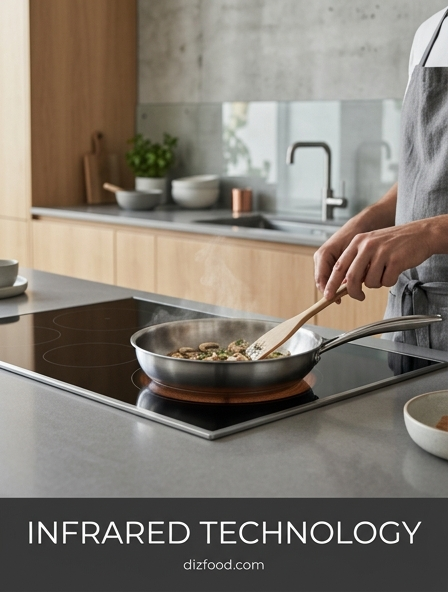
Understanding Infrared Radiation in Modern Kitchens
Infrared radiation is a form of electromagnetic energy that sits between visible light and microwaves on the spectrum. In the modern kitchen, this technology has revolutionized how we apply heat to food. Unlike traditional methods that rely on heating the surrounding air, infrared systems transmit energy directly to the surface of the ingredients. This process occurs through electromagnetic waves that excite molecules within the food, generating heat almost instantaneously upon contact. Most kitchen appliances utilize either near-infrared or far-infrared emitters, often constructed from quartz or ceramic materials.
- Near-Infrared (NIR): High-intensity waves that provide deep penetration and rapid surface searing.
- Far-Infrared (FIR): Lower intensity waves ideal for gentle warming and uniform internal cooking.
- Quartz Emitters: Known for their rapid response times and ability to reach peak temperatures in seconds.
Understanding these distinctions allows manufacturers to design appliances that offer superior control over the cooking environment. By harnessing specific wavelengths, infrared technology eliminates the lag time associated with thermal conduction, providing a more responsive and predictable culinary experience for both professional chefs and home cooks alike.
Energy Savings through Targeted Heat Waves
One of the most compelling advantages of infrared technology in kitchen appliances is its inherent energy efficiency. Traditional thermal cooking requires the appliance to heat a large volume of air or a heavy metal medium before the energy can be transferred to the food. This secondary heating phase results in significant energy loss through the walls of the appliance and into the kitchen environment. Infrared cooking bypasses this inefficiency by delivering targeted heat waves that focus energy exactly where it is needed.
Because the energy transfer is direct, infrared ovens and toasters require much lower wattage to achieve the same results as their conventional counterparts. The reduction in preheating time contributes significantly to lower cumulative energy consumption. Furthermore, because the heat is directed at the food rather than the air, the kitchen stays cooler, reducing the demand on air conditioning systems during heavy cooking periods. This dual-layered efficiency makes infrared technology a cornerstone of the modern green kitchen, allowing users to prepare high-quality meals while significantly reducing their monthly utility expenditures and overall environmental impact.
Comparing Convection and Infrared Heat Transfer
To appreciate the innovation of infrared technology, one must compare it to the standard convection methods used for decades. Convection relies on the movement of hot air molecules to transfer energy, a process that is subject to fluctuations and cold spots. In contrast, infrared heat transfer is radiant and does not require a medium to travel. This fundamental difference in physics leads to distinct performance variations in the kitchen environment.
| Feature | Convection Cooking | Infrared Cooking |
|---|---|---|
| Medium | Heated Air/Fans | Electromagnetic Waves |
| Preheat Time | 10 to 20 Minutes | Instant to 30 Seconds |
| Heat Uniformity | Prone to Hot Spots | Highly Uniform Distribution |
| Surface Texture | Can Dry Out Food | Superior Searing/Moisture Retention |
While convection is excellent for large-scale baking where air circulation is beneficial, infrared excels in speed and precision. The lack of air movement in radiant systems also means that delicate items are not buffeted by fans, preserving their structural integrity during the cooking process.
Accelerated Preheating Times in Infrared Toasters
The morning routine often demands speed, and traditional toasters frequently fail this test by requiring several minutes to reach the necessary temperature for browning. Infrared toasters have fundamentally changed this dynamic by utilizing high-intensity quartz heating elements. These elements can reach their maximum thermal output in less than a second, eliminating the need for a preheat cycle entirely. This "instant-on" capability is not merely a convenience; it represents a more logical application of thermal physics in small appliances.
When the toaster is activated, the infrared waves strike the surface of the bread immediately, initiating the Maillard reaction almost instantly. In a standard toaster, the wire filaments must first heat up, then heat the air, which then slowly warms the bread. By removing these intermediate steps, infrared models can complete a toasting cycle in nearly half the time of conventional units. This rapid delivery of energy ensures that the internal moisture of the bread is preserved, as the bread is exposed to heat for a much shorter duration, preventing the "cardboard" texture often associated with slow, convective toasting cycles.
Achieving the Perfect Golden Crust with Precision
The hallmark of great cooking is often the contrast between a crisp, golden exterior and a tender interior. Achieving this balance requires precise control over surface temperatures, a feat where infrared technology excels. Because infrared energy is absorbed primarily by the surface layers of food, it is exceptionally efficient at triggering the Maillard reaction-the chemical process between amino acids and reducing sugars that gives browned food its distinctive flavor.
- Direct Absorption: Energy is absorbed by the outer 1-2 millimeters of the food, causing rapid caramelization.
- Thermal Gradient: A sharp temperature difference is maintained between the crust and the core.
- Precise Modulation: Modern sensors can adjust the wave intensity to prevent burning while ensuring a deep golden hue.
This precision allows users to toast artisanal breads, sear proteins, or melt cheeses with a level of consistency that is difficult to replicate with hot air. The ability to pulse the infrared emitters further enhances this control, allowing the surface to reach the perfect degree of crispness without the risk of overcooking the center, resulting in professional-grade textures at home.
The Thermodynamics of Radiant Cooking Efficiency
Radiant cooking efficiency is governed by the laws of thermodynamics, specifically the Stefan-Boltzmann law, which states that the power radiated by a body is proportional to the fourth power of its absolute temperature. In a kitchen setting, this means that infrared emitters can transfer enormous amounts of energy very quickly once they reach operating temperatures. Because this energy is transferred via radiation rather than conduction or convection, the thermal resistance of the air becomes irrelevant.
In a standard oven, energy is lost every time the door is opened because the heated air escapes. In a radiant infrared system, the heat is stored in the emitters and the food itself. While some air temperature is lost, the primary cooking mechanism-the infrared waves-resumes the moment the door is closed and the emitters are powered. This creates a more stable thermal environment. The thermodynamics of these systems ensure that a higher percentage of the electricity pulled from the wall is converted into heat that actually cooks the food, leading to a thermodynamic efficiency rating that far surpasses traditional resistive heating elements or gas burners.
Reducing Carbon Footprints with Smart Heating
As the global focus shifts toward sustainability, the kitchen remains a primary area for domestic energy reduction. Infrared heating technology plays a vital role in this transition by offering a lower carbon footprint through several mechanical advantages. First, the lack of a preheating phase means less idle electricity usage. Second, the speed of cooking reduces the total "on-time" of the appliance, which directly correlates to lower kilowatt-hour consumption over the life of the product.
Furthermore, infrared components are often more durable and require fewer raw materials for construction compared to heavy cast-iron or thick-walled convection ovens. The precision of smart infrared heating also reduces food waste; by providing more consistent results and preventing overcooking or uneven burning, fewer meals are discarded due to preparation errors. When integrated with smart home energy management systems, these appliances can operate during off-peak hours or be modulated to use the minimum energy required for a specific task. By choosing radiant technology, consumers are actively participating in a more sustainable lifestyle without sacrificing the quality or speed of their meal preparation.
Moisture Retention and Texture in Infrared Toasting
The primary complaint with traditional toasting methods is the tendency for the bread to become dry and brittle throughout. This occurs because slow heating allows time for the moisture in the center of the slice to evaporate before the surface has adequately browned. Infrared toasting solves this problem through the principle of "flash heating." By applying high-intensity radiant energy to the exterior, the surface is sealed and toasted before the heat has a chance to drive out the internal moisture.
- Sealing Effect: Rapid surface heating creates a moisture barrier.
- Soft Crumb: The interior remains at a lower temperature, preserving the original bread texture.
- Structural Integrity: Breads with high sugar or fat content brown evenly without collapsing.
This retention of moisture is not limited to bread; it applies to frozen snacks, leftover pizza, and proteins as well. The result is a superior sensory experience where the crunch of the crust is followed by a soft, hydrated interior. This capability makes infrared technology particularly suited for revitalizing foods that typically suffer when reheated in a microwave or standard toaster oven.
The Role of Wavelengths in Uniform Heat Distribution
Uniform heat distribution is the "holy grail" of kitchen technology, and it is achieved in infrared systems through the careful manipulation of wavelengths. Near-infrared waves have shorter wavelengths and higher frequencies, allowing them to penetrate slightly deeper into certain food types. Far-infrared waves have longer wavelengths that are absorbed primarily at the very surface. Advanced kitchen appliances often use a "hybrid" approach, combining these wavelengths to ensure that heat is distributed evenly across the entire surface area of the food.
The geometry of the reflectors inside the appliance also plays a critical role. By using parabolic or multi-faceted reflective surfaces, manufacturers can bounce infrared waves at multiple angles, ensuring that the sides and edges of the food receive the same energy as the top. This eliminates the "ring effect" where the edges of a piece of toast are burnt while the center remains white. The result of this complex wave management is a perfectly uniform cook, regardless of where the food is placed on the rack. This scientific approach to heat distribution ensures that every meal is cooked to the same standard every time.
Future Trends in Energy Efficient Kitchen Technology
The future of kitchen technology is increasingly focused on the integration of infrared sensors and artificial intelligence. We are moving toward a "set and forget" paradigm where appliances can detect the moisture content and surface temperature of food in real-time. Infrared cameras and sensors will allow ovens to adjust their radiant output dynamically, ensuring that a steak is seared to a precise degree or that a cake rises perfectly without any manual intervention from the user.
- Multi-Spectrum Emitters: Appliances that switch between different IR wavelengths based on the food type detected.
- AI Integration: Algorithms that optimize the heating profile for specific recipes to maximize energy savings.
- Compact Design: Smaller, more powerful infrared units that replace bulky traditional ovens in urban living spaces.
As solid-state heating technology advances, we may see the total elimination of traditional heating coils in favor of highly efficient, long-lasting infrared panels. These innovations will continue to push the boundaries of what is possible in the kitchen, making professional-level precision accessible to everyone while further reducing the energy demands of the modern household.


Comments