
Tired of your kitchen looking like a tangled "cord spaghetti" crime scene? The battle between retractable and fixed power cords is the ultimate showdown for anyone looking to reclaim their countertop real estate and achieve a minimalist aesthetic. While fixed cords are the traditional industry standard, they often leave you wrestling with unsightly excess slack that traps grease and dust. In contrast, retractable cord mechanisms allow you to pull out only the length you need, snapping the rest safely out of sight inside the appliance housing. If you're ready to streamline your morning routine and transition to a high-end, organized workspace, understanding how this simple design feature impacts your appliance portability and safety is the secret to a truly decluttered kitchen.
| Feature | Retractable Power Cord | Fixed Power Cord |
|---|---|---|
| Storage Footprint | Internal; zero external footprint. | External; requires manual winding/ties. |
| Visual Clutter | Hidden; maintains minimalist counters. | Exposed; creates "cord chaos." |
| Durability | Protected housing; limits fraying. | Prone to kinking and insulation wear. |
| Safety Profile | Low trip risk; no excess slack. | Higher snag/trip hazard on counters. |
| User Convenience | Instant "one-tug" organization. | Time-consuming manual management. |
| Appliance Cost | Mid-to-high (Premium feature). | Low (Standard/Budget-friendly). |
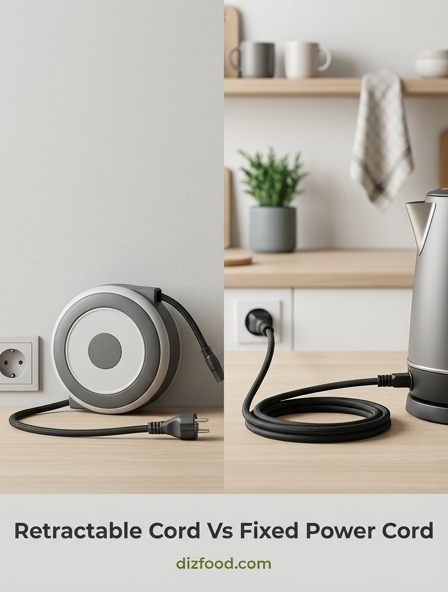
Retractable vs Fixed Power Cords Key Differences
In the modern kitchen environment, the distinction between retractable and fixed power cords centers on versatility versus stability. A fixed power cord is the traditional standard, consisting of a continuous insulated wire permanently attached to an appliance. Its length is predetermined, usually ranging from three to six feet, providing a consistent flow of electricity without any internal moving parts. This design is most common in stationary appliances such as refrigerators, dishwashers, and wall ovens, where the proximity to the outlet is rarely altered.
Conversely, retractable cord systems utilize a spring-loaded reel mechanism that allows the user to pull out the exact length of wire needed. Any excess cord remains stored within a protective housing, typically built into the base of the appliance or a ceiling-mounted reel. The primary functional differences include:
- Internal Continuity: Fixed cords have a direct connection, whereas retractable cords rely on slip rings or rotating contacts to maintain electrical flow while the reel turns.
- Storage: Fixed cords must be manually coiled or tucked away, often leading to unsightly "cable nests" behind microwaves or mixers.
- Mechanical Complexity: Retractable units involve springs, ratchets, and locking paws, while fixed cords are purely structural and electrical.
Ultimately, the choice between these two systems dictates how an operator interacts with their kitchen workspace. While fixed cords offer the highest level of electrical simplicity, retractable cords provide a level of adaptability that caters to dynamic tasks, such as using a hand mixer across a large island or pulling a vacuum to clean a pantry area.
Durability and Lifespan Comparison
When evaluating the longevity of kitchen equipment, the power delivery system is a common point of failure. Fixed power cords are generally considered more durable because they lack mechanical failure points. In a high-heat kitchen environment, the heavy-duty insulation of a fixed cord can withstand significant ambient temperatures and occasional contact with hot surfaces without compromising the internal copper strands. Because the cord does not move through a narrow aperture or rub against a reel, the outer jacket experiences minimal abrasion over time.
Retractable cords, while highly convenient, have a finite lifespan defined by their cycle count. Every time a cord is pulled out and retracted, the internal spring loses a microscopic amount of tension, and the sliding electrical contacts experience friction-based wear. In a professional kitchen, where tools are used dozens of times daily, these mechanisms may eventually fail to lock or lose their ability to retract fully. Furthermore, the constant bending of the wire at the reel's exit point can lead to "work hardening" of the copper, eventually causing the wire to fray internally.
To provide a clearer view of how these two solutions compare in terms of longevity, consider the following factors:
- Vulnerability to Debris: Fixed cords are easy to wipe down. Retractable reels can suck flour, grease, and dust into the internal housing, which may gum up the mechanism over time.
- Mechanical Fatigue: Retractable systems are prone to spring failure, a non-issue for fixed cords.
- Chemical Exposure: In kitchens, exposure to cleaning agents is frequent; fixed cords offer a continuous surface that is easier to protect with specialized coatings.
Space Saving Benefits of Retractable Cord Reels
Spatial efficiency is a primary concern in both residential and commercial kitchens. Countertop real estate is often at a premium, and the presence of excess cabling can significantly hinder food preparation workflows. Retractable cord reels address this by eliminating "cord sprawl." When an appliance like a toaster or a blender is not in use, the cord is stored entirely within the device or a wall-mounted reel, leaving the surrounding area clean and unobstructed. This is particularly beneficial for small appliances that are frequently moved in and out of cupboards.
In larger commercial settings, ceiling-mounted retractable reels provide power to islands or prep stations that are not adjacent to walls. This allows chefs to pull power down when needed and retract it once the task is finished, keeping the floor clear of cables that would otherwise be snaked across the walking path. The organizational benefits extend beyond just aesthetics; a tidy workspace allows for faster cleaning and more efficient movement between different cooking zones.
Key space-saving advantages include:
- Reduced Clutter: Prevents multiple cords from tangling in storage drawers or on countertops.
- Adjustable Reach: Users can extend only the necessary amount of cord, preventing loops of wire from dipping into sinks or across hot burners.
- Integrated Design: Many modern high-end appliances now feature internal "cord garages," utilizing retractable technology to maintain a minimalist kitchen profile.
Safety Considerations for Fixed and Retractable Cords
Safety in the kitchen is paramount due to the presence of water, heat, and sharp objects. Fixed cords pose a significant tripping hazard if they are too long or if they drape across walkways. Furthermore, fixed cords that are excessively long are often bundled with zip ties; if these bundles are kept tight while the appliance draws high current, they can generate heat through induction, potentially melting the insulation. However, because fixed cords have no moving parts, the risk of an internal electrical arc is nearly zero under normal operating conditions.
Retractable cords introduce a different set of safety variables. One major concern is the "solenoid effect." If a retractable cord is under heavy electrical load while still mostly coiled on the reel, it can overheat rapidly. Most high-quality kitchen reels include a thermal cut-out switch to prevent fires, but lower-end models may lack this feature. Additionally, the snapping action of a spring-loaded cord can be dangerous if the plug end is released suddenly, potentially striking glassware or the user.
| Safety Factor | Fixed Power Cord | Retractable Cord |
|---|---|---|
| Tripping Risk | High (if not managed) | Low (stored when not used) |
| Overheating | Low (straight runs) | High (if used while coiled) |
| Electrical Arc | Negligible | Possible at slip rings |
| Mechanical Injury | None | Moderate (snap-back risk) |
Maintenance Requirements for Retractable Mechanisms
Maintenance is where the two cord types diverge most sharply. A fixed power cord requires virtually no maintenance other than periodic inspections for cracks in the insulation or bent prongs on the plug. In contrast, a retractable cord reel is a mechanical assembly that demands regular attention to ensure safe and smooth operation. Because the kitchen is a high-particulate environment-full of flour, spice dust, and vaporized oils-the cord must be wiped clean before it is allowed to retract into the housing. If grease is pulled into the reel, it can act as an adhesive for dust, eventually seizing the internal spring or the locking ratchet.
Beyond external cleaning, the internal components of a retractable system may require occasional servicing. Industrial kitchen reels often feature adjustable tensioners that must be tightened over time as the spring fatigues. If the reel uses carbon brushes to transfer electricity to the rotating drum, these brushes will eventually wear down and require replacement to prevent flickering power or internal sparking. For fixed cords, the only real "maintenance" is ensuring the cord is not pinched by heavy appliances or furniture, which can lead to localized hot spots and wire degradation. Therefore, facilities choosing retractable solutions must be prepared for a higher labor overhead to keep the equipment in peak condition.
Industrial Reliability of Fixed Power Cords
In industrial food processing and high-volume commercial kitchens, reliability is the most critical metric. For this reason, fixed power cords remain the industry standard for heavy-duty equipment. When a machine operates 24/7-such as a commercial walk-in refrigerator or a continuous-motion industrial mixer-any failure in the power delivery system results in immediate downtime and potential product loss. Fixed cords are chosen for these applications because they provide a "hard-wired" level of reliability. There are no springs to snap, no brushes to wear out, and no locking mechanisms to fail.
Industrial fixed cords are often constructed with SOOW (Service, Oil-resistant, Other-resistant, Water-resistant) jackets, which are significantly thicker than the cords found on household appliances. This makes them nearly impervious to being stepped on, rolled over by equipment carts, or splashed with boiling water. In contrast, retractable cords must use thinner, more flexible jackets to allow them to wind tightly around a small diameter reel. This flexibility comes at the cost of puncture resistance and overall ruggedness. While a retractable reel might be convenient for a handheld stick blender used for finishing sauces, it is rarely trusted for the main power feed of a 60-quart floor mixer where a consistent, high-amperage draw is required without the risk of mechanical interruption.
Tangle Prevention and Workplace Organization
One of the most frustrating aspects of kitchen management is the "tangle factor." When multiple appliances-blenders, slow cookers, and coffee makers-are grouped together, their fixed cords often become inextricably knotted. This not only looks unprofessional but also makes it difficult to move a single appliance for cleaning or repositioning. Retractable cords are the ultimate solution to this problem. Because the cord only extends as far as the outlet, there is no "dead length" to get caught under the feet of other appliances or to create a bird's nest of wires on the countertop.
Workplace organization is further enhanced by the predictable nature of retractable systems. In a professional prep line, having a retractable reel hanging from the ceiling ensures that the power source is always in the same 3D coordinate in space, rather than lying somewhere on a wet or flour-covered floor. For the home cook, retractable cords allow for a "clear counter" policy, where the kitchen can be transitioned from a high-activity cooking zone to a clean entertaining space in seconds. The ability to instantly hide the power cord changes the kitchen from a cluttered workshop into a streamlined environment, reducing the cognitive load on the cook and allowing for a more focused and organized culinary process.
Impact of Frequent Use on Cord Integrity
Frequent use affects fixed and retractable cords through different physical mechanisms. For a fixed cord, the primary point of stress is the "strain relief" where the wire enters the appliance and the plug. Repeatedly plugging and unplugging a cord, or wrapping it tightly around the appliance for storage, causes the internal copper strands to stretch and eventually break. This is why many old kitchen mixers have frayed wires right where the cord meets the plastic housing. However, if the appliance stays plugged in and stationary, a fixed cord can last for decades without any degradation of its integrity.
Retractable cords suffer from "dynamic wear." Every use involves friction between the cord's outer jacket and the exit guide of the reel. Over time, this can shave down the insulation, potentially exposing the colored wires inside. Furthermore, the internal electrical transition-where the moving cord connects to the stationary house wiring-is a site of constant movement. In high-frequency environments, this can lead to heat buildup due to increased resistance as the contact surfaces wear down. Users of retractable systems must be vigilant in checking for "necking" (where the cord becomes thinner due to stretching) and ensuring the outer jacket hasn't become tacky from kitchen oils, which would increase the stress on the internal retraction motor or spring.
Cost Analysis of Each Power Solution
When analyzing the cost of power solutions, one must look beyond the initial purchase price and consider the total cost of ownership (TCO) over the appliance's life. Fixed power cords are significantly cheaper to manufacture and install. A standard replacement fixed cord might cost between $10 and $20, and the labor to install it is minimal due to the simplicity of the connection. This makes them the most cost-effective choice for budget-conscious consumers and high-scale commercial operations that want to minimize maintenance expenses.
Retractable cord reels represent a higher upfront investment. An integrated retractable system can add $50 to $150 to the price of a high-end kitchen appliance. Professional-grade ceiling-mounted reels can cost several hundred dollars. The long-term costs are also higher; when a retractable mechanism fails, it is often more expensive to repair than a simple cord, sometimes requiring the replacement of the entire reel assembly. However, one must also factor in the "hidden" cost savings of retractable cords, such as reduced labor time spent untangling wires and the prevention of accidental damage caused by tripping over loose cables.
- Fixed Cord TCO: Low initial cost, near-zero maintenance, low replacement cost.
- Retractable Cord TCO: Higher initial cost, requires periodic maintenance, potential for mechanical failure.
- Value Proposition: Retractable cords trade higher costs for increased ergonomic efficiency and improved aesthetics.
Choosing the Best Cord for Your Application
The decision between a retractable and a fixed power cord ultimately depends on the specific use case and the environment of the kitchen. For stationary, high-power appliances that are "set and forget," fixed cords are the superior choice. This includes refrigerators, dishwashers, and ovens. In these instances, the mechanical complexity of a retractable reel provides no benefit and only introduces a potential point of failure. The stability of a fixed connection ensures that these critical appliances remain powered without interruption.
For portable or countertop appliances that are used intermittently, retractable cords are vastly superior. If you frequently move a stand mixer from a cabinet to an island, or if you use a hand blender that needs to reach across a stove, the flexibility of a retractable system is invaluable. In commercial prep areas, ceiling-mounted retractable reels are essential for maintaining a safe, trip-free environment. When making your choice, consider the following checklist:
- Frequency of Movement: If the tool moves daily, go retractable. If it stays put, go fixed.
- Amperage Requirements: High-draw heating elements (like large griddles) are safer with heavy-duty fixed cords.
- Available Space: In cramped kitchens, the space-saving nature of retractable cords is a game-changer.
- Maintenance Capability: If you lack the time to clean and maintain a reel mechanism, stick with the simplicity of a fixed cord.

Comments