
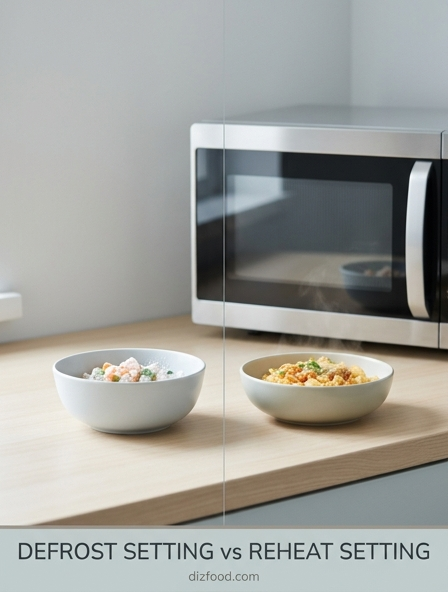
Navigating your microwave's settings can be the difference between a gourmet leftover experience and a rubbery disappointment. When deciding between the defrost and reheat modes, the choice hinges on how much power you're applying to the food's molecular structure to ensure optimal quality. While the defrost setting uses low-intensity, pulsed energy (typically 30% power) to gently thaw ice crystals without prematurely "cooking" the edges, the reheat setting operates at a medium-high power level designed to bring pre-cooked items back to serving temperature quickly while preserving moisture. Understanding these nuances allows you to maintain the intended texture and flavor of your meals, preventing common pitfalls like dehydrated proteins or cold centers.
| Feature | Defrost Setting | Reheat Setting |
|---|---|---|
| Power Level | Low (20% - 30% capacity) | Medium-High (70% - 80% capacity) |
| Energy Delivery | Pulsed cycles to allow heat conduction | Steady, concentrated thermal energy |
| Primary Objective | Ice-to-water phase transition (Thawing) | Raising internal temp to 165°F (Serving) |
| Best Used For | Frozen raw meats, poultry, and bread | Leftovers, pre-cooked meals, and soups |
| Texture Impact | Prevents rubbery, overcooked edges | Maintains moisture and prevents drying |
| Duration | Longer (5-10+ mins per pound) | Short (1-4 mins per serving) |
Microwave Power Levels Explained
Understanding microwave power levels is essential for mastering kitchen efficiency and food quality. Most modern microwaves operate on a scale from 1 to 10, or 10% to 100% wattage. Unlike an oven where the temperature is constant, a microwave typically operates at full power or not at all. To achieve "lower" power levels, the appliance utilizes a duty cycle, pulsing the magnetron on and off over a set period. For example, at 50% power, the microwave might emit radiation for five seconds and remain idle for five seconds.
The standard power levels generally correlate to the following culinary tasks:
- Level 10 (100%): Best for boiling liquids, cooking fresh vegetables, or heating thin soups.
- Level 7-8 (70-80%): Ideal for "Reheat" functions, ensuring proteins don't toughen too quickly while heating through.
- Level 5 (50%): Suitable for slow-cooking stews or heating dense dairy products to prevent curdling.
- Level 3 (30%): The standard "Defrost" setting, allowing ice to melt without cooking the outer edges of the food.
- Level 1 (10%): Used for keeping foods warm or softening butter and chocolate without melting them completely.
By selecting the appropriate level, you control the rate of molecular agitation. High power levels cause water molecules to vibrate violently, generating heat rapidly. Lower levels provide the necessary "rest" periods for thermal conduction to move heat from the exterior to the interior of the food, preventing a burnt crust and a frozen center.
Defrost Versus Reheat Key Differences
While both functions aim to raise the temperature of food, their mechanical execution and intended outcomes differ significantly. The defrost setting is designed to transition water from a solid state (ice) to a liquid state without crossing the threshold into cooking. Conversely, the reheat setting is designed to take food that is already cooked and chilled, bringing it back to a palatable, steaming-hot serving temperature.
| Feature | Defrost Setting | Reheat Setting |
|---|---|---|
| Default Power Level | Usually 30% Power | Usually 70% to 80% Power |
| Primary Goal | Phase change (Ice to Water) | Increasing internal temperature |
| Duration | Longer cycles (5-15 mins) | Shorter cycles (1-4 mins) |
| Food State | Frozen/Raw or Pre-cooked | Refrigerated/Pre-cooked |
The primary difference lies in the pulse frequency. Defrosting requires very long "off" periods to allow the heat to migrate through the ice crystals via conduction. If you were to use a reheat setting on a frozen block of ground beef, the high power would cook the outer inch of the meat to a grey, rubbery texture while the core remained a solid block of ice. Reheating uses a higher sustained energy burst because the water in refrigerated food is already liquid and can distribute heat more efficiently than ice.
How Microwave Defrosting Actually Works
The science of defrosting in a microwave is a delicate balance of physics. Microwave radiation is highly absorbed by liquid water but is surprisingly poor at being absorbed by solid ice. This creates a physical challenge: once a small pocket of ice melts into liquid water, that water begins to absorb energy much faster than the surrounding ice. This can lead to "hot spots" where parts of the food begin to cook while other parts remain frozen.
To combat this, the defrost setting uses a low duty cycle. By pulsing the magnetron for only 30% of the total time, the microwave allows for "thermal equilibrium." During the "off" periods, the heat generated in the small pockets of liquid water is conducted into the adjacent ice crystals, melting them naturally. This process mimics the effect of leaving food on a counter but at a highly accelerated rate.
For effective defrosting, the following steps are recommended:
- Remove all metal-flecked packaging or aluminum foil.
- Break apart frozen items, such as hamburger patties or berries, as soon as they are soft enough.
- Rotate or flip the food item halfway through the cycle to ensure even exposure.
- Allow for "standing time" after the cycle ends to let the remaining ice crystals vanish.
Understanding that the microwave is essentially "waiting" for the ice to catch up during the silent parts of the cycle explains why defrosting takes much longer than standard cooking. Patience during this phase is the key to maintaining the integrity of the raw ingredients.
Best Foods for Reheat Settings
Not all leftovers are created equal when it comes to the microwave. The reheat setting is specifically optimized for foods that have a high moisture content and a relatively uniform density. Because the reheat function typically operates at a medium-high power level, it excels at penetrating through layers of food without the extreme intensity of the "High" setting, which often explodes sauces or dries out proteins.
The best candidates for the reheat function include:
- Casseroles and Lasagna: The layered nature of these dishes benefits from the slightly slower energy transfer, allowing the center to get hot without the edges turning crunchy or hard.
- Soups and Stews: Liquid-heavy dishes distribute heat well through convection, and the reheat setting prevents the surface from splattering.
- Rice and Grains: When reheated with a splash of water and a lid, the medium power steams the grains back to their original fluffiness.
- Plated Meals: A mix of meat and vegetables responds better to the 70% power of a reheat cycle than the 100% power of a quick start.
Conversely, foods like bread or fried chicken rarely fare well on standard reheat settings. Bread contains very little water, and the microwave energy quickly turns the starch into a gluey, then rock-hard, texture. For fried foods, the microwave lacks the dry heat necessary to maintain crispiness, resulting in a soggy coating regardless of whether you use the reheat or cook setting.
Maintaining Texture During Microwave Heating
The greatest complaint regarding microwave use is the degradation of food texture. When food is heated, the rapid agitation of water molecules can lead to steam pressure that ruptures cell walls in vegetables or denatures proteins in meat too quickly. To maintain a "just-cooked" mouthfeel, one must manage moisture loss and energy distribution. The reheat setting is a tool for texture management because it reduces the speed of evaporation.
To preserve texture, consider these specific techniques:
- The Water Shield: Placing a small, microwave-safe cup of water in the corner of the microwave creates a humid environment, preventing bread or pizza crusts from becoming desiccated.
- Covering Food: Using a vented microwave cover or a damp paper towel traps steam. This steam acts as a secondary heating medium, keeping the surface of the food moist and supple.
- Arrangement: Place thicker or denser portions of food, like chicken breasts or broccoli stalks, toward the outer edge of the rotating plate, where they receive more energy.
- Power Reduction: For delicate items like fish or eggs, manually dropping the power level even lower than the default reheat setting can prevent the rubbery "over-coagulation" of proteins.
Texture is often sacrificed for speed. By choosing the reheat setting over the maximum power setting, you are essentially trading sixty seconds of time for a significantly higher quality meal. The slower ramp-up in temperature prevents the structural fibers of the food from tightening and expelling all their juices.
Technical Breakdown of Wattage Cycles
The technical operation of a microwave revolves around the magnetron, a vacuum tube that converts electricity into microwave radiation. Most consumer-grade microwaves are not "inverter" models. This means the magnetron can only operate at zero or 100% capacity. When you select a defrost or reheat setting, you are interacting with a software-controlled timer that manages the "duty cycle."
A duty cycle is defined as the percentage of time a signal or device is active. In a 1,000-watt microwave, the following wattage equivalents occur during different modes:
- High (100%): The magnetron runs continuously. Total output is 1,000 watts per second.
- Reheat (70%): The magnetron runs for 14 seconds of a 20-second window. The average energy delivered is 700 watts.
- Defrost (30%): The magnetron runs for 6 seconds of a 20-second window. The average energy delivered is 300 watts.
Inverter technology, found in higher-end models, differs by using a power supply that can actually dim the output. Instead of pulsing 1,000 watts on and off, an inverter microwave can provide a steady, continuous stream of 300 watts for defrosting. This results in much smoother thawing and heating without the "pulsing" effect that can occasionally cook the edges of delicate foods. Understanding whether your machine is a traditional transformer-based model or an inverter model will help you decide how much you need to manually intervene during the heating process.
Food Safety Risks When Thawing
Defrosting meat, poultry, and seafood in the microwave introduces specific food safety risks that must be managed to prevent foodborne illness. The "Danger Zone" is the temperature range between 40°F and 140°F, where bacteria such as Salmonella and E. coli multiply most rapidly. Because microwave defrosting is uneven, the exterior of a piece of meat may reach the Danger Zone while the interior is still frozen solid.
To minimize these risks, hygiene and timing are paramount. When using the defrost setting, it is a strict safety requirement that the food be cooked immediately after the cycle finishes. You should never defrost meat in a microwave and then place it back in the refrigerator to cook later. The warm spots created during the defrost cycle can jumpstart bacterial growth that a refrigerator's cool temperature cannot sufficiently halt once it has begun.
Furthermore, juices that leak from thawing meat can contain high concentrations of bacteria. These juices often pool in the bottom of the microwave dish and can be "cooked" onto the surface, creating a cross-contamination hazard. Always use a deep, microwave-safe container to catch these liquids, and sanitize the microwave turntable and the container thoroughly after use. If the microwave has a "Weight Defrost" feature, use it accurately; underestimating the weight can leave the core raw, while overestimating can partially cook the meat, making it a breeding ground for pathogens.
Preventing Rubberiness in Reheated Leftovers
The dreaded "rubbery" texture in reheated leftovers is usually the result of overexposure to high-frequency radiation, which causes proteins to bond too tightly and moisture to evaporate instantly. This is particularly common with lean meats like chicken breast, pork chops, and even certain types of pasta. The reheat setting is your first line of defense against this, as it utilizes a lower power level that doesn't "shock" the protein fibers.
To further prevent a rubbery consistency, consider the following list of interventions:
- Slice Thinly: Before reheating, slice meats into thin strips. This allows the heat to reach the center faster, reducing the total time the meat is exposed to radiation.
- Add Fat or Liquid: A small pat of butter, a teaspoon of olive oil, or a tablespoon of stock can create a protective barrier that prevents the protein from drying out.
- The "Ring" Method: When reheating pasta or mashed potatoes, create a hole in the center of the food (like a donut shape). Microwaves heat from the outside in; removing the center prevents the edges from being overcooked while the middle stays cold.
- Intermittent Stirring: Even on the reheat setting, stopping the microwave every 60 seconds to stir the food redistributes the heat and prevents specific areas from becoming tough.
By lowering the power and adding a source of moisture, you ensure that the heat is being used to vibrate the water molecules gently rather than forcing them to blast out of the food's cellular structure, which is what leads to that undesirable chewy, elastic texture.
Energy Efficiency of Microwave Functions
When considering energy efficiency, the microwave is already one of the most efficient appliances in the kitchen because it heats the food directly rather than the air around it. However, there is a nuanced difference in energy consumption between the "High," "Reheat," and "Defrost" settings. While it might seem like a lower power setting uses less electricity, the total energy consumed is often similar because lower power settings require significantly longer run times.
Consider the energy math: A microwave running at 100% power for two minutes uses the same amount of electricity as a microwave running at 50% power for four minutes. The difference lies in the quality of the heat transfer. For energy efficiency in the context of kitchen workflow:
- High Power: Most efficient for liquids and high-moisture vegetables where speed does not compromise quality.
- Defrost/Reheat: Less "time-efficient" but more "resource-efficient" in the sense that they prevent food waste. Ruining a meal on high power is an energy loss.
- Standby Power: Modern microwaves use a significant amount of energy just to power the digital clock and sensors.
To maximize efficiency, use the defrost setting for frozen items rather than trying to "blast" them on high, which often results in food that is inedible and must be thrown away. Additionally, keep the interior of the microwave clean; food splatters on the walls absorb microwave energy, meaning less energy is reaching your actual meal, forcing longer cook times and higher electricity usage.
Final Verdict on Heating Modes
The choice between defrost, reheat, and full power is the difference between a culinary success and a kitchen failure. Each mode is a specific tool designed for a specific state of matter. The Defrost setting is a low-intensity, high-patience mode intended solely for managing the phase change from ice to liquid. It should never be skipped when dealing with frozen proteins, as it ensures the safety and texture of the raw ingredient before the actual cooking process begins.
The Reheat setting is the "Goldilocks" of microwave functions. It provides enough power to be fast, but enough "rest" time to be gentle. It is the superior choice for almost all leftovers, particularly those containing meat, cheese, or starch. Using the Reheat function-ideally paired with a cover and a splash of moisture-will consistently produce results that are far superior to the 100% power "Quick Start" button.
In summary, use these guidelines for the best results:
- Use Defrost: For anything frozen that needs to be prepped for cooking or for pre-cooked frozen meals that are dense.
- Use Reheat: For anything that was previously cooked and stored in the fridge, especially plated meals and casseroles.
- Use High Power: Only for boiling water, steaming fresh veggies, or heating thin liquids like coffee or broth.
Mastering these settings transforms the microwave from a simple "heating box" into a versatile tool capable of preserving the hard work you put into your initial meal preparation.





Comments