
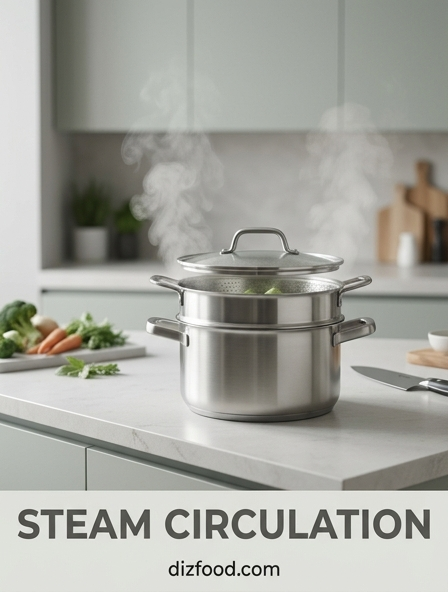
The Mechanics of Steam Movement
Steam movement within a kitchen environment relies heavily on the principles of thermodynamics and fluid dynamics. As water reaches its boiling point, it undergoes a phase change, expanding significantly in volume and decreasing in density. This buoyancy causes the vapor to rise rapidly, creating natural convection currents. In a confined space like a steamer or a lidded pot, this rising vapor encounters cooler surfaces, creating a pressure differential that drives the steam into every available crevice of the food items.
- Buoyancy: Hotter, less dense steam moves upward, displacing cooler air.
- Pressure Gradients: Steam naturally moves from high-pressure zones near the heat source to lower-pressure areas.
- Vapor Expansion: The rapid increase in volume ensures that the entire cooking chamber is saturated quickly.
Effective circulation is not just about the upward trajectory; it involves the continuous displacement of air. Without a dedicated path for the steam to travel, stagnant pockets can form, hindering the efficiency of the heat transfer. Modern kitchen equipment often utilizes specifically designed vents and curved interior walls to guide these currents, ensuring that the kinetic energy of the water molecules is distributed evenly throughout the vessel.
Eliminating Cold Spots with Uniform Airflow
In traditional cooking methods, cold spots often emerge due to uneven heat distribution or the presence of "dead zones" where air becomes trapped. Uniform steam circulation acts as a corrective force by enveloping the food in a consistent thermal shroud. Because steam carries significantly more energy than dry air at the same temperature, ensuring that this vapor reaches every surface of the ingredient is critical for food safety and quality. When airflow is restricted, the center of a batch may remain undercooked while the exterior reaches the desired temperature.
- Active Displacement: Moving steam forces trapped air out of dense clusters of food.
- Thermal Equilibrium: Constant circulation helps the entire cooking chamber reach a steady state faster.
- Boundary Layer Reduction: Turbulent steam flow breaks through the thin layer of stagnant air surrounding cold food.
To achieve this uniformity, it is essential to consider the geometry of the cooking chamber. Equipment that facilitates a circular or "cyclonic" flow ensures that the steam is not merely rising and exiting, but rather swirling around the ingredients. This kinetic interaction minimizes the temperature variance across the cooking surface, allowing for predictable results regardless of the food's position within the unit.
Maintaining Optimal Humidity Levels
The relationship between steam circulation and humidity is vital for maintaining the textural integrity of delicate ingredients. In a well-circulated environment, the relative humidity remains near 100%, which prevents the evaporation of internal moisture from the food. If the circulation is poor, localized areas may suffer from a drop in humidity, leading to surface drying or "skin" formation. Conversely, excessive condensation in stagnant areas can lead to waterlogged results.
| Humidity Level | Effect on Food | Circulation Requirement |
|---|---|---|
| Low (<80%) | Surface dehydration, crusting | Increase steam injection |
| Moderate (80-95%) | Controlled browning, moist interior | Balanced fan speed |
| High (100%) | Rapid poaching, no moisture loss | High-velocity circulation |
By controlling the flow of vapor, chefs can manipulate the rate at which moisture interacts with the food's surface. High-velocity steam circulation ensures that even as some vapor condenses, it is immediately replaced by fresh, humid air. This cycle preserves the natural juices of meats and the crispness of vegetables, ensuring that the final product is neither desiccated nor overly saturated with external water.
The Science of Heat Transfer via Vapor
The primary reason steam is such an efficient cooking medium is the "latent heat of vaporization." When steam hits a cooler object, it condenses back into liquid water, releasing a massive amount of energy in the process. This energy transfer is far more rapid than the conductive heat transfer found in dry roasting or the convective heat transfer of hot air. Effective steam circulation ensures that this condensation process happens uniformly across all surfaces of the food, rather than being concentrated on the leading edge of the steam flow.
- Condensation Heating: The phase change from gas to liquid releases 2,260 kJ/kg of energy.
- Thermal Conductivity: Moist air is a better conductor of heat than dry air.
- Penetration: High-energy vapor molecules can penetrate porous food structures more deeply than dry heat.
Without proper circulation, the steam near the food surface cools down and stays there, acting as an insulating barrier. Active flow removes this "spent" cooler vapor and replaces it with fresh, high-temperature steam. This continuous renewal of the vapor layer allows for a sustained high rate of heat transfer, which is the secret behind the rapid cooking times associated with professional-grade steam equipment.
Preventing Surface Sogginess Through Circulation
One common misconception is that more steam always results in soggier food. However, sogginess is typically the result of poor circulation rather than an abundance of vapor. When steam is allowed to pool and condense into large droplets on the ceiling of a cooker, it eventually drips onto the food, creating wet patches. Proper airflow ensures that moisture remains in a gaseous or finely atomized state, interacting with the food surface without overwhelming it with liquid water.
- Droplet Dispersion: High-velocity air prevents large water droplets from forming.
- Evaporative Balance: Moving air can carry away excess surface moisture even in high-humidity settings.
- Drainage Efficiency: Circulation helps direct condensate toward the walls and drainage ports of the vessel.
By maintaining a steady flow, the steamer creates an environment where the food is "washed" by vapor rather than "soaked" by water. This is particularly important for items like dumplings, breads, or delicate fish, where the surface texture is just as important as the internal temperature. Controlled circulation allows for a "dry steam" effect that cooks thoroughly while leaving the exterior surface clean and properly set.
Impact of Steam Flow on Cooking Speed
The velocity of steam circulation directly correlates with the speed of the cooking process. In a stationary steam environment, the rate of heat transfer is limited by natural convection. However, when steam is forced to move-either through mechanical fans or pressurized injection-it significantly increases the "heat transfer coefficient." This means that the food reaches its target internal temperature much faster than it would in a traditional oven or a slow-boiling pot.
| Cooking Method | Medium | Relative Speed Factor |
|---|---|---|
| Dry Roast | Air | 1.0x |
| Boiling | Water | 2.5x |
| Active Steaming | Circulating Vapor | 4.0x |
The speed advantage of circulating steam is most evident in high-volume production. Because the vapor can wrap around complex shapes and penetrate through stacks of trays, the "recovery time" (the time it takes for the oven to return to temperature after opening the door) is drastically reduced. This efficiency not only saves time but also reduces energy consumption, making it the preferred method for high-efficiency commercial kitchens where throughput is a primary concern.
Vapor Pressure and Nutrient Retention
Steam circulation plays a critical role in the nutritional profile of the finished dish. Unlike boiling, where water-soluble vitamins (such as Vitamin C and B-complex) are leached into the surrounding liquid, steaming keeps the nutrients locked within the food's cellular structure. When steam circulates effectively, it creates a slightly pressurized environment that helps to "seal" the surface of vegetables and proteins quickly, further preventing the loss of essential minerals and antioxidants.
- Enzyme Inactivation: Rapid heating via circulating steam quickly stops the enzymes that cause vegetable spoilage.
- Cellular Integrity: Gentle vapor pressure maintains the crisp texture of plant cell walls.
- Color Preservation: Quick, even heat prevents the breakdown of chlorophyll, keeping greens vibrant.
The efficiency of nutrient retention is highly dependent on the "doneness" timing. Because circulating steam is so effective at transferring heat, the cooking window is much shorter. This reduced exposure to heat prevents the thermal degradation of delicate phytonutrients. By optimizing the flow of vapor, chefs can ensure that the food is not only cooked safely but also retains its maximum biological value and aesthetic appeal.
Optimizing Basket Placement for Airflow
Effective steam circulation is often hindered by improper loading of the cooking chamber. Even the most powerful steamer cannot overcome the physical barrier of over-packed baskets or overlapping ingredients. To maximize the benefits of vapor movement, it is essential to leave adequate space between items and to stagger the placement of trays. This allows the steam to travel in a "zig-zag" pattern, ensuring that the bottom of one tray does not act as a complete ceiling for the tray below it.
- Perforated Surfaces: Always use baskets with maximum hole density to allow vertical steam passage.
- Centrally Spaced Loading: Place larger items in the center where the airflow is typically strongest.
- Staggered Stacking: Offset multiple tiers of baskets to prevent "shadowing" of the steam flow.
When stacking multiple levels, the lowest level often receives the most intense heat. However, with optimized placement, the rising steam is diverted and channeled upward through the gaps, creating a secondary convection effect for the upper levels. Monitoring the clearance between the food and the walls of the steamer is equally important; a two-inch margin is generally recommended to allow the vapor to circulate back down and complete the convection loop.
The Role of Convection in Modern Steamers
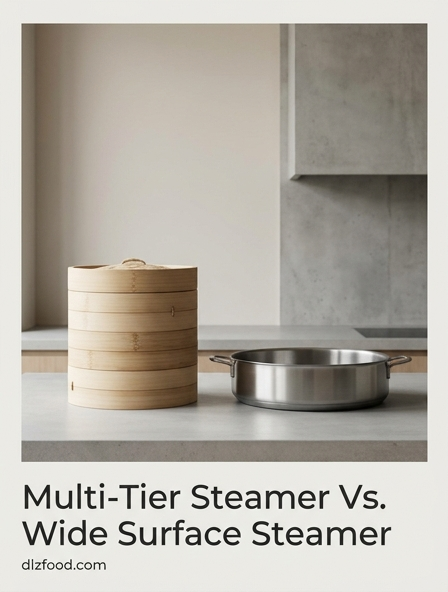
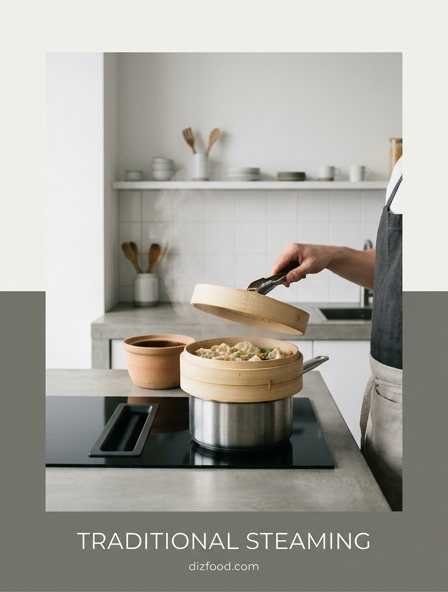
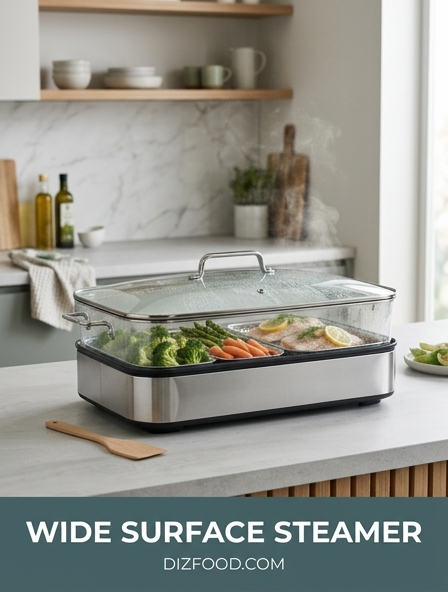
Modern kitchen technology has evolved from passive steaming to active convection steaming. While traditional bamboo steamers rely on the natural rise of vapor, combi-ovens and high-end steamers use high-speed fans to pull steam from the generator and blast it across the cooking chamber. This forced convection creates a more turbulent environment, which is significantly better at stripping away the insulating "cool air" layer that naturally forms around cold food items.
- Fan Speed Control: Allows for delicate steaming of fish or high-velocity cooking of dense root vegetables.
- Reversible Fans: Modern units change fan direction to prevent "wind-tunnel" effects and ensure 360-degree coverage.
- Steam Injection: Precise amounts of vapor are introduced into the airflow to maintain exact humidity percentages.
The marriage of convection and steam allows for a degree of precision previously unattainable. By controlling the velocity of the air, the chef can manage how aggressively the steam interacts with the food surface. This is particularly useful for complex tasks like par-baking bread, where an initial burst of high-velocity steam is needed to allow for maximum "oven spring," followed by a period of lower-humidity circulation to develop the crust.
Achieving Consistency Across Batch Cooking
Consistency is the hallmark of a professional kitchen, and steam circulation is the key to achieving it at scale. When cooking hundreds of portions simultaneously, the risk of variance between the front-left and back-right of a steamer is high. Proper circulation systems are designed to neutralize these variances by ensuring that every cubic inch of the chamber maintains the same temperature and moisture level. This ensures that the first plate served is identical to the last.
| Factor | Impact on Consistency | Solution |
|---|---|---|
| Load Weight | Heavier loads drop chamber temp | Increase steam flow rate |
| Food Density | Blocks steam penetration | Utilize pulsed steam injection |
| Door Openings | Loss of heat/humidity | Rapid recovery via forced convection |
To maintain this consistency, sensors within modern steamers monitor the "wet-bulb" and "dry-bulb" temperatures, adjusting the circulation fans and steam generators in real-time. This feedback loop compensates for any irregularities in how the food was loaded or the initial temperature of the ingredients. Ultimately, the goal of steam circulation is to remove the guesswork from the kitchen, providing a reliable, repeatable environment that produces high-quality results every time.

Comments