
Multi-Tier Steamer Vs. Wide Surface Steamer: The Right Choice for Maximizing Your Cooking Efficiency
Selecting the ideal steaming tool is a pivotal decision for any home chef looking to balance nutritional integrity with kitchen productivity. If you are focused on preparing diverse, multi-course meals simultaneously, the multi-tier steamer utilizes vertical space to prevent flavor transfer between proteins and vegetables, making it a powerhouse for meal prepping. On the other hand, a wide surface steamer-such as a traditional bamboo basket or large-format insert-is the superior choice for handling oversized ingredients like whole fish or delicate rows of dumplings that require uniform steam circulation without overcrowding. By matching the steamer's architecture to your specific culinary habits, you can significantly reduce your time over the stove while ensuring every ingredient retains its vibrant texture and peak vitamin content.
| Feature | Multi-Tier Steamer | Wide Surface Steamer |
|---|---|---|
| Best For | Complex meals (grains, veg, & meat at once) | Large proteins, dumplings, & long greens |
| Space Efficiency | Vertical; saves counter/stove footprint | Horizontal; requires larger pan diameter |
| Flavor Profile | Isolated tiers prevent juice/scent mixing | Single-chamber; flavors tend to meld |
| Heat Uniformity | Varies slightly by level (bottom is hottest) | Rapid, even distribution across one plane |
| Capacity | High volume through stacked layers | High surface area for non-overlapping items |
| Storage | Compact; tiers often nest inside each other | Bulky; requires wide cabinet or rack space |
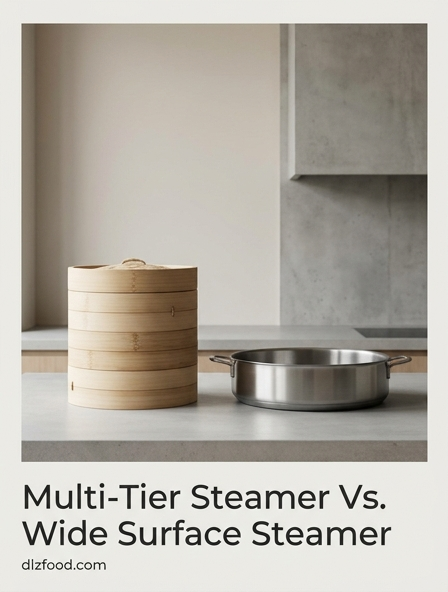
Multi-Tier Steamer vs Wide Surface Steamer Key Differences
The primary distinction between a multi-tier steamer and a wide surface steamer lies in their architectural approach to heat application and spatial management. A multi-tier steamer, often seen in the form of bamboo baskets or stacked electric units, utilizes a vertical orientation. It allows users to cook different food groups simultaneously by stacking baskets on top of one another over a single boiling water source. This design capitalizes on the natural upward movement of steam, creating a graduated temperature environment where the hottest steam hits the bottom layer first.
In contrast, a wide surface steamer, such as a large stainless steel insert or a specialized fish poacher, prioritizes horizontal real estate. These steamers are designed to fit into wide pots or pans, providing a broad, flat area for food placement. The goal here is not height, but rather the ability to spread food out in a single, even layer. This prevents crowding and ensures that every piece of food has direct, unobstructed access to the rising vapor.
| Feature | Multi-Tier Steamer | Wide Surface Steamer |
|---|---|---|
| Orientation | Vertical / Stacked | Horizontal / Flat |
| Footprint | Compact / Narrow | Broad / Large |
| Food Arrangement | Layered by type | Single layer spread |
| Primary Use | Bulk variety meals | Delicate or long items |
Maximizing Vertical Space with Multi-Tier Food Steamers
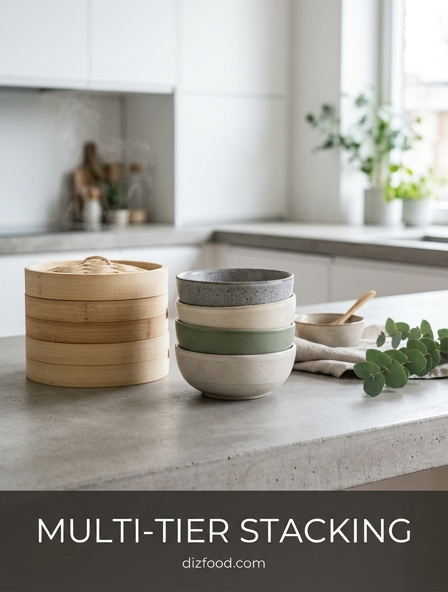
Multi-tier steamers are the champions of efficiency for kitchens with limited countertop or burner space. By stacking components upward, these devices allow for a high volume of food to be processed without requiring a large stove footprint. This verticality is particularly beneficial for preparing multi-course meals where components require similar cooking methods but different durations. The design facilitates a "set it and forget it" workflow, as the steam circulates through perforated floors from the base to the lid.
One of the unique advantages of the vertical stack is the ability to manage flavor profiles and cooking intensities across different levels. While steam rises through all levels, the bottom tier typically experiences the most intense heat and moisture. This creates a functional hierarchy within the cooker that seasoned chefs use to their advantage. To maximize the utility of these steamers, consider the following organizational tips:
- Place dense proteins like chicken or pork in the bottom tier where the steam is hottest.
- Use middle tiers for root vegetables such as carrots or potatoes that need consistent heat.
- Reserve the top tier for leafy greens or delicate dumplings that cook quickly in milder steam.
- Line tiers with parchment or cabbage leaves to prevent juices from dripping onto lower levels.
- Ensure the lid is tight-fitting to maintain internal pressure throughout the stack.
The Performance Benefits of Wide Surface Steamers
While multi-tier systems focus on variety, wide surface steamers excel in precision and uniformity. By spreading food across a broad area, these steamers eliminate the "shading" effect where food on one level blocks steam from reaching the level above it. This makes them ideal for professional-grade results where texture and appearance are paramount. Because the food is arranged in a single layer, there is a much lower risk of some pieces being overcooked while others remain raw in the center.
Wide surface steamers are also superior for heat recovery. When the lid is lifted to check for doneness, a wide, shallow vessel often returns to its optimal steaming temperature faster than a tall, multi-layered tower. The increased surface area of the water reservoir below usually correlates with a higher volume of steam production, which envelops the food more aggressively. This is particularly useful for techniques that require high-intensity steam, such as cooking shellfish or quickly blanching vibrant green vegetables to preserve their color and snap.
Furthermore, these steamers allow for better air circulation around each individual morsel. In a crowded multi-tier basket, food can become mushy if it touches the sides or other pieces. The wide surface design encourages a dry-steam environment where moisture doesn't collect in puddles, ensuring that the exterior of the food remains intact and aesthetically pleasing for presentation.
Steam Distribution and Heat Retention Compared
The physics of steam distribution differs significantly between these two configurations. In a multi-tier steamer, the steam must navigate through multiple layers of food and perforated trays. This creates a pressure gradient; the pressure is highest at the bottom and gradually dissipates as the steam reaches the top. While this is excellent for cooking different foods at once, it can lead to uneven results if the tiers are not rotated or if the bottom layer is packed too tightly, obstructing the flow to the upper chambers.
Wide surface steamers operate on a more egalitarian principle. Since all food sits on a single plane, the steam distribution is relatively uniform across the entire batch. There are fewer obstacles for the vapor to overcome, resulting in a consistent temperature profile from the center to the edges. However, heat retention can be a challenge for wider vessels if the lid is not perfectly sealed, as the larger circumference provides more opportunities for heat to escape through gaps.
In terms of thermal mass, multi-tier steamers-especially those made of bamboo-are exceptional at retaining heat. The wood absorbs excess moisture and acts as an insulator, keeping food warm even after the heat source is turned off. Wide surface steamers, typically made of stainless steel or aluminum, have lower thermal gaps but react much faster to changes in the stove's heat settings, providing the cook with more immediate control over the cooking process.
Cooking Capacity and Layered Meal Efficiency
When evaluating cooking capacity, the multi-tier steamer is generally the winner for large families or meal-prepping individuals. The ability to stack three, four, or even five baskets means you can cook a pound of rice, a dozen dumplings, and several servings of vegetables simultaneously. This layered meal efficiency reduces the total time spent in the kitchen and minimizes the number of pots and pans requiring cleaning later. It is a holistic approach to cooking that treats the entire meal as a single unit of production.
Wide surface steamers, however, offer a different kind of capacity. While they may not hold as many diverse items, they can accommodate larger individual portions that would never fit in a standard circular basket. For example, a wide steamer can hold multiple large chicken breasts or several fillets of salmon without them overlapping. This is crucial for even cooking, as overlapping proteins often result in rubbery textures or undercooked spots where the meat was touching.
- Assess the total volume of food: Multi-tier is better for high-volume, small-item batches.
- Identify food variety: If you need three different sides, the multi-tier stack is more efficient.
- Evaluate surface requirements: If the food must not touch to cook correctly, a wide surface is necessary.
- Consider timing: Multi-tier allows you to add layers at different times based on cooking speed.
Best Steamers for Large and Long Ingredients
Standard multi-tier steamers are usually circular and restricted by the diameter of the stacking rings, which is typically between 8 and 12 inches. This poses a significant problem for long ingredients such as whole fish, long-stemmed broccoli, or full ears of corn. Attempting to force these items into a circular tier often results in breaking the food or leaving it awkwardly coiled, which ruins the presentation and can lead to uneven cooking. For these specific culinary challenges, the wide surface steamer is the undisputed champion.
Wide surface steamers are often rectangular or oval, specifically designed to accommodate the natural shape of large proteins and long vegetables. An oval fish steamer, for instance, allows a whole snapper or sea bass to lay flat, ensuring that the head and tail cook at the same rate as the thickest part of the body. This is also the preferred tool for asparagus or leeks, which should ideally be laid out in single rows to maintain their structural integrity and prevent them from becoming limp and waterlogged.
For those who frequently host dinner parties or prepare traditional dishes that feature whole-animal proteins, the utility of a wide surface cannot be overstated. It provides the "canvas" necessary for elegant plating right from the steaming rack. While a multi-tier steamer focuses on the vertical utility of the kitchen, the wide surface steamer focuses on the integrity of the ingredient itself.
Space Saving Design vs Surface Area Utility
The choice between these two steamers often comes down to the eternal kitchen struggle: storage space versus functional utility. Multi-tier steamers are the epitome of space-saving design. Bamboo versions can be stacked and tucked into a deep drawer, while many electric multi-tier models feature baskets that nest inside one another when not in use. This makes them ideal for apartment dwellers or those with cluttered cabinets. You get a massive amount of cooking area that collapses into a very small footprint.
On the flip side, wide surface steamers can be cumbersome to store. A large, wide steaming pan or a broad rectangular insert takes up significant shelf real estate and often cannot be nested with other cookware. However, the trade-off is the utility of the surface area. A wide steamer can often double as a roasting pan, a poaching vessel, or a large lid for other pots, whereas a dedicated multi-tier electric steamer is usually a single-purpose appliance. The utility of a wide surface is found in its versatility during the cooking process, allowing for techniques like "steam-frying" where food is briefly seared before liquid is added and the lid is closed.
Ultimately, a chef must decide if they value the ability to clear their counters or the ability to spread out their ingredients. If your cooking style involves many small, disparate components, the space-saving multi-tier is logical. If your style involves high-end proteins and large-format vegetables, the storage "cost" of a wide surface steamer is a necessary investment.
Which Steamer Style Cooks Food Faster
The speed of cooking in a steamer is determined by steam density and the proximity of the food to the heat source. In a wide surface steamer, the food is generally closer to the boiling water and is subjected to a more concentrated "envelope" of steam. Because there is only one layer of food, the steam does not lose energy as it passes through multiple barriers. This often results in slightly faster cooking times for items like shrimp or thin vegetable slices, as the thermal transfer is immediate and intense across the entire surface.
Multi-tier steamers can be slower, particularly for the items placed in the upper-most tiers. As the steam rises, it loses some of its latent heat to the food in the lower levels. If you have three tiers filled with cold vegetables, the top tier may not even begin cooking for several minutes until the lower levels have reached a certain temperature. However, the multi-tier steamer is "faster" in a total-meal context because it completes three or four different dishes in the same window of time, whereas a wide surface steamer might require multiple sequential batches to achieve the same variety.
To optimize speed in either device, it is essential to ensure the water is at a rolling boil before adding the food. In a multi-tier setup, pre-heating the empty baskets can also reduce the lag time for the upper layers. In a wide steamer, using a lid with a heavy seal prevents the "chimney effect" where steam escapes too quickly, ensuring the internal temperature remains at a constant 212°F (100°C) for rapid cooking.
Cleaning and Maintenance of Different Steamer Types
Maintenance requirements vary drastically depending on the material and the design of the steamer. Multi-tier bamboo steamers require the most care; they cannot be placed in the dishwasher and must be hand-washed with mild soap or simply rinsed with hot water. They must be air-dried completely to prevent mold growth in the porous wood. Electric multi-tier steamers often feature plastic trays that are dishwasher safe, but the base unit contains the heating element and requires careful descaling with vinegar to remove mineral deposits from the water reservoir.
Wide surface steamers, typically made of high-grade stainless steel, are generally the easiest to maintain. They are almost universally dishwasher safe and can handle aggressive scrubbing if food particles happen to get stuck in the perforations. Because they are often just a single piece of metal or a pan with an insert, there are fewer nooks and crannies for bacteria or old food to hide. This makes them a more hygienic choice for those who frequently cook high-protein items like fish or meat that may leave behind oils and residues.
- Bamboo: Hand-wash only, air-dry thoroughly, avoid soaking.
- Stainless Steel (Wide): Dishwasher safe, durable, can be scrubbed.
- Plastic Tiers: Top-rack dishwasher safe, prone to staining over time.
- Electric Bases: Requires monthly descaling with a 1:1 water-vinegar solution.
Final Verdict Choosing the Right Steamer for Your Needs
The decision between a multi-tier steamer and a wide surface steamer ultimately hinges on your habitual cooking patterns and kitchen constraints. Neither is objectively superior; rather, they serve different culinary philosophies. If you are a fan of Dim Sum, meal prepping for the week, or cooking for a large family where variety is key, the multi-tier steamer is an essential tool. Its ability to compartmentalize different foods and maximize vertical space makes it a powerhouse of efficiency that is hard to beat in a busy household.
Conversely, if you are a culinary enthusiast who prioritizes the perfect cook on a delicate piece of salmon or wants to steam long, fresh vegetables without mutilating them, the wide surface steamer is the better investment. Its uniform heat distribution and ability to accommodate large-format ingredients provide a level of precision that stacked baskets cannot match. It is the tool of choice for those who prefer quality and presentation over sheer volume and variety.
Consider your most common meals. If your plate usually features a single steamed protein and a side of greens, the wide surface steamer will serve you well. If your meals are a tapestry of dumplings, buns, grains, and mixed vegetables, the multi-tier system will revolutionize your workflow. Regardless of your choice, both methods offer the health benefits of oil-free cooking and the preservation of vital nutrients that boiling or frying often destroys.

Comments