
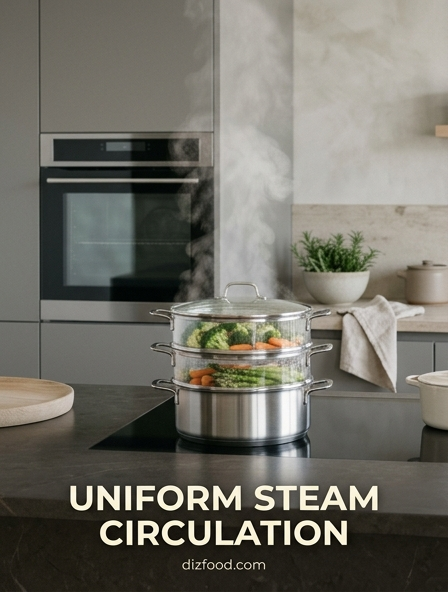
The Science of Uniform Steam Distribution
Uniform steam distribution is rooted in the principles of thermodynamics and fluid dynamics within a confined culinary environment. When water reaches its boiling point, it transitions into a gaseous state, carrying significant latent heat. For professional-grade results, this vapor must be managed to ensure it reaches every surface of the food simultaneously. Without controlled circulation, "cold spots" can emerge, leading to uneven cooking where one side of a protein is overdone while the center remains raw.
Effective systems utilize specific chamber geometries and ventilation patterns to create a pressurized environment. This pressure forces the steam to move in a predictable, cyclonic fashion. By maintaining a constant flow, the kinetic energy of the water molecules is transferred more efficiently to the food. This scientific approach eliminates the reliance on luck, ensuring that the thermal energy is applied with mathematical precision across all cooking racks.
- Thermal Equilibrium: Balancing temperature across the entire chamber.
- Vapor Pressure: Ensuring the steam penetrates the surface of dense ingredients.
- Convection Currents: Utilizing the natural rise and fall of heated air to move steam.
- Condensation Management: Preventing water droplets from pooling on food surfaces.
Preserving Essential Nutrients Through Circulation
Traditional cooking methods, particularly boiling, often result in the leaching of water-soluble vitamins and minerals into the cooking liquid. Uniform steam circulation offers a superior alternative by surrounding food with a gentle, moist heat that does not require immersion. This process is particularly beneficial for preserving Vitamin C, B-complex vitamins, and delicate antioxidants that are sensitive to both high heat and excessive water contact.
Because the steam is distributed evenly, the cooking time is significantly reduced. Shorter exposure to heat further protects the molecular integrity of the nutrients. When steam circulates freely, it creates a protective envelope around the food, maintaining the internal cellular structure. This ensures that the nutrients stay locked within the fiber of vegetables and the tissues of lean proteins. Professional chefs prefer this method because it delivers a product that is not only aesthetically pleasing but also nutritionally dense. By optimizing the airflow, the steamer ensures that even the most heat-sensitive phytonutrients remain intact from the outer layer to the core.
Achieving Perfect Texture in Every Bite
Texture is perhaps the most critical indicator of culinary skill, and uniform steam circulation is the primary tool for achieving consistency. When steam is distributed poorly, certain areas of the food may become waterlogged and mushy, while others remain tough or fibrous. A consistent flow of vapor ensures that the hydration levels are balanced throughout the cooking process, resulting in a firm yet tender mouthfeel.
- Structural Integrity: Steam supports the cellulose in vegetables, keeping them crisp.
- Protein Denaturation: Gentle heat prevents meat fibers from tightening too quickly.
- Starch Gelatinization: Grains and dumplings achieve a uniform fluffiness without sticking.
- Moisture Equilibrium: Prevents the exterior from drying out before the interior is cooked.
By controlling the movement of steam, kitchens can reproduce gourmet results every time. For delicate items like fish or dim sum, the uniformity of the steam prevents the breaking of fragile surfaces. The result is a professional finish where every portion served to a guest possesses the exact same structural quality and textural appeal.
How Airflow Impacts Steaming Consistency
The movement of air within a steamer is just as important as the temperature of the steam itself. In an enclosed environment, stagnant steam loses its energy quickly as it encounters cooler food surfaces. Active airflow mechanisms, such as internal fans or strategically placed vents, ensure that "spent" steam is replaced by fresh, high-energy vapor. This constant replenishment is what defines modern high-performance steaming technology.
Without proper airflow, the steam tends to rise to the top of the chamber, leaving the lower racks undercooked. This is known as stratification. To combat this, precision engineering focuses on directing the air in a path that intercepts every layer of the cooking basket. By breaking up the boundary layer of air surrounding the food, the steam can transfer its heat much faster. This dynamic movement also helps in evacuating excess moisture that could otherwise lead to soggy results. Ultimately, the synergy between air velocity and vapor density dictates the speed and uniformity of the entire steaming cycle, making airflow the silent hero of the kitchen.
Maximizing Heat Efficiency for Better Results
Heat efficiency in the kitchen is not just about saving energy; it is about the speed and quality of the cooking process. Uniform steam circulation maximizes the transfer of latent heat, which is the energy released when steam condenses back into water on the food's surface. This transition is incredibly efficient compared to dry air roasting or pan frying. By ensuring the steam is distributed evenly, the appliance uses less water and less electricity to achieve the desired core temperature.
| Method | Heat Transfer Efficiency | Consistency Level |
|---|---|---|
| Conventional Boiling | Medium | High (but leaches flavor) |
| Standard Steaming | Medium-High | Variable |
| Uniform Circulated Steam | Excellent | Superior |
When the heat is applied uniformly, there is no need for "buffer time" to allow heat to conduct from overcooked outer layers to the center. This precision reduces the overall energy footprint of the kitchen while increasing the throughput of the cooking line.
The Secret to Vibrant Vegetable Colors
The visual appeal of a dish is often judged by the vibrancy of its colors, particularly the deep greens of chlorophyll-rich vegetables. Uniform steam circulation plays a pivotal role in "setting" these colors. When vegetables are exposed to erratic temperatures or submerged in boiling water, their acids are released and react with the chlorophyll, turning it a dull olive-drab color. High-velocity, uniform steam quickly neutralizes surface enzymes and stabilizes the pigments.
Because the steam circulates so effectively, the vegetables reach the "blanching" point almost instantaneously across the entire batch. This rapid heat-up period locks in the natural color molecules before they have a chance to degrade. Additionally, the lack of oxygen in a steam-saturated environment prevents oxidation, which can brown certain vegetables like artichokes or cauliflower. A kitchen equipped with proper steam circulation can produce plates that look as fresh as the raw ingredients themselves, providing a gourmet aesthetic that signals health and freshness to the consumer. This consistent application of heat is the only way to ensure every floret of broccoli is identical in hue.
Uniform Steam vs Traditional Boiling Methods
While boiling has been a household staple for centuries, it is often destructive to the delicate balance of flavor and texture. Uniform steam circulation represents an evolution in cooking technology that addresses the shortcomings of immersion. In boiling, the turbulent movement of water can physically damage soft foods, and the high volume of water dilutes the natural essence of the ingredients. In contrast, steaming maintains the physical and chemical profile of the food.
- Flavor Retention: Steaming keeps natural salts and sugars inside the food.
- Water Usage: Steamers use a fraction of the water required for boiling.
- Safety: There is less risk of splashing or boil-overs with contained steam.
- Speed: Steam reaches temperature faster than a large pot of water.
The primary advantage of uniform circulation over boiling is the elimination of the "washed out" taste. By using vapor instead of liquid, the kitchen preserves the inherent character of the produce or protein. This makes uniform steam the preferred choice for high-end culinary applications where the quality of the ingredient is the star of the show.
Precision Engineering for Gourmet Steaming
Modern steamers are masterpieces of precision engineering, designed to manipulate gas behavior for culinary perfection. Engineers focus on the "baffle" design and the curvature of the interior walls to eliminate turbulence that could lead to dead zones. Every angle is calculated to ensure that as the steam enters the chamber, it is diverted into a series of micro-currents that wrap around the food containers. This level of detail is what separates a standard home appliance from a professional gourmet tool.
Materials also play a significant role. High-grade stainless steel is often used not just for durability, but for its thermal properties which help maintain a consistent internal temperature. Sensors within these advanced systems monitor the humidity and temperature in real-time, adjusting the steam generation to compensate for any fluctuations. This automated feedback loop ensures that the circulation remains uniform regardless of how much food is placed in the steamer. For the chef, this means they can load the machine to its maximum capacity without worrying about a drop in performance or an uneven cook.
Retaining Flavor and Moisture Naturally
One of the most significant challenges in cooking is preventing the loss of moisture. Traditional dry-heat methods, like baking or grilling, evaporate the internal juices of the food. Uniform steam circulation solves this by creating a high-humidity environment where moisture loss is physically impossible. In fact, steaming can actually enhance the moisture content of certain starches and proteins, leading to a much juicier final product.
- Atmospheric Saturation: The air is so full of moisture that it cannot pull water from the food.
- Flavor Concentration: Natural aromatics are not carried away by dry air.
- Fat Reduction: No oils are needed to keep the food moist, resulting in a cleaner flavor.
This natural retention of flavor means that chefs can use fewer seasonings and sauces, allowing the true taste of the ingredient to shine. When the steam is distributed uniformly, this moisture retention is consistent throughout the entire batch. Whether it is a piece of salmon or a simple carrot, the result is a succulent, flavor-packed bite that hasn't been compromised by harsh cooking environments.
Advanced Techniques for Consistent Vapor Flow
To master uniform steam circulation, one must understand the advanced techniques used to manage vapor flow. One such technique is "pulse steaming," where steam is injected into the chamber in timed bursts to prevent the air from becoming too heavy or stagnant. This keeps the vapor energized and moving. Another technique involves the use of perforated trays with specific hole patterns that are designed to harmonize with the steamer's internal airflow, ensuring that steam doesn't just hit the bottom of the tray but moves through it.
Chefs also utilize multi-stage steaming, starting with high-pressure circulation to sear the exterior with heat, followed by a lower-velocity flow to finish the cooking process gently. This prevents the outer layers from becoming over-saturated while ensuring the core is perfectly done. By understanding how to manipulate these flows, a kitchen can handle diverse ingredients-from dense root vegetables to airy soufflés-simultaneously. Consistent vapor flow is the backbone of a high-efficiency kitchen, providing the reliability needed for complex menu execution and large-scale catering without sacrificing the artisanal quality of the food.

Comments