
Choosing between the expansive flow of an open-concept kitchen and the focused efficiency of a galley layout often dictates the social rhythm of your home. If you thrive on being the center of the action, an open-concept layout acts as a communal hub, allowing you to prep appetizers while staying fully engaged with guests in the living area. On the other hand, the galley kitchen offers a sophisticated "chef's sanctuary," favoring intimacy and high-performance ergonomics that keep the culinary magic-and the inevitable cleanup-tucked away from view. Whether you prefer a high-energy, multi-functional party space or a private, rhythmic environment for focused hosting, understanding how these layouts influence movement and noise is key to aligning your kitchen's architecture with your unique entertaining style.
| Feature | Open Concept Hosting | Galley Kitchen Intimacy |
|---|---|---|
| Spatial Dynamic | Seamless flow; integrates with living/dining. | Compact, corridor-style; maximizes verticality. |
| Social Interaction | High; host remains part of the conversation. | Focused; ideal for one-on-one "helper" chats. |
| Workflow | Dispersed; requires more steps between zones. | Highly ergonomic; everything within arm's reach. |
| Visual Privacy | Low; prep mess and dishes are always visible. | High; conceals clutter from the main guest area. |
| Aroma & Noise | Spreads quickly; requires high-CFM ventilation. | Contained; minimizes sensory bleed to other rooms. |
| Best For | Large parties, families, and casual buffets. | Formal dinner prep and precision cooking. |
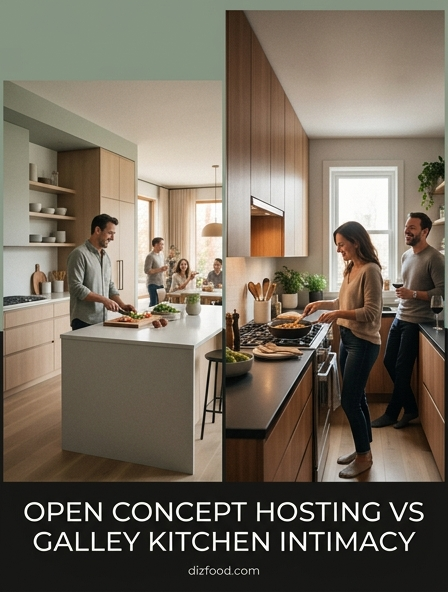
Open Concept vs Galley Kitchen Hosting Styles
The debate between open concept and galley kitchen layouts often centers on the fundamental philosophy of domestic life. In an open concept design, the kitchen acts as a stage, integrated seamlessly with the living and dining areas. This layout prioritizes visibility and collective engagement, allowing the host to remain part of the conversation while preparing meals. It is a style that favors transparency, where the clatter of pans and the sizzle of the stove become part of the ambient soundtrack of the gathering.
Conversely, the galley kitchen offers a more structured and secluded environment. Characterized by two parallel runs of cabinetry and countertops, this layout is designed for maximum utility and concentration. In a hosting scenario, the galley kitchen creates a boundary between the "back of house" preparation and the "front of house" enjoyment. This separation allows the host to focus entirely on the culinary craft without the pressure of an audience, often resulting in a more polished final presentation for the guests.
| Feature | Open Concept | Galley Kitchen |
|---|---|---|
| Visibility | High; integrated with living space | Low; tucked away or secluded |
| Social Dynamics | Interactive and communal | Focused and intimate |
| Mess Management | Visible to all guests | Easily hidden from view |
| Acoustics | Shared with the whole room | Contained within the workspace |
The Social Advantages of Open Concept Living
Open concept living has transformed the modern home into a democratic space where barriers are removed to foster togetherness. The most significant social advantage is the elimination of "host isolation." In traditional layouts, the individual responsible for the meal often spends hours away from the group, missing out on jokes, stories, and the general flow of the evening. Open designs ensure that the cook is always a participant in the social event, bridging the gap between labor and leisure.
- Encourages "grazing" styles of entertaining where guests can sample food as it is prepared.
- Creates a versatile environment where children can be supervised during meal prep.
- Maximizes natural light by allowing windows from different sides of the house to share illumination.
- Provides ample space for multiple people to assist in the cooking process without crowding.
- Facilitates a smoother transition from appetizers to the main course.
Furthermore, the absence of walls makes the home feel significantly larger and more inviting. Guests feel more comfortable moving around, as there are no narrow corridors to navigate. This fluidity is particularly beneficial for large parties, where people naturally congregate around a kitchen island or peninsula. The kitchen becomes the hearth of the home, serving as a hub for communication and connection that transcends the mere function of food preparation.
Creating Culinary Focus in a Galley Kitchen
While open spaces celebrate the social aspect of cooking, the galley kitchen is a sanctuary for the serious culinary enthusiast. The narrow, focused layout minimizes the number of steps required to move between the refrigerator, sink, and stove. This efficiency allows for a high degree of concentration, which is essential when executing complex recipes or multi-course meals. For those who view cooking as a precise art form, the galley provides a controlled environment free from the distractions of external social stimuli.
- Zoning the workspace to ensure that prep and cleanup do not overlap.
- Utilizing vertical storage to keep countertops clear for ingredient preparation.
- Implementing task lighting that highlights the specific work zones without glare.
- Restricting foot traffic to ensure the cook has an unobstructed path.
- Focusing on high-performance ventilation to manage heat and odors within the small space.
The intimacy of a galley kitchen also allows the cook to develop a deep rhythm. With everything within arm's reach, the process of cooking becomes more ergonomic and less physically taxing. This "cockpit" style of design is preferred by many professional chefs because it prioritizes the workflow above all else. When hosting, this focus translates into better-timed meals and a more controlled kitchen environment, ensuring that the host can deliver a high-quality experience without the chaos of a crowded open-plan area.
Entertaining Guests in Seamless Open Spaces
Entertaining in an open-concept kitchen requires a unique approach to organization and presentation. Because the kitchen is fully visible to guests, the aesthetic appeal of the space must be maintained even during the height of preparation. Seamless integration often involves using high-end materials that match the living room decor, such as custom cabinetry that resembles furniture or hidden appliances that blend into the wall. This visual continuity ensures that the kitchen does not feel like a utility zone, but rather an extension of the entertaining area.
The heart of this experience is typically a large central island. This feature acts as a natural gathering point, offering a place for guests to rest their drinks or help with light tasks like chopping vegetables or pouring wine. To make the most of this, hosts often set up "stations" on the island-a cheese board at one end, a wine chiller at the other-to direct the flow of guests away from the active cooking zones. This keeps the party lively without compromising the safety or efficiency of the cook.
However, the open nature also means that noise management is crucial. Choosing quiet dishwashers and high-powered but silent range hoods is essential to prevent the sounds of the kitchen from drowning out conversation. When executed correctly, the open kitchen allows for a theatrical style of hosting where the preparation of a meal becomes an interactive performance that delights the guests and reinforces the bond between host and visitor.
The Efficiency and Intimacy of Galley Layouts
The galley kitchen, named after the narrow kitchens on ships and planes, is a masterclass in spatial efficiency. By utilizing two parallel walls, it eliminates dead space and ensures that every square inch is used for storage or workspace. This layout is particularly advantageous in smaller homes or urban apartments where space is at a premium. Despite their compact nature, galley kitchens can feel incredibly luxurious when finished with high-quality materials and thoughtful lighting, creating an intimate atmosphere that larger spaces often lack.
- Reduced "work triangle" distance, making it easier to pivot between tasks.
- Clearly defined boundaries that prevent guests from accidentally wandering into a hot stove area.
- Superior organization potential through the use of back-to-back cabinetry.
- Lower renovation costs due to a smaller footprint and less flooring material required.
- A cozy, "hidden gem" feel that makes the cooking process feel like a private ritual.
Intimacy in a galley kitchen is not just about the size; it is about the feeling of being tucked away. For some hosts, this provides a much-needed break from the social pressure of a party. They can retreat to the kitchen for a few minutes to finish a sauce or plate a dessert, enjoying a moment of quiet before re-entering the social fray. This separation can actually make the time spent with guests more meaningful, as the host is not distracted by the logistical details of the kitchen while they are in the dining room.
Choosing Your Kitchen Layout for Better Socializing
Selecting between an open concept and a galley kitchen depends heavily on your personal hosting style and the personality of your household. If you are someone who thrives on energy and wants to be the center of the action, the open concept is the natural choice. It supports a casual, "come as you are" vibe that is perfect for modern life. On the other hand, if you prefer a more formal dining experience where the meal is presented as a finished product, a galley kitchen might be more aligned with your goals.
| Consideration | Choose Open Concept If... | Choose Galley If... |
|---|---|---|
| Guest Interaction | You want guests to help or watch you cook. | You prefer guests to relax in the lounge. |
| Household Size | You have a large family or entertain big groups. | You live in a smaller space or cook solo. |
| Tidiness Level | You don't mind guests seeing a bit of mess. | You want to hide dirty dishes until later. |
| Sound Control | You like a lively, loud atmosphere. | You value a quiet dining environment. |
Ultimately, the best layout is the one that makes you feel most comfortable as a host. Some people find the openness of a modern floor plan overwhelming, feeling that they can never truly "turn off" the kitchen work. Others find the walls of a galley kitchen claustrophobic and isolating. By analyzing your past hosting experiences, you can identify which environment allows you to be the most relaxed and engaging version of yourself for your guests.
Maximizing Workflow in Galley Kitchen Designs
To make a galley kitchen truly effective for hosting, one must master the art of the workflow. The goal is to create a seamless line of production that prevents backtracking or congestion. This starts with the logical placement of the primary work centers: the refrigerator for storage, the sink for preparation, and the stove for cooking. In a well-designed galley, these three points form a tight triangle or a linear progression that allows the cook to move fluidly from one stage of meal preparation to the next.
- Group similar items together, such as keeping all baking supplies in one section of the cabinetry.
- Install pull-out pantry shelves to maximize depth and accessibility.
- Use a "one-in, one-out" policy for counter appliances to maintain workspace.
- Incorporate a small prep sink if the main sink is often occupied by dirty dishes.
- Ensure the "through-traffic" path is wide enough for one person to pass the cook safely.
Lighting also plays a critical role in workflow. Because galley kitchens can sometimes feel dark, installing under-cabinet LEDs and bright overhead pendants can make the space feel larger and safer. Additionally, choosing a light color palette for the walls and cabinetry can help bounce light around, reducing the "tunnel" effect. When the workflow is optimized, a galley kitchen can handle surprisingly large volumes of food prep, making it a powerhouse for dinner parties and holiday meals despite its narrow footprint.
Modern Hosting Trends Open Concept vs Galley
Current design trends are seeing a fascinating hybrid approach to the open versus galley debate. Many homeowners are now opting for the "broken plan" layout, which uses partial walls, glass partitions, or different floor levels to define the kitchen space without completely walling it off. This provides the visual spaciousness of an open concept while maintaining some of the architectural boundaries of a galley. It allows for a balance between the social benefits of visibility and the practical benefits of sound and smell containment.
Another rising trend is the "dirty kitchen" or prep scullery. In this scenario, the main kitchen remains open and aesthetically perfect for guests, featuring a beautiful island and minimal appliances. Meanwhile, a secondary, smaller galley-style kitchen is hidden behind a door. This is where the heavy lifting happens-the frying, the dishwashing, and the mess. This trend acknowledges that while we love the idea of open living, the reality of a working kitchen can be messy and noisy, and having a dedicated space to hide that reality is the ultimate luxury for modern hosts.
Smart home technology is also influencing these trends. Integrated systems can now control lighting scenes and sound zones independently. For an open kitchen, this means the host can dim the kitchen lights while keeping the dining area bright, effectively "hiding" the prep mess in the shadows once the meal is served. These innovations are making both layouts more versatile, allowing hosts to tailor their environment to the specific needs of each event.
The Cozy Appeal of Private Kitchen Spaces
There is a growing movement back toward private kitchen spaces, driven by a desire for intimacy and a "retreat" from the constant connectivity of modern life. A private kitchen offers a sense of enclosure that can be incredibly comforting. It is a place where the family can gather for a quiet breakfast without the distraction of the television or the sight of the living room's clutter. For a host, this privacy provides a dedicated zone where they can be creative and messy without any judgment from their guests.
- The ability to close the door on smells like fish, garlic, or deep-frying.
- A reduction in the transmission of noise from appliances like blenders and mixers.
- The opportunity for more adventurous wall colors and decor that doesn't have to match the rest of the house.
- More wall space for cabinets, spice racks, and hanging pot rails.
- A clear psychological distinction between "work time" and "relax time."
For guests, being invited into a private kitchen can feel like a special privilege. It is an invitation to the "inner sanctum" of the home. During a party, a few guests might drift into the kitchen for a private conversation away from the main group, creating those small, memorable moments of connection that are often lost in large, open spaces. The private kitchen isn't just about utility; it's about the charm of a space dedicated solely to the craft of nourishment and the warmth of a contained hearth.
Impact of Kitchen Design on Guest Experience
The layout of your kitchen profoundly influences the psychological experience of your guests. In an open-concept home, guests often feel more like participants. They are witnesses to the effort that goes into the meal, which can lead to a deeper appreciation for the food and a more relaxed, informal atmosphere. The lack of physical barriers encourages movement and interaction, making the evening feel dynamic and energetic. However, if the kitchen is overly cluttered or noisy, it can also lead to a sense of sensory overload for some guests.
In contrast, a home with a galley or private kitchen often provides a more structured and tranquil guest experience. When the host emerges from the kitchen with a platter of food, there is a sense of occasion and "reveal" that is missing from open-plan living. Guests can focus entirely on the conversation and the ambiance of the dining area without being distracted by the logistics of the meal. This often results in a more sophisticated and traditional hosting style, where the focus is on the hospitality and the final presentation.
Ultimately, whether through the inclusive energy of an open space or the refined focus of a galley, the kitchen's design sets the tone for the entire evening. A well-designed kitchen that suits the host's personality ensures that they are at their best, which in turn makes the guests feel more at ease. By understanding the strengths and weaknesses of each layout, homeowners can create a space that not only functions perfectly for daily life but also elevates every social gathering into a memorable experience.

Comments