
If you're looking to swap heavy pasta for nutrient-dense "zoodles," choosing between a vegetable spiralizer and a julienne peeler is the first step toward mastering low-carb cooking. While both tools transform humble root vegetables into healthy noodles, they offer very different experiences: the spiralizer is a powerhouse designed for volume and variety, creating long, curly ribbons that mimic spaghetti perfectly, whereas the julienne peeler is a compact, budget-friendly hero ideal for quick garnishes and small batches. Whether you have a spacious kitchen and a love for meal prepping or a tiny apartment where every inch of drawer space counts, understanding the trade-offs in speed, texture, and versatility will help you pick the ultimate tool for your plant-based lifestyle.
| Feature | Vegetable Spiralizer | Julienne Peeler |
|---|---|---|
| Noodle Style | Long, continuous spirals & curls | Straight, thin "matchstick" strips |
| Versatility | Multiple blades (ribbons, linguine, etc.) | Fixed width; single cutting style |
| Speed & Effort | High-speed crank; processes whole veg fast | Manual strokes; slower for large quantities |
| Storage | Bulky; requires counter or shelf space | Compact; fits easily in a utensil drawer |
| Waste Level | Leaves a small "core" of the vegetable | Minimal waste; peels until the end |
| Price Range | $15 - $50 (Manual to Electric) | $5 - $15 (Handheld) |
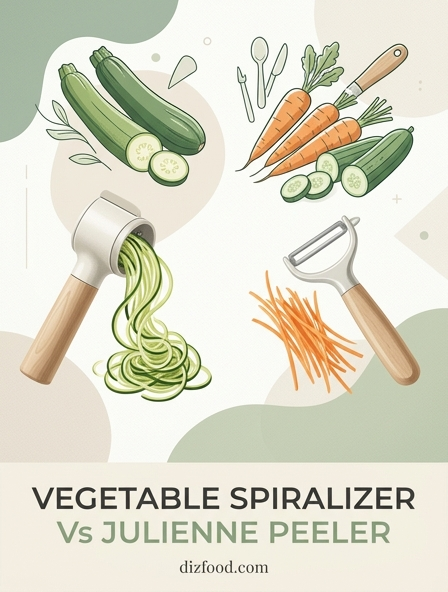
Vegetable Spiralizer vs Julienne Peeler Main Differences
The primary difference between a vegetable spiralizer and a julienne peeler lies in their mechanical design and the physical nature of the output they produce. A vegetable spiralizer is typically a larger, countertop appliance or a specialized handheld cylindrical device that uses a crank or gravity-fed mechanism to rotate vegetables against a fixed blade. This creates continuous, curly strands that resemble traditional pasta shapes like spaghetti or fettuccine. Because the vegetable is rotated, the resulting cuts are often several feet long and have a structural curl that is ideal for replacing grain-based noodles.
In contrast, a julienne peeler is a compact, handheld tool that resembles a standard potato peeler but features a serrated blade with sharp, protruding teeth. Instead of rotating the vegetable, the user pulls the peeler across the surface of the produce in a linear motion. This produces straight, uniform matchsticks rather than curls. The fundamental design differences can be summarized as follows:
- Mechanism: Spiralizers use rotational force; peelers use linear pulling force.
- Output Shape: Spiralizers create long, helical curls; peelers create short, straight strips.
- Stability: Spiralizers are often suctioned to the counter; peelers are entirely dependent on manual grip.
- Versatility: Spiralizers often feature interchangeable blades for different widths; peelers usually have a single fixed blade width.
How a Vegetable Spiralizer Works for Healthy Meals
A vegetable spiralizer works by securing a vegetable between a spiked handle and a circular blade plate. As the user turns the crank, the vegetable is pushed forward while simultaneously rotating. This dual-action motion allows the blades to slice the produce into long, continuous ribbons or "noodles." This tool has become a staple for those following ketogenic, paleo, or gluten-free diets because it transforms dense, low-calorie vegetables like zucchini, butternut squash, and sweet potatoes into "zoodles" or "soodles." These vegetable-based noodles serve as a nutrient-dense vessel for sauces, effectively reducing the caloric load of a meal while increasing fiber intake.
Beyond simply mimicking pasta, the spiralizer encourages the consumption of a wider variety of vegetables by changing their mouthfeel. For example, raw beets or parsnips, which might be unappealing in large chunks, become light and crunchy when spiralized into thin curls. This textural transformation makes it easier to incorporate raw produce into salads or lightly sautéed side dishes. The mechanical efficiency of a spiralizer also ensures that the vegetables cook evenly and quickly, preserving more heat-sensitive vitamins compared to boiling traditional pasta. By automating the cutting process, it allows home cooks to prepare large quantities of "pasta" substitutes in minutes, making healthy meal prep more sustainable for busy lifestyles.
The Benefits of Using a Manual Julienne Peeler
The manual julienne peeler is prized for its simplicity, precision, and portability. Unlike bulkier kitchen gadgets, the julienne peeler offers the cook a high degree of tactile control. This is particularly beneficial when working with smaller or more delicate vegetables, such as a single carrot or a small radish, where a large spiralizer would be overkill or physically unable to grip the produce. The peeler allows for targeted cutting, meaning you can stop exactly where you want, avoiding the "core" of certain vegetables that might be too seedy or watery.
Another significant benefit is the professional aesthetic it provides for garnishes and salads. Because the strips produced are straight and uniform matchsticks, they are the standard for classic culinary presentations like Coleslaw, Asian-style salads, or spring roll fillings. Additionally, the manual nature of the tool means there are no complex parts to assemble or plastic housings that might crack over time. It is a minimalist tool that performs a specific task exceptionally well. For cooks who prefer a "less is more" approach to their kitchen inventory, the julienne peeler provides the necessary functionality for fine cutting without the need for a dedicated countertop footprint or a complex cleaning routine.
Comparing Texture and Shape Spiralizer vs Julienne
Texture and shape play a critical role in how ingredients interact with sauces and how they feel during consumption. Spiralizers are designed for volume and "slurpability." The helical shape creates a spring-like texture that holds onto heavy sauces like pesto or marinara very effectively. Because the strands are continuous, they wrap around a fork just like spaghetti, providing a psychological and physical experience that closely mimics eating traditional pasta. This makes them the superior choice for main-course noodle replacements.
Julienne peelers, however, produce straight, distinct shards. These matchsticks offer a "crunchier" bite because they do not have the structural elasticity of a curl. They are better suited for raw applications where a distinct, snappy texture is desired. In cooked applications, julienne strips tend to lay flat and can clump together if not tossed frequently, whereas spiralized curls remain separated by their natural shape. The following table highlights these physical differences:
| Feature | Vegetable Spiralizer | Julienne Peeler |
|---|---|---|
| Shape | Curls, Helixes, Ribbons | Straight Matchsticks |
| Length | Continuous (often several feet) | Length of the vegetable |
| Thickness | Adjustable (usually 3-6mm) | Fixed (usually 2-3mm) |
| Ideal Use | Pasta substitutes, curly fries | Garnishes, salads, stir-fry |
Kitchen Storage and Space Considerations for Both Tools
For many home cooks, the decision between these two tools comes down to available kitchen real estate. A countertop spiralizer is a significant commitment in terms of space. These units are often the size of a small toaster and require a flat, clear surface for their suction feet to grip effectively. Even "handheld" spiralizers, which are shaped like large hourglasses, occupy about as much space as a large coffee mug. If you have a small kitchen or limited cabinet space, a spiralizer can quickly become a "clutter" item that is buried in the back of a cupboard, leading to less frequent use.
The julienne peeler is the clear winner regarding storage efficiency. It is virtually identical in size to a standard vegetable peeler, meaning it can be tucked into a utility drawer alongside spoons and spatulas without a second thought. It requires zero setup time and can be grabbed and used instantly. For those living in apartments or individuals who value a minimalist kitchen, the julienne peeler provides the ability to create thin vegetable strips without sacrificing a square foot of storage. While the spiralizer offers more versatility in shape, the trade-off is a bulky plastic frame and multiple blade inserts that must be stored safely to prevent accidental cuts or damage to the sharp edges.
Best Vegetables for Spiralizing vs Julienne Peeling
The effectiveness of each tool depends heavily on the structural integrity and shape of the vegetable being used. Spiralizers require vegetables that are relatively straight, firm, and at least 1.5 inches in diameter to be held securely by the spikes. They excel with "sturdy" produce that can withstand the rotational pressure without turning into mush. Conversely, julienne peelers are more flexible with vegetable diameter but require a certain amount of surface area to pull the blade across effectively.
- Best for Spiralizing:
- Zucchini (the gold standard for zoodles)
- Butternut Squash (long necks are perfect)
- Large Sweet Potatoes and Beets
- English Cucumbers (seeded or unseeded)
- Best for Julienne Peeling:
- Carrots (often too thin for many spiralizers)
- Parsnips and Daikon Radish
- Celery Root (peeled first)
- Bell Peppers (using a specific technique)
Vegetables like potatoes work well with both tools, but the end result differs: the spiralizer creates curly fries, while the julienne peeler creates "shoestring" or "matchstick" fries. Generally, if the vegetable is very thin (like a small carrot), the julienne peeler is more efficient. If the vegetable is wide and round (like a beet), the spiralizer is the only way to get long, continuous strands.
Speed and Efficiency in Meal Preparation Comparison
When preparing food for a large group, the spiralizer is significantly faster. Once the vegetable is prepped and loaded, a few turns of the handle can process an entire zucchini in under ten seconds. The continuous feed mechanism means you are cutting hundreds of "noodles" simultaneously. For meal prepping a week's worth of vegetable pasta, a spiralizer can save twenty to thirty minutes of manual labor compared to using a handheld peeler. However, the "hidden" time cost of a spiralizer includes the assembly of the unit and the time spent cleaning the complex blade housing afterward.
The julienne peeler is faster for small, "one-off" tasks. If you only need a handful of carrot strips to top a salad, retrieving, assembling, and then washing a spiralizer is inefficient. With a peeler, you can simply pull it from a drawer, run it over the carrot five or six times, and rinse it under the tap. While it takes more physical effort and more "strokes" to process a large quantity of food, the lack of setup and teardown makes it the more efficient choice for daily, minor tasks. Efficiency is therefore relative to the volume of food: high volume favors the spiralizer, while low volume or garnishing favors the julienne peeler.
Cleaning and Maintenance of Spiralizers and Peelers
Maintenance is often where users grow frustrated with spiralizers. Because the blades have many small crevices and the plastic body can have intricate tracks for the sliding mechanism, food particles often get trapped. If used with colorful vegetables like beets or carrots, the plastic components can stain quickly if not washed immediately. Most spiralizers are "top-rack dishwasher safe," but the heat of a dishwasher can sometimes warp the plastic over time, and the high-pressure water might not reach into the tiny needle-blades. Manual cleaning usually requires a dedicated brush to safely scrub the blades without cutting one's fingers.
Julienne peelers are significantly easier to maintain. They are typically made of stainless steel or high-quality plastic with a single blade attachment. They can be rinsed under a hot tap or thrown into the silverware caddy of a dishwasher without concern for space or warping. Because they are smaller and have fewer moving parts, there are fewer places for bacteria to hide. In terms of longevity, the blades on a julienne peeler will eventually dull and are rarely replaceable, requiring the purchase of a new tool. Many countertop spiralizers, however, come with replaceable blade plates, meaning the main unit can last for years even if one specific blade loses its edge.
Cost Analysis Which Tool Offers Better Value
From a purely financial perspective, the julienne peeler offers the lowest barrier to entry. A high-quality, professional-grade julienne peeler typically costs between $8 and $15. This makes it an affordable "impulse buy" for anyone looking to experiment with vegetable shapes. Because of its durability and multi-use nature (it can often double as a standard peeler if you are careful), the value per dollar is exceptionally high. It is a low-risk investment for a tool that can last several years in a home kitchen.
Vegetable spiralizers represent a larger investment, ranging from $20 for basic handheld models to $50 or more for heavy-duty countertop versions with multiple blades. While the initial cost is higher, the "value" is found in the tool's ability to replace expensive pre-cut "zoodles" found in grocery stores. Pre-packaged spiralized vegetables often cost three to four times more than the whole vegetable. If a household consumes vegetable pasta twice a week, a $30 spiralizer can pay for itself in less than a month through grocery savings. Therefore, the peeler is the better value for occasional garnishing, while the spiralizer is the better financial investment for those committed to a high-volume vegetable-based diet.
Final Verdict Choosing the Best Tool for Your Kitchen
The decision between a vegetable spiralizer and a julienne peeler should be based on your primary culinary goals and your kitchen habits. If your main objective is to replace traditional pasta with a healthy, low-carb alternative, the vegetable spiralizer is the indispensable choice. Its ability to create long, curly, "slurpable" strands cannot be replicated by a peeler. It is the better tool for families and those who do heavy meal prepping, provided they have the cabinet space to store it and the patience to clean its various components.
On the other hand, if you are looking for a tool to enhance salads, create beautiful garnishes, or prepare ingredients for stir-fries and spring rolls, the julienne peeler is the superior option. Its compact size, ease of cleaning, and precision make it a more practical everyday tool for the average cook. It is also the better choice for those on a tight budget or those with limited kitchen storage. Many seasoned cooks find that there is room for both: the peeler for quick daily additions and the spiralizer for specialized, health-focused dinners. Ultimately, the best tool is the one that fits your most frequent cooking style.

Comments