
Choosing between a silicone popcorn maker and a glass microwave popper can be the difference between chewy kernels and that perfect movie-theater crunch. Silicone bowls are the champions of convenience, offering a collapsible, unbreakable design that is ideal for busy families or those with limited cabinet space. On the other hand, glass poppers-typically crafted from premium borosilicate-are the purists' choice, providing superior heat distribution and a non-porous surface that ensures your snacks remain free from any lingering plastic scents or chemical aftertastes. Whether you prioritize the "toss-and-go" durability of food-grade silicone or the sophisticated, BPA-free elegance of glass, picking the right tool ensures your movie night snacks are healthy, fluffy, and consistently delicious.
| Feature | Silicone Popcorn Maker | Glass Microwave Popper |
|---|---|---|
| Durability | Unbreakable; flexible food-grade material. | Fragile; prone to cracking if dropped. |
| Storage | Collapsible; saves 50-70% shelf space. | Rigid and bulky; requires careful handling. |
| Heat Source | High-heat resistant; cools quickly to touch. | Superior heat retention; stays hot longer. |
| Flavor Purity | Generally good; potential for scent absorption. | Non-porous; preserves 100% natural flavor. |
| Safety | BPA-free; safe for kids to handle. | Thermal-shock resistant; no chemical leaching. |
| Cleaning | Dishwasher safe; easy to flip inside out. | Dishwasher safe; residue wipes off easily. |
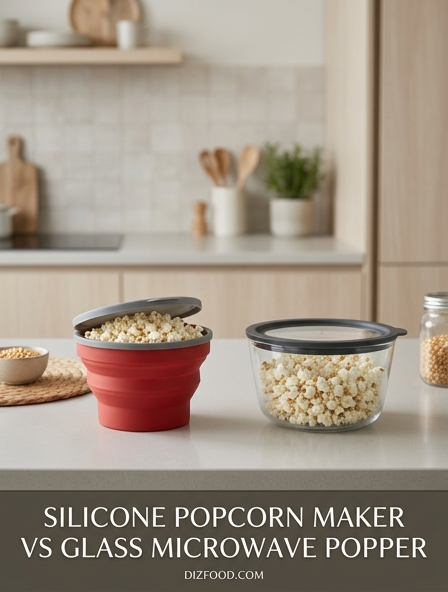
Durability and Material Comparison
The fundamental difference between silicone and glass microwave poppers lies in their structural resilience. Silicone models are manufactured from food-grade, BPA-free polymers that offer an almost indestructible profile. These units are highly flexible, meaning they can be dropped from counter height onto hard tile without any risk of fracture or structural failure. This makes them an ideal choice for households with children or high-traffic kitchens where accidents are common. The material is rated to withstand temperatures up to 450 degrees Fahrenheit, ensuring it does not degrade during the intense heat of a microwave cycle.
In contrast, glass poppers typically utilize borosilicate glass, a specialized material known for its low coefficients of thermal expansion. This allows the glass to transition from a cool pantry to a hot microwave without shattering from thermal shock. While glass offers a premium, crystal-clear aesthetic that allows you to watch the kernels pop, its primary drawback is brittleness. A single drop or a hard impact against a granite edge can lead to immediate breakage. While glass is more "permanent" in terms of chemical stability, silicone is more "permanent" in terms of physical survival.
| Feature | Silicone Popper | Glass Popper |
|---|---|---|
| Impact Resistance | High (Unbreakable) | Low (Fragile) |
| Temperature Stability | Excellent | Very High (Thermal Glass) |
| Visual Clarity | Opaque/Translucent | Transparent |
Storage Efficiency and Collapsible Designs
Space management is a critical factor for modern kitchen organization, and this is where silicone poppers hold a distinct advantage. Most silicone models are designed with a concertina-style body, allowing the entire vessel to collapse into a flat disc. This design reduces the vertical footprint by nearly 70%, enabling the popper to be tucked into narrow drawers or stacked under other bowls. For those living in apartments or tiny homes with limited cabinetry, the ability to shrink a large-capacity bowl into a two-inch-thick profile is a significant convenience.
Glass poppers, by necessity, are rigid and bulky. Because they cannot be folded or compressed, they require a dedicated space in the cupboard equivalent to a medium-sized mixing bowl or a small kettle. Furthermore, because glass is prone to chipping, you cannot easily stack heavy cast-iron pans or metal bowls on top of them. This makes glass poppers more demanding in terms of kitchen real estate. Users must decide if the visual appeal of glass outweighs the logistical hurdle of storing a non-collapsible, fragile item.
- Silicone: Collapses to ~2 inches for drawer storage.
- Glass: Requires full-height shelf space (~6-8 inches).
- Stacking: Silicone can be compressed; glass must be handled with care.
- Weight: Silicone is lightweight and portable; glass is heavier and stationary.
Health Safety and Chemical Profiles
When heating materials to high temperatures in a microwave, chemical leaching is a primary concern for many consumers. Glass is widely regarded as the "gold standard" for health safety. Being an inert material, borosilicate glass does not react with oils, salts, or kernels, and it contains zero plasticizers or synthetic additives. There is no risk of BPA, BPS, or phthalates migrating into your food, even after years of repeated use. For those who prioritize a chemical-free lifestyle, glass provides total peace of mind.
Silicone is also considered a safe alternative to traditional plastics, provided it is "platinum-cured" and 100% food-grade. High-quality silicone does not contain the toxic fillers found in cheap plastic microwave bags. However, consumers must be vigilant about the quality of the silicone; "filler" materials can sometimes produce odors or smoke when heated. While reputable silicone poppers are FDA-approved and BPA-free, they are still a synthetic polymer. Most health experts agree that both materials are significantly safer than pre-packaged microwave popcorn bags, which often contain PFOAs and artificial flavorings.
- Ensure silicone is labeled "100% Food Grade" to avoid fillers.
- Glass is naturally inert and requires no special certifications for safety.
- Both materials eliminate the need for the chemical linings found in disposable bags.
- Both options are generally PFOA-free.
Popping Speed and Kernel Efficiency
The physics of heat distribution determines how quickly kernels pop and how many "old maids" (unpopped kernels) are left at the bottom of the bowl. Glass poppers tend to excel in heat retention. The glass walls heat up and hold that thermal energy, creating a mini-oven effect inside the microwave. This often results in a faster popping cycle and a higher percentage of popped kernels, as the radiant heat from the glass helps reach the popping threshold more consistently.
Silicone, while an excellent insulator, does not retain heat in the same way glass does. It acts more as a container than a heat-radiator. In many tests, silicone poppers require 15 to 30 seconds longer to finish a batch compared to glass. Additionally, because the bottom of a silicone popper is often more flexible, kernels can sometimes settle into the corners and fail to reach the necessary temperature to pop. However, silicone poppers often feature a concentrated base design to mitigate this issue. Efficiency is generally high for both, but glass has a slight edge in speed due to its thermal properties.
Cleaning Convenience and Dishwasher Safety
Both silicone and glass popcorn makers are marketed as dishwasher safe, but the daily cleaning experience differs. Glass is exceptionally easy to clean because of its non-porous surface. Popcorn oil, butter, and seasonings slide off easily with standard dish soap. Even if you burn a batch of popcorn, the residue can usually be scrubbed off the glass with a bit of soaking. Glass does not retain odors, so a batch of "extra garlic" popcorn won't affect the flavor of the plain batch you make the next day.
Silicone is also dishwasher safe, but it has a tendency to retain a "greasy" feel if not washed with a high-quality degreaser. Because silicone is slightly porous at a microscopic level, it can absorb oils over time. Some users report that silicone bowls can take on a faint scent of old oil or dish soap if they are not rinsed thoroughly. However, the flexibility of silicone makes it easy to flip inside out to scrub the corners, which is something you cannot do with a rigid glass vessel. For the best results with silicone, a top-rack dishwasher cycle is recommended to prevent the material from picking up odors from other dirty dishes.
| Factor | Silicone | Glass |
|---|---|---|
| Surface Type | Slightly Porous | Non-Porous |
| Oil Retention | Can feel greasy | Rinses clean |
| Odor Resistance | Moderate | Excellent |
Flavor Purity and Heat Distribution
Flavor purity is often the deciding factor for culinary enthusiasts. Glass is non-reactive, meaning it does not impart any flavor of its own to the popcorn. This results in a "cleaner" tasting snack that highlights the natural nuttiness of the corn and the quality of the butter used. Because glass heats evenly across its entire surface, the kernels are less likely to experience localized "hot spots" that can cause scorching or a burnt aftertaste in specific areas of the bowl.
Silicone can occasionally influence the flavor profile, especially if the product is new or contains low-quality fillers. New silicone poppers may emit a slight "plastic" smell during the first few uses, though this usually dissipates after a thorough washing and a few heat cycles. In terms of heat distribution, silicone is effective but depends heavily on the microwave's turntable. Since silicone doesn't reflect or radiate heat as intensely as glass, the kernels rely almost entirely on the microwave's friction-based heating. This can lead to slightly more uneven browning if the microwave has inconsistent power delivery.
- Glass: Best for "pure" flavor without synthetic interference.
- Silicone: May require a "break-in" period to remove manufacturing odors.
- Heat: Glass creates a more consistent radiant heat environment.
- Seasoning: Both allow for oil-free popping, preserving flavor.
Handling Safety and Burn Prevention
Safety during the transition from microwave to couch is a major differentiator. Glass poppers become extremely hot during the 2-4 minute popping cycle. The glass body and the lid can reach temperatures capable of causing significant burns. Most glass models include a plastic or silicone handle, but users must still exercise caution and often use oven mitts to safely retrieve the unit. The steam released when opening a glass lid is also very concentrated, posing a risk to the face and hands.
Silicone poppers are much safer to handle. While the popcorn inside is hot, silicone itself does not conduct heat as efficiently as glass, meaning the handles or the top rim stay relatively cool to the touch. Many silicone models feature built-in tabs that allow you to lift the bowl without any protective gear. Furthermore, silicone lids are usually lightweight and flexible, allowing steam to escape gradually through the edges rather than in one dangerous burst. This "cool-touch" property makes silicone the superior choice for families where children might be helping with snack preparation.
- Use oven mitts for all glass poppers to avoid thermal burns.
- Silicone handles generally remain safe for bare-hand contact.
- Vent steam away from the face when peeling back silicone lids.
- Glass units require a heat-safe trivet when placed on coffee tables.
Long Term Durability and Value
Evaluating value requires looking at the lifespan of the product relative to its cost. Silicone poppers typically range from $10 to $20. Given that they cannot be broken by dropping or thermal shock, a single silicone popper could theoretically last a decade or more. The only real threat to silicone is physical damage from sharp knives or the degradation of the polymer if used at extreme temperatures beyond its rating. In terms of "cost per use," silicone is an exceptional investment because the risk of replacement is nearly zero.
Glass poppers are often priced slightly higher, usually between $15 and $30. While glass is chemically more durable and won't stain or absorb odors over time, its physical vulnerability makes it a riskier long-term investment. If you are careful and never drop your kitchenware, a glass popper will maintain its "like-new" appearance indefinitely, whereas silicone might eventually show signs of staining or wear. However, for most households, the "breakability factor" of glass means it is statistically more likely to need replacement sooner than a silicone version. Value is therefore subjective: glass offers aesthetic longevity, while silicone offers functional survival.
Capacity and Serving Size Differences
The physical design of these poppers dictates how much popcorn you can make in a single batch. Silicone poppers are frequently available in large "family sizes," often capable of holding 15 cups of popped corn. Because the material is flexible, the bowls can be quite wide, allowing for a large volume of corn to expand without pushing the lid off. This makes silicone the preferred choice for large groups or families where one small bowl simply isn't enough.
Glass poppers are generally limited by weight and manufacturing constraints. A 15-cup glass vessel would be heavy, unwieldy, and prone to breaking. Consequently, most glass microwave poppers are designed for personal or "date night" portions, typically ranging from 1.5 to 3 quarts (about 6 to 12 cups). While this is sufficient for one or two people, it may require running multiple batches for a larger gathering. If you prioritize high-volume output in a single microwave cycle, silicone designs usually provide the larger capacity options.
| Metric | Silicone (Typical) | Glass (Typical) |
|---|---|---|
| Max Capacity | Up to 15 Cups | Up to 12 Cups |
| Batch Time | 2:30 - 3:30 mins | 2:00 - 3:00 mins |
| Portion Size | Family / Large Group | Personal / Couple |
Final Verdict for Home Movie Nights
The choice between a silicone and glass microwave popper ultimately depends on your lifestyle priorities and kitchen environment. If you live in a household with children, have limited storage space, or prioritize safety and durability, the silicone popper is the undisputed winner. Its collapsible nature and unbreakable construction make it a practical, "set-it-and-forget-it" tool that survives the rigors of a busy home. It is the utilitarian choice that emphasizes ease of use and high-volume output.
However, if you are a popcorn purist who values flavor above all else, the glass popper is the superior option. The inert nature of borosilicate glass ensures the cleanest possible taste, and its superior heat distribution leads to a crispier texture and fewer unpopped kernels. While it requires more careful handling and more storage space, it offers a more "premium" experience and an attractive presentation. For a sophisticated movie night where the quality of the snack is the main event, glass is the way to go. For daily snacking and hassle-free cleanup, silicone remains the practical favorite.
- Choose Silicone for: Small kitchens, families with kids, and maximum durability.
- Choose Glass for: Gourmet flavor, chemical purity, and visual appeal.
- Both: Cost-effective and healthier than store-bought bags.

Comments