
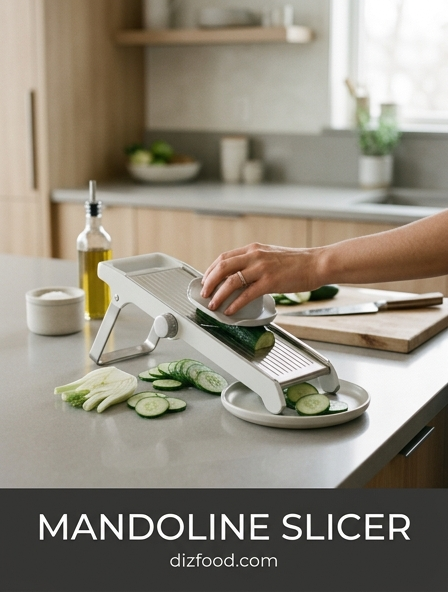
The Power of Precision Slicing
The mandoline slicer stands as a testament to the importance of precision in the modern kitchen. Unlike traditional knife work, which relies heavily on the steadiness of the human hand and years of practice, a mandoline offers a mechanical consistency that is nearly impossible to replicate manually. The primary appeal lies in the ability to achieve paper-thin slices that are uniform in thickness, allowing for delicate presentations and optimized textures. When every slice of a radish or cucumber is exactly one millimeter thick, the ingredient interacts with dressings and seasonings more effectively, creating a harmonious flavor profile.
Achieving this level of precision requires an understanding of the tool's adjustment settings. Most high-end mandolines feature a dial or a set of inserts that control the height of the runway relative to the blade. This control is vital for several reasons:
- It ensures that delicate vegetables do not tear or bruise during the slicing process.
- It allows for the creation of translucent garnishes that elevate the visual appeal of a dish.
- It provides a repeatable standard for recipes that require specific dimensions for textural integrity.
- It reduces waste by utilizing the entire vegetable with minimal off-cuts.
Speed Up Your Meal Prep
For home cooks and professional chefs alike, time is often the most valuable resource. The mandoline slicer is designed specifically to maximize efficiency, turning what would be a twenty-minute chopping task into a two-minute breeze. When preparing dishes that require bulk quantities of sliced ingredients, such as a traditional potato gratin or a large batch of homemade coleslaw, the speed of a mandoline is unmatched. The rapid back-and-forth motion allows for a continuous flow of output, keeping the kitchen workflow moving at a brisk pace.
To fully harness the speed of a mandoline without compromising quality or safety, follow these sequential steps in your preparation routine:
- Wash and dry all produce thoroughly to prevent slipping on the slicer's surface.
- Trim the ends of the vegetables to create a flat surface for better contact with the blade.
- Select the appropriate thickness setting before starting the bulk of the work.
- Use a consistent, fluid motion rather than erratic, high-pressure pushes.
- Empty the catch tray frequently to prevent backlogging and blade obstruction.
Achieving Uniform Vegetable Cuts
Uniformity in vegetable cuts is not merely an aesthetic choice; it is a fundamental requirement for even cooking. When pieces vary in size, the smaller sections often overcook and turn mushy while the larger pieces remain raw or crunchy. The mandoline eliminates this inconsistency by ensuring every piece is identical. This is particularly crucial for root vegetables, which have dense fibers that require specific heat penetration times. By using a mandoline, you ensure that every slice of sweet potato or beet finishes cooking at the exact same moment.
The following table illustrates common settings and their typical culinary applications for achieving maximum uniformity:
| Thickness Setting | Common Ingredient | Recommended Dish |
|---|---|---|
| 1.0 mm - 1.5 mm | Potatoes / Beets | Homemade Crisps or Chips |
| 2.0 mm - 3.0 mm | Cucumber / Onion | Salads and Pickling |
| 4.0 mm - 6.0 mm | Zucchini / Eggplant | Grilling or Ratatouille |
Mandoline Safety Best Practices
While the mandoline is an incredibly efficient tool, its razor-sharp blade demands a high level of respect and caution. Safety is the most important aspect of operating this device, as the speed of the slicing action can lead to accidents if the user becomes distracted or negligent. Most accidents occur when the vegetable gets small and the user's fingers get too close to the blade. To mitigate these risks, manufacturers include safety guards, and aftermarket cut-resistant gloves have become a staple for anyone serious about kitchen safety.
Adhering to a strict set of safety protocols will ensure your culinary experience remains productive and injury-free:
- Always use the food holder or safety guard provided with the unit.
- Wear a stainless-steel mesh or high-grade synthetic cut-resistant glove on your dominant hand.
- Maintain a clear, unobstructed workspace to avoid bumping into the slicer during use.
- Never attempt to slice the very last bit of a vegetable by hand; discard it or chop it manually.
- Store the mandoline with the blade in the "locked" or "safe" position when not in use.
Mastering Julienne and Waffle Cuts
Beyond simple flat slices, many mandoline slicers come equipped with specialized blades for julienne and waffle cuts. These "fancy" cuts add a professional dimension to your cooking, introducing varied textures that hold sauces better and provide a more interesting mouthfeel. The julienne blade creates long, thin matchsticks that are perfect for stir-fries, spring rolls, or raw salads. Mastering these techniques requires a slight adjustment in how you handle the produce and the pressure applied to the machine, as the additional teeth of the julienne blade create more resistance.
To achieve the elusive waffle or "crinkle" cut, the process involves a specific rotational technique that is easy to learn with practice:
- Install the wavy or crinkle-cut blade into the mandoline housing.
- Perform the first slice downward as you would for a standard cut.
- Rotate the vegetable 90 degrees before performing the second slice.
- Maintain consistent pressure to ensure the ridges on the top and bottom align correctly.
- Repeat the rotation for every subsequent slice to maintain the pattern.
Versatility Across Every Recipe
The versatility of a mandoline slicer extends far beyond the typical salad preparations. It is a multi-functional tool that can be integrated into almost every category of cooking, from breakfast to dessert. In the morning, use it to create perfectly thin apple slices for oatmeal or uniform potato rounds for a breakfast hash. For dinner, it can shave Brussels sprouts into a fine slaw or slice garlic so thinly that it melts into your pasta sauce. Its ability to handle both hard and soft produce makes it an essential asset for any recipe requiring volume and consistency.
Consider the following ingredients that benefit significantly from the use of a mandoline:
- Firm fruits like pears and apples for tarts and dehydrating.
- Hard cheeses like Parmesan or Manchego for elegant platters.
- Tough aromatics like ginger or lemongrass for infusions.
- Cabbage varieties for quick-pickled garnishes or krauts.
- Citrus fruits for thin wheels used in cocktails or garnishing fish.
Essential Mandoline Blade Attachments
Understanding the anatomy of your mandoline slicer involves recognizing the different blade attachments and their specific functions. Most versatile models feature an interchangeable system that allows the user to swap out the straight blade for specialized options. This modularity is what makes the mandoline a "Swiss Army knife" of the kitchen. While the straight blade is the most frequently used for basic slicing, having access to serrated or julienne inserts opens up a world of culinary creativity. Each blade is designed with a specific bevel and edge to handle the resistance of different food densities.
The table below highlights the most common attachments found in a professional-grade mandoline set:
| Blade Type | Edge Characteristic | Primary Function |
|---|---|---|
| Straight Blade | Flat and Sharp | Standard slicing of firm vegetables. |
| Julienne Blade | Vertical Teeth | Creating matchstick strips and fries. |
| Serrated/Wavy | Fluted Edge | Crinkle cuts and waffle-cut patterns. |
Maintaining Your Slicer for Longevity
A mandoline slicer is a precision instrument, and like any high-quality tool, it requires proper maintenance to function at its peak for years. The blades are the most critical component, and keeping them sharp and clean is essential for both performance and safety. A dull blade requires more force, which increases the likelihood of slipping and causing an accident. Furthermore, juice and starch from vegetables can build up in the tracks and adjustment mechanisms, leading to stiffness or corrosion over time. Regular cleaning and mindful storage are the keys to longevity.
To keep your slicer in top condition, follow these maintenance steps after every use:
- Rinse the slicer immediately after use to prevent starches from drying and hardening.
- Use a soft-bristled brush to clean the blades, always brushing away from the sharp edge.
- Hand wash the unit with warm, soapy water rather than using a dishwasher to preserve blade sharpness.
- Dry the components thoroughly to prevent rust, especially if the blades are carbon steel.
- Periodically apply a food-grade mineral oil to moving parts and blades for protection.
Professional Results in Home Kitchens
One of the greatest joys of owning a mandoline is the ability to produce restaurant-quality dishes in your own home. Professional chefs rely on the mandoline to create the intricate garnishes and perfectly layered stacks that define high-end plating. By incorporating this tool into your routine, you move away from "rustic" cuts and toward a more refined culinary aesthetic. Whether you are building a visually stunning vegetable terrine or simply want your everyday salads to look more appetizing, the mandoline provides the technical edge needed to transform simple ingredients into edible art.
To elevate your plating using a mandoline, focus on these visual elements:
- Transparency: Use the thinnest setting for a delicate, veil-like appearance.
- Stacking: Create architectural height by layering uniform slices.
- Texture: Combine julienne cuts with flat slices for a multifaceted mouthfeel.
- Color Contrast: Slice colorful root vegetables thinly to highlight their internal patterns.
- Symmetry: Ensure every element on the plate is identical for a clean, professional look.
Streamlining Your Culinary Workflow
Integrating a mandoline slicer into your daily cooking routine is about more than just fast slicing; it is about streamlining your entire culinary workflow. It encourages better organization and "mise en place," a professional term for having all your ingredients prepped and ready before you start cooking. When you can process an entire head of cabbage or a bag of potatoes in minutes, the cooking process becomes less stressful and more enjoyable. This efficiency allows you to focus on the more nuanced aspects of cooking, such as heat control and seasoning, rather than being stuck at the cutting board.
Consider how the following habits can improve your kitchen experience:
- Group your prep by thickness setting to minimize blade adjustments.
- Prepare a "prep station" with a large bowl to catch slices directly from the mandoline.
- Batch-prep ingredients for multiple meals at once to save on cleanup time.
- Clean the tool as soon as the prep is done to keep the workspace clear for the actual cooking.
- Keep the slicer within easy reach to encourage its use for even small tasks.

Comments