
Choosing between a gravity feed slicer and a vertical slicer is the defining decision for any professional kitchen aiming for consistent, paper-thin results. While gravity feed models utilize an angled carriage to let physics do the heavy lifting-making them the go-to choice for high-volume deli meats and cheeses-vertical slicers require a bit more "hand-on" technique but offer unparalleled precision for large, awkward cuts like fresh roasts or carpaccio. Understanding the mechanical nuances between these two powerhouses is the secret to achieving professional precision, ensuring every slice maintains its structural integrity while simultaneously optimizing your workflow and significantly reducing product waste.
| Feature | Gravity Feed Slicer | Vertical Slicer |
|---|---|---|
| Blade Angle | Angled (usually 45°) for auto-feeding. | Strictly 90° vertical orientation. |
| Operation Style | Gravity-assisted; less operator fatigue. | Manual pushing required; total user control. |
| Primary Use Case | Standard deli meats, salamis, and cheeses. | Large roasts, raw meats, and ultra-thin steaks. |
| Slice Precision | High consistency for high-volume production. | Superior accuracy for delicate, irregular cuts. |
| Space Requirement | Compact; ideal for standard countertops. | Larger footprint due to horizontal travel. |
| Cleaning Effort | Quick; fewer components to disassemble. | Detailed; requires thorough plate/guard removal. |
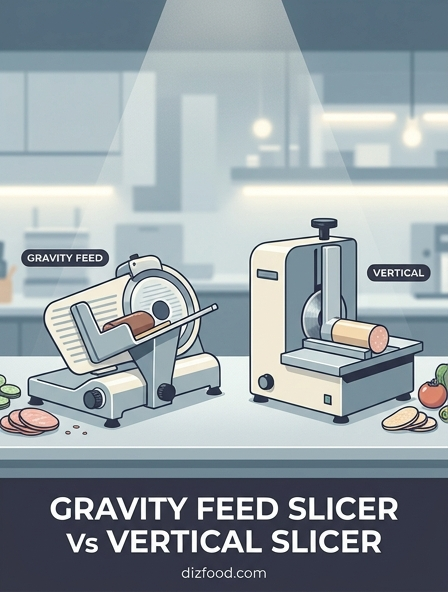
Understanding Gravity Feed vs Vertical Slicer Mechanics
The fundamental distinction between gravity feed and vertical slicers lies in the orientation of the product carriage relative to the blade. In a gravity feed slicer, the carriage is set at an angle, typically between 35 and 45 degrees. This design utilizes the natural force of gravity to pull the food product down toward the rotating blade. As the operator moves the carriage back and forth, the weight of the meat or cheese ensures consistent contact with the blade plate, reducing the amount of physical force the operator must apply to keep the product in place.
In contrast, a vertical slicer features a carriage that is positioned at a strict 90-degree angle to the blade. Because the product does not slide down an incline, the operator or a mechanical weighted arm must manually push the food item against the blade and the gauge plate. This vertical orientation requires more active participation from the user to maintain pressure, but it provides a different level of control over the slicing process. While gravity slicers are the standard in most modern delis, vertical slicers are often preferred in traditional European butcher shops and high-end charcuterie stations where specific mechanical advantages are required for delicate items.
Key Differences in Performance and Efficiency
When evaluating performance, the choice between gravity and vertical models often comes down to the balance between speed and precision. Gravity feed slicers are generally considered more efficient for high-speed operations because the incline minimizes the effort required to feed the product. This allows for faster strokes and less operator fatigue during busy shifts. Vertical slicers, however, excel in the quality of the "shave." Because the product sits flat, there is less risk of the weight of the product causing it to deform or tear as it hits the blade at an angle.
| Feature | Gravity Feed Slicer | Vertical Slicer |
|---|---|---|
| Primary Force | Gravity/Incline | Manual/Mechanical Pressure |
| Operator Effort | Low to Medium | Medium to High |
| Slicing Speed | High | Moderate |
| Product Control | General | High Precision |
Efficiency is also dictated by the type of product being processed. Gravity feed models are the workhorses for standard sandwich meats and hard cheeses. Vertical models are more efficient when dealing with oversized items or very soft, cured meats that might collapse under their own weight if placed on a steep incline. The vertical positioning allows for a "drop" onto a receiving tray that keeps the slice perfectly flat, which is a major performance advantage for presentation-focused kitchens.
Benefits of Gravity Feed Slicers for High Volume
For commercial environments like busy delis, grocery store meat counters, and high-volume sandwich shops, the gravity feed slicer is often the preferred choice. The primary benefit is the reduction of physical labor. Because gravity assists in pushing the product toward the blade, the operator can maintain a rapid rhythm without having to fight the weight of a heavy ham or large roast. This lead to several operational advantages:
- Reduced Operator Fatigue: Staff can operate the machine for longer periods without experiencing significant arm or shoulder strain.
- Consistency in Bulk: The constant pressure provided by the incline ensures that the first slice is as thick as the last, even when the product starts to get smaller.
- Automation Capability: Most fully automatic slicers utilize a gravity feed design, allowing the machine to run independently while the operator performs other tasks.
- Versatility: These machines handle a wide variety of shapes and sizes with minimal adjustment to the carriage grips.
In high-volume settings, time is money. The ability to quickly load a product and let its own mass facilitate the slicing process means faster turnaround for customer orders. Gravity feed slicers are designed to be the "marathon runners" of the kitchen, capable of processing hundreds of pounds of product daily with consistent results and minimal mechanical downtime.
Why Precision Operators Prefer Vertical Slicers
While gravity feed models dominate the volume market, vertical slicers remain the gold standard for precision and artisanal applications. Chefs and charcuterie specialists often prefer vertical models because they offer total control over the product's movement. In a vertical system, the operator determines exactly how much pressure is applied against the blade, which is crucial when slicing expensive, delicate, or irregularly shaped cured meats like Prosciutto di Parma or Bresaola.
The vertical orientation prevents the product from "slumping" against the blade. In a gravity slicer, a very soft meat might compress at the bottom due to its own weight, leading to uneven slices or a tapered edge. The vertical slicer keeps the product perpendicular, ensuring that every slice is perfectly uniform from top to bottom. Furthermore, vertical slicers are often designed with a larger carriage capacity, allowing them to hold massive whole muscles that would be too heavy or awkward for a slanted gravity feed tray. For those who view slicing as a craft rather than just a preparation task, the tactile feedback and geometric accuracy of a vertical slicer are irreplaceable.
Ergonomics and Operator Comfort Comparison
Ergonomics play a vital role in long-term kitchen safety and staff retention. Gravity feed slicers are generally rated higher for ergonomic comfort because the sliding motion of the carriage is more natural. The operator uses a back-and-forth motion that engages the larger muscle groups of the arm and shoulder. Because gravity is doing the "feeding," the hand on the carriage handle only needs to guide the motion, rather than pushing the product inward. This significantly lowers the risk of repetitive strain injuries in high-use environments.
Vertical slicers present a different ergonomic profile. Since the product does not naturally fall toward the blade, the operator must often apply lateral pressure while simultaneously moving the carriage. On older or manual models, this can be taxing on the wrist and elbow. However, some high-end vertical slicers incorporate ergonomic handle placements and weighted product holders that alleviate this stress. When choosing based on comfort, the kitchen manager must consider the height of the counter; a gravity slicer on a high counter can be difficult for shorter operators to reach over, whereas a vertical slicer might offer a more accessible working height for specific tasks. Overall, for sheer repetitive ease, the gravity feed model is the ergonomic winner for general staff.
Best Food Applications for Each Slicer Type
Choosing between these two machines often depends on what specifically is being placed on the carriage. Certain foods respond better to the mechanics of one over the other. Gravity feed slicers are the "all-rounders" of the kitchen, while vertical slicers are the specialists. Using the right tool for the specific food item ensures better yield and less waste.
- Gravity Feed Slicers:
- Standard deli meats (turkey, ham, roast beef).
- Hard and semi-hard cheeses (cheddar, provolone, swiss).
- Firm vegetables (cabbage for slaw, onions, peppers).
- Dense processed loaves.
- Vertical Slicers:
- Delicate cured meats (prosciutto, carpaccio, serrano).
- Very soft or "weeping" meats that require gentle handling.
- Large, heavy whole-muscle roasts that exceed standard carriage sizes.
- Ultra-thin "shaved" applications where transparency is required.
In a gourmet setting where the aesthetic of the meat is as important as the taste, the vertical slicer is indispensable. It allows the meat to fall naturally onto the receiving plate without being dragged across the blade housing, preserving the fat marbling and texture. Conversely, for a high-paced sandwich shop making hundreds of turkey subs, the gravity feed's ability to churn through firm blocks of meat and cheese makes it the superior choice.
Cleaning and Sanitization Requirements for Both Models
Sanitation is a non-negotiable aspect of food service, and both slicer types require rigorous daily cleaning routines to prevent cross-contamination and bacterial growth. Generally, both types of slicers feature removable components such as the product deflector, blade cover, and meat grip. However, the angled design of the gravity feed slicer can sometimes lead to juices and debris pooling at the bottom of the "well" where the carriage meets the base. This area must be scrubbed thoroughly to prevent Listeria and other pathogens from harboring in the crevices.
Vertical slicers have a different set of challenges. Because the carriage is upright, debris can fall straight down into the tracks or onto the base of the machine. Operators must be diligent in cleaning the space behind the blade and the vertical support pillars. Regardless of the model, the use of NSF-approved degreasers and sanitizers is essential. Most modern units from reputable manufacturers are designed with "no-tool" disassembly, making it easier for staff to strip the machine down for deep cleaning. It is also important to note that vertical slicers often have more surface area on the carriage itself, which requires more time to wipe down. Proper maintenance also includes sanitizing the sharpening stones, which can collect meat fats and oils over time, hindering their ability to maintain a sharp edge on the blade.
Comparing Footprint and Counter Space Requirements
Kitchen real estate is often limited, making the physical dimensions of the slicer a key purchasing factor. Gravity feed slicers tend to have a larger "dynamic" footprint. Because the carriage is set at an angle and moves along a diagonal path, these machines require significant clearance not just for the base, but for the travel of the carriage during operation. If placed too close to a wall or another appliance, the carriage may hit the obstruction, limiting the size of the product that can be sliced.
Vertical slicers often have a more compact stationary footprint. Because the carriage moves parallel to the blade in a more contained manner, they can sometimes fit into narrower spaces. However, they may require more vertical clearance or "headroom" for the operator to load large products from the top. When planning the layout, it is crucial to measure the "full stroke" of the carriage to ensure the operator has enough room to stand comfortably and move the arm without hitting surrounding equipment. Gravity slicers also tend to be deeper from front to back due to the incline of the tray, whereas vertical slicers are often wider from left to right. Managers should consider not only where the machine sits, but where the receiving tray and the operator will be positioned during a busy service period.
Safety Features and Blade Accessibility Differences
Safety is the most critical consideration when operating any machinery with a high-speed rotating blade. Both gravity and vertical slicers are equipped with various safety mechanisms designed to protect the operator's hands and fingers. Common features across both models include blade guards, which cover the non-cutting edge of the knife, and "no-volt release" switches that prevent the machine from automatically restarting after a power interruption.
- Blade Guards: Most gravity slicers have a permanent ring guard that protects the blade even when the cover is removed for cleaning.
- Interlocks: Modern machines often feature carriage interlocks that prevent the machine from starting if the carriage is not properly locked or if the gauge plate is open.
- Product Grips: Gravity slicers use weighted or spring-loaded meat grips to keep hands away from the blade. Vertical slicers often use more robust "spikes" or mechanical arms to secure heavy products.
- Blade Removal Tools: To ensure safety during cleaning, many manufacturers provide a specialized tool that allows the blade to be removed without the operator ever touching the sharp edge.
The primary safety difference lies in the interaction. Gravity feed slicers naturally keep the operator's hand further away from the blade due to the angle of the handle. In vertical slicing, the hand can sometimes be closer to the cutting zone, necessitating even stricter adherence to using the product pusher and wearing cut-resistant gloves. Regular training on these features is essential for preventing workplace accidents.
Choosing the Right Slicer for Your Commercial Kitchen
Deciding between a gravity feed and a vertical slicer depends on a careful analysis of your menu, volume, and staff. There is no one-size-fits-all answer; rather, the choice should be driven by the specific needs of your daily operations. If your kitchen produces a high volume of standard deli sandwiches or handles large quantities of cheese, the gravity feed slicer is almost certainly the better investment. Its ease of use, lower operator fatigue, and speed make it the industrial standard for a reason.
However, if your establishment focuses on high-end charcuterie, authentic Italian meats, or precision plating where every millimeter counts, the vertical slicer offers the control and delicacy required for those tasks. Many high-end delis actually choose to house both units: a gravity feed for the "heavy lifting" of turkey and ham, and a vertical slicer for the boutique meats that command a higher price point. When making your final decision, consider the skill level of your staff; gravity slicers are generally more intuitive for beginners, while vertical slicers may require a bit more finesse to master. Ultimately, investing in a high-quality machine that matches your primary food applications will result in better product yield, happier staff, and more consistent quality for your customers.



Comments