
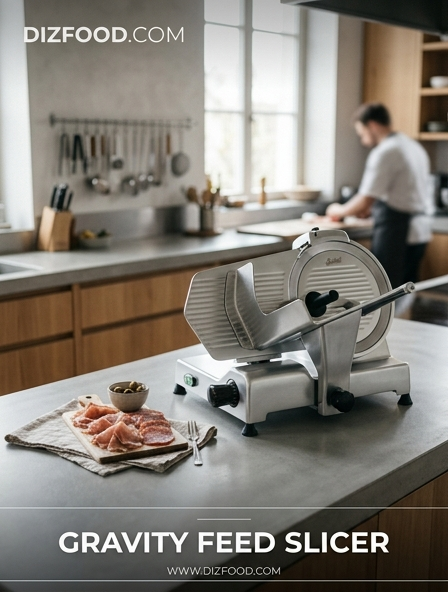
Gravity Feed Mechanics and Deli Efficiency
The gravity feed slicer is a cornerstone of modern deli efficiency, utilizing a specialized 45-degree angled carriage to leverage natural forces during operation. Unlike horizontal slicers that require the operator to manually push the product toward the blade, the gravity-assisted design allows the meat or cheese to slide down naturally. This mechanical advantage ensures that the product maintains constant contact with the blade plate, resulting in a more fluid motion and faster cycling times.
- Reduced manual force required to feed the product.
- Consistent pressure against the gauge plate for uniform thickness.
- Increased speed when processing large logs of deli meats.
- Lower physical resistance during the slicing stroke.
By integrating these mechanics, kitchens can significantly decrease the time spent per order. The weight of the product itself dictates the feeding speed, allowing the operator to focus on the rhythmic movement of the carriage rather than exerting unnecessary downward or forward pressure, which is vital during peak service hours.
Maximizing Throughput for High Volume Production
In high-volume environments like commercial delis and large-scale catering kitchens, throughput is the primary metric of success. Gravity feed slicers are engineered to handle the rigorous demands of continuous operation without overheating or losing precision. The design allows for rapid reloading of product logs, as the slanted carriage provides an intuitive loading zone that secures the item quickly. This minimizes downtime between different meat types or cheese blocks.
To maximize output, these machines often feature powerful induction motors and high-torque belt or gear drives. This ensures that even dense products, such as aged hams or cold salamis, do not slow the blade rotation. When the machine maintains a consistent RPM, the operator can move the carriage faster, effectively increasing the number of slices produced per minute. High-throughput kitchens rely on this reliability to clear queues during lunch rushes, ensuring that the equipment never becomes a bottleneck in the production line. Consistent speed translates directly to customer satisfaction and higher daily revenue.
Ergonomic Design to Reduce Operator Fatigue
The ergonomic benefits of gravity feed slicers cannot be overstated, particularly concerning the long-term health of kitchen staff. By utilizing a slanted carriage, the machine takes over the most strenuous part of the slicing process: maintaining product position. This prevents the repetitive strain injuries often associated with manual horizontal slicers, where the wrist and shoulder are under constant tension.
| Ergonomic Feature | Operator Benefit |
|---|---|
| 45-Degree Angle | Reduces shoulder and arm extension strain. |
| Contoured Handle | Provides a natural grip to prevent wrist fatigue. |
| Weighted Meat Grip | Secures product without constant manual pressure. |
| Smooth Glide Rails | Minimizes the effort required for carriage movement. |
When employees are less fatigued, they remain more alert, which indirectly improves safety and portion accuracy. An ergonomic workspace fosters a more positive environment, reducing turnover and ensuring that staff can perform at peak levels throughout their entire shift without physical discomfort.
Precision Slicing for Consistent Meat Portions
Precision is the hallmark of a high-quality gravity feed slicer. The ability to produce paper-thin slices of prosciutto or thick slabs of turkey with the same machine is essential for versatile menu offerings. These slicers utilize a micro-adjustment knob that controls the gauge plate, allowing for increments as small as a fraction of a millimeter. This level of control is necessary for maintaining strict portion costs and meeting customer expectations for texture and presentation.
- Micro-metric thickness control for precise adjustments.
- High-carbon steel blades for a razor-sharp cutting edge.
- Built-in sharpeners to maintain blade integrity daily.
- Rigid carriage construction to prevent flexing during the cut.
Consistent portioning ensures that every sandwich or platter looks identical, which is crucial for brand standards. Furthermore, precision slicing prevents "shingling" errors where slices vary in thickness from top to bottom. By keeping the product perfectly aligned through gravity, the blade makes a clean, vertical pass every time, ensuring the structural integrity of the meat remains intact.
Streamlining Workflow with Slanted Carriage Systems
The slanted carriage system is more than just a mechanical aid; it is a workflow optimizer. In a fast-paced kitchen, the physical layout of the equipment dictates the speed of the assembly line. Gravity feed slicers are typically designed with a footprint that allows for easy integration into narrow prep tables. Because the product slides downward, the exit path for the sliced meat is predictable and focused, making it easier for the operator to catch and stack the product efficiently.
This streamlining effect is particularly noticeable when switching between different products. The slanted design makes cleaning and wiping down the carriage faster between tasks, as crumbs and juices naturally migrate toward the collection area. This prevents cross-contamination and allows the operator to transition from slicing roast beef to ham with minimal interruption. By reducing the number of manual adjustments and cleaning steps, the overall workflow becomes a rhythmic, uninterrupted process that supports high-speed food assembly and better kitchen organization.
Safety Features for Rapid Deli Environments
In the frantic environment of a busy deli, safety is paramount. Gravity feed slicers are equipped with multiple layers of protection to prevent accidental contact with the high-speed rotating blade. These features are designed to be intuitive so they do not hinder productivity while ensuring the highest level of operator protection. Modern machines prioritize both active and passive safety mechanisms to mitigate the risks associated with sharp cutlery and mechanical movement.
- Blade guard ring that covers the non-cutting edge of the knife.
- No-volt release system to prevent automatic restarts after power loss.
- Interlock switches that disable the motor when the carriage is removed.
- Permanent blade edge guards for protection during cleaning.
- Non-slip rubber feet to ensure machine stability during operation.
These safety protocols are essential for training new staff quickly and safely. By minimizing the exposed surface area of the blade and ensuring the machine cannot be operated in an unsafe state, kitchen managers can reduce the likelihood of workplace injuries and the subsequent costs associated with medical leave and liability.
Reducing Waste through Gravitational Meat Alignment
Food waste significantly impacts the bottom line of any deli operation. Gravity feed slicers help mitigate this by ensuring that the meat product is always perfectly aligned with the blade. In manual horizontal systems, the product can occasionally tilt or lift, leading to uneven "wedged" slices that must be discarded. The constant gravitational pull on the meat log ensures it stays flush against the gauge plate and the product fence, maximizing the usable portion of every roast or ham.
Additionally, the weighted product press-often called the "meat grip"-works in tandem with gravity to hold the end-piece (the "heel") of the meat securely. This allows the operator to slice much further into the product than would be possible by hand, significantly reducing the size of the leftover scrap. When every ounce of product is utilized, the cost per serving decreases, directly increasing the profit margin on every sandwich sold. Over the course of a year, the reduction in waste can pay for the machine itself.
Simplified Cleaning Protocols for Busy Kitchens
Maintaining hygiene in a kitchen is a non-negotiable requirement, yet it can be time-consuming. Gravity feed slicers are designed with "clean-out" features that simplify the sanitation process. Most models feature removable components that can be stripped down without the need for specialized tools, allowing for deep cleaning of the blade, carriage, and deflector. The use of anodized aluminum surfaces ensures that food particles do not stick easily and that the machine can withstand harsh sanitizing chemicals.
- Set the thickness gauge to zero to protect the blade edge.
- Remove the product press and carriage for separate washing.
- Use a specialized brush to clear debris from the blade center.
- Wipe down the body with a food-safe sanitizing solution.
- Reassemble and lock the components for the next shift.
By simplifying these steps, kitchens can ensure that staff actually perform the cleaning tasks as required by health codes. Smooth, rounded corners and the absence of deep crevices prevent the buildup of bacteria, ensuring a safe and sanitary environment for food preparation.
Durability Requirements for Constant Slicing Loads
A gravity feed slicer is a significant investment, and durability is essential for ensuring a long service life under heavy use. Commercial-grade slicers are built with robust materials designed to withstand the acidic nature of processed meats and the abrasive cleaners used in kitchens. The motor and drive system are the heart of the machine, requiring high-quality components to prevent burnout during long shifts.
| Component | Recommended Material/Type |
|---|---|
| Blade | Hardened stainless steel or chrome-plated carbon steel. |
| Body | Anodized aluminum for corrosion resistance. |
| Drive System | Poly-V belt or heavy-duty gears for torque. |
| Bearings | Permanently lubricated ball bearings for smoothness. |
Choosing a machine with these specifications ensures that it can handle the "constant slicing load" of a 24-hour deli or a busy supermarket. Heavy-duty construction reduces the frequency of repairs and prevents the carriage from becoming misaligned, which is critical for maintaining slice quality over several years of operation.
Optimizing Labor Costs in Deli Operations
Labor is often the highest expense in a deli, and optimizing how staff spend their time is key to profitability. Gravity feed slicers contribute to labor optimization by increasing the speed of production and reducing the training time required for new employees. Because the machine does much of the work regarding product alignment and feeding, even less experienced staff can produce professional-grade results with minimal instruction. This versatility allows managers to cross-train employees more effectively.
Furthermore, the efficiency of a gravity-assisted system means that one operator can do the work that might take two people using less efficient equipment. This allows for leaner scheduling during off-peak hours without sacrificing the ability to serve customers quickly. By reducing the physical toll on workers, the slicer also helps maintain a higher level of productivity at the end of a shift compared to more labor-intensive manual alternatives. Investing in high-quality gravity feed equipment is a strategic move to lower the cost of labor per unit of food produced, directly enhancing the kitchen's overall economic performance.





Comments