
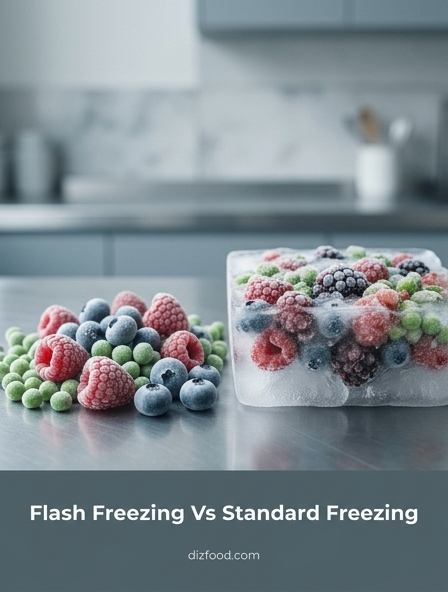
Ever wonder why some frozen foods taste just like the day they were harvested while others lose their bite? The difference lies in the battle between speed and temperature. Flash freezing, or Individual Quick Freezing (IQF), rapidly drops temperatures to lock in cellular integrity, preventing the formation of large, jagged ice crystals that typically tear through food fibers. While your standard home freezer is great for long-term storage, its slower cooling process allows moisture to migrate and expand, often resulting in a mushy texture and loss of essential nutrients. Choosing the right method isn't just about cold storage; it's about mastering thermal dynamics to ensure that every berry, steak, or vegetable retains its peak flavor, vibrant color, and "just-picked" nutritional profile from the moment it's frozen until it hits your plate.
| Feature | Flash Freezing (IQF) | Standard Freezing |
|---|---|---|
| Freezing Speed | Seconds to minutes (ultra-fast) | 3 to 24 hours (gradual) |
| Ice Crystal Size | Micro-crystals; preserves cells | Large crystals; punctures cell walls |
| Texture & Taste | Maintains original firmness/flavor | Often soft, mushy, or watery |
| Drip Loss (Thawing) | Minimal (<1% moisture loss) | High (3-10% moisture/juice loss) |
| Nutrient Density | Maximum vitamin/mineral retention | Gradual loss during slow freeze |
| Best Use Case | Commercial seafood, fruit, meat | Leftovers, bulk dry-good storage |
The Core Differences Between Flash and Standard Freezing
The fundamental distinction between flash freezing and standard freezing lies in the speed at which the temperature of a food item drops. Standard freezing, the process utilized by conventional home appliances, typically takes several hours or even a full day to solidify a product. This slow decline in temperature allows moisture within the food to migrate and form large structures. In contrast, flash freezing-often referred to as blast freezing-utilizes specialized equipment to subject food to temperatures well below -30 degrees Fahrenheit, accompanied by high-velocity airflow. This process solidifies the item in a matter of minutes rather than hours.
| Feature | Flash Freezing | Standard Freezing |
|---|---|---|
| Freezing Speed | Minutes | Hours to Days |
| Ice Crystal Size | Microscopic | Large and Jagged |
| Cellular Damage | Minimal | Significant |
| Equipment | Industrial Blast Chiller | Residential Freezer |
The discrepancy in speed creates a ripple effect throughout the entire culinary profile of the food. While standard freezing is convenient for leftover storage, it is less effective at maintaining the original quality of raw proteins or delicate vegetables. Flash freezing is the gold standard for commercial food preservation because it effectively "locks" the food in its current state, preventing the degradation that occurs during a slow transition to a frozen state.
How Rapid Cooling Preserves Food Cell Structure
To understand why rapid cooling is superior, one must look at the cellular composition of food. Whether it is a piece of steak or a fresh strawberry, food is primarily composed of water held within biological cell walls. When food is cooled slowly, the water molecules have ample time to find one another and form large, expansive ice crystals. These crystals act like tiny shards of glass, piercing the delicate cell membranes and causing the internal structure of the food to collapse. This phenomenon is why slow-frozen fruit often becomes a soft, mushy mess once it returns to room temperature.
Rapid cooling bypasses the "zone of maximum crystallization," which is the temperature range where most ice crystals form (typically between 25°F and 31°F). By moving through this range at lightning speed, flash freezing forces the water molecules to freeze in place. This prevents the formation of large, damaging crystals. Instead, thousands of microscopic crystals form simultaneously, which are too small to rupture the cell walls. Consequently, the internal structural integrity of the food remains intact. When the food is eventually thawed, the cells remain plump and functional, retaining the same snap and firmness found in the fresh version of the product.
Comparing Ice Crystal Formation in Slow and Fast Freezing
The science of ice crystal formation is the primary factor that determines the quality of frozen goods. In a standard home freezer, the air is relatively stagnant, and the temperature is not low enough to trigger an immediate phase change in the water content of the food. This leads to a gradual crystallization process. As the first crystals form, they draw in surrounding water molecules, growing larger and more destructive over time. These large crystals create voids in the tissue and push apart fibers, permanently altering the food's anatomy.
- Fast Freezing: Promotes "nucleation," creating many small crystals throughout the tissue simultaneously.
- Slow Freezing: Encourages "accrual," where existing crystals grow by pulling moisture from neighboring cells.
- Mechanical Stress: Large crystals apply physical pressure to proteins and fibers, leading to a loss of elasticity.
- Moisture Migration: Slow freezing causes water to move out of the cells and into the interstitial spaces, resulting in "drip loss" during thawing.
By controlling the rate of crystallization, flash freezing ensures that the moisture remains evenly distributed within the food's fibers. This prevents the "dehydration" effect that often accompanies slow freezing. Because the ice crystals are kept microscopic, they do not disrupt the complex network of proteins and carbohydrates that give food its unique bite and density. This is especially critical for seafood and tender greens, which are highly susceptible to texture degradation.
Nutritional Value Retention in Flash Frozen Produce
A common misconception in the kitchen is that frozen food is less nutritious than fresh produce. However, when flash freezing is employed, the opposite is often true. Most produce begins to lose vitamins and minerals the moment it is harvested. Enzymes within the food continue to break down nutrients during transport and storage on grocery store shelves. Flash freezing halts this enzymatic activity almost instantly. Because the process happens so quickly, the vitamins-particularly water-soluble ones like Vitamin C and B-complex-are "locked" inside the cellular structure before they have a chance to degrade or oxidize.
Standard freezing is less effective at nutrient retention because the slow cooling process allows for continued enzymatic action for several hours. Furthermore, the large ice crystals formed during slow freezing can rupture the cells that contain these vital nutrients. When the food thaws, the nutrient-rich fluid (known as "purge") leaks out, leaving the food less nutritious. Flash freezing minimizes this purge, ensuring that the vitamins and minerals remain within the food until it is consumed. Studies have shown that flash-frozen spinach or peas can contain higher levels of antioxidants and vitamins than fresh produce that has been sitting in a refrigerator for a week.
Impact on Texture and Taste After Thawing
The ultimate test of any freezing method occurs at the dinner table. The texture of food is defined by its ability to hold water and maintain its fiber density. When food is standard-frozen, the massive ice crystals mentioned previously cause a loss of "turgor pressure" in plant cells and "water-holding capacity" in meat. Upon thawing, the water that was once trapped inside the cells simply drains away. This results in meat that feels dry and stringy, or vegetables that have lost their characteristic crunch. The mouthfeel becomes grainy or spongy, which is a hallmark of poorly frozen items.
Taste is also heavily influenced by the freezing method. Many of the flavor compounds in food are volatile or held within the cellular juices. When cell walls are ruptured by slow freezing, these flavor compounds are lost along with the moisture. Flash freezing prevents this loss by keeping the cell walls intact. Because the moisture stays where it belongs, the food retains its original juiciness and concentrated flavor. This explains why a flash-frozen steak can taste nearly identical to a fresh-cut steak, whereas a steak frozen in a standard home freezer often requires extra seasoning or marinating to compensate for its loss of natural flavor and moisture.
Why Standard Home Freezers Cause Freezer Burn
Freezer burn is the enemy of long-term food storage, and it is almost exclusively a byproduct of standard freezing environments. This phenomenon is not actually "burning," but rather a form of dehydration caused by sublimation. Sublimation occurs when ice turns directly into water vapor without becoming a liquid first. In a standard freezer, the environment is prone to several factors that encourage this process:
- Temperature Fluctuations: Home freezers often cycle their temperatures to prevent frost buildup, which causes ice crystals on the food's surface to melt and refreeze.
- Air Exposure: Standard freezers lack the rapid sealing power of industrial methods, allowing air to come into contact with the food surface.
- Slow Cooling: The long time it takes for a home freezer to reach a stable state allows moisture to escape to the surface of the food.
- Moisture Migration: Water molecules move from the interior of the food to the colder surface, forming frost and leaving the food dry and leathery.
When the surface of the food becomes severely dehydrated, it develops white or greyish-brown patches. These areas become tough and develop off-flavors due to oxidation. Because flash freezing creates such tiny ice crystals and is often paired with vacuum sealing, the moisture is effectively trapped, and the lack of air prevents the sublimation process from ever beginning.
The Science of Instant Freezing Technology
The science behind flash freezing, or instant freezing, relies on the principles of thermodynamics and heat transfer. To freeze something instantly, you must remove heat from the core of the object at a rate faster than the heat can move from the center to the surface. Industrial blast chillers achieve this by using extremely cold air (often as low as -40°F) and circulating it at high speeds. This high-velocity air strips away the "thermal boundary layer"-the thin layer of warmer air that naturally surrounds an object-allowing the cold air to make direct contact with the food's surface for maximum efficiency.
Another form of instant freezing is cryogenic freezing. This involves exposing food directly to liquid nitrogen or solid carbon dioxide. Liquid nitrogen has a boiling point of -320°F, which creates a temperature differential so massive that freezing occurs almost instantly upon contact. This level of technology is generally reserved for high-end industrial applications or molecular gastronomy. The goal of all these technologies is to reach the "glass transition temperature" of the food as quickly as possible. When this state is reached, the water in the food enters a "vitrified" or glass-like state rather than a crystalline state, which is the ultimate way to preserve the original molecular arrangement of the food.
Food Safety and Bacteria Prevention in Freezing Methods
While freezing does not typically kill bacteria, it does stop them from multiplying. However, the safety of the freezing process is heavily dependent on how quickly the food moves through the "danger zone"-the temperature range between 40°F and 140°F where bacteria thrive and double their population every twenty minutes. Standard freezing is inherently riskier because large batches of warm food can sit in this danger zone for an extended period while the home freezer struggles to bring the temperature down. This is particularly dangerous for dense items like large roasts or thick stews.
Flash freezing eliminates this risk by transitioning the food through the danger zone in a fraction of the time. By dropping the temperature of the food to below freezing within minutes, it effectively "paralyzes" any microbial activity before the bacteria have the chance to colonize or produce toxins. Additionally, because flash freezing preserves the cellular structure, there is less "leakage" of nutrient-rich fluids when the food is thawed. These fluids are a primary breeding ground for bacteria during the thawing process. Therefore, flash-frozen foods are often safer from a microbiological standpoint, provided they are handled correctly during the thawing phase.
Industrial Flash Freezing versus Conventional Home Methods
The gap between industrial flash freezing and home freezing is primarily a matter of hardware power. An industrial blast freezer is designed to move massive volumes of air and maintain ultra-low temperatures even when loaded with hot food. A home freezer, by contrast, is designed to maintain a steady cold temperature for already-frozen items. When you place a tray of room-temperature chicken in a home freezer, the ambient temperature inside the unit actually rises, slowing the freezing process for everything else in the freezer as well.
- Convection Power: Industrial units use powerful fans; home units rely on passive cooling.
- Compressor Strength: Industrial compressors are built for rapid heat extraction; home compressors are built for energy efficiency.
- Surface Area: Industrial methods often use "individual quick freezing" (IQF) where items are frozen separately on a belt to maximize surface exposure.
- Home Workarounds: Home cooks often try to mimic flash freezing by using "fast freeze" settings or placing items on pre-chilled metal trays.
Despite these home "hacks," a standard residential freezer cannot reach the speeds necessary for true flash freezing. The lack of air movement is the biggest hurdle. Without a fan to circulate the air, a "warm" pocket of air remains around the food, insulating it and slowing the cooling process. This is why even a very cold home freezer will still produce the large ice crystals and texture issues characteristic of slow freezing.
Choosing the Best Freezing Method for Long Term Storage
When deciding how to store food for the long term, the choice often depends on the type of food and the intended use. For items that will be used in soups or stews-where texture is less critical-standard home freezing is perfectly adequate. However, for high-quality proteins, delicate berries, or blanched vegetables, flash freezing (or purchasing flash-frozen products) is vastly superior. If you are preparing food at home for the freezer, you can bridge the gap by utilizing techniques that increase the speed of cooling, such as spreading items out in a single layer rather than stacking them.
For the best results in long-term storage, follow these guidelines:
- Pre-chill food in the refrigerator before moving it to the freezer to reduce the time spent in the danger zone.
- Use vacuum sealing to remove air, which complements the freezing process by preventing freezer burn and oxidation.
- Freeze items in small portions to ensure the cold can reach the center of the food more quickly.
- Label everything with the date, as even flash-frozen food will eventually succumb to quality loss over many months.
Ultimately, the goal is to minimize the time the food spends in the transitional state between liquid and solid. While you may not have an industrial blast freezer in your kitchen, understanding the principles of flash freezing allows you to make better choices about which foods to freeze and how to handle them to ensure the best possible quality upon thawing.






Comments