
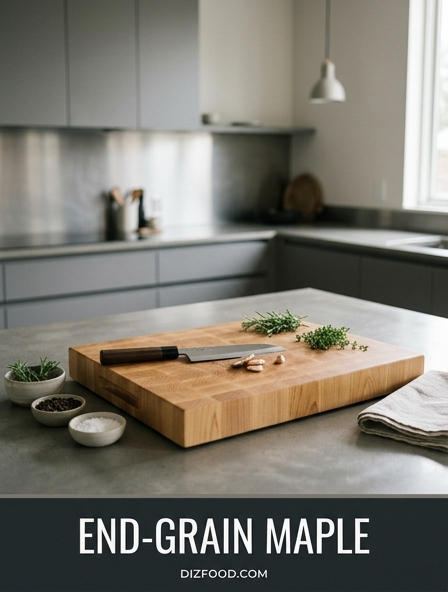
Understanding End Grain Wood Fiber Dynamics
The structural integrity of an end-grain maple cutting surface is defined by the vertical orientation of the wood fibers. Unlike edge-grain boards, where the wood is laid flat to expose the long grain, end-grain construction involves arranging the wood blocks so that the growth rings face upward. This orientation is often compared to a bundle of straws. In this configuration, the knife blade does not cut across the fibers but rather slides between them during the downward stroke. This unique dynamic allows the board to withstand significant pressure while remaining incredibly resilient.
- Fibers are oriented perpendicular to the cutting surface.
- Capillary action is maximized for moisture management.
- Structural density provides a heavy, stable work base.
- Grain patterns naturally hide knife marks.
Because the fibers are exposed on their ends, they possess a natural elasticity. When a chef applies force, the fibers spread apart to accommodate the edge and then return to their original position. This minimizes the structural damage to the wood and creates a surface that is both durable and forgiving, ensuring that the kitchen environment remains efficient for long-term culinary use.
Why Hard Rock Maple Benefits High Carbon Steel
High carbon steel knives are favored by enthusiasts for their ability to maintain an incredibly sharp, thin edge. However, this sharpness comes at the cost of brittleness. If a high carbon blade strikes a surface that is too hard, such as glass or stone, the edge will inevitably chip or shatter. Hard rock maple, specifically Acer saccharum, provides the perfect counterpoint to this metallurgical reality. Its Janka hardness rating is high enough to resist deep gouging but low enough to offer a "soft" landing for the delicate apex of a professional knife.
The chemical composition of maple is also beneficial. It contains natural oils and a tight grain structure that prevents the absorption of excess moisture, which can cause high carbon steel to rust or discolor prematurely. By providing a stable, non-abrasive interface, maple ensures that the integrity of the steel is protected. This synergy between the organic material of the board and the high-performance alloy of the knife creates a harmonious cutting experience that maximizes the lifespan of expensive cutlery.
The Mechanics of Vertical Fiber Impact Absorption
The physics of impact absorption in an end-grain maple board is centered on the dissipation of kinetic energy. When a heavy cleaver or a delicate petty knife strikes the surface, the vertical fibers act like microscopic shock absorbers. Instead of the energy reflecting back into the blade-which can lead to edge fatigue-the energy is channeled downward through the length of the wood fibers. This mechanical response is critical for maintaining the structural health of both the knife and the chef's joints.
| Feature | Impact Response |
|---|---|
| Fiber Alignment | Vertical / Perpendicular |
| Energy Transfer | Linear Dissipation |
| Surface Bounce | Minimal |
| Blade Stress | Significantly Reduced |
This absorption process prevents the microscopic "crushing" of the wood that occurs on edge-grain boards. Because the fibers are not being severed, the board retains its flat profile longer, ensuring a consistent surface for precision tasks. This mechanical advantage is why maple end-grain remains the industry standard for heavy-duty prep stations.
How Self Healing Surfaces Preserve Edge Sharpness
The term "self-healing" refers to the ability of end-grain maple to close up after being subjected to a knife stroke. Because the blade travels between the vertical fibers rather than across them, the fibers are pushed aside. Once the blade is lifted, the natural tension and moisture content of the wood cause these fibers to spring back together. This process is essential for preserving edge sharpness because the knife encounters minimal resistance and no abrasive cross-sections.
On a plastic or edge-grain board, every cut creates a permanent groove. These grooves can catch the knife edge in subsequent strokes, leading to microscopic bending of the steel. In contrast, the self-healing nature of maple ensures a consistently smooth surface. By preventing the formation of deep scars and jagged plastic ridges, the board ensures that the knife edge stays straight and sharp. This reduces the need for frequent honing and allows the chef to maintain a high level of precision throughout the duration of their food preparation tasks.
Comparing Maple Density to Professional Blade Requirements
Selecting the right wood density is a balancing act. If a wood is too soft, like cedar, it will scar too easily and lack the durability required for a professional kitchen. If it is too hard, like teak or bamboo, the high silica content or extreme density will dull knives within minutes. Maple sits in the ideal median. Professional blade requirements dictate a surface that supports the edge without causing it to deflect or dull upon contact.
- Sugar Maple: Approximately 1,450 lbf on the Janka scale.
- Japanese Steel: Requires a surface that prevents micro-chipping.
- Western Steel: Benefits from the density during heavy rock-chopping.
The density of maple also plays a role in sanitation. The wood is dense enough to prevent deep bacterial penetration, yet porous enough to allow the natural antimicrobial enzymes to work effectively. For a professional chef, this density provides the necessary feedback-a subtle "thud" rather than a "clack"-which indicates that the surface is absorbing the impact and protecting the finely tuned edge of the tool.
Reducing Microscopic Edge Rolling and Chipping
The most common cause of a dull knife is not the loss of metal, but rather the rolling of the microscopic edge. When a sharp blade hits a hard, unyielding surface, the thin tip of the steel can fold over to one side. This is known as "rolling." Additionally, extremely hard steels used in professional Japanese knives are prone to "chipping" when they encounter lateral resistance. End-grain maple significantly reduces both of these issues by providing a forgiving interface.
Because the vertical fibers yield to the blade, there is very little lateral pressure exerted on the edge as it enters and exits the wood. The absence of cross-grain resistance means the steel is not being "pushed" in a direction it wasn't designed to go. By maintaining the vertical alignment of the knife's apex, maple allows the edge to remain functional for much longer. This protection is particularly vital for knives with a high Rockwell hardness rating, where the steel is less flexible and more prone to permanent damage from improper cutting surfaces.
The Physics of Knife Contact on End Grain Surfaces
When a knife contacts an end-grain surface, the physics are governed by the separation of fibers rather than the shearing of material. The coefficient of friction is notably lower when a blade moves parallel to the grain fibers. This means the chef experiences less "drag" during the slicing motion. The lack of friction not only makes the work easier for the user but also generates less heat at the microscopic edge of the knife, which can theoretically affect the tempering of extremely delicate steels over time.
Furthermore, the capillary structure of the end grain provides a slight suction effect that helps stabilize the food being cut. As the blade passes through the food and touches the board, the fibers provide a tactile feedback that is distinct from the harsh vibration felt on synthetic surfaces. This sensory input allows for better control over the depth and speed of the cut. The result is a more fluid, rhythmic cutting motion that maximizes the efficiency of the tool while minimizing the physical wear on the blade's geometry.
Maintaining Blade Alignment During High Volume Prep
High-volume food preparation involves thousands of repetitive strokes. In this environment, even a slight misalignment of the blade edge can lead to significant fatigue and a decrease in cutting performance. End-grain maple is the preferred surface for high-volume environments because it helps maintain the "true" of the blade. The vertical fibers ensure that the knife hits the same type of surface every time, regardless of the angle of the stroke.
Unlike plastic boards, which develop "fuzz" or deep gouges that can pull the blade off-center, maple remains remarkably flat. This flatness is critical for techniques like julienning or chiffonade, where precision is paramount. By providing a predictable and stable surface, maple allows the chef to maintain a consistent honing schedule rather than stopping for emergency sharpening. This reliability is why the most demanding kitchens in the world invest in heavy-duty maple blocks; they understand that the surface is just as important as the knife for maintaining a high standard of prep work.
Long Term Edge Retention and Sharpening Frequency
The primary financial benefit of using an end-grain maple board is the extension of the knife's sharpening cycle. Every time a knife is sharpened on a stone, metal is removed from the blade. Over years of use, a knife will eventually lose its profile and need to be replaced. By using a surface that maximizes edge retention, you directly extend the life of your investment. Maple's gentle interaction with the steel ensures that the edge stays sharp for days or weeks longer than it would on inferior materials.
- Fewer sharpening sessions per year.
- Reduced metal removal during maintenance.
- Consistent performance between professional hones.
- Lower long-term costs for knife replacement.
Professional sharpeners often note that knives used on maple require less "correction" during the sharpening process. The edges tend to wear evenly, without the deep chips or severe rolls associated with harder surfaces. This even wear pattern makes it easier to bring the knife back to its peak performance with minimal effort on the whetstone, saving both time and steel.
Why Professional Chefs Prioritize Maple Cutting Surfaces
Professional chefs prioritize maple because it represents the pinnacle of kitchen utility and tool protection. A cutting board is not merely a platform; it is a critical component of the knife system. The choice of end-grain maple reflects a commitment to the longevity of one's tools and the quality of the final product. The tactile feedback provided by maple allows for greater accuracy, while the natural beauty of the wood adds a level of craftsmanship to the kitchen environment.
Beyond the mechanical benefits, maple is favored for its sanitary properties. Studies have shown that wood possesses natural antimicrobial properties that can be more effective than plastic in certain conditions. For a chef, the combination of a "kind" surface for their expensive knives and a safe surface for food prep is unbeatable. The durability of end-grain construction means a single board can last for decades if properly maintained, making it a sustainable and highly functional choice for any professional or serious home cook who values their cutlery.

Comments