
Tired of digging through cluttered drawers for that one whisk? Mastering vertical kitchen storage is the secret to a functional chef's oasis, but choosing between a versatile pegboard wall system and a classic S-hook hanging rail can be a game-changer for your workflow. While pegboards offer a modular, "blank canvas" approach that lets you rearrange hooks, bins, and shelves as your gadget collection grows, S-hook rails provide a sleek, minimalist aesthetic perfect for keeping heavy pans and frequently used utensils within arm's reach. Whether you're looking to turn a bare wall into a professional-grade tool hub or simply want to reclaim your countertop space, understanding the nuances of these two storage powerhouses will help you design a high-efficiency kitchen that works as hard as you do.
| Feature | Pegboard Wall Systems | S-Hook Hanging Rails |
|---|---|---|
| Versatility | High; supports hooks, shelves, and bins. | Limited; primarily for handled items. |
| Space Requirement | Large; requires significant flat wall area. | Minimal; fits under cabinets or narrow strips. |
| Weight Capacity | Moderate; distributed across multiple points. | High; ideal for heavy cast iron and copper. |
| Ease of Access | Excellent for organized "zones." | Instant; slide-and-grab linear movement. |
| Installation | Moderate; requires furring strips or spacers. | Simple; basic two-point screw mounting. |
| Visual Style | Industrial/Crafty; covers wall imperfections. | Modern/Professional; highlights wall tile. |
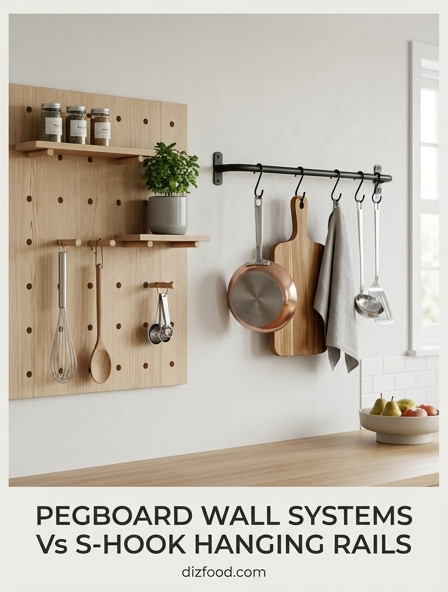
Pegboard Wall Systems vs S-Hook Hanging Rails Comparison
When evaluating the differences between pegboard wall systems and S-hook hanging rails, the primary distinction lies in their structural configuration and spatial orientation. Pegboards offer a comprehensive grid-based surface that allows for both vertical and horizontal placement of items. These systems typically consist of a perforated board made of tempered wood, plastic, or metal, where various hooks, bins, and shelves can be inserted into pre-drilled holes. This provides a high degree of modularity, as the user is not confined to a single linear path. In contrast, S-hook hanging rails, often referred to as pot racks or bistro rails, operate on a linear horizontal axis. They consist of a sturdy metal rod mounted to the wall or ceiling, utilizing sliding S-shaped hooks to suspend items.
| Feature | Pegboard Systems | S-Hook Hanging Rails |
|---|---|---|
| Orientation | Two-dimensional grid | Linear horizontal |
| Primary Material | Metal, Wood, or Plastic | Stainless Steel or Brass |
| Attachment Type | Insertable pegs/baskets | Sliding S-hooks |
| Visual Style | Industrial/Utility | Minimalist/Professional Kitchen |
The choice between these two systems often hinges on the volume of items needing storage and the specific layout of the kitchen. While pegboards cover more surface area and can hide wall imperfections, hanging rails offer a sleeker, more open appearance that integrates seamlessly into modern cabinetry. Understanding these fundamental structural differences is the first step in determining which system will better serve the functional requirements of a high-traffic culinary environment.
Maximizing Vertical Storage and Organization Efficiency
Vertical storage is the cornerstone of an efficient kitchen, especially when floor and counter space are at a premium. Pegboard systems excel in maximizing square footage because they turn an entire wall into a functional storage zone. By utilizing a grid, users can group items by frequency of use or by task, such as creating a specific "baking zone" or "prep station." The ability to add small bins for spices or shelves for cookbooks alongside hanging utensils makes the pegboard an all-in-one organizational powerhouse. This layout reduces the time spent rummaging through drawers, as every tool is visible and has a designated "shadow" or spot.
On the other hand, S-hook hanging rails focus on a more streamlined approach to efficiency. They are particularly effective for heavy or bulky items that are used daily, such as cast iron skillets, colanders, and large saucepans. By keeping these items on a rail, you eliminate the need to stack them in deep cabinets, which often leads to scratching and difficulty in retrieval. Efficiency in a rail system is achieved through accessibility; items can be slid along the rail to make room for others, or grouped tightly to maximize the linear foot. To optimize a rail system, consider the following organizational tips:
- Hang the most frequently used pans closest to the stove.
- Use different hook sizes to accommodate various handle thicknesses.
- Maintain consistent spacing to prevent items from clanking together.
- Reserve the rail for items with integrated hanging loops to avoid needing additional clips.
Ultimately, while pegboards provide a broader canvas for diverse items, rails offer a focused, high-speed access point for the most essential cookware in a chef's arsenal.
Durability and Weight Capacity Analysis
The longevity and safety of a kitchen storage system are directly tied to its material composition and weight-bearing capacity. Pegboards vary significantly in durability based on their construction. Traditional hardboard or masonite pegboards are susceptible to moisture and may warp or tear if overloaded with heavy kitchen machinery. However, modern galvanized steel or aluminum pegboards are exceptionally robust. These metal variants are resistant to rust, grease, and high temperatures, making them ideal for environments near ovens or sinks. A well-installed metal pegboard can support significant weight, provided the mounting brackets are secured into wall studs, allowing for the storage of heavy stand mixer attachments or multiple iron pans.
S-hook hanging rails are traditionally designed for heavy-duty applications. Most professional-grade rails are manufactured from thick-walled stainless steel, wrought iron, or solid brass. Because the weight is distributed across a solid horizontal bar, these systems are less likely to flex or fail under the weight of heavy cookware. The primary point of failure for a rail is not the bar itself, but the mounting hardware and the wall anchors. When properly bolted into studs, a single rail can often support 50 to 100 pounds, depending on the manufacturer's specifications. It is crucial to consider the hook strength as well; lightweight hooks may bend, whereas heavy-duty S-hooks provide a secure hold for heavy Dutch ovens. In high-humidity kitchen environments, stainless steel rails remain the gold standard for preventing corrosion and maintaining structural integrity over decades of use.
Ease of Installation and Mounting Requirements
Installation requirements differ significantly between the two systems, often influencing the choice for renters versus homeowners. Pegboard installation generally requires more planning because the board must be "furred out" from the wall. This means creating a small gap between the wall and the back of the board so that the hooks can be inserted into the holes. Many modern metal kits come with built-in flanges that handle this spacing automatically, but traditional wood boards require the installation of wooden furring strips first. This process involves multiple drill points and ensures the load is distributed across several anchors or studs to prevent the board from pulling away from the drywall.
In contrast, S-hook hanging rails are generally simpler to install, requiring only two or three mounting points. Most rails come with two end brackets and occasionally a center support for longer spans. The critical factor for rail installation is ensuring the rail is perfectly level and that at least one, if not all, mounting screws are driven into a wall stud. If studs are unavailable, high-quality toggle bolts are necessary to handle the downward shear force of heavy pots. The streamlined nature of the rail makes it a quicker DIY project, often completed in under thirty minutes. For those looking for a non-permanent solution, some rails can even be mounted under cabinets or on the side of islands, offering more placement flexibility than a large-format pegboard.
Versatility in Kitchen and Workshop Settings
The concept of "cross-compatibility" is where pegboards truly shine. A pegboard system is not limited to the kitchen; it is a universal organizational language used in workshops, garages, and craft rooms. In a kitchen setting, this versatility means you can use the same board to hold a magnetic knife strip, a paper towel holder, and a basket for fresh produce. If your needs change-perhaps you switch from a focus on stovetop cooking to espresso brewing-the pegboard can be reconfigured in minutes without any tools. You simply unhook the accessories and move them to new positions. This makes pegboards the superior choice for users who enjoy evolving their workspace or who have a wide variety of differently shaped gadgets.
S-hook rails, while appearing more specialized, offer a different kind of versatility. They are highly effective in "dead spaces" where a pegboard would be too bulky, such as the narrow backsplash between a countertop and upper cabinets. Beyond the kitchen, rails are frequently used in entryways for coats, in bathrooms for towels, or in workshops for large handheld power tools. However, the rail is limited by the fact that it can only hold items that can be hung or clipped. It cannot easily support small jars, loose papers, or flat items unless they are placed in a hanging basket. While less modular than a pegboard, the rail's aesthetic and functional simplicity allows it to blend into more formal environments where a utility-style pegboard might look out of place.
Customization Options for Different Storage Needs
Customization is the hallmark of the pegboard experience. The market is flooded with a vast array of specialized accessories designed specifically for pegboard holes. This allow users to tailor the wall to their exact inventory. Because the pegboard is a standardized grid (usually 1-inch spacing), you can mix and match parts from different manufacturers, especially if using a metal system. This level of customization ensures that even the smallest items, like measuring spoons or microplanes, have a dedicated spot that prevents them from getting lost. Common customization components for pegboards include:
- Multipurpose J-hooks and L-hooks for utensils.
- Wire baskets for holding fruit, onions, or cleaning supplies.
- Magnetic strips for securing steel knives and spice tins.
- Drill holders and bins for those who use their kitchen for DIY projects.
- Custom shelving brackets for displaying decorative items or oils.
S-hook rails offer a more curated form of customization. While you are limited to the rail itself, you can customize the types of hooks used. Swivel hooks, double hooks, and specialized "flat" hooks can change how items hang and overlap. Some rail systems are designed to integrate with specific accessories like hanging dish drying racks, herb pot holders, or tablet stands for following recipes. While the variety of accessories is lower than that of pegboards, the specialized nature of rail-mounted accessories often feels more "built-in" and intentional, catering to a premium kitchen experience rather than a utilitarian one.
Aesthetic Differences in Modern Home Design
The visual impact of these two systems can define the character of a kitchen. Pegboards are often associated with an "industrial-chic" or "craft-centric" aesthetic. They suggest a space of high activity and creative production. In modern interior design, painted pegboards (such as matte black, navy, or even vibrant yellow) serve as a focal point, turning kitchen tools into a form of wall art. Wooden pegboards with oversized dowels have also become popular in Scandinavian and minimalist designs, offering a warm, organic feel that moves away from the "garage" look of traditional metal boards.
S-hook rails provide a more classic, professional look often found in commercial kitchens or "bistro-style" home designs. They offer a clean, horizontal line that can help elongate a small kitchen. Because the rail itself is often a high-quality finish like polished chrome, brushed nickel, or oil-rubbed bronze, it acts more like hardware jewelry for the room. The aesthetic of a rail system is "open and airy," as it leaves more of the wall visible. This is particularly beneficial for kitchens with high-end tile backsplashes or designer wallpaper that the homeowner wants to showcase. While a pegboard conceals the wall, a rail complements it. Choosing between them often comes down to whether the homeowner wants their storage to be a bold statement piece (pegboard) or a subtle, elegant accent (rail).
Space Saving Benefits for Small Rooms
In compact living environments like urban apartments or tiny homes, every inch of wall space must be utilized strategically. Pegboards are the ultimate "vertical pantry." By covering a single wall from ceiling to counter, you can essentially replace an entire cabinet's worth of storage. The thin profile of the pegboard (usually less than an inch thick) ensures that it doesn't encroach on the "walking zone" of a narrow kitchen. Furthermore, because items are spread across a flat surface, the visual "depth" of the room is preserved, unlike bulky cabinets that can make a small room feel claustrophobic.
S-hook rails are also masters of small-space efficiency, but in a different way. They excel in utilizing "micro-spaces" that are otherwise wasted. This includes the space above a window, the side of a tall pantry cabinet, or the underside of a shelf. Rails are particularly good at clearing up "drawer-jamming" items. For example, hanging whisks, ladles, and tongs on a rail frees up a drawer for flat items like linens or cutlery. In a very small kitchen, a rail can be mounted high on the wall to store pots that are only used occasionally, keeping the primary workspace clear. While a pegboard requires a dedicated "zone" of wall space, a rail can be tucked into almost any nook or cranny, making it the more flexible option for awkwardly shaped rooms.
Cost Comparison and Long Term Value
When considering the budget, both systems offer entry-level and premium options. A basic hardboard pegboard is one of the most affordable storage solutions available, often costing very little for a large sheet. However, when you add the cost of specialized hooks, bins, and mounting hardware, the price can increase significantly. Metal pegboard kits are more expensive upfront but offer better long-term value because they do not wear out, chip, or require replacement after moisture exposure. The "value" of a pegboard lies in its adaptability; as your kitchen collection grows, you only need to buy a few more hooks rather than a new storage unit.
S-hook rails are generally moderately priced. A basic stainless steel rail from a big-box retailer is quite affordable, but designer versions or solid copper rails can be substantial investments. The cost of a rail system is usually "all-in" since the hooks are often included or sold in inexpensive sets. In terms of long-term value, a high-quality stainless steel rail is virtually indestructible and can last a lifetime. Unlike pegboards, which might go out of style or look "dated," the simple rail is a timeless design element that adds to the resale value of a home by suggesting a professional-grade kitchen. For those on a strict budget, a basic rail provides the most "bang for the buck" in terms of immediate organization for a few key items, whereas a pegboard is a larger investment for a total organizational overhaul.
Final Verdict Choosing the Right Hanging System
Choosing between a pegboard wall system and S-hook hanging rails ultimately depends on the specific goals of the user and the constraints of the kitchen environment. There is no objective "winner," but rather a "better fit" for different lifestyles. If the goal is to organize a vast collection of diverse tools-including small gadgets, spices, and heavy pans-and there is a significant amount of open wall space, the pegboard is the superior choice. Its unmatched customization and high-density storage capabilities make it a favorite for serious home cooks and hobbyists who treat their kitchen like a workshop.
Conversely, if the kitchen is designed with a minimalist aesthetic or if storage needs are limited to a few essential pots and pans, the S-hook hanging rail is the more elegant and efficient solution. It provides quick access to the most important tools without the visual clutter of a large grid system. For many, a hybrid approach works best: a small pegboard for baking tools and gadgets, paired with a sturdy rail over the stove for heavy skillets. By analyzing the weight of your items, the available wall space, and your personal design preference, you can select the hanging system that will create a more functional, organized, and enjoyable culinary space.


Comments