
Tired of battling a "cord jungle" every time you reach for the air fryer or blender? Achieving a pristine, tangle-free kitchen countertop often comes down to a showdown between two popular contenders: Adhesive Cord Organizers and Reusable Cable Ties. While adhesive organizers offer a sleek, permanent "wrap-and-stay" solution that sticks directly to your appliances, reusable ties provide a flexible, non-invasive way to bundle thick power cords or group multiple gadgets together. Whether you're looking for a hidden, low-profile anchor for small appliances or a heavy-duty, adjustable strap that can be swapped between devices, choosing the right tool is essential for maintaining both kitchen safety and a minimalist, organized workspace.
| Feature | Adhesive Cord Organizers | Reusable Cable Ties |
|---|---|---|
| Installation | Peel-and-stick; semi-permanent mount to device. | Manual wrap; tool-free and fully removable. |
| Versatility | Fixed to one device; ideal for standard lengths. | Universal; adjusts to any cord thickness or bundle. |
| Surface Safety | Potential adhesive residue; needs flat surfaces. | Zero residue; safe for delicate cord jackets. |
| Aesthetic | Low-profile; creates a "built-in" look. | Functional; visible but keeps bundles compact. |
| Durability | Heat-resistant silicone; adhesive may wear. | High-strength nylon or silicone; tear-resistant. |
| Best For | Single small appliances (mixers, toasters). | Heavy-duty cables or grouping multiple devices. |
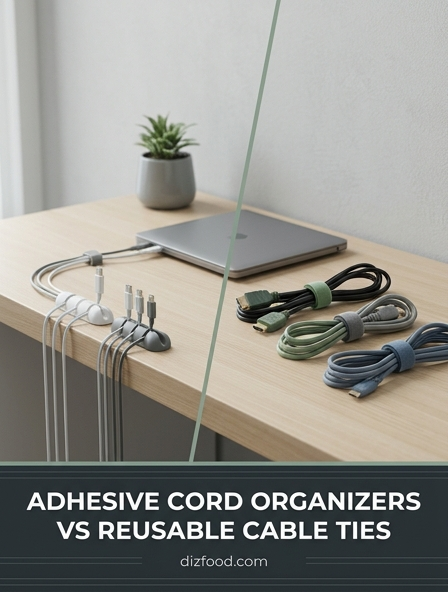
Comparing Adhesive Cord Organizers and Reusable Cable Ties
In the modern kitchen, the accumulation of small appliances often leads to a chaotic tangle of power cords that clutter countertops and fill cabinets. Choosing between adhesive cord organizers and reusable cable ties requires an understanding of how each management system interacts with kitchen surfaces and appliance mobility. Adhesive organizers are typically semi-permanent plastic wraps that stick directly onto the body of an appliance, such as a stand mixer or a coffee maker. They provide a designated spot to wind the cord, ensuring it never dangles or gets caught during storage.
On the other hand, reusable cable ties, often made of hook-and-loop fabric or silicone, offer a non-invasive way to bundle cords. Instead of attaching to the machine itself, they wrap around the folded cable to keep it tight. While adhesive mounts are prized for their "set it and forget it" convenience, cable ties are celebrated for their versatility. In a kitchen environment where heat, steam, and grease are prevalent, the choice often hinges on whether you want the cord management to be an integrated part of the device or a separate accessory that can be moved between various gadgets as your culinary tool collection evolves.
- Adhesive organizers create a fixed storage point on the appliance body.
- Reusable ties allow for bundling multiple cords together in a drawer.
- Kitchen heat can affect adhesive longevity compared to mechanical ties.
- Aesthetic preferences often dictate the choice between hidden bundles and visible wraps.
Benefits of Adhesive Mounts for Desk Management
Modern kitchens often feature a "command center" or a small desk area used for recipe browsing, tablet charging, and managing household schedules. In these specific zones, adhesive mounts offer a superior level of organization by keeping cables routed along the undersides of cabinets or the sides of the desk. Unlike loose ties, adhesive clips can be strategically placed to ensure that a charging cable stays exactly where it is needed, preventing it from slipping behind a heavy appliance or falling into a gap between the counter and the wall.
The primary benefit in a kitchen-desk setting is the elimination of "cable creep." When you unplug a laptop or tablet, an unanchored cord often falls to the floor. An adhesive mount acts as a permanent guide, keeping the connector within reach. This is particularly useful in a high-traffic kitchen where you might be handling devices with wet or flour-covered hands and cannot afford to go fishing for a dropped cord. Additionally, using adhesive mounts allows for vertical cable routing, which maximizes the limited surface area available on a kitchen workstation. By securing wires against the backsplash or along the leg of a table, the visual clutter is significantly reduced, maintaining the clean lines of a well-organized culinary space.
Furthermore, these mounts are ideal for permanent installations like under-cabinet lighting or built-in tablet mounts. They provide a structured path that cable ties simply cannot offer because ties require a secondary anchor point to stay in place. For the stationary elements of a kitchen office, the stability of an adhesive bond ensures that the wiring remains undisturbed by the daily vibrations of blenders or dishwashers nearby.
Why Reusable Ties Win for Flexibility and Travel
Flexibility is a cornerstone of kitchen efficiency, especially for appliances that are not used daily. Reusable cable ties, particularly those made of high-quality hook-and-loop material, excel in scenarios where an appliance is frequently moved from a deep pantry to the main countertop. For example, a slow cooker or a heavy-duty food processor may only come out for specific meal prep. A reusable tie allows you to bundle the cord tightly so it doesn't snag on other items in the cabinet, yet it can be completely removed or slid down the cord when the device is in use.
Travel and portability are also significant factors. If you are the type of cook who brings a specific immersion blender or a specialized spice grinder to a holiday gathering or a potluck, reusable ties are indispensable. They don't add permanent bulk to the appliance, allowing it to fit into its original box or a travel bag more easily. Unlike adhesive wraps, which are stuck in one position, a tie can be adjusted based on how the cord is folded, which is helpful if you need to pack the item tightly.
Furthermore, reusable ties are "appliance agnostic." If you replace an old toaster with a new one, you don't have to worry about removing a stuck-on plastic mount and dealing with the leftover residue. You simply untie the cord and move the strap to the new device. This adaptability makes them a more sustainable and long-term solution for a kitchen that is constantly being upgraded or rearranged. The ability to quickly cinch or release a cord without fighting against a fixed plastic track provides a tactile ease of use that many home chefs prefer during a busy cooking session.
Surface Safety Adhesive Clips vs Cable Ties
When considering the finish of high-end kitchen appliances-ranging from brushed stainless steel to powder-coated enamel-surface safety becomes a paramount concern. Adhesive cord organizers rely on chemical bonds to stay attached. While many modern adhesives are designed to be "removable," the reality in a kitchen is that heat from an air fryer or steam from a pressure cooker can cure the adhesive, making it brittle or exceptionally difficult to peel off without leaving a stubborn, tacky residue. In some cases, removing a long-permanent adhesive mount can even mar the finish or pull off decorative decals on vintage kitchen gear.
In contrast, reusable cable ties are the safest option for the physical integrity of the appliance. They exert zero chemical influence on the surface and rely purely on mechanical tension to hold the cord in place. There is no risk of discoloration, no sticky patches to scrub away with harsh degreasers, and no permanent alteration to the appliance's profile. For collectors of high-end or vintage kitchenware, preserving the original surface is often a priority that outweighs the convenience of an attached wrap.
However, if one chooses to use adhesive clips, the secret to surface safety lies in the preparation. The area must be cleaned with isopropyl alcohol to ensure a clean bond, and the adhesive should be allowed to cure for 24 hours before any tension is applied. If the clip ever needs to be removed, using a hair dryer to soften the glue is a standard safety measure. Nevertheless, for those who are risk-averse regarding their appliance's aesthetics, the non-contact nature of a hook-and-loop tie or a silicone strap is the clear winner for long-term surface preservation.
Handling Cable Clusters vs Individual Cord Routing
The management strategy changes significantly when dealing with a single cord versus a "cluster" of cables. In a kitchen corner where a coffee maker, a grinder, and a milk frother all share a single outlet, you are dealing with a cable cluster. Here, reusable cable ties are significantly more effective. They can bundle all three cords into a single neat "trunk," which can then be tucked behind the largest appliance. This prevents the "spiderweb" effect that occurs when multiple cords crisscross over the counter, creating traps for crumbs and spilled liquids.
Individual cord routing is where adhesive organizers shine. If you have a stand mixer that stays in one spot, an adhesive wrap on the back of the unit allows you to manage the specific slack of that one cord perfectly. It ensures the cord follows the contour of the machine rather than draping onto the counter. This is an "individual" solution for an "individual" problem. Adhesive clips are also better for routing a single wire along a backsplash or the underside of a cabinet to reach a distant plug, as they can hold the wire at specific intervals to keep it taut and invisible.
| Feature | Adhesive Organizers | Reusable Cable Ties |
|---|---|---|
| Best For | Single, fixed appliances | Groups of cables/clusters |
| Path Control | Precision routing along surfaces | Simple bundling and gathering |
| Space Usage | Attached to the device | Can be tucked away or hidden |
| Cleanliness | Reduces surface contact | May sit on the counter surface |
Long Term Durability of Adhesive vs Hook and Loop
Durability in a kitchen environment is tested by three main factors: temperature fluctuations, moisture, and grease. Adhesive cord organizers face a significant challenge in this department. Most standard adhesives begin to lose their grip when exposed to the high heat generated by ovens or the undersides of some countertop grills. Over time, the constant expansion and contraction of the plastic mount combined with the softening of the glue can cause the organizer to pop off, often at the most inconvenient time. Furthermore, if grease particles from frying settle on the edge of the adhesive, they can seep underneath and gradually break the bond.
Reusable ties, specifically the hook-and-loop (Velcro style) variety, offer exceptional long-term durability because they are mechanical. A fabric tie does not care if the kitchen is 90 degrees or if there is steam in the air; it stays fastened as long as the hooks can grab the loops. While they can eventually get "clogged" with dust or kitchen fibers, they are often washable or simply cheap enough to replace without much thought. Silicone ties are even more resilient, as they are heat-resistant and can be wiped clean of grease easily.
If you are looking for a solution that will last five to ten years without maintenance, the cable tie is generally the more robust choice. The adhesive mount is more of a "consumable" product that may need re-sticking or replacement every few years. However, if the adhesive used is a high-bond industrial grade (like 3M VHB), it can rival the lifespan of the appliance itself, provided the initial installation was performed on a perfectly clean, cool surface.
Best Use Cases for Adhesive Cord Organizers
Adhesive cord organizers are the premier choice for appliances that feature large, heavy, or stiff power cords that are difficult to manage by hand. The most iconic use case is the stand mixer. Because of the mixer's weight and the way it is often pushed back against a wall, a built-in cord wrap on the rear of the machine prevents the thick cord from being crushed or tangled in other items. Similarly, blenders and food processors, which have powerful motors and thick grounded wires, benefit from the structured winding path that an adhesive mount provides.
Another excellent use case is for under-cabinet lighting. When installing LED strips or puck lights, there are often long stretches of thin wire that need to stay hidden behind the cabinet lip. Small adhesive clips are the only way to ensure these wires don't sag down into view or into the workspace. They allow for a "pathway" to be built that follows the architecture of the cabinetry, keeping the electrical components entirely out of the chef's way.
Finally, adhesive mounts are ideal for "stationary" appliances that are rarely moved, such as a microwave or a countertop oven. Since these items are semi-permanent fixtures, the "permanent" nature of the adhesive is a benefit rather than a drawback. It allows the user to coil the excess cord and hide it directly on the back of the unit, ensuring that the only cord visible is the short span between the back of the appliance and the wall outlet. This creates a professional, built-in look for even the most basic countertop gadgets.
When to Choose Reusable Ties Over Permanent Mounts
Reusable ties should be the default choice for any appliance that is "transient" in nature. This includes seasonal items like an electric turkey roaster, a fondue set, or an ice cream maker. Since these items spend 90% of the year in a box or a basement, a permanent adhesive mount is unnecessary and might even get damaged during long-term storage in non-climate-controlled areas. A reusable tie allows you to secure the cord safely for storage and then use it freely when the appliance is finally brought out for a special occasion.
You should also opt for ties when dealing with high-heat appliances where the body of the machine becomes hot to the touch. Toasters, waffle irons, and indoor grills can reach temperatures that will melt or degrade most standard adhesives. Wrapping a cord around a hot machine using an adhesive plastic mount is a recipe for a sticky mess. A reusable tie allows you to bundle the cord separately from the machine's body, keeping the wire and the fastener away from the heat zones during the cooling-down process.
Lastly, choose ties for devices that have very long or very thin cords. Delicate cords, like those on some electric scales or small handheld frothers, can be pinched or stressed by the tight radius of some adhesive wraps. A hook-and-loop tie allows for a much gentler, larger loop that protects the internal copper wiring from fraying or breaking over time. This "soft" management style is much better for the longevity of the electrical components in smaller, more fragile kitchen electronics.
Aesthetic Appeal: Clean Lines vs Functional Bundling
The visual impact of cord management is a major factor for those who take pride in their kitchen's interior design. Adhesive cord organizers are designed for "stealth." They are often color-matched to the appliance (usually black, white, or grey) and are shaped to blend into the machine's silhouette. When used correctly, the cord is neatly coiled on the back of the device, completely hidden from the front view. This creates the "clean lines" look that is essential for minimalist or modern kitchen designs, where the goal is to make the space look as though no wires exist at all.
Reusable cable ties, by contrast, offer a look of "functional bundling." Even the neatest bundle of cables held together by a Velcro strap is still a visible bundle of cables. While this is a massive improvement over a tangled mess, it does not achieve the same level of architectural integration as an adhesive mount. However, for many, the "utilitarian" look of a neatly tied cord is a sign of an organized and efficient kitchen. It suggests a workspace that is ready for action, where tools can be deployed and retracted quickly.
Ultimately, the choice is between hiding the cord entirely and managing the cord visibly. If your appliances are displayed on open shelving or "appliance garages," adhesive wraps are the superior aesthetic choice because they maintain the item's intended shape. If your appliances are stored in drawers or behind closed cabinet doors, the aesthetic appeal of a tie is perfectly sufficient, as the primary goal is organization rather than visual camouflage. The "clean" look of a kitchen is often just as much about what you can't see as what you can.
Cost Effectiveness and Value for Wire Management
When analyzing the cost-to-benefit ratio, reusable cable ties are almost always the more economical choice. They are typically sold in bulk packs of 20, 50, or even 100 for a very low price. Because they are universal, a single pack can outfit an entire kitchen, including the pantry and the home office area. Their value is further enhanced by their reusability; they do not lose their "stickiness" or function when moved from one cord to another, meaning a one-time purchase can last for many years and across many different appliance lifecycles.
Adhesive cord organizers are generally more expensive on a per-unit basis. They are often sold in packs of two or four, and because they are permanent, you cannot "transfer" the value from an old appliance to a new one. Once the adhesive is used, the cost is sunk into that specific device. However, the "value" of an adhesive organizer is found in the time saved and the reduction of frustration. The convenience of never having to search for a lost tie or spend time manually bundling a cord every morning can outweigh the higher initial price tag for many users.
For a budget-conscious household, a hybrid approach is often the best value. Using high-quality adhesive mounts for the two or three most-used appliances (like the coffee maker and the stand mixer) provides the most daily benefit, while a cheap bulk pack of reusable ties can handle the rest of the cabinets and drawers. This strategy ensures that money is spent where it provides the most "lifestyle" value while maintaining total organization across the entire kitchen without breaking the bank.


Comments