
When it comes to conquering culinary chaos, choosing between nesting mixing bowls and stackable prep cups often boils down to the scale of your recipe and your available counter real estate. Nesting mixing bowls are the heavy-duty workhorses of the kitchen, designed to handle everything from folding thick bread doughs to tossing oversized family salads, all while collapsing into a single footprint for easy storage. Conversely, stackable prep cups are the essential tools for master-level mise en place, offering dedicated space for pre-measured spices, minced aromatics, and liquid components without crowding your workspace. Whether you are a bulk baker prioritizing volume or a precision-focused chef looking to eliminate mid-recipe scrambling, understanding the functional strengths of these organizational powerhouses is the secret to a truly streamlined kitchen workflow.
| Feature | Nesting Mixing Bowls | Stackable Prep Cups |
|---|---|---|
| Primary Function | Active mixing, whisking, & marinating | Mise en place & portion control |
| Typical Capacity | 1.5 Quarts to 8+ Quarts | 1 Ounce to 2 Cups |
| Space Footprint | Large diameter; vertical nesting | Ultra-compact; micro-stacking |
| Common Materials | Stainless steel, tempered glass, ceramic | Silicone, plastic, thin-wall glass |
| Best For | Batch cooking & high-volume prep | Complex recipes & spice organization |
| Cleanup Efficiency | Dishwasher safe; bulky in racks | Top-rack safe; minimal water usage |
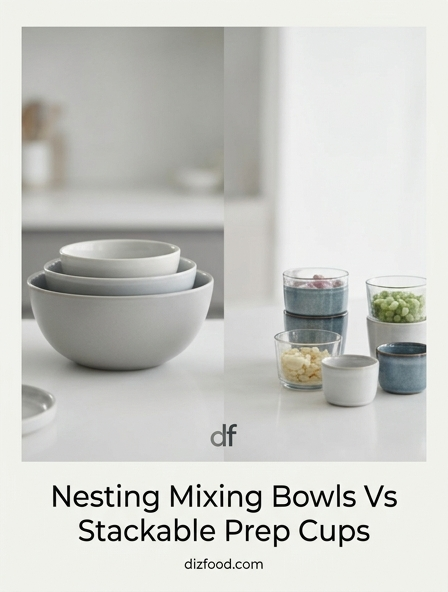
Nesting Mixing Bowls vs Stackable Prep Cups Overview
The modern kitchen thrives on efficiency and organization, two qualities epitomized by nesting mixing bowls and stackable prep cups. While both serve as essential vessels for food preparation, they fulfill distinct roles within the culinary workflow. Mixing bowls are typically the workhorses of the kitchen, designed for heavy-duty tasks such as kneading dough, tossing large salads, or whisking batters. Their primary design feature is a wide circumference and significant depth, allowing for vigorous movement without spilling contents. Because they nest within one another, they provide a full range of sizes while occupying only the footprint of the largest bowl.
In contrast, stackable prep cups are smaller, precision-oriented tools. They are specifically designed for the "mise en place" stage of cooking, where ingredients are measured and set aside before the actual cooking begins. These cups are ideal for holding spices, minced garlic, chopped herbs, or small liquid portions like soy sauce or vinegar. While mixing bowls handle the integration of ingredients, prep cups focus on the separation and organization of those components. Understanding the balance between these two types of containers is essential for any home cook looking to streamline their process. Below are the core differences in their primary functions:
- Mixing Bowls: Volume-heavy tasks, marinating, manual mixing, and serving.
- Prep Cups: Ingredient staging, portion control, and organized spice management.
- Design Focus: Bowls prioritize interior movement; cups prioritize visibility and accessibility.
Space Saving Kitchen Storage Solutions Compared
In smaller kitchens or urban apartments, cabinet real estate is a premium commodity. Both nesting mixing bowls and stackable prep cups are engineered to address the problem of clutter, but they do so through different geometric approaches. Nesting bowls utilize a concentric design where each smaller bowl fits perfectly inside the next larger size. This allows a set of six or eight bowls to take up no more horizontal space than a single large salad bowl. This vertical efficiency prevents the "cabinet avalanche" often associated with mismatched containers and lids.
Stackable prep cups, on the other hand, often feature a more uniform or slightly tapered shape that allows them to be stacked vertically into high columns. Because they are smaller, they can be tucked into narrow shelves or even stored inside the nested mixing bowls themselves. Choosing between them-or integrating both-depends on your specific storage constraints. Using a combination of both allows for a tiered storage system that maximizes every square inch of your pantry or drawer space.
| Storage Feature | Nesting Mixing Bowls | Stackable Prep Cups |
|---|---|---|
| Primary Footprint | Large (approx. 10-12 inches) | Small (approx. 3-4 inches) |
| Stacking Method | Concentric (One inside another) | Vertical (Bottom-to-top) |
| Ideal Location | Lower cabinets or deep drawers | Upper shelves or spice racks |
| Accessibility | Must unstack to reach middle sizes | Easy to grab individual units |
Best Uses for Large Nesting Mixing Bowls
Large nesting mixing bowls are the foundation of any baking or bulk meal preparation project. Their significant volume is necessary for tasks that involve air incorporation or chemical reactions, such as the rising of yeast dough or the whipping of egg whites into meringues. The curved interior of a high-quality mixing bowl is specifically designed to accommodate the sweep of a spatula or a whisk, ensuring that no dry pockets of flour are left at the bottom. Beyond baking, these bowls are indispensable for marinating meats, as they provide enough surface area for proteins to be fully submerged in liquid or rubbed with spices.
Another major use case is the preparation of voluminous greens. Tossing a Caesar salad or a kale mix requires enough room to move the ingredients without crushing the leaves or sloshing dressing over the sides. In a nesting set, the variety of sizes allows you to choose the perfect vessel for the specific task, ensuring you aren't using a five-quart bowl to whisk two eggs, which would be inefficient and create unnecessary cleanup. They also function well as temporary storage for peeled or chopped vegetables during large-scale meal prep sessions like Sunday "batch cooking."
- Kneading and proofing bread or pizza dough.
- Tossing large-scale salads and grain bowls.
- Whisking batters for pancakes, cakes, and muffins.
- Marinating large cuts of protein or poultry.
- Serving as a bain-marie (double boiler) for melting chocolate.
Benefits of Stackable Prep Cups for Mise en Place
Mise en place is a French culinary phrase meaning "everything in its place," and stackable prep cups are the physical manifestation of this philosophy. The primary benefit of using these small cups is the reduction of stress during the actual cooking process. When a recipe calls for adding ingredients in rapid succession-such as in a stir-fry or a complex sauce-having every spice, aromatic, and liquid already measured in its own cup prevents burning and timing errors. This systematic approach allows the cook to focus on heat management and technique rather than frantically measuring a teaspoon of cumin while the garlic is over-browning.
Furthermore, prep cups contribute to better hygiene and food safety. By portioning out ingredients beforehand, you avoid the risk of cross-contamination that occurs when reaching into large spice jars with hands that may have touched raw meat. They are also excellent for portion control in specialized diets, allowing you to pre-measure nuts, dressings, or snacks. Because they stack, you can line up ten different ingredients on a very small section of your countertop, keeping your primary workspace clear for chopping and assembly. This visual clarity helps even novice cooks follow complex instructions with greater confidence and precision.
Material Durability Stainless Steel vs Glass Options
When selecting between nesting bowls and prep cups, the choice of material is as important as the size. Stainless steel and glass are the two most popular options, each offering distinct advantages depending on the kitchen environment. Stainless steel is favored for its extreme durability and lightweight nature. It is virtually unbreakable, making it the ideal choice for high-volume kitchens or households with children. It also chills quickly, which is beneficial when whipping cream or chilling pastry dough. However, stainless steel is reactive with highly acidic foods if left for long periods and cannot be used in a microwave.
Glass options, particularly borosilicate or tempered glass, offer the advantage of being non-reactive and non-porous. This means they will not absorb odors or stains from pungent ingredients like garlic or turmeric. Glass is also transparent, which is highly useful for prep cups, as you can easily identify the contents from the side. The primary drawback of glass is its weight and fragility; it can chip or shatter if dropped, and glass sets are generally heavier to lift when nested. For those who frequently melt butter or chocolate, glass is often the winner because of its microwave compatibility.
| Feature | Stainless Steel | Glass (Tempered) |
|---|---|---|
| Weight | Very Lightweight | Heavy |
| Microwave Safe | No | Yes |
| Durability | High (Dents, doesn't break) | Moderate (Can shatter) |
| Non-Reactive | Mostly (Avoid long-term acid) | Fully Non-Reactive |
| Thermal Properties | Chills quickly | Retains heat well |
Capacity Differences Between Mixing Bowls and Prep Cups
The distinction between mixing bowls and prep cups is most clearly defined by their capacity. Mixing bowls are measured in quarts or liters, typically ranging from a small 1-quart bowl to a massive 8-quart or 10-quart professional size. A standard home nesting set usually includes a 1.5-quart, 3-quart, and 5-quart option. These capacities are designed to hold the "bulk" of the meal. For instance, a 5-quart bowl is necessary for a standard batch of cookie dough, providing enough headspace for the mixer to operate without throwing flour out of the container.
Prep cups are measured in ounces or fractions of a cup, typically ranging from 1 ounce (2 tablespoons) up to 1 or 2 cups. The smallest cups are intended for spices, salt, and leavening agents like baking soda. The mid-sized prep cups (around 4 to 8 ounces) are perfect for aromatics like chopped onions, celery, or carrots. Understanding these capacity thresholds helps a cook determine which tool to reach for. If you are holding an ingredient that will eventually be integrated into a larger mixture, the prep cup is the starting point. If you are doing the integration itself, the mixing bowl is the destination. This flow of volume-from small capacity to large capacity-is the rhythm of successful cooking.
- Mini Prep Cups: 1-2 oz (Spices, extracts, oils).
- Standard Prep Cups: 4-8 oz (Chopped aromatics, nuts, cheese).
- Small Mixing Bowls: 1-1.5 qt (Whisking eggs, small sauces).
- Medium Mixing Bowls: 2.5-3 qt (Cake batters, standard salads).
- Large Mixing Bowls: 5-8 qt (Bread dough, large pasta tosses).
Organizing Your Kitchen with Nesting Cookware Sets
Organization in the kitchen is about more than just aesthetics; it is about cognitive load. A disorganized kitchen forces the brain to work harder to find tools, which can lead to fatigue and mistakes. Nesting cookware sets, whether bowls or cups, provide an inherent organizational logic. Because they are designed as a unified set, they eliminate the visual noise of mismatched shapes and colors. When you open a cabinet and see a single, neat stack of bowls, your mind instantly knows exactly where every size is located. This predictability is a cornerstone of professional kitchen management.
To maximize the organizational benefits, it is recommended to store nesting sets in "zones." Mixing bowls should be placed near the primary prep area or the stand mixer, as they are most often used at the start of the cooking process. Stackable prep cups should be stored near the spice rack or the cutting board, where the chopping and measuring occur. Many modern sets also come with silicone or plastic lids. If your set includes lids, try to store them in a dedicated vertical organizer nearby. Keeping the lids separate from the nested stack ensures that you can still benefit from the space-saving nesting feature without having to wrestle with lids every time you need a bowl.
Versatility in Baking and Meal Preparation
The versatility of these tools extends far beyond their names. While a mixing bowl is named for its ability to combine ingredients, it is also an excellent tool for "shocking" vegetables in an ice bath or even serving as an informal punch bowl at a gathering. In baking, the varied sizes of a nesting set are vital for the "dry ingredients in one bowl, wet in another" method, which is the standard for muffins and quick breads. Having multiple bowls of different sizes allows you to manage these separate mixtures simultaneously without having to wash a bowl mid-recipe.
Prep cups are equally versatile. Outside of mise en place, they serve as excellent containers for individual portions of condiments like salsa, hummus, or ranch dressing for a snack platter. They can also be used as "pinch bowls" on the table for salt and pepper or as molds for small gelatin desserts or panna cotta. For those who practice portion control as part of a meal prep routine, stackable cups are the perfect size for measuring out daily servings of nuts or yogurt. This flexibility makes both sets indispensable, as they transition seamlessly from the preparation phase to the serving and even the storage phase of the culinary cycle.
Ease of Cleaning and Dishwasher Safety Factors
The utility of any kitchen tool is often judged by how easy it is to clean. Both nesting bowls and prep cups are generally designed with the dishwasher in mind, but there are nuances to consider. Stainless steel sets are almost always dishwasher safe and can withstand high-heat drying cycles without warping. However, if they have a silicone base for non-slip grip, it is important to check if the heat will eventually degrade the adhesive. Glass sets are also dishwasher safe and have the added benefit of being resistant to the "clouding" that can happen to plastic containers over time from detergent exposure.
Design details like the "rim" of the bowl or cup can significantly impact cleaning. A rolled rim on a stainless steel bowl can sometimes trap water in the dishwasher, leading to spotting or even rust if the steel is of lower quality. Flat-rimmed or "rimless" designs tend to dry more effectively. For prep cups, which are small and lightweight, there is a risk of them being flipped over by the water pressure in a dishwasher. Placing them in a secured rack or a mesh basket can prevent them from filling with dirty water. Overall, choosing sets with smooth, seamless interiors ensures that food particles don't get trapped in crevices, making hand-washing an easy secondary option.
Choosing the Right Set for Your Cooking Style
The final decision on whether to prioritize a high-quality set of nesting mixing bowls or a comprehensive collection of stackable prep cups depends on your personal cooking habits. If you are an avid baker who deals with large volumes of flour and dough, a heavy-duty set of stainless steel nesting bowls should be your first investment. The durability and capacity will serve your needs better than smaller containers. Conversely, if you enjoy complex, multi-ingredient cuisines like Thai, Indian, or French, the organization provided by stackable prep cups will be more transformative for your cooking experience.
For most home cooks, the ideal setup is a hybrid approach. A five-piece set of nesting bowls and an eight-piece set of prep cups cover nearly every possible culinary scenario. When shopping, look for features that enhance usability, such as measurement markings etched into the interior of the bowls and cups. This eliminates the need for separate measuring cups, further reducing the amount of equipment you need to clean. Consider also the "nesting height"; some sets nest completely flush, while others have a "stepped" profile. The flush-nesting sets are the ultimate space-savers for those with very limited storage. Ultimately, the right set is the one that makes you feel more organized and confident as you move through your kitchen.

Comments