
Choosing the right storage for your kitchen knives is about more than just aesthetics; it's a crucial decision for blade longevity, hygiene, and counter space optimization. While traditional wooden knife blocks offer a classic look and convenient accessibility, they can often harbor bacteria in hidden slots and inadvertently dull edges through repeated friction. Conversely, sleek magnetic knife strips provide a modern, space-saving solution that keeps your high-carbon steel blades visible and well-ventilated, effectively preventing moisture buildup and corrosion. Whether you prioritize the safety of enclosed storage or the professional efficiency of a wall-mounted display, understanding how these methods impact your culinary tools will help you maintain a sharper, safer, and more organized kitchen environment.
| Feature | Magnetic Knife Strip | Wooden Knife Block |
|---|---|---|
| Space Efficiency | Zero footprint; utilizes vertical wall space. | Requires 4-10 inches of valuable counter space. |
| Hygiene & Cleaning | Non-porous and easy to sanitize with a wipe. | Deep slots trap moisture, dust, and bacteria. |
| Blade Protection | Minimal contact; prevents edge chipping. | Frequent sliding against wood can dull tips. |
| Versatility | Fits any blade length or kitchen tool. | Limited by fixed number and size of slots. |
| Safety | High-mount keeps blades away from children. | Stable, but blades are at counter-level reach. |
| Visibility | Instant identification of the correct knife. | Blades are hidden; requires trial and error. |
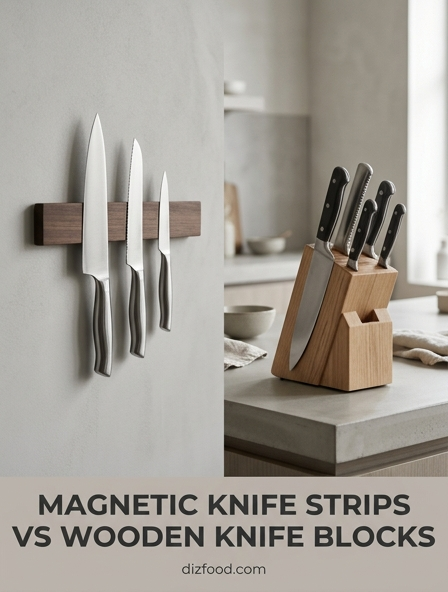
Magnetic Knife Strips vs Wooden Knife Blocks
The debate between magnetic knife strips and wooden knife blocks often centers on the balance between modern minimalism and traditional utility. For decades, the wooden knife block was the standard countertop fixture in most household kitchens. It provided a dedicated home for a set of knives, often sold together as a pre-packaged collection. However, as culinary enthusiasts have become more selective about their tools, the magnetic knife strip has surged in popularity. This shift reflects a broader trend toward professional-grade kitchen setups where efficiency and visibility are prioritized over bulk storage.
Choosing between these two methods involves evaluating your kitchen's workflow and the specific types of cutlery you own. While a block offers a sturdy, self-contained unit that requires no installation, a magnetic strip utilizes vertical space that is often neglected. The choice frequently boils down to whether a cook prefers their tools tucked away in a protective housing or displayed openly for immediate access. Both systems have evolved significantly, with modern blocks now featuring universal slots and magnetic strips incorporating wood veneers to protect delicate blades while maintaining a sleek profile. Ultimately, the decision impacts not just the organization of the kitchen, but also the longevity of the knives themselves.
Hygiene and Sanitation in Knife Storage
Hygiene is perhaps the most critical factor when comparing these two storage solutions. Wooden knife blocks are notorious for being difficult to sanitize. Because the slots are deep and narrow, they can harbor moisture, dust, and food particles. If a knife is inserted into a block while still slightly damp, it creates a dark, humid environment that is conducive to the growth of bacteria and mold. Since most users rarely clean the interior of the slots-largely because they cannot see inside them-this poses a hidden risk to food safety.
In contrast, magnetic strips are inherently more sanitary due to their open-air design. There are no hidden crevices where debris can accumulate, and the blades remain exposed to the air, allowing any residual moisture to evaporate quickly. Maintaining a magnetic strip usually requires nothing more than a quick wipe with a damp cloth and a mild disinfectant. To better understand the hygienic differences, consider the following points:
- Airflow: Strips allow 360-degree air circulation, preventing rust and bacterial blooms.
- Visibility: Magnetic surfaces allow you to see exactly where you are placing the knife, ensuring no cross-contamination.
- Accessibility for Cleaning: Blocks require specialized tools like pipe cleaners or compressed air to reach deep into slots, whereas strips are flat surfaces.
- Material Porosity: Many magnetic strips are made of non-porous stainless steel, which does not absorb oils or odors like wood can.
Countertop Space vs Wall Mounted Solutions
Kitchen real estate is often at a premium, making the footprint of your storage solution a vital consideration. For those with limited counter space, such as apartment dwellers or owners of galley-style kitchens, the wooden knife block can be a significant hindrance. These blocks often occupy a substantial square-foot area that could otherwise be used for food preparation or small appliances. Wall-mounted magnetic strips, on the other hand, reclaim this valuable workspace by moving the cutlery onto the backsplash or unused wall segments.
However, the choice is not always about saving space; it is also about the layout of the "work triangle" in the kitchen. A block can be moved around, allowing it to be placed exactly where the prep work is happening. A wall strip is stationary, meaning the cook must always return to the same spot to retrieve or store a tool. Below is a comparison of how these two solutions impact kitchen ergonomics:
| Feature | Magnetic Knife Strip | Wooden Knife Block |
|---|---|---|
| Space Utilization | Uses vertical wall space; leaves counters clear. | Occupies 20-50 square inches of countertop. |
| Portability | Fixed to the wall; permanent installation. | Mobile; can be moved to different prep areas. |
| Installation | Requires drilling or high-strength adhesive. | None; ready to use out of the box. |
| Accessibility | Keeps knives at eye level and within reach. | Keeps knives at waist level, often under cabinets. |
Protecting Blade Edges and Sharpness
The primary function of any storage device is to protect the knife's edge. A dull knife is not only inefficient but also dangerous. In a wooden block, the blade's edge frequently rubs against the interior of the slot every time the knife is inserted or removed. Over hundreds of repetitions, this friction can microscopically roll or dull the edge, especially if the block is made of a harder wood or if the user is not careful to slide the spine of the knife against the wood instead of the edge.
Magnetic strips present a different set of risks and benefits regarding sharpness. While there is no slot to rub against, the act of "clicking" a knife onto a powerful magnet can occasionally chip brittle, high-carbon steel blades if the contact is too forceful. To prevent this, users are taught to lead with the spine of the knife and pivot the edge onto the magnet. Some high-end magnetic strips are encased in wood or silicone to provide a softer landing for the steel, effectively combining the safety of a soft surface with the convenience of a magnetic hold. For ceramic knives, magnetic strips are non-functional, leaving the block or a protective sheath as the only viable options.
Pros and Cons of Magnetic Holders
Magnetic holders are favored by professional chefs for their efficiency and aesthetic appeal. They offer a "gallery" look that showcases the quality of the cutlery, making the kitchen feel like a serious culinary workspace. Because the entire blade is visible, there is no guesswork involved in grabbing the right tool. However, these holders are not without their drawbacks, particularly in households with children or pets where exposed blades could pose a significant hazard.
- Pro: Instant Identification. You can immediately distinguish between your 8-inch chef's knife and your 7-inch santoku without pulling them out half-way.
- Pro: Universal Fit. Unlike blocks with pre-sized slots, a strip can hold any metal tool, including kitchen shears, pizza cutters, or bench scrapers.
- Con: Weight Limits. Heavy cleavers may slide or fall if the magnetic force is insufficient, potentially damaging the floor or the knife.
- Con: Installation Requirements. Mounting a strip securely often requires drilling into tile or cabinetry, which may not be an option for renters.
- Con: Incompatibility. They do not work with ceramic, titanium, or some types of stainless steel that have low magnetic permeability.
Traditional Wooden Knife Block Benefits
Despite the rise of magnetic strips, the traditional wooden knife block remains a staple for several reasons. One of the most significant benefits is the physical protection it provides. By fully enclosing the blades, the block prevents accidental cuts when reaching across the counter. It also protects the knives from external environmental factors like grease splatters or falling objects. For many, the weight and stability of a solid oak or walnut block provide a sense of security and a classic aesthetic that fits perfectly in farmhouse or traditional kitchen designs.
Furthermore, many modern blocks have moved away from the "fixed slot" design. Universal blocks filled with plastic rods or varied horizontal slots allow users to mix and match knives from different brands and sizes. This flexibility addresses the old complaint that blocks were only useful for the specific sets they came with. Additionally, blocks often include a dedicated slot for a honing steel and kitchen shears, keeping all essential maintenance tools in one centralized location. This consolidation is highly convenient for home cooks who prefer to have their entire cutting kit organized in a single, portable unit that can be tucked into a corner or a pantry when not in use.
Ease of Cleaning and Maintenance
Maintenance requirements for these two storage types differ significantly in terms of frequency and effort. A magnetic strip is essentially "set it and forget it." Beyond a periodic wipe-down to remove dust or grease from cooking vapors, it requires almost no upkeep. If the strip is made of stainless steel, it is resistant to rust and can handle standard kitchen cleaning agents. If it is a wood-covered magnetic strip, a light application of mineral oil once a year will keep the wood from drying out and cracking.
Wooden blocks require a more rigorous maintenance schedule to ensure they remain sanitary. Experts recommend deep cleaning a block at least once every few months. This involves shaking out any crumbs, using a small brush or pipe cleaner with a bleach solution to scrub the slots, and ensuring the block is completely dry before reinserting knives. Because wood is a natural material, it can warp if it gets too wet or crack if it becomes too dry. Therefore, it requires regular conditioning with food-grade mineral oil to maintain its structural integrity and appearance. For most busy home cooks, the simplicity of the magnetic strip's maintenance profile is a major selling point compared to the labor-intensive care required for a traditional block.
Visual Accessibility and Knife Organization
The psychological ease of working in a kitchen where every tool is visible cannot be overstated. Visual accessibility is the hallmark of the magnetic knife strip. When knives are stored in a block, the handles are the only visible part of the tool. This often leads to a "guessing game" where the cook pulls out three different knives before finding the one they need, especially if the knives are part of a uniform set with identical handles. This minor friction can disrupt the flow of meal preparation.
Organization on a magnetic strip is also more customizable. You can arrange knives by size, by frequency of use, or by type (e.g., serrated vs. straight edge). The open layout allows for the storage of non-standard items that would never fit in a block, such as wide-bladed cleavers or offset offset spatulas. However, a wooden block provides a different kind of organization-one that is structured and compact. For those who prefer a clean, "hidden" look, the block keeps the visual clutter of many different blade shapes out of sight. It creates a designated zone for cutlery, whereas a magnetic strip can sometimes look cluttered if it is overloaded with too many tools of varying sizes and conditions.
Safety Considerations for Kitchen Storage
Safety is a primary concern, particularly in households with children. A magnetic knife strip presents a clear risk because the blades are exposed and often mounted at a height that might be reachable by curious toddlers or accidentally bumped by adults. If a knife is not placed perfectly on the strip, or if the magnet is weak, a heavy knife could fall, leading to serious injury. Users must be disciplined about how they attach and remove knives to ensure they don't accidentally knock adjacent blades off the strip.
Wooden blocks are generally considered the safer option for family homes. The blades are shielded, and the sharp edges are directed inward, making it nearly impossible to cut oneself while simply reaching for something nearby. The heavy base of a block also makes it difficult to tip over. However, safety isn't just about accidental touches; it's also about stability. A magnetic strip mounted with cheap adhesive rather than screws is a disaster waiting to happen. Likewise, a block that is too light can slide around on a wet countertop. To ensure safety regardless of the storage method, consider the following:
- Mount magnetic strips at least 5 feet high to keep them out of reach of children.
- Ensure the magnetic strip has a "north-to-south" magnetic field to prevent knives from pivoting.
- Check that wooden blocks have non-slip rubber feet to prevent sliding during use.
- Never store knives with the edge facing the user in a block; always ensure they are seated properly.
Durability of Different Knife Storage Materials
The lifespan of your storage solution depends heavily on the materials used. Wooden blocks are typically made from hardwoods like acacia, rubberwood, oak, or walnut. These materials are durable but susceptible to the elements. Over time, constant contact with metal blades can score the wood, and exposure to kitchen humidity can cause the wood to expand or contract, potentially splitting the block. However, a well-maintained, high-quality wooden block can easily last 20 years or more.
Magnetic strips are often constructed from stainless steel, aluminum, or wood-encased magnets. The magnets themselves, usually made of neodymium or ferrite, lose their strength at an incredibly slow rate-often less than 1% over a decade-meaning the "holding power" of the strip is essentially permanent for the lifetime of the kitchen. Stainless steel strips are nearly indestructible and resistant to heat, moisture, and impact. Wood-faced magnetic strips offer a middle ground; they provide the aesthetic of wood but are subject to the same wear and tear as blocks, such as drying out or staining. When considering durability, the magnetic strip generally wins due to its lack of moving parts and simpler construction, whereas the longevity of a block is entirely dependent on the user's commitment to regular cleaning and oiling.

Comments