
Achieving your dream physique requires more than just showing up to the gym; it demands a strategic approach to your kitchen habits that aligns with your physiological goals. Whether you are aiming for a calorie deficit to strip away body fat or muscle gain planning to build lean mass, your meal prep strategy must shift to meet these specific metabolic demands. While a deficit focuses on high-volume, low-calorie foods to keep hunger at bay, a surplus prioritizes nutrient-dense, calorie-heavy fuels to support intense training and recovery. By tailoring your macronutrient ratios and food selection, you transform your meal prep from a chore into a precision tool designed for targeted results.
| Feature | Calorie Deficit (Fat Loss) | Muscle Gain (Bulking) |
|---|---|---|
| Energy Target | 10-20% below TDEE (Maintenance) | 5-15% above TDEE (Maintenance) |
| Protein Priority | High (1.2-1.5g per lb) to preserve lean mass | Moderate-High (0.8-1g per lb) for repair |
| Carb/Fat Role | Lower carbs; fats for hormonal health | High carbs to fuel performance & insulin spikes |
| Food Density | Low calorie/High volume (Leafy greens, berries) | High calorie/Low volume (Nuts, oils, pasta) |
| Meal Frequency | Lower frequency or Intermittent Fasting | Higher frequency (4-6 meals per day) |
| Prep Strategy | Weighing portions; fiber-heavy "bulk" meals | Liquid calories; pre-workout carb loading |
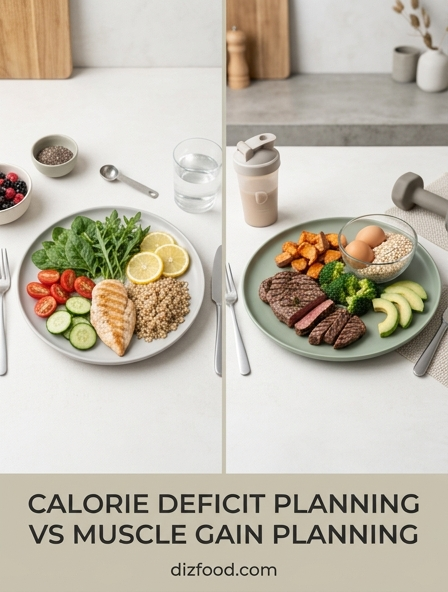
Defining the Core Differences Between Fat Loss and Muscle Growth
At the fundamental level, the kitchen serves as the laboratory where the body's metabolic direction is determined. Fat loss and muscle growth are governed by the laws of thermodynamics, yet they represent opposing physiological states. A caloric deficit, the hallmark of fat loss, forces the body to mobilize stored adipose tissue to meet energy demands. This catabolic process requires precise management of nutrient density to ensure that energy is pulled from fat stores rather than functional muscle tissue. Conversely, muscle growth, or hypertrophy, necessitates an anabolic environment fueled by a caloric surplus. In this state, the body has an abundance of energy, allowing it to invest in the calorically expensive process of repairing and expanding muscle fibers.
The distinction between these two goals is not merely about the volume of food, but the metabolic signaling involved. When cutting, the primary objective is to maximize fat oxidation while maintaining metabolic rate. When gaining, the objective is to maximize protein synthesis while minimizing unnecessary fat accumulation. While "body recomposition" attempts to achieve both simultaneously, most advanced practitioners find that dedicated phases allow for more significant progress. Success in either direction requires a shift in how one views the kitchen: it is either a tool for restriction and efficiency or a resource for fuel and structural expansion.
Nutritional Foundations for Caloric Deficits Versus Bulking Cycles
Establishing a nutritional baseline is the first step in any kitchen-based body transformation. For a caloric deficit, the focus shifts toward high-volume, low-calorie foods that provide satiety without overshooting the energy budget. This involves prioritizing fibrous vegetables and lean proteins that slow digestion. Most successful deficit plans involve a reduction of 15% to 25% below Total Daily Energy Expenditure (TDEE). This margin is large enough to trigger fat loss but small enough to prevent severe hormonal downregulation.
Bulking cycles, however, require a foundational shift toward energy-dense foods. If a trainee struggles to consume enough calories, the kitchen must be stocked with "easy" calories such as liquid nutrition, healthy fats, and refined carbohydrates. A surplus of 250 to 500 calories above TDEE is generally sufficient to support growth without excessive fat gain. The foundational differences can be summarized as follows:
- Deficit Planning: Focus on food volume to manage hunger; emphasis on "single-ingredient" whole foods to maximize micronutrient intake per calorie.
- Surplus Planning: Focus on calorie density; strategic use of oils, nuts, and starches to meet high energy requirements without digestive distress.
- Hydration: High water intake is crucial in a deficit to manage appetite, whereas in a surplus, it assists with the increased metabolic demand of processing more food.
Training Intensity Shifts for Weight Loss Compared to Hypertrophy
While the kitchen dictates the scale weight, training intensity dictates the quality of the weight lost or gained. During a weight loss phase, the primary role of resistance training is the preservation of existing muscle mass. Because energy is low, the body may attempt to shed metabolically expensive muscle; therefore, the trainee must provide a reason for the body to keep it. This means maintaining high intensity (the weight on the bar) while potentially reducing overall volume (total sets) to account for slower recovery times. Training in a deficit is often a battle of attrition, focusing on maintaining strength milestones rather than setting new ones.
In contrast, training for hypertrophy during a mass-gaining phase allows for aggressive progressive overload. With a surplus of glycogen and amino acids available, the trainee can handle higher volumes and increased frequency. The goal here is to push the boundaries of muscular fatigue to trigger the greatest possible adaptive response. In the kitchen, this translates to timed carbohydrate intake around the workout window to fuel performance and kickstart the recovery process. While a cutter might feel "flat" and struggle with pumps, a gainer utilizes the surplus to achieve maximal muscle swelling and workload capacity, making the most of the anabolic window provided by their diet.
Macro Distribution Strategies for Cutting and Gaining Phases
Macro distribution acts as the fine-tuning mechanism for body composition. In a cutting phase, the ratios typically lean toward higher protein and moderate fats, with carbohydrates being the primary variable manipulated to control calories. This ensures that the muscle is protected and hormones remain stable while the body is forced to burn fat. In a gaining phase, carbohydrates take center stage as they are highly anabolic and protein-sparing, allowing the surplus energy to be used efficiently for muscle repair.
The following table illustrates the typical shift in macronutrient priorities between the two phases:
| Macronutrient | Cutting (Deficit) Priority | Gaining (Surplus) Priority |
|---|---|---|
| Protein | Very High (1.2g+ per lb) | High (0.8g - 1g per lb) |
| Carbohydrates | Moderate to Low (Cyclical) | High (Energy for Performance) |
| Fats | Moderate (Hormonal Health) | Moderate (Calorie Density) |
During a cut, "carb cycling" is often used to keep the metabolism reactive. During a bulk, fats are kept high enough to support testosterone but low enough to allow for the massive carbohydrate intake required for heavy training sessions.
The Role of Protein Intake in Deficit vs Surplus Planning
Protein is the most critical macronutrient in the kitchen, but its role changes based on energy balance. In a caloric deficit, protein requirements actually increase. This counter-intuitive reality exists because, in the absence of sufficient dietary energy, the body is more likely to oxidize amino acids for fuel. A higher protein intake (often exceeding 1 gram per pound of body weight) provides a "buffer," ensuring that there are enough circulating amino acids to prevent the breakdown of skeletal muscle. Furthermore, protein has the highest Thermic Effect of Food (TEF), meaning the body burns more calories digesting it than it does for fats or carbs, which slightly aids the deficit.
In a surplus, protein is still vital, but its relative importance decreases slightly because carbohydrates and fats are "protein-sparing." When the body has an abundance of glucose and fatty acids, it has no need to burn protein for energy, allowing almost all ingested protein to be used for tissue synthesis. Therefore, a gainer can often see excellent results with slightly lower protein percentages than a cutter, provided their total calories are high. The kitchen focus during a bulk is on the quality and timing of protein-ensuring a steady stream of leucine-rich sources to keep Muscle Protein Synthesis (MPS) elevated throughout the day.
Recovery Requirements for Muscle Building Compared to Fat Loss
Recovery is where the actual transformation happens, yet it is often the most overlooked aspect of kitchen planning. In a caloric deficit, the body is in a state of physiological stress. Cortisol levels tend to rise, which can lead to water retention and hindered recovery. This necessitates a greater focus on anti-inflammatory foods and micronutrient-dense meals. Sleep is the primary recovery tool, but the kitchen supports this through magnesium-rich foods or evening meals that include small amounts of complex carbohydrates to aid in serotonin and melatonin production.
During a muscle-building phase, recovery is "easier" because the body is flooded with nutrients. However, the sheer volume of training required for hypertrophy places a different kind of stress on the central nervous system and joints. Recovery planning in the kitchen for a gainer focuses on reducing systemic inflammation caused by high-calorie, high-carb intake and ensuring that micronutrients like Zinc, Vitamin D, and Omega-3s are sufficient to support tissue repair. While a cutter recovers to survive the next workout, a gainer recovers to grow larger. If recovery isn't prioritized during a bulk, the surplus will simply result in fat gain because the body cannot effectively utilize the extra energy to build new muscle tissue.
Metabolic Adaptations During Caloric Restriction and Mass Gaining
The human body is an adaptive machine that seeks homeostasis. During prolonged caloric restriction, the body undergoes "adaptive thermogenesis." It becomes more efficient, lowering the basal metabolic rate and decreasing Non-Exercise Activity Thermogenesis (NEAT). In the kitchen, this manifests as a "stalling" of weight loss, requiring further caloric reductions or "refeed" days to convince the body it is not starving. Understanding these adaptations is crucial to prevent the metabolic crash that often follows aggressive dieting.
Conversely, during a mass-gaining phase, the metabolism often speeds up. The thermic effect of eating more food, combined with the energy required to carry more body weight and move more weight in the gym, increases the TDEE. Some individuals, known as "hardgainers," experience a massive surge in NEAT-they subconsciously fidget or move more-which burns off the surplus. For these individuals, kitchen planning must be even more aggressive to stay ahead of their rising metabolic rate. Recognizing these adaptations allows a trainee to adjust their meal plans proactively rather than reactively, ensuring that they don't plateau in their fat loss or remain stagnant in their muscle growth journey.
Effective Goal Setting for Body Recomposition and Growth
Goal setting in the kitchen requires different metrics for success depending on the phase. For those seeking fat loss, the scale is a useful but flawed tool. Successful deficit planning should also track waist measurements and mirror progress, as water fluctuations can mask fat loss. Goals should be centered on "non-scale victories," such as adherence to the meal plan and maintaining strength levels despite the lower energy. A realistic fat loss goal is typically 0.5% to 1% of body weight per week to ensure the weight lost is primarily adipose tissue.
For muscle growth, the goals are more long-term. Muscle tissue grows at a much slower rate than fat can be lost. A successful bulk might see a weight gain of only 1 to 2 pounds per month for an intermediate trainee. Goal setting here focuses on:
- Strength Milestones: Increasing the weight or reps in key compound movements.
- Caloric Consistency: Meeting daily surplus targets without missing meals.
- Body Composition: Ensuring that the gain in size is reflected in muscle fullness rather than just midsection expansion.
Cardio Integration Differences for Leaner or Larger Physiques
Cardio is a tool used differently in the kitchen-gym relationship. In a fat loss phase, cardio is primarily an "energy balancer." It allows the trainee to create a larger deficit without having to cut food to dangerously low or unsustainable levels. Low-Intensity Steady State (LISS) cardio is often preferred during a cut because it burns calories without adding significant recovery stress to a body already struggling with low energy. It is a way to "earn" more food, making the diet more psychologically bearable.
In a muscle-building phase, cardio's role shifts toward cardiovascular health and metabolic flexibility. It is not used to burn calories-since the goal is a surplus-but rather to ensure that the heart can support the increased body mass and that the metabolism remains efficient at partitioning nutrients. A gainer might perform limited HIIT (High-Intensity Interval Training) or moderate LISS to keep fat gain at bay and improve insulin sensitivity. This ensures that the surplus of carbohydrates is directed toward muscle cells rather than fat cells. In both cases, cardio should be viewed as a supplement to the diet, not a replacement for it, with the kitchen remaining the primary driver of the physique's direction.
Transitioning Between Cutting and Bulking for Long Term Success
The most dangerous time for a physique is the transition between phases. After a long caloric deficit, the body is primed to store fat; hormones like leptin are low, and hunger signals are high. Jumping immediately into a "dirty bulk" can result in rapid fat regain, often exceeding what was lost. The kitchen strategy here should be a "reverse diet," where calories are slowly added back to maintenance levels over several weeks. This allows the metabolism to stabilize and prevents the "rebound" effect that ruins many successful cuts.
Similarly, transitioning from a bulk to a cut requires a period of "consolidation." After months of eating in a surplus, the body needs time to adjust to its new, higher weight. Staying at maintenance for 2 to 4 weeks before starting the deficit helps "set" the new muscle mass and allows the nervous system to recover from heavy training. Long-term success is found in these "bridge" phases. They ensure that the kitchen remains a place of controlled transition rather than chaotic swings between overeating and starvation. By respecting the transition, a trainee ensures that each phase builds upon the last, leading to a leaner, more muscular physique over the years.






Comments