
Ever feel like you're forced to choose between bland, budget-friendly basics and a five-star dinner that empties your wallet? Mastering the art of "High-Low" meal planning allows you to bridge that gap by strategically investing in high-impact ingredients while saving on dietary staples. By pairing affordable, nutrient-dense foundations like legumes and grains with "gourmet flavor bombs"-such as aged cheeses, cold-pressed oils, or fresh aromatics-you can achieve a restaurant-quality experience for a fraction of the cost. This strategy isn't just about spending less; it's about applying culinary techniques that maximize the sensory ROI of every dollar in your grocery budget.
| Feature | Budget Strategy | Gourmet Strategy | The Value Hybrid |
|---|---|---|---|
| Core Ingredients | Bulk grains, beans, tubers | Prime cuts, organic imports | Bulk base + 1 premium protein |
| Flavor Profile | Dried herbs, salt, sugar | Fresh herbs, complex reductions | Acid (lemon/vinegar) + umami pastes |
| Avg. Cost/Meal | $1.50 - $3.00 | $15.00 - $40.00+ | $4.00 - $7.00 |
| Prep Focus | Batch cooking, efficiency | Precision techniques (sous-vide) | High-heat searing, slow braising |
| Shelf Life | High (processed/dried) | Low (fresh/unprocessed) | Balanced (frozen base + fresh garnish) |
| Nutritional Value | High Macro, Low Micro | Balanced, bioavailable | Optimized nutrient density/cost ratio |
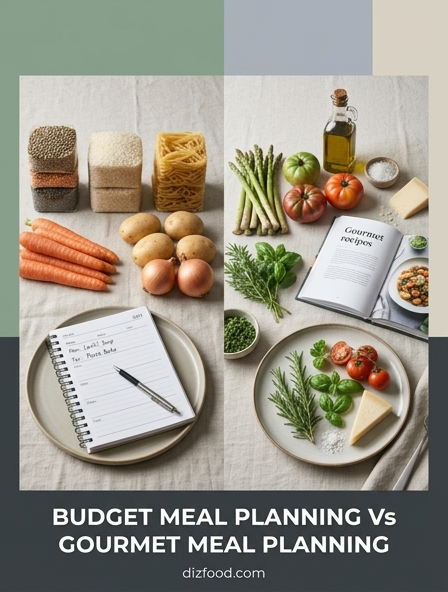
Defining Budget Meal Planning vs Gourmet Meal Planning
Budget meal planning is a strategic approach to nutrition that prioritizes financial sustainability and resourcefulness. The primary goal is to minimize the cost per serving while maintaining adequate caloric intake and basic nutritional requirements. This method often relies on high-volume, low-cost ingredients such as grains, legumes, and seasonal produce. In the budget framework, the cook acts as a manager of resources, focusing on inventory control, bulk purchasing, and the elimination of food waste to ensure the household remains within a strict monetary limit.
Conversely, gourmet meal planning treats the kitchen as a studio for artistic expression and sensory exploration. Here, the focus shifts from cost-minimization to quality-maximization. Gourmet planning is characterized by the selection of premium, often rare, ingredients and the application of complex culinary techniques. While budget planning asks "How can I feed the family for twenty dollars?", gourmet planning asks "How can I achieve the perfect balance of acidity, texture, and umami?"
- Budget focus: Caloric density, shelf-life, and multi-meal versatility.
- Gourmet focus: Flavor profiles, aesthetic presentation, and ingredient provenance.
- Budget tools: Coupons, sales flyers, and unit-price calculators.
- Gourmet tools: Specialty purveyors, seasonal calendars, and technical recipes.
Ultimately, the two philosophies represent different ends of the culinary spectrum. One serves the necessity of sustenance, while the other serves the luxury of experience, though both require significant organization and foresight to execute successfully.
The Cost Gap Between Pantry Staples and Premium Ingredients
The financial disparity between budget-friendly pantry staples and gourmet ingredients is often exponential. A budget-oriented kitchen is built on "anchor ingredients"-items that are shelf-stable, versatile, and inexpensive. These include bulk white rice, dried lentils, flour, and vegetable oil. These items provide the structural foundation of a meal at a fraction of the cost of their high-end counterparts. In a budget setting, the price of a protein might be the most scrutinized variable, often leading to the selection of chicken thighs or canned tuna over more expensive cuts.
In contrast, gourmet cooking frequently demands premium ingredients that carry significant price premiums due to their rarity, labor-intensive production, or geographical origin. The difference in price can be staggering when comparing basic versions of an ingredient to their artisanal versions. This cost gap is not merely a matter of branding; it often reflects a difference in flavor concentration and texture.
| Category | Budget Staple | Gourmet Alternative |
|---|---|---|
| Fats | Canola Oil ($0.05/oz) | First-Press Extra Virgin Olive Oil ($1.50+/oz) |
| Fungi | Canned Buttons ($1.00/can) | Fresh Chanterelles or Porcini ($30.00+/lb) |
| Grains | Long Grain White Rice ($0.50/lb) | Aged Carnaroli or Saffron-infused Basmati ($5.00+/lb) |
| Seasoning | Table Salt ($0.02/oz) | Maldon Sea Salt or Fleur de Sel ($2.00+/oz) |
The accumulation of these price differences results in a meal that can cost five to ten times more than its budget equivalent, highlighting the economic divide in kitchen planning.
Balancing Nutritional Density on a Strict Weekly Budget
Achieving a nutritionally complete diet on a shoestring budget requires a deep understanding of nutrient density versus price. The challenge for the budget meal planner is to avoid "empty calories"-foods that are cheap and filling but lack essential vitamins and minerals. To solve this, savvy planners often turn to the frozen aisle and the bulk bin. Frozen vegetables, for example, are often more nutrient-dense than "fresh" produce that has spent days in transport, yet they cost significantly less.
Maximizing nutrition on a budget involves prioritizing "super-staples" that offer a high return on investment. The following hierarchy is often used to ensure health is not sacrificed for savings:
- Plant-Based Proteins: Lentils, chickpeas, and black beans provide fiber and protein at a lower cost than any meat.
- Whole Grains: Brown rice, oats, and barley offer sustained energy and B-vitamins compared to refined whites.
- Inexpensive Powerhouses: Eggs, spinach, and sweet potatoes are relatively low-cost but packed with micronutrients.
- Healthy Fats: Buying large containers of peanut butter or flaxseeds provides essential fatty acids without the price tag of avocado oil.
By focusing on these pillars, a budget planner can construct a diet that rivals gourmet menus in health outcomes. The difficulty lies in the monotony of these ingredients, which requires the cook to be creative with spices and preparation methods to ensure the meals remain palatable over the long term.
Time Efficiency and Advanced Culinary Techniques Compared
Time is a currency just as valuable as money in the kitchen, and the two planning styles utilize it differently. Budget meal planning is often synonymous with time efficiency. Techniques such as batch cooking, "meal prepping" on Sundays, and the use of slow cookers are designed to minimize the active time spent in the kitchen during a busy work week. The goal is a high output of edible portions with minimal labor. For the budget cook, a "one-pot meal" is the pinnacle of efficiency, reducing both preparation and cleanup time.
Gourmet meal planning, however, often embraces time-consuming, labor-intensive processes as a means to achieve superior flavor and texture. Advanced culinary techniques like sous-vide, clarifying stocks for consommé, or tempering chocolate require precision and patience. In a gourmet kitchen, time is an ingredient. A sauce might take three days of reduction to reach the desired consistency, or a piece of meat might undergo a 48-hour dry-aging process. These methods are not efficient, but they are essential for the complexity associated with fine dining. While the budget planner looks for shortcuts, the gourmet planner looks for the "long way" that yields the best result. This creates a sharp divide: the budget cook saves time to live their life, while the gourmet cook spends time as a form of hobby or passion.
Essential Kitchen Tools for Frugal and High End Cooking
The tools found in a kitchen often reflect the philosophy of the cook. A budget-conscious kitchen functions on a "minimalist-multipurpose" rule. Every tool must earn its keep by performing multiple tasks. A high-quality chef's knife, a large cast-iron skillet, and a sturdy stockpot are the workhorses of the frugal kitchen. These items are durable, often lasting a lifetime, and can handle everything from searing cheap cuts of meat to simmering large batches of beans.
The gourmet kitchen, by contrast, is often populated with specialized, "task-specific" equipment designed to achieve professional-grade results. While a budget cook might use a hand whisk, a gourmet planner might insist on a stand mixer with specific attachments or a high-speed blender for ultra-smooth purees. The high-end kitchen often looks like a laboratory, featuring precision instruments that are rarely found in an economy-focused home.
- Frugal Essentials: Slow cooker, stainless steel mixing bowls, box grater, and silicone spatulas.
- Gourmet Essentials: Immersion circulator, digital gram scale, mandoline slicer, and carbon steel pans.
- Specialty Tools: Culinary torch, pasta machine, and siphon for foams.
While a skilled cook can produce great food with either set of tools, the high-end equipment allows for a level of consistency and textural refinement that is difficult to replicate with basic gear. However, the initial investment for a gourmet kitchen can run into the thousands, whereas a functional budget kitchen can be outfitted for a few hundred dollars.
Smart Grocery Shopping Strategies for Every Price Point
The success of any meal plan is determined at the grocery store. For budget planners, shopping is a tactical exercise. It involves "loss leader" shopping-visiting multiple stores to buy only the items on deep discount. These shoppers master the art of the unit price, understanding that a larger bag is not always cheaper. They shop the perimeter for produce but dive into the middle aisles for bulk dry goods, often opting for generic or store brands which are frequently identical in quality to name brands.
Gourmet shopping strategies focus on sourcing and seasonality rather than price. A gourmet planner might visit three different specialty shops: a local butcher for dry-aged beef, a cheesemonger for unpasteurized brie, and a farmers' market for heirloom tomatoes. Their strategy is built on relationships with purveyors to ensure they get the "first pick" of the best arrivals.
| Strategy Component | Budget Approach | Gourmet Approach |
|---|---|---|
| Venue | Discount Warehouses / Salvage Grocers | Artisanal Markets / Direct-from-Farm |
| Timing | Weekly Sales Cycles / Late-night markdowns | Peak Seasonal Harvest / Arrival Dates |
| Brand Choice | Generic / Private Label | Imported / Single-Origin / Small-Batch |
Both styles benefit from a list and a plan, but the budget shopper's list is dictated by what is cheap, while the gourmet shopper's list is dictated by what is at its absolute peak of quality.
Elevating Simple Flavors vs Masterful Gourmet Complexity
Flavor development is where the two styles truly diverge in execution. In budget cooking, the goal is "elevation." Since the base ingredients may be humble, the cook relies on high-impact, low-cost flavor enhancers. This includes the heavy use of aromatics like onions and garlic, the application of acidic brightness via vinegar or citrus zest, and the strategic use of dried spices. A budget meal relies on one or two "hero" flavors to make a simple dish like lentil soup or pasta more exciting. It is about making "more with less."
Gourmet complexity is a different beast entirely. It is not about making one flavor stand out, but about building layers of flavor that evolve as you eat. This often involves techniques like "fond" development (deglazing the browned bits in a pan), using homemade bone broths instead of water, and incorporating "hidden" ingredients like anchovy paste or miso to add depth. A gourmet dish might feature a contrast of temperatures, textures (crunchy vs. silky), and tastes (sweet, salty, bitter, sour) all in a single bite. While the budget dish is a catchy pop song-simple and satisfying-the gourmet dish is a symphony, where every ingredient plays a specific, calculated role in a larger, more complex arrangement.
Waste Reduction Methods for Thrifty and Fine Dining
Waste reduction is a shared goal but stems from different motivations. In a budget kitchen, waste reduction is a financial necessity. Every discarded broccoli stem or stale bread crust represents lost money. Frugal waste management is about "reincarnation." The remains of a Sunday roast become Monday's stew; vegetable scraps are collected in the freezer for stock; sour milk is used for pancakes. The mindset is "nose-to-tail" but for the entire pantry.
In fine dining and gourmet planning, waste reduction is often about "refinement" and sustainability. While gourmet chefs might trim a vegetable into a perfect cube (creating waste), the "scraps" are often repurposed into high-end components like emulsions, infusions, or dehydrated powders. This is frequently seen in modern kitchens where "sustainability" is a hallmark of luxury.
- The Stock Bag: Both styles use onion skins and carrot ends to create flavorful bases, avoiding store-bought liquids.
- Preservation: Gourmet cooks might ferment or pickle excess produce, while budget cooks might freeze it.
- Portion Control: Budget cooks use portions to ensure leftovers; gourmet cooks use them to ensure the "perfect plate" without excess.
Ultimately, the thifty cook saves the scrap to fill a belly later, while the gourmet cook saves the scrap to extract its essence for a future sauce, ensuring no flavor potential is lost.
The Lifestyle Impact of Choosing Economy over Elegance
The choice between budget and gourmet planning significantly impacts daily life and psychological well-being. Budget meal planning, while financially responsible, can sometimes lead to "decision fatigue" or a sense of deprivation. The constant monitoring of prices and the repetitive nature of low-cost meals can make eating feel like a chore or a purely functional act. However, the lifestyle benefit is a reduction in financial stress and the pride of being self-sufficient and disciplined. It often fosters a "maker" culture within the home, where skills are honed out of necessity.
Gourmet planning elevates the kitchen to a place of recreation and status. It transforms the act of eating into a social event and a hobby. This lifestyle choice prioritizes pleasure and curiosity, often leading to a more adventurous palate and a deeper connection to different cultures. The downside, however, is the significant drain on both time and disposable income. It can also create an "elitist" barrier to cooking, where one feels they cannot cook unless they have the finest ingredients. Choosing economy often leads to a more grounded, practical lifestyle, while choosing elegance leads to a more sensory-rich, though potentially more volatile, domestic experience.
Blending Frugality with Fine Dining for Optimal Results
The most successful home cooks often inhabit the middle ground, practicing what is known as "High-Low" cooking. This philosophy involves using budget-saving strategies on 80% of the meal to justify a "gourmet splurge" on the remaining 20%. By mastering the techniques of both worlds, a cook can achieve optimal results-eating like a king on a commoner's salary. This might mean serving a perfectly seared, expensive dry-aged steak alongside a massive, low-cost side of roasted seasonal root vegetables and a sauce made from kitchen scraps.
Blending these worlds requires a specific set of habits:
- Invest in Technique: A gourmet technique applied to a budget ingredient (like a slow-braised beef shank) yields better results than a poorly cooked expensive cut.
- Strategic Splurging: Buy the cheap pasta, but buy the high-end Parmigiano-Reggiano to grate over it.
- Grow Your Own: A budget-friendly way to get gourmet herbs and microgreens is a small windowsill garden.
- Bulk Gourmet: Buy luxury items like truffle oil or saffron in bulk online to lower the per-use cost.
This hybrid approach removes the stress of extreme budgeting and the pretension of pure gourmet planning. It creates a sustainable, enjoyable kitchen culture where quality is valued, but financial health is maintained, proving that elegance and economy are not mutually exclusive.

Comments