
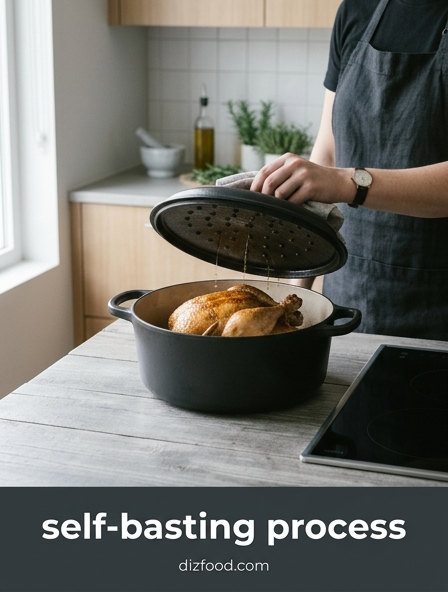
Mechanics of the Continuous Basting Cycle
The mechanics of self-basting rely on a closed thermal circuit where moisture transition is the primary driver of quality. As the internal temperature of the cooking vessel rises, the liquids at the base-comprising water, stocks, and rendered juices-begin to evaporate. This steam rises to the top of the vessel, where it encounters a cooler surface, typically a heavy lid designed with dimples or specific contours. These structural features act as condensation points, forcing the vapor back into a liquid state. Once the weight of the droplet overcomes surface tension, it falls back onto the meat.
- Evaporation: Liquid transforms into vapor under high heat.
- Condensation: Steam collects on the vessel lid or upper interior.
- Precipitation: Droplets fall uniformly across the food surface.
- Absorption: The meat exterior remains hydrated by the returning moisture.
This perpetual motion prevents the exterior of the protein from reaching a state of desiccation. By maintaining a constant state of humidity, the self-basting cycle ensures that the cooking environment remains saturated with moisture, which is essential for long, slow roasting processes where dry heat would otherwise lead to toughness.
Enhancing Succulence with Rendered Fats
The integration of rendered fats into the self-basting process is essential for achieving a luxurious mouthfeel. As the meat heats, the subcutaneous fat begins to liquefy, a process known as rendering. In a self-basting setup, this liquid fat joins the water-based vapors to create a rich emulsion. When this mixture drips back onto the meat, it coats the surface in a thin, insulating layer that provides a more effective barrier against moisture loss than water alone. This interaction can be categorized by the type of fat being rendered:
| Fat Type | Melting Point | Basting Effect |
|---|---|---|
| Poultry Fat | Low | Creates a glossy, thin glaze. |
| Bovine Tallow | Medium | Provides heavy coating and deep richness. |
| Porcine Lard | Low-Medium | High fluidity for even coverage. |
This fat-rich environment doesn't just hydrate; it carries fat-soluble flavor compounds back into the meat's crevices. The result is a finished product where the succulence is derived from the inherent lipids of the protein being redistributed consistently throughout the cooking duration.
How Marinades Influence Moisture Retention
While self-basting manages the external environment, the initial marinade sets the stage for how well the meat retains the introduced moisture. Marinades containing salts and acids alter the protein structure of the meat, creating more space for water molecules to be held within the muscle fibers. When the self-basting cycle begins, the meat is already chemically primed to absorb the falling droplets rather than simply allowing them to run off into the pan. This synergy ensures that the interior of the roast remains as hydrated as the exterior.
- Denaturation: Acids break down tight protein chains.
- Osmosis: Salt draws moisture and flavors into the cellular structure.
- Capillary Action: The basted liquid travels into the loosened fibers.
The presence of solutes in the marinade also raises the boiling point of the liquids within the meat, which slows down the internal evaporation process. By coordinating the chemical prep of marinating with the physical process of self-basting, the chef creates a dual-layered defense against dryness that lasts from the first minute of cooking until the final rest.
Science Behind Deep Flavor Penetration
Flavor penetration during self-basting is a result of diffusion facilitated by heat. In a standard roasting environment, flavor often sits solely on the surface, but the continuous "rain" of juices in a self-basting vessel creates a dynamic interface. As liquid drips onto the meat, it carries dissolved spices and aromatics. The constant presence of moisture keeps the surface pores of the meat open, allowing these compounds to migrate deeper into the tissue via the thermal gradient. Without this constant hydration, the surface would sear and seal, creating a "bark" that, while flavorful, prevents further seasoning from entering the center.
Furthermore, the high humidity inside the vessel prevents the volatile flavor oils from escaping into the kitchen air. Instead, they are forced back into the liquid cycle. This results in a feedback loop where the basting liquid becomes increasingly concentrated with flavor as the cooking progresses. The deep penetration achieved here is noticeably different from manual basting, as the frequency of the self-basting drips ensures there is never a "dry" period where the diffusion process is interrupted by surface cooling or hardening.
Achieving Uniform Heat and Juice Distribution
Uniformity is the hallmark of a successful self-basting environment. In a traditional oven, heat often fluctuates, and the top of a roast may be significantly drier than the bottom. Self-basting mitigates this by using liquid as a heat-transfer medium. Water and fat carry heat more efficiently than air; as they drip over the roast, they provide a consistent thermal application to the top surface, which is usually the most exposed to direct heat. This creates a more balanced internal temperature profile throughout the protein mass.
The following table illustrates the differences in distribution between manual and self-basting methods:
| Feature | Manual Basting | Self-Basting |
|---|---|---|
| Temperature Stability | Low (Lid opens often) | High (Closed system) |
| Moisture Coverage | Intermittent | Constant and Uniform |
| Labor Requirement | High | None |
Because the vessel remains closed, the steam creates an omnidirectional heating effect. The moisture acts as a buffer, preventing hotspots and ensuring that every square inch of the meat is subjected to the same level of hydration and thermal energy simultaneously.
Impact of Self Basting on Meat Texture
The texture of meat is fundamentally changed by the self-basting process, primarily through the controlled breakdown of connective tissues. Collagen, the protein responsible for toughness, requires both heat and moisture to transform into gelatin. In a dry roasting environment, the exterior of the meat can become hard and leathery before the internal collagen has had time to melt. Self-basting ensures that the meat's surface remains soft and permeable, allowing heat to penetrate steadily and convert those tough fibers into silky gelatin.
This process results in a "fork-tender" consistency that is difficult to achieve otherwise. The impact on texture can be seen in three distinct ways:
- Softening of the exterior fibers, preventing a thick, dry "overcook" ring.
- Accelerated breakdown of silver skin and intramuscular connective tissue.
- Maintenance of a supple, moist grain that doesn't crumble when sliced.
Ultimately, self-basting allows the chef to push the cooking time longer to achieve maximum tenderness without the risk of the meat becoming stringy or parched, which is a common pitfall in high-heat, dry roasting scenarios.
Trapping Volatile Aromatics for Richer Taste
Taste is a combination of flavor and aroma, and self-basting excels at preserving the latter. Many of the most complex flavors in herbs and spices are held in volatile oils that evaporate at low temperatures. In an open roasting pan, these aromatics are lost to the oven vent and the room. However, in a self-basting vessel, these molecules are trapped within the closed system. As they evaporate, they hit the lid and are condensed back into the liquid, effectively being "re-infused" into the meat every few minutes.
This trapping mechanism creates a highly concentrated aromatic environment. Ingredients like rosemary, garlic, and peppercorns contribute much more significantly to the final profile because their essences are recycled. Instead of a fleeting scent, the aromatics become an integral part of the basting liquid's chemical makeup. This results in a finished dish with a much deeper, more rounded flavor profile that lingers on the palate. The steam acts as a carrier, ensuring that even the hardest-to-reach parts of the roast are bathed in these concentrated aromatic compounds throughout the entire duration of the cook.
Role of Surface Tension in Flavor Layering
Surface tension plays a surprisingly critical role in how flavors are layered during the self-basting process. When a droplet of basting liquid falls from the lid, it must spread across the surface of the meat to be effective. The interaction between the liquid's surface tension and the texture of the meat determines how well the flavor "clings." As the liquid cools slightly upon contact with the meat, its surface tension increases, causing it to form a thin, temporary film rather than immediately running off into the pan. This brief pause allows for better absorption and layering.
Over several hours, these layers build up, creating a complex coating that is rich in proteins, sugars, and fats. This can be understood as follows:
- Initial Contact: Droplet hits the meat and spreads based on surface tension.
- Film Formation: A thin layer of liquid coats the peaks and valleys of the muscle.
- Dehydration/Concentration: The water slightly evaporates, leaving flavor solids.
- Successive Layering: The next drop lands, adding another layer of seasoning.
This microscopic layering process is what gives self-basted meats their characteristic depth of flavor, as the seasoning is literally built up in thousands of thin, moist applications.
Maximizing Tenderness Through Natural Hydration
Tenderness in meat is largely a function of water retention at the cellular level. Self-basting maximizes this through a process of natural hydration where the meat is essentially cooked in its own juices. By preventing the "stall"-a phenomenon where evaporation cools the meat and halts the temperature rise-self-basting allows for a more linear and controlled cooking process. The natural juices that would normally be lost to the pan stay in constant contact with the meat, providing a protective, hydrating envelope that keeps the muscle fibers from contracting too tightly.
This method of hydration is superior to adding external water because it maintains the natural mineral and protein balance of the meat. The following factors contribute to this tenderness:
| Factor | Effect on Tenderness |
|---|---|
| Vapor Pressure | Slows the escape of internal cellular fluids. |
| Enzymatic Activity | Humid heat allows enzymes to work longer before denaturing. |
| Gelatinization | Constant moisture facilitates the conversion of collagen. |
By leveraging the meat's own moisture, self-basting ensures that the end result is not just wet, but truly tender from the inside out, preserving the structural integrity while softening the bite.
Synergizing Marinating Prep and Self Basting
The final quality of a self-basted dish is often determined before the heat is even applied, through the synergy of marinating and the basting cycle. A well-prepared marinade acts as a primer, ensuring the meat is chemically ready to interact with the basting liquids. For instance, a marinade with high sugar content will facilitate a mild Maillard reaction even in a high-moisture environment, while the self-basting drips prevent those sugars from burning. This balance allows for a rich color and complex flavor without the bitterness of scorched ingredients.
To maximize this synergy, chefs often use a specific sequence:
- Deep Piercing: Allowing the marinade to enter the core of the meat.
- Resting: Giving the salts time to reorganize the protein structure.
- Sealing: A quick initial sear to create a textured surface for drips to cling to.
- Closed Roasting: Beginning the self-basting cycle to lock in the prep work.
When these two techniques are combined, the marinade provides the base notes of flavor, while the self-basting process provides the top notes and the physical environment necessary for those flavors to bloom. This holistic approach results in a superior culinary outcome that cannot be replicated by either technique in isolation.

Comments