
Ever wonder why restaurant-quality proteins have that perfect, satisfying "snap" while home-cooked versions can sometimes feel watery or limp? The secret lies in mastering moisture control through seafood curing and firm tofu soaking. While seafood curing uses a salt-sugar ratio to draw out excess moisture and denature proteins for a buttery, concentrated texture, tofu soaking (often in a saltwater brine) utilizes osmosis to season the block deeply while tightening its structure for a superior sear. Whether you're aiming for the translucent firmness of a high-end crudo or the resilient, meaty bite of a pan-fried tofu steak, understanding these two distinct preparation methods is the ultimate hack for achieving professional-grade texture in every dish.
| Feature | Seafood Curing | Firm Tofu Soaking |
|---|---|---|
| Primary Goal | Moisture extraction & protein tightening. | Flavor infusion & structural resilience. |
| Key Agent | Dry salt/sugar or concentrated brine. | Warm saltwater brine or marinade. |
| Texture Result | Dense, translucent, and "snappy." | Porous yet firm; prevents crumbling. |
| Process Time | 10 mins (scallops) to 48 hours (gravlax). | 15 mins (quick soak) to 2 hours. |
| Chemical Action | Denatures proteins to "cook" without heat. | Displaces bland water with savory solutes. |
| Best Application | Ceviche, sushi, and pan-seared fish. | Stir-frys, grilling, and crispy air-frying. |
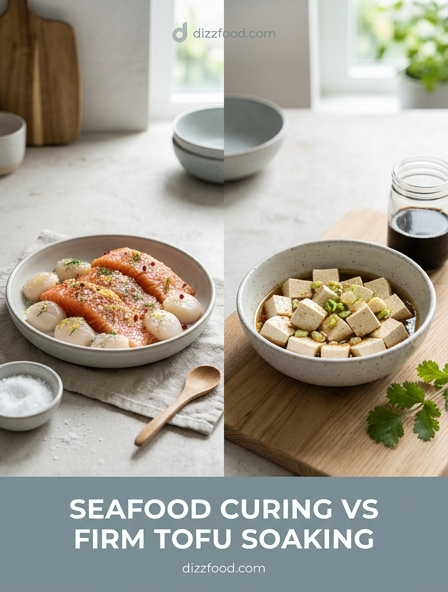
Science of Osmosis in Curing and Soaking
Osmosis is the primary physical mechanism governing both the curing of seafood and the soaking of firm tofu, though the direction of solute movement often serves different culinary purposes. In the context of the kitchen, osmosis involves the movement of water molecules through a semi-permeable membrane-the cellular walls of fish or the protein matrix of soy-from an area of low solute concentration to an area of high solute concentration. When curing seafood, a high concentration of salt or sugar is applied to the exterior, creating an osmotic pressure that draws internal moisture out of the flesh. This dehydration process inhibits microbial growth and concentrates the natural flavors of the proteins.
Conversely, while osmosis still plays a role in tofu soaking, the process is often more about equilibrium and diffusion. Because tofu is a coagulated soy protein curd with a high water content, soaking it in a seasoned brine allows flavor molecules and salts to penetrate the porous structure. The goal here is usually infusion rather than dehydration. The following factors influence the rate of osmotic exchange in both mediums:
- Solute Concentration: Higher salt ratios accelerate moisture extraction in seafood.
- Temperature: Heat increases kinetic energy, speeding up the movement of molecules, though it carries safety risks for raw fish.
- Surface Area: Thinner slices of fish or cubed tofu reach osmotic equilibrium significantly faster than whole fillets or blocks.
- Membrane Integrity: The fat content in fish can act as a barrier, slowing the movement of water compared to the more uniform, sponge-like structure of tofu.
Salt Effects on Seafood Protein Density
Salt serves as the most critical reagent in seafood curing, acting far beyond a simple seasoning agent. When salt is applied to the surface of fish, it initiates a process called denaturation. Specifically, the salt ions interact with the myofibrillar proteins, primarily myosin and actin. As salt penetrates the muscle fibers, it causes these proteins to unwind and then cross-link. This creates a tighter, more resilient protein network, which is perceived by the palate as a "firm" or "snappy" texture. Without this chemical transition, the fish remains soft and highly perishable.
The density of the seafood increases as water is expelled and the protein structure collapses into a more compact form. This is particularly evident in products like salt cod or gravlax, where the weight of the fish can decrease by 10% to 15% during the curing process. The effect varies depending on the method of application, as shown in the table below:
| Curing Method | Effect on Protein Density | Textural Result |
|---|---|---|
| Dry Salt Rub | High; rapid moisture loss | Firm, leather-like, or chewy |
| Equilibrium Brine | Moderate; controlled hydration | Plump, succulent, and uniform |
| Sugar-Salt Blend | Variable; preserves some suppleness | Silky, tender, and translucent |
Brine Infusion Methods for Firm Tofu
Firm tofu acts as a culinary sponge, but its ability to absorb flavor is often limited by its existing water content. To effectively infuse tofu with brine, one must first address the internal moisture. The most common method involves pressing the tofu to expel the bland packing water, creating physical space within the protein lattice for the seasoned brine to enter. Once pressed, the tofu is submerged in a liquid solution where salt and aromatics move into the soy matrix via diffusion. This is a stark contrast to seafood curing, where the objective is usually to pull liquid out.
Advanced infusion methods can significantly enhance the depth of flavor in firm tofu. One effective technique is the "Freeze-Thaw-Soak" cycle. Freezing the tofu causes the water inside to expand into ice crystals, which creates large, honeycomb-like pockets. When thawed and squeezed, these pockets act as reservoirs that instantly pull in brine upon immersion. Another method is the hot-soak technique, where boiling brine is poured over sliced tofu. The heat slightly expands the protein structure and increases the solubility of the flavor compounds, leading to a faster and more thorough infusion compared to cold soaking. Salt in the tofu brine also serves to season the interior, ensuring that every bite is as flavorful as the exterior, rather than relying on surface sauces alone.
Comparing Moisture Removal and Absorption
The fundamental difference between seafood curing and tofu soaking lies in the desired net movement of moisture. In seafood curing, the process is primarily one of exudation. The chef uses salt to pull water out of the fish cells to create an environment hostile to bacteria and to transform the texture. This moisture removal is essential for preservation. If the water remained trapped within the protein structure during a long cure, the fish would likely spoil or become unpleasantly soft. The result of successful seafood curing is a product that is more concentrated, drier, and more shelf-stable than its raw counterpart.
In contrast, tofu soaking is characterized by imbibition and flavor exchange. Because tofu is already a processed product made of water and soy solids, it does not require dehydration for safety or structural integrity. Instead, the goal is to replace the neutral moisture of the tofu with a flavorful liquid. While seafood loses mass during the curing process, tofu often gains or maintains mass as it absorbs the brine. The culinary intent for tofu is to maximize hydration with seasoned liquids, whereas the intent for seafood is to minimize hydration to highlight the essence of the fish. This divergence dictates every step of the preparation, from the concentration of the salt used to the duration the food remains in the solution.
Role of Acidity in Texture Modification
Acidity plays a transformative role in the kitchen, acting as a chemical "cook" that modifies the physical properties of both fish and tofu. In seafood, acids such as lemon juice, lime juice, or vinegar lower the pH of the flesh, causing the proteins to denature in a process similar to heat cooking. This is the science behind ceviche. The acid tightens the protein bonds, turning the flesh from translucent and soft to opaque and firm. However, if the acid is left in contact with the fish for too long, it can eventually break down the connective tissues too much, resulting in a mushy or chalky texture. Balance is required to ensure the acid firms the protein without dissolving it.
When applied to firm tofu, acidity functions differently. While it does not "cook" the soy protein in the same way, it influences the tofu's ability to hold onto moisture and its surface tension. A slightly acidic brine can help "set" the exterior of the tofu, making it more resilient during subsequent cooking steps like searing or frying. Furthermore, acidity acts as a flavor brightener that cuts through the earthy, bean-like notes of the soy. In both cases, the timing of acid introduction is crucial:
- Early Addition: Results in deep structural changes and significant texture toughening in seafood.
- Late Addition: Provides topical flavor without compromising the internal structural integrity of the protein.
- Equilibrium: Using a buffered acid (like a vinaigrette) allows for a gentler modification of texture over a longer period.
Timeline Differences for Fish versus Soy
The temporal aspect of curing and soaking is perhaps the most divergent factor between these two ingredients. Seafood curing is a high-stakes timeline governed by both the thickness of the fish and the risk of over-denaturation. A light cure for a delicate white fish might take as little as 20 minutes to achieve the desired "snap," while a deep cure for a side of salmon intended for gravlax can take anywhere from 24 to 72 hours. If the seafood stays in the salt for too long, it becomes excessively salty and loses its pleasant texture, eventually becoming "burned" by the chemical action of the salt.
Tofu, however, is much more forgiving regarding time. Because tofu does not have the same delicate muscle fibers as fish, it can be soaked in a brine for several days without significant degradation of its structure. In fact, a longer soak usually results in a better flavor profile. While a minimum of 30 minutes is required for surface seasoning, a 24-hour soak is often preferred for deep flavor penetration. Unlike seafood, there is no risk of the tofu becoming "over-cured" in a traditional sense, although the saltiness will continue to increase. For the best results, the following timelines are generally observed:
- Ceviche Style (Fish): 5 to 30 minutes.
- Light Salmon Cure: 2 to 4 hours.
- Traditional Gravlax: 2 to 3 days.
- Quick Tofu Soak: 30 minutes to 2 hours.
- Overnight Tofu Infusion: 12 to 24 hours.
Essential Aromatics for Preservation and Flavor
Aromatics serve a dual purpose in curing and soaking: they provide complex flavor profiles and often contribute secondary preservative qualities. In seafood curing, traditional aromatics include dill, peppercorns, juniper berries, and citrus zests. These ingredients contain essential oils and compounds like limonene and pinene, which possess mild antimicrobial properties. These help to suppress the growth of spoilage bacteria while the salt does the heavy lifting of dehydration. The aromatics are typically crushed to release their oils and then pressed directly into the flesh of the fish to ensure maximum contact during the osmotic exchange.
For tofu, the aromatics are usually dissolved or suspended in the soaking brine. Common choices include soy sauce, ginger, star anise, garlic, and toasted sesame oil. Since tofu is relatively flavor-neutral, it can handle much bolder and more diverse aromatic profiles than most seafood. The goal with tofu is to create a complex liquid environment that the porous soy curd can pull into its center. While fish aromatics are usually dry or paste-based, tofu aromatics are often liquid-based to facilitate better diffusion. In both cases, the use of aromatics transforms a scientific process of moisture management into a culinary art, layering scent and taste into the very fibers of the food.
Critical Safety Rules for Raw Seafood
When curing seafood, safety is the paramount concern, as the process often does not involve heat to kill pathogens. The "danger zone" for bacterial growth (40°F to 140°F) must be strictly avoided. All curing must take place in a refrigerated environment. Furthermore, the quality and source of the fish are non-negotiable. Using "sushi-grade" or "sashimi-grade" fish ensures that the product has been handled and frozen specifically to eliminate parasites, which salt curing alone may not always kill. It is essential to follow these critical safety rules:
- Temperature Control: Always keep the fish below 40°F (4°C) throughout the entire curing and rinsing process.
- Parasite Management: Use fish that has been commercially flash-frozen to -4°F for at least seven days or -31°F for 15 hours.
- Cross-Contamination: Use dedicated cutting boards and sanitized containers to prevent the transfer of bacteria from other raw foods.
- Salt Concentration: Ensure the salt-to-sugar ratio is sufficient to inhibit spoilage; typically, a 50/50 ratio is the minimum for long-term cures.
- Storage Life: Even after curing, seafood has a limited shelf life. Consume cured fish within 3 to 5 days unless it is a fully dried product.
Optimizing Tofu Surface for Better Soaking
The texture of a tofu's surface determines how effectively it can interface with a soaking brine. While a block of firm tofu may look uniform, its surface is often slick and somewhat sealed from the manufacturing process. To optimize the surface for soaking, many chefs employ "scarification" or structural modification. Simply slicing the tofu increases the surface-area-to-volume ratio, allowing more brine to enter. However, more advanced techniques involve changing the physical state of the surface. For example, lightly parboiling the tofu in salted water before soaking can "open" the pores of the soy protein, making it more receptive to cold brines later.
Another popular method is to sear the tofu surface before soaking. While this seems counterintuitive, a light pan-fry creates a micro-crust that, when submerged in brine, acts like a sponge, drawing liquid into the layer between the crust and the soft interior. This is particularly effective for dishes where the tofu is served cold. Additionally, the "torn" method-where tofu is broken into irregular pieces by hand rather than cut with a knife-creates a jagged, high-surface-area exterior that holds significantly more flavor and brine than a smooth, knife-cut edge. These optimizations ensure that the brine doesn't just sit on the outside but becomes an integral part of the tofu's structure.
Culinary Best Practices for Curing Success
Achieving professional results in curing and soaking requires attention to detail and consistency. One of the most important best practices is the use of weights. In seafood curing, placing a weight on top of the fish (often called "pressing") helps to physically force moisture out and ensures even contact between the cure and the flesh. For tofu, weighting is done *before* the soak to remove excess water, but generally not *during* the soak, as you want the tofu to be able to expand slightly as it takes on the flavored liquid.
Rinsing and drying are the final, often overlooked steps that define the quality of the finished product. After the curing time is complete for fish, the excess salt and sugar must be thoroughly rinsed off to prevent the fish from becoming unpalatably salty. Following the rinse, the fish should be patted bone-dry and allowed to sit uncovered in the refrigerator for a few hours. This develops a "pellicle"-a slightly tacky surface layer-which helps aromatics and smoke (if used) adhere better. For tofu, a similar principle applies: after soaking, patting the exterior dry allows for a better sear if the tofu is to be cooked further. Consistent application of these techniques ensures a balance of flavor, safety, and texture in every preparation.


Comments