
Deciding between the intense sear of high-heat grilling and the patient transformation of low and slow roasting depends entirely on your cut of meat and desired texture. High-heat grilling utilizes direct radiant heat to trigger the Maillard reaction, creating a savory, caramelized crust on tender cuts like steaks and chops while maintaining a juicy center. In contrast, low and slow roasting relies on indirect convection to gently break down tough connective tissues and render intramuscular fat in larger, collagen-rich cuts like brisket or pork shoulder. By matching the cooking temperature to the muscle structure of your protein, you can ensure every bite is either perfectly charred or melt-in-your-mouth tender.
| Feature | High-Heat Grilling | Low & Slow Roasting |
|---|---|---|
| Temperature | 400°F - 600°F+ (200°C+) | 225°F - 275°F (107°C - 135°C) |
| Best Cuts | Steaks, burgers, kabobs, fish | Brisket, ribs, pork butt, chuck roast |
| Primary Goal | Surface searing & speed | Collagen breakdown & fat rendering |
| Cooking Time | 5 - 20 minutes | 4 - 12+ hours |
| Texture | Firm, charred exterior | Fork-tender, "fall-off-the-bone" |
| Heat Source | Direct (Radiant) | Indirect (Convection/Smoke) |
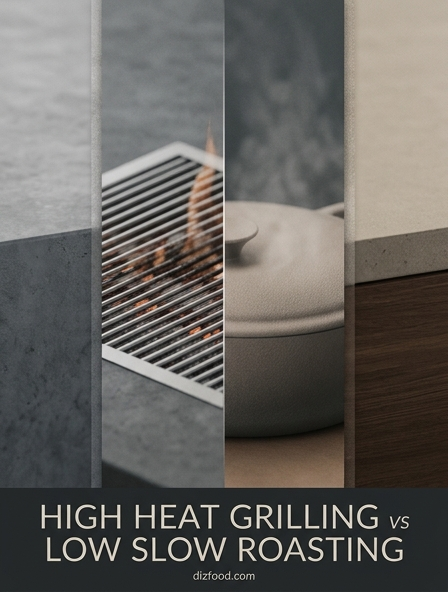
Basics of Grilling and Roasting Techniques
Grilling and roasting are two foundational pillars of culinary arts, yet they operate on fundamentally different thermodynamic principles. Grilling is typically defined as a dry-heat cooking method that utilizes direct, intense radiant heat. Whether using charcoal, gas, or wood, the heat source is positioned directly beneath the food, often reaching temperatures between 450°F and 700°F. This method is characterized by speed; it is designed to cook items rapidly, focusing on surface development while the interior reaches the desired temperature through conduction from the exterior layers.
In contrast, roasting is a dry-heat method that relies on indirect heat and convection within an enclosed environment, such as an oven or a closed grill. Temperatures are significantly lower, usually ranging from 250°F to 375°F. Unlike grilling, where the heat is unidirectional, roasting surrounds the food with hot, moving air. This allows for a more uniform heat distribution, making it ideal for larger items that would burn on the outside before the center is cooked if exposed to direct flames. Understanding these basics is essential for any cook:
- Grilling: Best for thin, tender portions that cook in under 20 minutes.
- Roasting: Best for whole birds, large joints of meat, and dense root vegetables.
- Heat Transfer: Grilling uses radiation; roasting uses convection and conduction.
While both methods utilize air as the medium rather than water or oil, the intensity and proximity of the heat source dictate the texture and moisture retention of the final product. Mastery of these techniques allows a chef to manipulate the kitchen environment to suit the specific needs of the ingredients.
Science of Searing vs Gentle Heat
The science behind high-heat searing involves a process of rapid thermal energy transfer. When a piece of meat hits a hot grill grate, the surface moisture evaporates almost instantly. This allows the temperature to rise above the boiling point of water, triggering the chemical transformation of proteins and sugars. High heat is about creating a temperature gradient where the outside is significantly hotter than the inside. This disparity is what creates the "crust" that is so prized in grilled foods. However, this method requires precision, as the window between a perfect sear and carbonized char is exceptionally narrow.
Gentle heat, or low-temperature roasting, operates on the principle of equilibrium. By keeping the ambient temperature lower, the difference between the surface of the food and its core is minimized. This results in a more even "edge-to-edge" doneness. From a cellular perspective, gentle heat prevents the muscle fibers from contracting too violently. When meat is exposed to sudden high heat, fibers tighten and squeeze out internal juices. By using a gentler approach, the proteins denature more slowly, which helps the meat retain its natural moisture and structural integrity. This is why a slow-roasted prime rib lacks the gray, overcooked ring often found in steaks cooked too quickly over an unregulated flame. The choice between searing and gentle heat is essentially a choice between dramatic flavor contrast and uniform textural consistency.
Best Cuts for High Heat Grilling
Success in high-heat grilling is largely determined by the cut of meat selected. Because the cooking time is short, the meat must be naturally tender and possess a relatively high fat content or a thin enough profile to cook through before the exterior burns. Steaks with significant intramuscular fat, known as marbling, are ideal because the fat melts quickly, lubricating the muscle fibers and providing flavor. Furthermore, cuts that are "loose-grained" benefit from the high heat as it allows for a quick sear that locks in juices without making the meat chewy.
- Ribeye: High fat content makes it forgiving under intense heat.
- Skirt and Flank Steak: Thin profiles and coarse grains allow for rapid cooking and maximum surface area for char.
- Filet Mignon: Extremely tender, requiring only a quick sear to reach the desired internal temperature.
- Lamb Chops: Small size and high fat content make them perfect for a fast, smoky finish.
- Chicken Thighs (Boneless): Higher fat and connective tissue compared to breasts prevent them from drying out quickly.
When selecting cuts for the grill, it is important to avoid those with heavy collagen or thick connective tissues. These "tough" muscles, like the shank or brisket, will not have enough time to break down in a high-heat environment, resulting in a rubbery and inedible texture. For the grill, the focus should always be on "fast-twitch" muscles that are naturally lean and soft.
Top Cuts for Low Slow Roasting
Low and slow roasting is the preferred method for "hardworking" muscles that are rich in connective tissue and collagen. These cuts come from parts of the animal that move frequently, such as the shoulder, legs, and chest. While these cuts are initially tough, they contain the most flavor. The goal of slow roasting is to transform these tough fibers into something succulent and tender. This requires time-often several hours-and a steady, low temperature to facilitate the chemical breakdown of the meat's internal structure.
- Pork Butt/Shoulder: The gold standard for roasting, containing enough fat and collagen to stay moist over eight to twelve hours.
- Beef Brisket: A notoriously tough cut that becomes buttery and tender when the collagen converts to gelatin.
- Short Ribs: Rich in bone marrow and connective tissue, perfect for long, dry-heat roasting or braising.
- Chuck Roast: Often used for pot roasts, it thrives in an environment where the heat can slowly penetrate the center.
- Whole Chicken/Turkey: Roasting allows the dark meat to reach its ideal temperature without drying out the delicate white meat.
Choosing these cuts for a high-heat grill would be a mistake; they would remain tough and stringy regardless of the surface char. In the world of roasting, the presence of bone and fat is an advantage, acting as an insulator and a flavor enhancer that self-bastes the meat throughout the long duration of the cook.
Maillard Reaction vs Collagen Breakdown
The distinction between grilling and roasting can be summarized by two chemical processes: the Maillard reaction and collagen breakdown. The Maillard reaction is a chemical reaction between amino acids and reducing sugars that gives browned food its distinctive flavor. It begins to occur rapidly at temperatures above 285°F. On a grill, this reaction is the star of the show, creating hundreds of different flavor compounds that range from savory and nutty to slightly bitter. This is what creates the "umami" punch associated with a grilled steak.
| Feature | Maillard Reaction | Collagen Breakdown |
|---|---|---|
| Primary Temperature | 285°F to 330°F | 160°F to 180°F |
| Goal | Surface flavor and aroma | Internal texture and moisture |
| Key Component | Amino acids and sugars | Connective tissue (Collagen) |
| Cooking Method | Grilling / Searing | Roasting / Braising |
Collagen breakdown, on the other hand, is a structural transformation. Collagen is a tough, triple-helix protein that holds muscle fibers together. It does not melt; it dissolves. However, this process only happens in the presence of heat over time. When collagen is held at temperatures between 160°F and 180°F for an extended period, it turns into gelatin. Gelatin provides a silky, rich mouthfeel and keeps the meat tasting "moist" even if the actual water content has evaporated. While grilling focuses on the Maillard reaction for instant flavor, roasting prioritizes collagen breakdown for structural elegance.
Texture Benefits of Slow Cooking
The primary benefit of slow cooking is the evolution of texture. When meat is cooked at a high temperature, the muscle fibers contract and expel moisture, often resulting in a firm, bouncy, or even tough texture if overcooked. Slow roasting avoids this "thermal shock." By applying heat gradually, the proteins denature in a way that allows them to retain a softer, more delicate structure. The most notable textural achievement in slow roasting is the "pull-apart" effect, where the meat loses its elasticity and can be easily separated with a fork.
Furthermore, the conversion of collagen into gelatin during a slow roast creates a lubricated texture that cannot be replicated by any other method. This gelatin coats the muscle fibers, providing a succulent sensation that masks the loss of actual water. Additionally, fat rendering plays a major role in texture. In high-heat grilling, fat often drips away or flares up. In slow roasting, the fat renders slowly, seeping into the meat and softening the surrounding tissues. This results in a finished product that is uniformly tender from the surface to the bone. For vegetables, slow roasting allows for the breakdown of complex starches into simple sugars, resulting in a creamy interior and a caramelized, slightly chewy exterior that offers a sophisticated contrast in every bite.
Essential Gear for Grilling and Roasting
Achieving professional results in the kitchen requires specific tools tailored to either the intense heat of the grill or the controlled environment of the oven. For grilling, the gear must be able to withstand extreme temperatures and provide the cook with distance from the heat source. For roasting, the focus shifts to heat retention, air circulation, and precise temperature monitoring.
Grilling Essentials:
- Long-Handled Tongs: Crucial for moving food without getting burned by the radiant heat.
- Cast Iron Grates: Excellent for heat retention and producing distinct sear marks.
- Wire Grill Brush: Necessary for maintaining a clean surface to prevent sticking and off-flavors.
- Chimney Starter: The most efficient way to light charcoal without the chemical taste of lighter fluid.
Roasting Essentials:
- Heavy-Bottomed Roasting Pan: Prevents the drippings from burning and ensures even heat.
- V-Rack: Lifts the meat off the bottom of the pan to allow hot air to circulate 360 degrees.
- Instant-Read Digital Thermometer: The only way to guarantee the center has reached the target temperature.
- Dutch Oven: Ideal for slow-roasting cuts that benefit from a little trapped moisture.
While some tools overlap, such as a high-quality chef's knife for prep, the specialized gear for each method ensures that the cook can manage the specific challenges of heat control and food safety inherent in each technique.
Comparing Cook Times and Prep
The logistical differences between grilling and roasting are most apparent in the preparation and time management required. Grilling is often seen as a spontaneous activity. Prep usually involves bringing meat to room temperature and applying a simple seasoning or a marinade. Because the cook time is measured in minutes, the griller must stay present, constantly monitoring the food for flare-ups or overcooking. It is an active, high-engagement cooking process.
| Aspect | High-Heat Grilling | Low-Slow Roasting |
|---|---|---|
| Prep Focus | Surface seasoning / Marinades | Deep rubs / Trimming / Brining |
| Cook Duration | 5 to 20 Minutes | 2 to 12 Hours |
| Active Time | High (Continuous flipping) | Low (Set and forget) |
| Resting Time | 5 to 10 Minutes | 20 to 60 Minutes |
Roasting, conversely, requires significant foresight but offers a more relaxed cooking experience. Prep might involve dry-brining meat 24 hours in advance to ensure the salt penetrates the deep muscle tissues. Once the item is in the oven, however, the cook is largely free to perform other tasks. The "active" time is low, but the "total" time is high. Another critical difference is the resting period. Grilled meats require a short rest to allow juices to redistribute. Roasted meats, due to their mass and the amount of rendered gelatin, often require an hour or more of resting to ensure the structure sets and the juices remain within the meat when sliced.
Flavor Profiles: Char vs Tenderness
The flavor profile of grilled food is defined by "fire and smoke." When fat drips onto hot coals or flavor bars, it vaporizes and rises back up, coating the food in a complex smoky essence. The high heat also creates "char"-bits of carbonized seasoning and protein that provide a bitter, crunchy contrast to the savory meat. This flavor is bold, aggressive, and deeply rooted in the Maillard reaction. It is a profile that celebrates the exterior of the food, where the seasoning and the fire meet to create a crust that is often the most flavorful part of the dish.
In slow roasting, the flavor profile is more "concentrated and integrated." Because the food stays in the heat for a long time, the flavors of the rubs, herbs, and aromatics have time to migrate inward. The natural flavors of the meat are also more pronounced because they haven't been masked by heavy smoke or char. Instead of the sharp, bitter notes of a grill, roasting produces sweet, earthy, and deeply savory notes. The sugars in vegetables or meat coatings caramelize slowly, resulting in a mellow richness. While grilling is about the "hit" of flavor on the first bite, roasting is about the "depth" of flavor that persists through the entire cut. One rewards the palate with intensity, while the other rewards it with complexity and a luxurious mouthfeel.
Choosing the Right Cooking Method
Choosing between high-heat grilling and low-slow roasting ultimately depends on three factors: the cut of meat, the time available, and the desired sensory outcome. There is no superior method, only the correct application of heat for the ingredient at hand. To make the best decision for your kitchen, consider the following checklist:
- Evaluate the Fat and Fiber: Is it a lean, tender cut like a tenderloin? Choose the grill. Is it a tough, fatty cut like a shoulder? Choose the oven.
- Check the Clock: Do you need dinner in 30 minutes? Grilling is your only option. Do you have a full afternoon to let the kitchen fill with aromas? Roasting is the way to go.
- Consider the Weather and Setting: Grilling is often a social, outdoor activity, whereas roasting is a comforting, indoor process that warms the house.
- Determine the Texture: Do you want a firm, seared bite or a soft, melting sensation?
Understanding these variables allows a cook to be versatile. In some cases, the best results come from a hybrid approach, such as the "reverse sear," where meat is roasted at a very low temperature until it reaches the perfect internal doneness and then finished on a high-heat grill for the flavorful crust. By mastering both ends of the thermal spectrum, you gain complete control over the textures and flavors produced in your kitchen, ensuring that every ingredient is treated with the respect its biology demands.



Comments