
Whether you're a weekend griller or a seasoned home chef, understanding the tug-of-war between refrigerated and countertop marinating is the key to unlocking both peak safety and mouthwatering results. While the countertop method promises faster penetration due to relaxed muscle fibers, it dances on the edge of the USDA "Danger Zone," risking rapid bacterial growth that can turn a gourmet meal into a health hazard. Conversely, cold-temperature marinating in the fridge is the gold standard for food safety, allowing for a slower, more controlled chemical breakdown that ensures your proteins remain succulent and deeply seasoned without the risk of spoilage. Mastering this balance ensures every bite of your steak, poultry, or seafood is as healthy as it is flavorful.
| Feature | Refrigerated Marinating | Countertop Marinating |
|---|---|---|
| Temp Range | 35°F - 40°F (Safe Zone) | 68°F - 72°F (Danger Zone) |
| Safety Profile | Bacterial growth is inhibited | High risk of Salmonella/E. coli |
| Infusion Rate | Slow; requires 2-24 hours | Rapid; fibers relax quickly |
| Texture | Firm and consistent | Risk of mushiness/surface breakdown |
| Max Duration | Up to 2 days (protein dependent) | Strictly 30-60 mins (Not recommended) |
| Best Use Case | Thick cuts, poultry, long-prep meals | Quick acid-based ceviche (rare) |
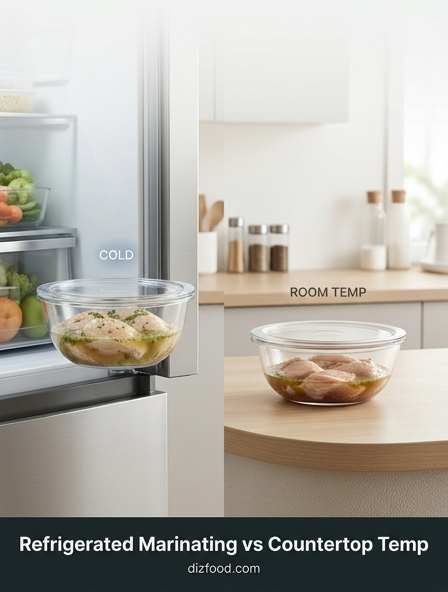
Food Safety Risks of Room Temperature Marinating
Leaving raw meat to marinate on a kitchen counter is one of the most common yet dangerous practices in home cooking. The primary risk involves the rapid proliferation of pathogenic bacteria that thrive in temperate environments. When meat is removed from the cold chain and placed at room temperature, it quickly enters a state where biological contaminants can reach hazardous levels. This environment provides the three essential components for bacterial growth: moisture, a rich protein source, and a favorable temperature.
The risks are not merely limited to spoilage, which often provides sensory cues like foul odors or slime. Pathogenic bacteria, which cause foodborne illnesses, are frequently odorless and invisible. These microorganisms can produce toxins that are heat-stable, meaning even thorough cooking may not render the meat safe to consume if it has sat out for too long. Common pathogens associated with improper marinating temperatures include:
- Salmonella: Highly prevalent in poultry and capable of doubling every 20 minutes in warm conditions.
- Staphylococcus aureus: A bacterium that produces toxins resistant to the heat of frying or grilling.
- Escherichia coli (E. coli): Often found in ground beef, where surface contamination is mixed throughout the meat.
- Campylobacter: A leading cause of bacterial gastroenteritis linked to raw or undercooked meat.
By bypassing the refrigerator, cooks inadvertently turn their marinade into a petri dish. Even if the marinade contains acidic components like vinegar or citrus juice, these are rarely strong enough to neutralize bacteria within the short window before the meat becomes unsafe.
The Science of Refrigerator vs Countertop Marinating
The debate between refrigerator and countertop marinating often centers on the kinetic energy of molecules. At room temperature, molecules move faster, theoretically allowing the marinade to penetrate the meat fibers more quickly. However, this scientific "advantage" is negligible when compared to the physical structure of meat. Meat is primarily composed of water, protein, and fat. The absorption of flavors is governed by osmosis and diffusion, processes that occur effectively even at temperatures near 40°F (4°C).
In a refrigerated environment, the process is slower, but it allows for a more controlled interaction between the ingredients. Cold temperatures keep the fats in the meat solid, which prevents the marinade from simply sliding off the surface and helps in creating a more even coating. Conversely, at room temperature, the surface of the meat begins to soften and release juices, which can actually dilute the marinade and prevent it from adhering properly. The following table illustrates the core differences between the two environments:
| Feature | Refrigerator (35°F-40°F) | Countertop (68°F-75°F) |
|---|---|---|
| Bacterial Growth | Inhibited/Slowed | Exponential/Rapid |
| Enzymatic Activity | Controlled and steady | Aggressive and inconsistent |
| Safety Duration | Up to several days | Less than 2 hours |
| Fat Stability | Solid/Firm | Soft/Rendered |
Ultimately, the refrigerator acts as a stabilizer. It ensures that the chemical reactions-such as the breaking down of connective tissues by acids-happen at a pace that preserves the integrity of the protein while maintaining a sterile environment.
How Temperature Affects Meat Flavor Absorption
Temperature plays a secondary role in flavor absorption compared to the chemical composition of the marinade. While it is a common belief that warmth helps "open the pores" of the meat, meat does not actually have pores like human skin. Instead, it consists of muscle fibers bundled together. The movement of salt, the only ingredient that truly penetrates deep into the meat, is driven by ionic diffusion. While heat does increase the rate of diffusion, the difference between 40°F and 70°F is not significant enough to justify the safety risks.
In a cold marinade, the salt has ample time to draw moisture out and then pull the seasoned brine back into the center of the cut. This slow process results in a deeper, more seasoned profile. When marinating occurs at room temperature, the exterior of the meat may become over-seasoned while the interior remains bland. Furthermore, aromatic compounds in spices and herbs are volatile. In a warm environment, these flavors may dissipate into the air of the kitchen rather than staying trapped within the liquid and the meat.
Effective flavor absorption is better achieved through the following methods rather than increasing temperature:
- Increasing Salt Concentration: This facilitates the osmotic process regardless of temperature.
- Surface Area: Scoring the meat allows the marinade to reach more muscle fibers.
- Time: A longer soak in the refrigerator provides more consistent flavor than a short, warm soak.
- Acidity Balance: Using the right amount of acid ensures the meat remains receptive to flavors without becoming mushy.
Understanding the Food Safety Danger Zone
The concept of the "Danger Zone" is a fundamental principle of food science, defined by the USDA as the temperature range between 40°F and 140°F (4°C to 60°C). Within this window, bacteria can double in number in as little as twenty minutes. When you marinate meat on the countertop, you are placing the food directly into the heart of this zone. The longer the meat stays in this range, the higher the "viral load" of bacteria becomes, increasing the likelihood of illness.
It is important to understand that the Danger Zone applies not just to the air temperature, but to the internal temperature of the meat itself. Even if a kitchen feels cool, the surface of a steak or chicken breast will rise into the Danger Zone within minutes of leaving the refrigerator. This is particularly problematic with marinades, as the liquid often provides a medium for bacteria to travel from the surface into any crevices or cuts in the meat.
- The Two-Hour Rule: Food should never be in the danger zone for more than two hours.
- The One-Hour Rule: If the ambient temperature is above 90°F (32°C), the limit drops to one hour.
- Cumulative Effect: The time spent in the danger zone during preparation, marinating, and sitting before cooking is cumulative.
Because marinating typically requires several hours to be effective, it is mathematically impossible to marinate on the counter safely. By the time the flavor has started to penetrate, the bacterial colonies have already reached levels that can overwhelm the human immune system or produce toxic byproducts.
Impact of Marinating Temperature on Meat Texture
Temperature significantly influences the texture of meat by modulating the activity of acids and enzymes. Most marinades contain an acidic component (like lemon juice or vinegar) or proteolytic enzymes (found in pineapple, papaya, or ginger). These ingredients work by denaturing proteins and breaking down collagen. However, the rate of these chemical reactions is highly sensitive to heat. At room temperature, these reactions can occur too rapidly and unevenly.
When meat is marinated in a warm environment, the surface proteins can break down so quickly that they become "mealy" or "mushy" before the marinade has even reached the center. This creates an unappealing contrast between a disintegrated exterior and a tough interior. In the refrigerator, the cold temperature slows these enzymatic reactions, allowing for a more uniform tenderization process across the entire cut. This is especially crucial for delicate proteins like seafood or chicken breast.
Consider the following effects of temperature on specific components:
- Proteins: Warmth causes proteins to contract and then relax too quickly, leading to moisture loss.
- Connective Tissue: Cold marinating allows for the gradual softening of fibers without compromising the meat's structure.
- Fats: Cold temperatures keep intramuscular fat (marbling) intact, which preserves the "mouthfeel" of the meat after cooking.
By maintaining a cold temperature, you ensure that the marinade enhances the texture rather than destroying it. The goal of marinating is to improve the eating experience; countertop marinating often does the opposite by compromising the structural integrity of the protein.
Why Refrigeration is Essential for Long Marinating
Long marinating-defined as any period lasting from four hours to overnight-is only possible through refrigeration. The primary reason is the suppression of microbial activity over extended durations. While a piece of meat might survive sixty minutes on a counter without making someone ill, it certainly will not survive twelve hours. Refrigeration extends the "lag phase" of bacterial growth, which is the period where bacteria are adjusting to their environment but not yet reproducing rapidly.
Beyond safety, refrigeration is essential for long-term marinating because it prevents the marinade from spoiling. Ingredients like garlic, fresh herbs, and onions can oxidize or begin to ferment if left in a warm, moist environment. In the refrigerator, these ingredients remain fresh and continue to release their aromatic oils slowly into the meat. This slow-release method results in a more complex and nuanced flavor profile that cannot be replicated in a high-speed, warm environment.
For those looking to marinate for 12 to 24 hours, the refrigerator provides several benefits:
- Consistency: The temperature remains stable, unlike a kitchen which may heat up during the day.
- Hydration: Cold meat retains its natural juices better than meat that has begun to "sweat" at room temperature.
- Safety: It eliminates the guesswork involved in timing and ensures the food remains well below the Danger Zone.
Without the cold environment of a refrigerator, long marinating would be a recipe for food poisoning rather than a culinary technique for flavor enhancement.
Comparing Bacterial Growth at Room Temperature
The speed of bacterial growth at room temperature compared to refrigeration is staggering. Under ideal conditions-which a protein-rich, moist marinade provides-a single bacterium can grow into a colony of millions in just a few hours. This exponential growth is why "just an hour on the counter" can be more dangerous than it sounds. In a refrigerator set to 38°F, the same bacteria may take days to reach the same population level.
Pathogens like Listeria monocytogenes are particularly noteworthy because they can grow at refrigerated temperatures, but their growth is extremely slow. At room temperature, however, they join other pathogens in a race to colonize the meat. The following data highlights the difference in growth potential over a 4-hour period for common foodborne bacteria:
| Time Elapsed | Bacteria Count (Refrigerated) | Bacteria Count (Room Temp) |
|---|---|---|
| 0 Hours | 1,000 units | 1,000 units |
| 1 Hour | ~1,050 units | 8,000 units |
| 2 Hours | ~1,100 units | 64,000 units |
| 4 Hours | ~1,200 units | 4,000,000+ units |
This comparison demonstrates that even a relatively clean piece of meat can become highly contaminated in a short afternoon. Cooking may kill the bacteria, but it will not always neutralize the toxins they have left behind. Therefore, the only way to ensure the meat remains "clean" is to never allow the temperature to rise to a level that supports this level of biological activity.
USDA Recommendations for Safe Meat Preparation
The United States Department of Agriculture (USDA) provides clear and stringent guidelines for marinating meat to ensure public safety. Their primary recommendation is unequivocal: always marinate meat in the refrigerator. The agency emphasizes that foodborne illness is preventable through proper temperature control and cross-contamination awareness. They warn against the "countertop method" regardless of the type of marinade or the cut of meat being used.
In addition to temperature control, the USDA outlines several critical steps for the marinating process. These rules are designed to prevent the spread of bacteria from the raw meat to other surfaces or back into the finished dish. Adhering to these guidelines is essential for any domestic or professional kitchen environment.
- Use Food-Grade Containers: Only use glass, stainless steel, or food-grade plastic. Avoid aluminum, as the acid in marinades can react with the metal.
- Never Reuse Marinade: If a marinade has touched raw meat, it contains bacteria. It must be boiled for several minutes if it is to be used as a sauce, though discarding it is safer.
- Separate for Basting: If you intend to use the marinade for basting or as a dip, set a portion aside before adding the raw meat.
- Sanitize Surfaces: Any area touched by the marinating container or raw meat drippings must be cleaned with hot, soapy water or a sanitizer.
By following these federal guidelines, cooks can ensure that the flavor-enhancement process does not result in medical emergencies. Safety should always be the foundation of culinary technique.
Common Myths About Countertop Flavor Infusion
Several myths persist regarding why room-temperature marinating is supposedly superior. One of the most common is the idea that "meat absorbs flavor better when it's relaxed." The theory suggests that cold meat is "tight" and resists liquid. In reality, the muscle structure of meat does not significantly "relax" until it is heated during the actual cooking process. Marinating at room temperature does not change the physical permeability of the muscle fibers in any meaningful way compared to the refrigerator.
Another myth is that the acid in the marinade-such as vinegar, lime juice, or wine-acts as a disinfectant that kills bacteria, making room temperature marinating safe. While acids can inhibit some bacterial growth, they are not nearly concentrated enough in a standard recipe to act as a sterilizing agent. In fact, many bacteria are acid-tolerant and will continue to multiply despite the presence of citrus or vinegar. Other myths include:
- "Pores Open Up": Meat does not have pores; flavor moves via osmosis, which works fine in the cold.
- "It Cooks Faster": While room temp meat might reach its internal target slightly sooner, the risk of surface spoilage far outweighs the few minutes saved.
- "Alcohol Sterilizes the Meat": The alcohol content in wine or beer marinades is far too low to kill pathogens effectively.
Relying on these myths can lead to dangerous outcomes. Modern food science consistently proves that the "benefits" of countertop marinating are psychological, while the risks are biological and very real.
Optimal Conditions for Marinating Different Proteins
Different proteins require different marinating times and conditions to achieve the best results without compromising safety or texture. Because the refrigerator is the only safe environment, the focus should be on the duration and the container used. For instance, delicate proteins like seafood can be ruined by long marinating times even in the cold, while tough cuts of beef benefit from extended stays.
The container choice is also vital. A sealed plastic bag is often superior to a bowl because it maximizes the surface area of the meat in contact with the liquid and prevents leaks that could contaminate other items in the refrigerator. Using the right duration for each protein ensures that the flavor is absorbed without the acid turning the meat into an unappealing texture.
| Protein Type | Recommended Time (Cold) | Potential Issues |
|---|---|---|
| Seafood/Fish | 15-30 Minutes | Becomes "cooked" by acid; mushy texture |
| Chicken/Poultry | 2-6 Hours | Salmonella risk if cross-contaminated |
| Pork (Chops/Loin) | 4-12 Hours | Dryness if the marinade lacks oil |
| Beef (Steak/Roast) | 6-24 Hours | Surface graying from high acidity |
For all proteins, the temperature should be maintained between 34°F and 38°F. Always place the marinating container on the bottom shelf of the refrigerator. This prevents any accidental drips from falling onto produce or cooked foods, providing a final layer of protection against cross-contamination during the flavor-infusion process.




Comments