
Ever wondered why your Sunday roast chicken stays succulent while your grilled steak gains that complex, zesty char? The secret lies in the fundamental science of poultry brining versus beef marinating. While brining is a moisture-locking game-changer-using a salt-water equilibrium and osmosis to push hydration deep into lean bird tissues-marinating is an art of surface transformation, employing acids, oils, and enzymes to break down tough beef fibers and infuse bold aromatics. Mastering these distinct techniques ensures you can manipulate protein structures for the ultimate drip-down-your-chin turkey or a melt-in-your-mouth flank steak, eliminating the risk of dry, bland meat forever.
| Feature | Poultry Brining | Beef Marinating |
|---|---|---|
| Primary Goal | Cellular hydration & moisture retention. | Surface flavoring & fiber tenderization. |
| Core Mechanism | Osmosis; salt dissolves muscle proteins to hold water. | Denaturation; acids/enzymes soften connective tissue. |
| Key Ingredients | High salt concentration, water, and sugar. | Acids (vinegar/citrus), oils, and aromatics. |
| Penetration Depth | Deep; salt interacts with internal muscle fibers. | Shallow; mostly affects the exterior 1-3mm. |
| Typical Duration | 4 to 24 hours (size dependent). | 30 minutes to 12 hours (acid dependent). |
| Ideal Cuts | Chicken breast, whole turkey, lean pork chops. | Flank steak, skirt steak, chuck, or ribs. |
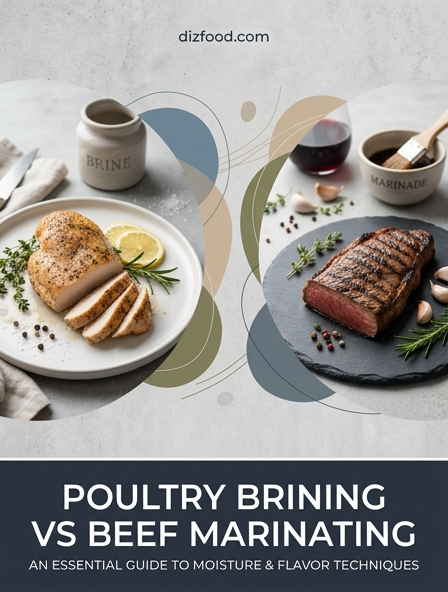
Poultry Brining vs Beef Marinating Key Differences
In the culinary world, the preparation of poultry and beef requires distinct approaches to moisture management and flavor infusion. Brining and marinating are often used interchangeably in casual conversation, yet they serve fundamentally different functions dictated by the biology of the meat. Brining is primarily a technique for poultry, such as chicken or turkey, focused on deep moisture retention. By submerging the bird in a saltwater solution, the cook ensures that the lean proteins remain succulent even after exposure to high heat.
In contrast, marinating is the preferred method for beef, particularly tougher or leaner cuts like flank or hanger steak. While a brine relies on salt to pull water into the muscle fibers, a marinade utilizes acidic components-such as vinegar, citrus, or wine-to alter the surface texture and impart complex flavors. The primary differences can be summarized by their goals: poultry brining aims for internal juiciness, while beef marinating seeks surface tenderization and aromatic depth.
| Feature | Poultry Brining | Beef Marinating |
|---|---|---|
| Primary Agent | Salt (Sodium Chloride) | Acids or Enzymes |
| Main Objective | Moisture retention | Flavor and Tenderization |
| Penetration | Deep into muscle tissue | Mostly surface-level |
| Typical Duration | 4 to 24 hours | 30 minutes to 6 hours |
The Science of Salt Brines vs Acidic Marinades
The efficacy of brining poultry lies in the principles of osmosis and diffusion. When poultry is submerged in a salt solution, the concentration of salt is higher outside the cells than inside. Through diffusion, salt ions migrate into the meat, where they interact with the protein structure. Specifically, salt causes the filaments of the muscle, such as myosin, to dissolve or denature. This creates a matrix that can physically trap and hold onto water molecules. During the cooking process, these denatured proteins resist contracting as tightly as they normally would, which prevents the moisture from being squeezed out.
Beef marinating operates through a chemical breakdown of the meat's exterior. Acids in a marinade work by denaturing the surface proteins, essentially "pre-cooking" the outer layers. This process can help soften the connective tissues, though it rarely penetrates more than a few millimeters deep. Unlike salt, which moves deep into the tissue over time, the large molecules in acidic marinades-and the fats often paired with them-remain on the surface. If beef is left in an acidic marinade for too long, the surface can become mushy or mealy, a sharp contrast to the firm, plump texture resulting from a properly brined chicken breast.
How Brining Chicken Compares to Marinating Steak
Applying these techniques requires an understanding of how chicken and steak react to different environments. Chicken, especially the breast, is notoriously lean and lacks the intramuscular fat found in many beef cuts. Because it must be cooked to a specific internal temperature to ensure safety, it is highly susceptible to drying out. Brining acts as an insurance policy. By increasing the raw weight of the chicken by 10% or more through water absorption, the cook ensures that even if the bird is slightly overcooked, it remains palatable and moist.
Steak presents a different set of challenges. Most steaks are prized for their "beefy" flavor and fat content, which provides natural lubrication. Marinating steak is less about preventing dryness-since many steaks are served medium-rare-and more about adding a flavor profile that complements the char of a grill. While a brine for chicken is usually a simple salt-and-water ratio, a steak marinade is a complex emulsion of oils, acids, and aromatics. Consider the following practical applications:
- Chicken: Best suited for "wet brining" in a 5% salt solution to ensure even moisture distribution throughout the thickest parts of the breast.
- Steak: Best suited for "acid-based marinating" to break down the tough fibers of skirt or flank steaks, making them easier to chew.
- Chicken: Can also benefit from "dry brining," which uses salt to draw out juices that are then reabsorbed as a concentrated brine.
- Steak: Often benefits from oil-based marinades that carry fat-soluble spice flavors deep into the crevices of the meat surface.
Moisture Retention Secrets in Poultry Brining
The secret to the succulent texture of brined poultry is the change in the muscle's capacity to hold water, known as "water-holding capacity." In a standard piece of chicken, the proteins are tightly packed. When heat is applied, these proteins coagulate and shrink, forcing out the water contained within the cells. This is why a pan often fills with liquid when cooking un-brined poultry. By introducing salt before cooking, the cook fundamentally alters the protein geometry.
Once the salt ions penetrate the muscle fibers, they create an electrical charge that causes the protein filaments to repel each other slightly. This creates more space within the molecular structure, allowing more water to enter and stay there. Furthermore, the salt dissolves a portion of the protein structure that normally acts as a "spring" to squeeze out moisture. Consequently, when the chicken is roasted or grilled, the "spring" is broken, and the water stays trapped within the meat. This results in a finished product that is significantly heavier and juicier than its non-brined counterpart, providing a "pop" of moisture when bitten into.
Breaking Down Connective Tissue with Beef Marinades
Beef, particularly cuts from the hard-working muscles of the cow, contains high amounts of collagen and tough connective tissue. While slow cooking is the traditional way to melt collagen into gelatin, marinades offer a chemical shortcut for thinner cuts. The acidic components of a marinade-such as lime juice, vinegar, or even yogurt-begin to break down the peptide bonds that hold protein strands together. This process is particularly effective on the surface of the meat, where the heat of the grill will later create a flavorful crust.
In addition to acids, many beef marinades utilize proteolytic enzymes found in natural ingredients. For example, pineapple contains bromelain, and papaya contains papain. These enzymes are incredibly aggressive at breaking down proteins. When used correctly, they can turn a tough piece of beef into something much more tender. However, the kitchen must be cautious:
- Enzymes work much faster than acids and can ruin the texture if left too long.
- Marinades should always include an oil to help the flavors adhere to the beef's surface.
- Sugar is often added to beef marinades to encourage the Maillard reaction during searing, which provides a savory counterpoint to the acidic tenderization.
Why Poultry Needs Brine While Beef Benefits from Acid
The structural composition of poultry and beef explains why they favor different treatments. Poultry meat is composed of shorter muscle fibers and less connective tissue than beef. Its primary weakness is its lack of fat and its high water loss during the cooking process required for food safety. Brining addresses this specific weakness by artificially increasing the water content. Because poultry is relatively porous, the salt solution can travel through the meat quite efficiently, ensuring that even the innermost sections of a turkey or chicken are seasoned and hydrated.
Beef, however, has a much denser muscle structure. It is less porous than poultry, meaning that even a long soak in a salt brine will not result in the same level of deep moisture absorption. Instead, beef benefits from the flavor-forward nature of marinades. Since beef is often consumed at lower internal temperatures (like 130°F to 145°F), it does not lose as much of its natural moisture as poultry does at 165°F. Therefore, the goal for beef is not to add water, but to enhance the existing flavors and soften the exterior texture to improve the eating experience. The acidity in the marinade provides a bright contrast to the rich, fatty notes of the beef, a balance that is less critical in the milder flavor profile of poultry.
Tenderizing Techniques for Poultry and Beef Compared
Tenderization in the kitchen is achieved through either physical or chemical means. For poultry, the tenderizing effect of brining is a byproduct of the meat swelling with water. As the muscle fibers absorb the brine, they expand, which makes the meat feel softer and more delicate on the tongue. This is a gentle form of tenderization that preserves the integrity of the bird. It is rarely necessary to use aggressive acids on poultry, as the meat is already naturally tender; doing so often leads to a "chalky" or mushy exterior that is unappealing after roasting.
Beef tenderization is more of a "search and destroy" mission. Because beef fibers are much tougher, they can withstand the aggressive action of acids and enzymes. In fact, many beef recipes call for a combination of mechanical tenderization (using a mallet or a Jaccard tool) followed by a marinade. This allows the marinade to seep into the channels created by the physical tools, tenderizing the beef from the inside out. When comparing the two, poultry tenderization is about "plumping," whereas beef tenderization is about "breaking down." Each method is tailored to the specific density and fiber length of the protein in question.
Salt Concentration in Brines vs Surface Flavor in Marinades
The concentration of ingredients plays a vital role in the success of these two methods. A brine must have a specific salinity to be effective. If the salt concentration is too low, osmosis will not occur effectively; if it is too high, the meat can become unpalatably salty and the proteins may actually tighten too much. A standard wet brine typically uses a 5% to 6% salt-to-water ratio by weight. This specific balance allows the salt to penetrate the meat without curing it like ham.
Marinades, conversely, are not governed by strict ratios of salinity but by the balance of flavor. The goal is to create a high-impact surface coating. Because the marinade stays on the outside, it needs to be bold. Culinary experts generally follow a three-part structure for marinades:
- Acid: Vinegar, citrus, or buttermilk to weaken the surface proteins.
- Fat: Oil to transfer fat-soluble flavors from herbs and spices to the meat.
- Aromatics: Garlic, ginger, herbs, and sugar to create a complex flavor profile that caramelizes upon contact with heat.
Choosing the Best Method for Texture and Juiciness
Selecting between brining and marinating depends on the specific cut of meat and the desired final texture. For any lean white meat, such as chicken breasts, pork loin, or turkey, brining is almost always the superior choice. It provides a safety net against the dry, stringy texture that occurs when these proteins lose their internal fluids. If the goal is a roast with crispy skin and a drippingly moist interior, a dry brine (salting the skin and letting it sit in the fridge) is the gold standard, as it hydrates the meat while drying out the skin for maximum crunch.
When dealing with beef, the choice is dictated by the cut's quality and toughness. Premium cuts like ribeye or filet mignon should never be marinated; they require only salt and high heat to shine. However, for tougher "utility" cuts, marinating is essential. A flank steak that is marinated for four hours will have a much more luxurious mouthfeel and a more complex flavor than one that is simply salted. The decision-making process can be simplified by assessing the fat content: low-fat poultry needs the hydration of a brine, while low-fat, high-fiber beef needs the chemical breakdown of a marinade.
Poultry Brining and Beef Marinating Culinary Results Compared
The final culinary results of these two techniques are strikingly different. A brined chicken breast will appear plump, with a translucent, glistening interior when sliced. The salt will have seasoned the meat all the way to the bone, resulting in a consistent savory flavor in every bite. The texture is characterized by its "snap"-the meat feels firm yet yields easily, releasing a burst of moisture. This makes brining the ideal preparation for cold applications as well, such as chicken salad, where the meat must remain moist even after cooling.
A marinated beef steak, such as a carne asada or a London broil, offers a different sensory experience. The interior remains dense and classically "meaty," while the exterior provides a sharp, tangy, and deeply caramelized crust. The marinade creates a flavor "shell" that contrasts with the rich, iron-like taste of the beef's center. Unlike the uniform seasoning of a brined bird, a marinated steak provides a transition of flavors from the bold, seasoned outside to the pure beef flavor of the inside. Ultimately, brining is the art of enhancement through hydration, while marinating is the art of enhancement through seasoning and surface transformation.


Comments