
Maximizing Surface Area for Rapid Absorption
In the culinary arts, the rate at which flavors penetrate muscle fibers is directly proportional to the available surface area. When dealing with dense proteins like flank steak or chicken breast, the external membrane often acts as a shield, slowing down the transition of aromatics and salts into the deep tissue. By manipulating the physical geometry of the meat, chefs can bypass these natural barriers to ensure a more uniform flavor profile. Increasing the contact points between the marinade and the internal myofibrils allows for a faster diffusion process, which is essential for high-volume kitchen environments where time is a critical constraint.
- Butterflying thick cuts to halve the distance to the center.
- Slicing proteins against the grain to expose the ends of muscle bundles.
- Utilizing thin-shaving techniques for stir-fry applications.
- Applying micro-incisions across the fat cap and silver skin.
This approach ensures that the seasoned liquids do not merely sit on the surface but are drawn into the structural gaps of the muscle. This rapid absorption is the foundation of creating savory depth in a fraction of the traditional marinating time.
Deep Scoring for Direct Fiber Contact
Deep scoring is a precision technique used to create physical channels within the muscle structure. By cutting into the meat-typically in a cross-hatch or diamond pattern-you provide a direct pathway for oils, acids, and spices to reach the interior sections of the protein. This method is particularly effective for tougher cuts with thick connective tissue that would otherwise resist liquid penetration. The depth of the score must be balanced; it should be deep enough to reach the secondary layers of muscle fibers but not so deep that it compromises the structural integrity of the cut during the cooking process.
| Technique | Depth | Best For |
|---|---|---|
| Diamond Scoring | 5mm to 8mm | Duck Breast, Pork Belly |
| Linear Parallel | 10mm | Flank Steak, Skirt Steak |
| Cross-Hatch | 3mm | Calabrese Salami, Whole Fish |
When the heat hits these scored areas, the increased surface area also promotes superior Maillard reaction, leading to a complex crust that complements the deeply infused interior flavors. This dual-purpose strategy enhances both the texture and the aromatic intensity of the dish.
Mechanical Tenderization and Flavor Flow
Mechanical tenderization involves the use of tools like mallets, needle injectors, or bladed tenderizers to physically disrupt the dense network of protein fibers and collagen. This disruption does more than just soften the bite; it creates a porous internal landscape. When the muscle fibers are crushed or pierced, the internal pressure drops, allowing marinades to flow through the newly created voids via capillary action. This is a vital step for lean meats that lack the natural intramuscular fat which typically facilitates flavor movement. By breaking the tight bonds of the sarcomeres, the chef effectively transforms a solid block of protein into a sponge-like matrix ready to hold onto juices. This process is essential for ensuring that every bite is as flavorful as the exterior crust, preventing the common "dry center" syndrome found in larger roasts or thick chops. Proper mechanical intervention allows for a more aggressive infusion of bold ingredients like garlic, ginger, and citrus zest, which might otherwise remain trapped on the surface of the meat.
Breaking the Protein Barrier Instantly
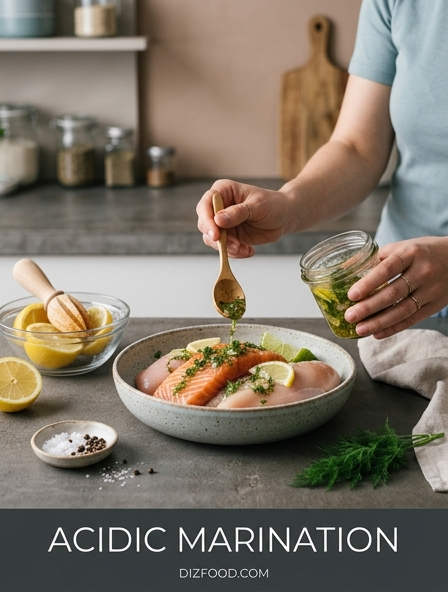
The protein barrier is a chemical and physical resistance layer that prevents external liquids from entering the muscle cell. To achieve instant flavor saturation, this barrier must be dismantled using a combination of enzymatic and acidic agents. These components work by denaturing the surface proteins, essentially "unfolding" them to create space for flavor molecules to lodge themselves within the fiber strands. Without this intervention, even the most potent marinade will only penetrate a few millimeters over several hours. Understanding the timeline of this breakdown is crucial to avoid turning the meat mushy.
- Apply an acidic base (vinegar or citrus) to lower the pH.
- Introduce proteolytic enzymes like bromelain from pineapple for rapid softening.
- Incorporate salt to dissolve myosin, a key structural protein.
- Massage the mixture into the fibers to ensure total coverage.
By coordinating these chemical reactions, the chef can achieve a level of infusion in fifteen minutes that would normally take a full day. This scientific approach to protein manipulation ensures that the integrity of the muscle is preserved while maximizing its capacity for bold flavor retention.
Strategic Piercing for Deep Bold Infusion
Strategic piercing utilizes specialized tools to create micro-conduits deep into the heart of the muscle. Unlike scoring, which is focused on the surface and sub-surface layers, piercing reaches the core of the cut. This is particularly useful for large-format proteins like brisket, leg of lamb, or whole turkeys. By creating thousands of tiny punctures, you are essentially building a highway system for the marinade. This technique bypasses the hydrophobic nature of certain fat layers and the dense resistance of connective tissue. When liquid is introduced to a pierced protein, the osmotic pressure forces the seasoning into these micro-channels, saturating the muscle from the inside out. This results in a finished product that is incredibly juicy, as the channels also serve to trap rendered fats and juices during the roasting or smoking process. It is a highly efficient way to ensure that the seasoning is not just a topical treatment but an intrinsic part of the protein's cellular structure, leading to a more sophisticated and layered taste experience that persists through every slice.
Optimizing Muscle Fiber Marinade Exposure
Optimizing exposure requires an understanding of the grain of the meat. Muscle fibers run in parallel bundles; by identifying the direction of these bundles, a chef can decide the best angle for intervention. Exposing the ends of these fibers is like opening the ends of a bundle of straws; it allows the marinade to be drawn up into the meat through natural suction. This phenomenon is most effective when the marinade contains a balanced ratio of salt and fat. Salt opens the fiber structure, while fat carries the fat-soluble flavor compounds from spices and herbs deep into the interior.
- Identify the grain direction before any cutting or piercing.
- Use a diagonal cut to maximize the surface area of the fiber ends.
- Ensure the marinade has a surfactant, like mustard or lecithin, to aid flow.
- Rest the meat in a vacuum-sealed environment to force liquid into the gaps.
By focusing on the structural orientation of the muscle, you can ensure that every cubic centimeter of the protein has been exposed to the seasoning agent, resulting in a superior flavor density.
Accelerating Infusion Through Tissue Disruption
Tissue disruption is the intentional act of breaking down the rigid connective networks that hold muscle fibers together. In a culinary context, this can be achieved through vigorous whisking of a marinade directly on the meat or by using a vacuum tumbler. These methods use physical force to pull the fibers apart slightly, creating microscopic gaps. As the tissue is disrupted, the internal moisture is briefly displaced, creating a vacuum effect that pulls the surrounding marinade into the center of the meat. This is a highly efficient way to deal with very lean proteins that have little natural "give" in their structure. By forcing this disruption, you are not only tenderizing the meat but also ensuring that the flavor delivery system is operating at peak efficiency. This method is often used in professional charcuterie and high-end restaurant prep to ensure that salt and curing agents are distributed perfectly evenly, preventing any "gray spots" in the center of the meat. The result is a consistent texture and a vibrant, bold flavor that is impossible to achieve through passive soaking alone.
Achieving Instant Bold Flavor Saturation
Instant saturation is the goal of modern fast-casual and high-intensity cooking. It relies on the principle of hyper-osmolarity, where the concentration of flavor in the marinade is significantly higher than that inside the muscle cells. This gradient forces the flavor molecules to move rapidly into the protein to reach equilibrium. To achieve this, marinades should be highly concentrated pastes rather than thin liquids. These pastes cling to the disrupted fibers and provide a continuous source of seasoning as the meat cooks. The heat of the pan or grill then acts as a catalyst, further accelerating the movement of these molecules.
| Component | Role in Saturation | Common Ingredients |
|---|---|---|
| Solvent | Carries flavor molecules | Oil, Water, Alcohol |
| Solute | Provides high concentration | Salt, Sugar, Dry Rubs |
| Catalyst | Speeds up reaction | Heat, Acid, Enzymes |
When these elements are combined with mechanical disruption, the saturation is nearly instantaneous, allowing for immediate cooking after preparation without the traditional wait times.
Enhancing Brine Penetration via Direct Contact
Brining is traditionally a slow process of diffusion, but it can be significantly enhanced through direct contact techniques. Instead of merely submerging the meat in a salt solution, the brine can be "massaged" into the muscle fibers after they have been mechanically prepared. This ensures that the salt ions-which are responsible for denaturing the proteins and increasing water-holding capacity-get to work immediately on the internal myofibrils. The goal is to reach a state where the protein can hold up to 10% more moisture than its raw state.
- Prepare a high-saturation brine with a 5% to 10% salt concentration.
- Perform mechanical tenderization on the protein surface.
- Apply the brine using a brush or by immersion with agitation.
- Use a weight or press to keep the meat in constant, high-pressure contact.
This direct contact method reduces the brining time from hours to minutes. Because the salt penetrates so deeply and quickly, the muscle fibers swell and lock in flavors, resulting in an exceptionally succulent and well-seasoned end product that resists drying out even under high heat.
Mastering Fast Muscle Fiber Infusion
The mastery of fast infusion lies in the synthesis of all these techniques: surface area maximization, mechanical disruption, and chemical manipulation. The modern chef views a piece of meat not as a solid object, but as a complex biological filter that can be tuned to accept flavor. By understanding the physics of muscle bundles and the chemistry of protein denaturation, you can dictate exactly how and when a flavor profile develops. This level of control is what separates average home cooking from professional culinary execution. Fast infusion allows for spontaneity in the kitchen, enabling the preparation of complex, deep-flavored dishes on demand. It requires a bold approach to seasoning and a fearless use of kitchen tools to break down the natural defenses of the meat. Ultimately, the goal is to create a harmonious balance where the natural taste of the protein is elevated by the infused aromatics, creating a multi-dimensional sensory experience. Mastering these techniques ensures that every fiber of the muscle is a conduit for flavor, leading to culinary results that are consistently bold, juicy, and profoundly satisfying.


Comments