
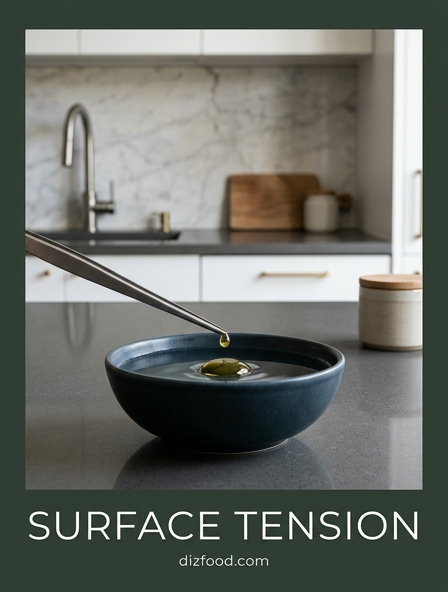
Understanding Surface Tension in Cooking Oil
Surface tension in the context of culinary science refers to the cohesive forces between molecules at the interface of cooking oil and the surrounding atmosphere or food surface. Unlike water, which has a very high surface tension due to hydrogen bonding, vegetable oils possess a lower but significant molecular attraction. This phenomenon creates an elastic-like "skin" on the oil's surface. In a deep fryer, this tension dictates how the medium interacts with the submerged ingredients. When oil has high surface tension, it tends to bead up rather than flow into the microscopic crevices of the food.
This molecular behavior is primarily governed by van der Waals forces. Because the molecules at the surface are not surrounded by identical molecules on all sides, they experience a net inward pull. This inward force minimizes the surface area, which is why droplets of oil appear spherical. Understanding this balance is crucial for chefs because it determines the "wetting" ability of the oil-the degree to which it makes contact with the food's surface to facilitate heat transfer.
The Relationship Between Tension and Crispiness
The quest for the perfect crunch in fried foods is deeply tied to the physics of surface tension. Crispiness is achieved when the moisture on the surface of the food evaporates rapidly, leaving behind a dehydrated, rigid structure known as the crust. High surface tension plays a defensive role here; it acts as a barrier that prevents the oil from prematurely entering the pores of the food. If the tension is maintained at an optimal level, the oil stays on the outside while the heat it carries migrates inward to cook the center.
If the surface tension of the oil is too high, heat transfer can be inefficient because the oil does not "wet" the food surface well enough to transmit energy. Conversely, if it is too low, the oil floods the internal structure of the food before a crust can form. The following elements contribute to this delicate balance:
- Initial Contact: The moment food hits the oil, surface tension determines the footprint of the heat exchange.
- Crust Formation: Tension helps maintain the integrity of the steam barrier.
- Structural Rigidity: Proper tension prevents the "soggy" effect caused by deep oil penetration.
How Surface Tension Controls Oil Absorption
Oil absorption is one of the most critical factors in determining the quality of fried items. Surface tension serves as the primary gatekeeper in this process. When food is submerged, the internal moisture turns to steam, creating an outward pressure that prevents oil from entering. As the cooking progresses and the steam pressure subsides, the surface tension of the oil determines whether it will be drawn into the food's capillaries or remain on the surface to be drained away after cooking.
| Tension Level | Oil Interaction | Culinary Outcome |
|---|---|---|
| High | Minimal Wetting | Crisp, low-fat exterior |
| Moderate | Optimal Wetting | Ideal browning and texture |
| Low | Deep Penetration | Greasy and heavy texture |
Lowering the surface tension too much leads to excessive oil uptake. This is why fresh oil often produces a "cleaner" fried product than oil that has been used repeatedly. As oil breaks down, its surface tension drops, allowing it to seep into the food more easily, resulting in a greasy mouthfeel and higher caloric content.
The Impact of Temperature on Oil Elasticity
Temperature is the most significant external variable affecting the surface tension of cooking fats. As the temperature of the oil rises, the kinetic energy of its molecules increases. This heightened movement weakens the intermolecular forces that create surface tension, causing the oil to become "thinner" and more fluid. This change in elasticity is vital for professional frying, as it allows the oil to flow more easily into the uneven surfaces of the food, ensuring that every nook and cranny is exposed to high heat.
However, there is a thermal "sweet spot." If the oil is not hot enough, the surface tension remains too high, leading to poor heat transfer and uneven browning. If the temperature exceeds the smoke point, the chemical structure of the oil begins to collapse, drastically reducing tension and leading to rapid absorption. Maintaining a stable temperature between 350°F and 375°F (175°C to 190°C) ensures that the oil's elasticity is low enough for good contact but high enough to prevent the oil from overwhelming the food's internal structure.
Surfactants and Their Effect on Frying Quality
Surfactants are compounds that lower the surface tension between two liquids or a liquid and a solid. In the kitchen, surfactants are naturally produced as oil breaks down through heat, light, and moisture exposure. Common surfactants in the frying process include monoglycerides, diglycerides, and free fatty acids. While we often think of "pure" oil as best, a small amount of surfactants is actually necessary for high-quality frying. This is known as the "break-in" period of the oil.
Fresh oil has such high surface tension that it often "repels" the food, leading to pale, unevenly cooked results. As surfactants form, they allow the oil to "wet" the surface of the food more effectively. This facilitates better heat transfer and more uniform browning. However, as the concentration of these surfactants increases with continued use, the surface tension eventually drops too low. When this happens, the oil loses its ability to stay on the surface, and the food becomes excessively oily. Managing surfactant levels is the key to maintaining consistent frying results over multiple shifts in a professional kitchen.
Achieving Better Batter Adhesion Through Physics
Batter adhesion is a common challenge for chefs, and it is largely a problem of surface tension. For a batter to stick to a piece of food-such as a chicken breast or a vegetable-the liquid batter must successfully "wet" the surface of the ingredient. If the food has a naturally waxy or oily surface, its surface energy will be low, causing the batter to bead up and slide off. This is a direct conflict between the surface tension of the batter and the surface energy of the food.
To overcome this, chefs use various techniques to manipulate these physical properties:
- Dredging: Coating the food in flour increases the surface area and creates a rough texture that "pins" the liquid batter.
- Pre-dusting: Using starches to absorb surface moisture, which increases the surface energy and allows for better wetting.
- Thickening agents: Adding proteins or gums to the batter to modify its internal cohesion.
By understanding that adhesion is a battle of surface forces, cooks can more effectively troubleshoot why coatings fail to stick during the frying process.
Steam Release and the Surface Tension Barrier
When food is placed in hot oil, the water within it quickly turns to steam. This steam must escape to the surface, creating the characteristic bubbling seen during frying. The surface tension of the oil acts as a barrier that these steam bubbles must overcome to be released into the atmosphere. This interaction creates a protective "steam jacket" around the food, which is essential for maintaining a barrier between the oil and the moist interior.
If the oil's surface tension is too high, the bubbles have difficulty breaking through the oil's "skin," which can cause the oil to foam or boil over. If the tension is too low, the bubbles escape too easily, and the protective steam jacket becomes thin and unstable. This allows the oil to make direct contact with the internal moisture, leading to a rapid exchange where the oil replaces the water. The visual cue of "steady bubbling" is a sign that the surface tension is perfectly balanced, allowing steam to exit while keeping the oil at bay.
The Role of Degraded Oil in Surface Tension
The chemical degradation of oil is an inevitable part of the cooking process. As oil is exposed to high temperatures, it undergoes oxidation, hydrolysis, and polymerization. These chemical reactions produce polar compounds that act as surfactants. Consequently, the surface tension of the oil decreases steadily as it is used. This is why "old" oil behaves fundamentally differently than "new" oil. Degraded oil has a much higher "wetting" capacity, which sounds positive but quickly leads to quality issues.
- Increased Penetration: Low tension allows oil to enter the food's cellular structure.
- Darker Color: Increased contact leads to faster, often excessive, Maillard reactions.
- Off-flavors: The polar compounds that lower tension also carry the bitter notes of oxidation.
Professional kitchens often use "active packaging" or filtration systems to remove these polar compounds. By removing the products of degradation, they effectively raise the surface tension back toward its original state, extending the life of the oil and ensuring the food remains crisp rather than greasy.
Optimizing Surface Tension for Even Browning
Even browning, or the Maillard reaction, requires consistent and uniform heat transfer across the entire surface of the food. Surface tension is the primary factor that determines how the heat-carrying oil distributes itself. If the surface tension is too high, the oil will not settle into the microscopic valleys of the food's surface, leading to "white spots" or uneven coloration. This is frequently seen in very fresh oil where the high tension prevents the oil from fully enveloping the ingredient.
To optimize browning, chefs often "season" their oil by adding a small amount of used oil to a fresh batch. This introduces just enough surfactants to lower the surface tension to a point where the oil "hugs" the food's surface without penetrating it. This creates a uniform interface for heat exchange. The result is a consistent, golden-brown color that indicates the crust has formed evenly. Monitoring this transition from high-tension fresh oil to the "sweet spot" of seasoned oil is a hallmark of experienced frying technique.
Scientific Techniques for Professional Frying Results
To achieve professional-grade results, chefs must move beyond intuition and apply scientific principles to manage surface tension. The goal is to maintain the oil in its peak performance window for as long as possible. This involves controlling the variables that accelerate the drop in surface tension, such as moisture, salt, and loose flour particles. Moisture from food triggers hydrolysis, while salt acts as a catalyst for oxidation, both of which produce tension-lowering surfactants.
Professional techniques for managing these forces include:
- Dry Brining: Removing excess surface moisture before frying to protect the oil's tension.
- Skimming: Frequently removing food debris that carbonizes and breaks down the oil's molecular structure.
- Oil Rotation: Mixing old and new oil to achieve a consistent surfactant level.
- Testing: Using total polar material (TPM) meters to scientifically measure when surface tension has dropped below acceptable levels.
By treating cooking oil as a dynamic physical system rather than a static ingredient, professionals can ensure that every fried dish achieves the perfect balance of a dry, crisp exterior and a succulent interior.

Comments