
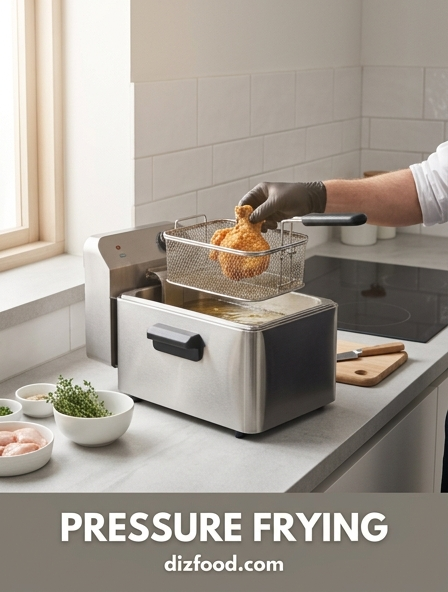
Fundamentals of Pressure and Vacuum Frying
The core mechanics of pressure and vacuum frying revolve around the manipulation of the boiling point of water within food items. In traditional atmospheric frying, water evaporates at 100°C, but by altering the internal environment of the frying vessel, chefs and food scientists can significantly change how heat interacts with the product. Pressure frying increases the atmospheric pressure, which in turn raises the boiling point of water. This prevents the internal moisture of the food from escaping rapidly, allowing the product to cook through its own steam while the exterior browns. Conversely, vacuum frying lowers the pressure below atmospheric levels, causing water to boil and evaporate at much lower temperatures, often between 60°C and 90°C.
These techniques are essential for different culinary outcomes. Pressure frying is predominantly used for proteins like chicken to maintain succulence, while vacuum frying is the preferred method for delicate fruits and vegetables. By controlling the pressure-temperature relationship, the kitchen operator dictates the rate of moisture loss and the specific degree of thermal degradation occurring within the cellular structure of the snack or meal component.
The Science of Snack Oil Absorption
Oil absorption in snacks occurs through a complex mechanism primarily during the cooling phase rather than the frying phase. As water evaporates from the snack during immersion in hot oil, it creates an internal pressure gradient that pushes outward, preventing oil from penetrating the porous structure. However, once the snack is removed from the heat, the internal steam condenses, creating a vacuum that pulls surface oil into the evacuated pores. Understanding this "suction effect" is critical for managing the total fat content of the final product.
- Porosity: The number and size of empty spaces left by evaporated water.
- Surface Tension: The ease with which oil adheres to the exterior of the snack.
- Cooling Rate: Faster cooling under specific conditions can trap oil on the surface before it enters the core.
- Interfacial Tension: The interaction between the food's moisture and the frying medium.
By optimizing the transition from the fryer to the cooling rack, manufacturers can mitigate the amount of oil that settles within the product. This ensures a crispier texture without the greasy mouthfeel associated with high oil uptake.
Pressure Frying for Superior Texture
Pressure frying is a specialized technique that excels at producing a unique textural contrast: a crisp, sealed exterior paired with an exceptionally moist interior. Because the high-pressure environment inhibits the rapid escape of steam, the internal fibers of the food-particularly meat-undergo a pressurized steaming process. This breaks down connective tissues more efficiently than open frying, resulting in a tender product in a shorter duration. The increased pressure also forces heat into the center of the food faster, reducing the overall cooking time by up to 50% compared to conventional methods.
The exterior crust formation in a pressure fryer is also distinct. The rapid heat transfer allows the Maillard reaction to occur quickly, developing a rich color and complex flavor profile without overcooking the underlying layers. This method is particularly effective for breaded items, as the pressure prevents the coating from becoming overly saturated with oil while ensuring the starch granules gelatinize perfectly. The result is a snack or entrée that maintains its structural integrity and remains juicy even after several minutes under a heat lamp.
Vacuum Frying for Reduced Fat Content
Vacuum frying is the gold standard for producing low-fat vegetable and fruit chips that retain their natural color and flavor. By operating in a near-vacuum, the system allows for the removal of moisture at temperatures that are too low to trigger significant oil degradation or acrylamide formation. Because the process occurs at lower temperatures, the oil remains more viscous, and the expansion of the food's cellular structure is more controlled, leading to a lighter, puffier texture.
| Feature | Atmospheric Frying | Vacuum Frying |
|---|---|---|
| Boiling Point | 100°C | 60°C - 90°C |
| Oil Content | 35% - 45% | 10% - 25% |
| Nutrient Loss | High | Low |
| Color Retention | Moderate/Low | Excellent |
The critical stage in vacuum frying is the "de-oiling" process, which must occur while the vessel is still under vacuum. By centrifuging the snacks before restoring atmospheric pressure, the surface oil is mechanically removed before the internal vacuum can pull it into the pores, resulting in a significantly leaner snack.
Temperature Control and Oil Uptake
Precision in temperature management is the most influential factor in determining how much oil a snack will absorb. If the oil temperature is too low, the crust does not form quickly enough to act as a barrier, and the cooking time must be extended, leading to higher oil penetration. Conversely, if the temperature is too high, the exterior burns before the interior is safe for consumption. For snacks, the "golden zone" usually lies between 160°C and 180°C, where the rate of water evaporation is high enough to create sufficient steam pressure to repel the oil.
In pressure and vacuum systems, temperature control must be even more rigorous. Thermal sensors must account for the rapid heat recovery needed when a cold batch of food enters the oil. If the temperature drops significantly, the pressure cannot be maintained at the required level, leading to a soggy product. Advanced fryers utilize proportional-integral-derivative (PID) controllers to maintain temperature within a fraction of a degree, ensuring that each batch experiences the same thermal kinetics and, consequently, identical oil uptake profiles.
Maintaining Nutrient Density in Snacks
Conventional high-temperature frying is notorious for destroying heat-sensitive vitamins and antioxidants. However, alternative frying methods can preserve a high percentage of a food's original nutritional value. Vacuum frying, in particular, protects bioactive compounds by avoiding the high temperatures that cause thermal oxidation and isomerization.
- Vitamin Preservation: Ascorbic acid (Vitamin C) and B-vitamins are highly susceptible to heat; low-temp frying keeps them intact.
- Pigment Stability: Carotenoids in carrots and anthocyanins in beets remain vibrant rather than turning brown.
- Reduction of Acrylamides: Lower temperatures prevent the chemical reaction between asparagine and reducing sugars.
- Lipid Protection: Lower heat reduces the formation of trans-fats and polar compounds in the frying oil.
By utilizing these advanced methods, producers can market "better-for-you" snacks that offer more than just empty calories. Maintaining the nutrient density not only improves the health profile but also enhances the natural flavor of the raw ingredients, reducing the need for excessive salt or artificial flavorings during the seasoning phase.
Comparing Pressure and Vacuum Methods
While both pressure and vacuum frying offer advantages over open-pot frying, they serve distinct purposes in the kitchen and food industry. Pressure frying is an "intensified" version of traditional frying, focusing on speed and moisture retention in proteins. Vacuum frying is a "gentle" version, focusing on color preservation and oil reduction in carbohydrates and plant-based materials. The equipment requirements differ significantly, with pressure fryers requiring heavy-duty locking lids and safety valves, while vacuum fryers require airtight chambers and high-capacity vacuum pumps.
| Metric | Pressure Frying | Vacuum Frying |
|---|---|---|
| Primary Use | Meats/Chicken | Fruits/Vegetables |
| Internal Temp | High (>100°C) | Low (<90°C) |
| Texture Output | Juicy/Crispy | Crunchy/Aerate |
| Flavor Profile | Savory/Caramelized | Natural/Bright |
Choosing between these methods depends on the desired end-product characteristics. If the goal is a traditional, hearty fried taste with maximum efficiency, pressure is the winner. If the goal is a innovative, health-conscious snack with vibrant aesthetics, vacuum frying is the superior choice.
Achieving Consistent Snack Quality
Consistency in snack production is a result of controlling variables including moisture content, oil quality, and batch size. In a pressure or vacuum environment, even small deviations can lead to large discrepancies in quality. For instance, if a batch of potatoes has a higher sugar content than the previous one, vacuum frying parameters must be adjusted to prevent over-browning. Similarly, the "load-to-oil" ratio is critical; overloading a fryer causes a temperature drop that the system may not be able to recover quickly, resulting in greasy snacks.
To ensure uniformity, operators must implement strict standardized operating procedures (SOPs). This includes regular testing of the frying oil for Free Fatty Acids (FFAs) and polar compounds, which can alter the smoke point and flavor. Monitoring the "delta-T"-the difference between the oil temperature and the food's internal temperature-allows for real-time adjustments. Consistent quality is not just about the frying time; it is about the entire lifecycle of the snack, from the initial slicing thickness to the final nitrogen-flushed packaging that prevents oxidative rancidity.
Equipment Calibration for Oil Reduction
Minimizing oil content is as much about the hardware as it is about the chemistry. Equipment used in pressure and vacuum frying must be calibrated frequently to ensure the seals are airtight and the pressure gauges are accurate. Any leak in a vacuum system will raise the boiling point, leading to increased oil absorption and potential scorching. Furthermore, the mechanical components responsible for removing oil-such as high-speed centrifuges or vibrating conveyors-must be tuned to the specific density of the snack being produced.
- Gasket Inspection: Ensuring pressure lids seal perfectly to maintain internal steam levels.
- Pump Maintenance: Keeping vacuum pumps at peak efficiency to reach target pressures rapidly.
- Centrifuge Speed: Adjusting RPMs to remove surface oil without breaking fragile snacks.
- Sensor Accuracy: Calibrating thermocouples to ensure displayed temperatures reflect the actual oil heat.
Properly calibrated equipment ensures that the "de-oiling" phase occurs within the critical window before the snack cools. This technical precision is what allows for the production of snacks that are significantly lower in fat than their traditional counterparts while maintaining the desired crunch.
Future Trends in Healthy Frying Techniques
The future of frying is moving toward even greater integration of technology and health-centric engineering. One emerging trend is the use of ultrasonic-assisted frying, where high-frequency sound waves are used to create microscopic bubbles in the oil, enhancing heat transfer and further reducing cooking times. This technology, combined with vacuum frying, could lead to snacks with almost negligible oil content. Additionally, there is a growing move toward "smart fryers" that use AI and optical sensors to monitor the color of snacks in real-time, automatically ending the frying cycle at the moment of perfect doneness.
Sustainability is also driving innovation, with new systems designed to recover and reuse heat from the frying process, significantly lowering the carbon footprint of snack production. We are also seeing the development of hybrid fryers that can switch between pressure and vacuum modes, allowing chefs to experiment with textures that were previously impossible to achieve. As consumer demand for "clean label" products grows, these advanced frying techniques will become the standard, bridging the gap between the indulgence of fried foods and the requirements of a healthy lifestyle.

Comments