
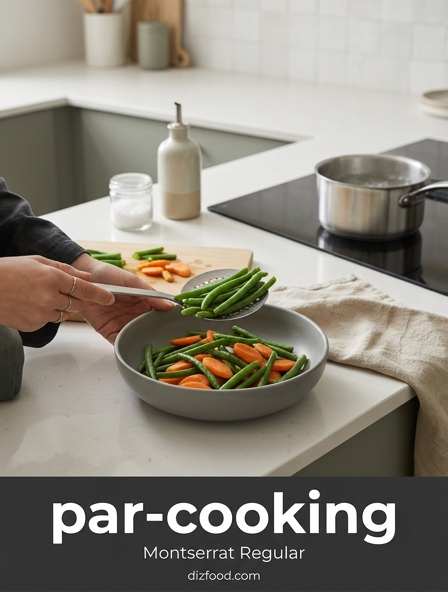
The Science of Low Temperature Frying
Low temperature frying, typically conducted between 130°C and 150°C, serves as the critical first stage in the par-cooking process. Unlike high-heat searing, this phase focuses on gentle thermal conduction to transform the raw internal structure of the ingredient without triggering the Maillard reaction too early. By maintaining a lower thermal threshold, the cook ensures that the product undergoes necessary biochemical changes while the exterior remains pale and flexible.
The primary objectives of this stage include:
- Softening tough fibrous structures within vegetables and tubers.
- Denaturing proteins at a controlled rate to prevent tightening and moisture loss.
- Allowing heat to migrate to the geometric center of the food item.
- Reducing the moisture content of the surface layer gradually.
This method utilizes oil as a high-efficiency heat transfer medium that surrounds the food entirely, providing more uniform energy distribution than steaming or boiling. This thermal environment prepares the ingredient for the secondary, high-heat stage where texture and color are finalized.
Starch Gelatinization and Texture Development
During the par-cooking phase, starch-rich ingredients like potatoes undergo a vital process known as gelatinization. As the internal temperature rises above 60°C, starch granules begin to absorb surrounding moisture and swell. This physical expansion leads to the disruption of the semi-crystalline structure of the starch, resulting in a soft, translucent gel-like consistency that defines a well-cooked interior.
| Starch Component | Role in Par-Cooking |
|---|---|
| Amylose | Leaches out to help form a future crispy crust. |
| Amylopectin | Provides the structural integrity and "fluffiness" inside. |
| Granule Swelling | Converts rigid cells into a palatable, creamy texture. |
Achieving full gelatinization during the first fry is essential. If the starch does not fully hydrate and expand, the final product will retain a raw, gritty texture, regardless of how crispy the exterior becomes during the second fry. This stage effectively "pre-computes" the interior texture, leaving only the dehydration of the surface for the final step.
Managing Internal Moisture Retention
One of the most delicate balances in par-cooking is reducing surface water while retaining enough internal moisture to prevent the food from becoming hollow or leathery. When food is submerged in oil, the water inside turns to steam. This steam creates an internal pressure that pushes outward, acting as a barrier that prevents oil from penetrating deep into the cellular structure of the ingredient.
Proper moisture management involves the following steps:
- Maintaining a steady oil temperature to ensure a constant but gentle steam release.
- Monitoring the "bubble rate," which indicates the speed of evaporation.
- Removing the food once the internal structure is tender but before the core dehydrates.
- Allowing the product to rest, which redistributes remaining moisture.
If the par-fry is too long, the steam pressure drops, and the product begins to absorb excessive oil, leading to a greasy result. Conversely, proper retention ensures a contrast between a moist, succulent center and the eventually crispy shell.
Preventing Premature Surface Crust Formation
The success of the par-cooking stage relies on the absence of a hard crust. If the oil is too hot initially, the surface dehydrates instantly, forming a rigid barrier that traps raw starches and moisture inside. This premature "shelling" prevents the core from reaching the necessary temperature for gelatinization and can cause the food to explode or rupture as internal steam builds up without an exit path.
To avoid this, the chef must monitor the oil's thermal energy. The goal is to keep the surface permeable. A permeable surface allows for the gradual migration of moisture from the center to the outside. This slow migration creates a "starchy slurry" on the exterior, which, once cooled and dried, provides the raw material for a superior crunch during the second fry. Keeping the temperature low ensures that the sugars on the surface do not caramelize or carbonize, keeping the color light and the flavor neutral until the final finishing stage.
The Role of Heat Gradients in Frying
Thermal gradients describe the difference in temperature between the surface of the food and its center. In par-cooking, the objective is to minimize a steep gradient. High-heat frying creates a steep gradient where the outside is significantly hotter than the inside, leading to uneven cooking. Low-temperature frying flattens this gradient, allowing the heat to move through the food via conduction at a manageable pace.
Factors influencing the heat gradient include:
- Surface Area: Smaller items heat faster but are more prone to overcooking.
- Thermal Diffusivity: How quickly the specific food material conducts heat.
- Oil Volume: A larger volume of oil maintains a more stable temperature when food is added.
By controlling the gradient, the chef ensures that the center reaches the 85°C to 95°C range required for cellular breakdown without the exterior exceeding the point of browning. This uniformity is the hallmark of professional par-cooking, providing a consistent baseline for high-volume kitchen operations.
Achieving Uniform Internal Doneness
Uniformity is the primary goal of the par-fry. When preparing large batches of items like frites or chicken wings, ensuring every piece has reached the same level of internal "doneness" is critical for service consistency. This is achieved by ensuring the items are not overcrowded in the fryer, which would cause the oil temperature to drop too low and result in poaching rather than frying.
To evaluate uniform doneness, cooks often look for specific physical cues:
- The item offers no resistance when pierced with a skewer.
- The product becomes buoyant and floats to the surface of the oil.
- The vigorous bubbling subsides to a gentle simmer.
- The texture changes from rigid to limp or slightly flexible.
Once uniform doneness is achieved, the items are removed and spread in a single layer. This prevents residual steam from "carry-over" cooking the items further into a mushy state. This controlled cooling stabilizes the starch and prepares the item for refrigerated storage or immediate high-heat finishing.
Enzymatic Breakdown for Creamy Interiors
In certain vegetables, particularly potatoes, enzymatic activity plays a hidden role during the early stages of heating. While the par-fry is often too fast to utilize long-term enzymatic action like a low-temp sous vide bath, the transition through the 50°C to 70°C range can activate certain pectin methylesterases. These enzymes can actually strengthen the cell walls slightly, preventing the food from falling apart while the interior starches become creamy.
This biochemical transformation creates a specific mouthfeel characterized by:
- A velvety texture that lacks graininess.
- Improved structural integrity during handling.
- A distinct "melt-in-the-mouth" quality after the second fry.
Understanding this breakdown allows chefs to choose the right variety of produce. High-starch, low-moisture cultivars respond best to this thermal treatment, as their cellular structure is predisposed to becoming fluffy. The par-cooking stage effectively "cures" the interior, ensuring that the final product is not just cooked, but has an optimized textural profile that contrasts sharply with the outer crust.
Preparing the Cellular Structure for Crispness
Crispness is not just a result of high heat; it is a result of structural preparation. During the par-fry, the heat causes the cells to expand and some moisture to leave, creating microscopic voids and a rougher surface at a cellular level. As the food cools after the first fry, the starch retrogrades-it firms up and becomes slightly crystalline again.
This cooling period is as important as the frying itself. It allows for:
- Surface Evaporation: Residual heat drives off excess surface moisture.
- Starch Setting: The "gel" created during frying firms up, making the item easier to handle.
- Pore Formation: Small channels are created where water once resided, which will later become sites for rapid oil-heat exchange.
Without this preparation, the final fry would only produce a thin, fragile crust. By par-cooking, the chef creates a robust, porous scaffold that can withstand the intense heat of the second fry, resulting in a thicker, more durable, and more satisfying crunch.
Thermal Conductivity and Oil Absorption
The relationship between thermal conductivity and oil absorption is the defining physics of the fryer. During par-cooking, the oil must be hot enough to keep the water vapor flowing out, which prevents the oil from flowing in. Oil absorption primarily occurs when the temperature of the food drops, causing the steam inside to condense and create a vacuum that pulls oil into the pores.
| Phase | Action | Oil Impact |
|---|---|---|
| Initial Immersion | Vigorous evaporation | Minimal absorption due to outward pressure. |
| Middle Par-Fry | Steady simmering | Slight surface oil adhesion. |
| Removal/Cooling | Steam condensation | Potential for high absorption if not drained well. |
Effective par-cooking maximizes heat transfer (conductivity) while minimizing the "sponge effect" (absorption). This is why items are often vigorously shaken or placed on wire racks immediately after the first fry. Managing these physical properties ensures the food remains light and crisp rather than heavy and saturated.
The Foundation of the Double Fry Technique
The double fry technique is the culmination of all the principles discussed, with par-cooking serving as the essential foundation. The first fry handles the "heavy lifting" of cooking-softening the texture, gelatinizing the starches, and stabilizing the moisture. This allows the second fry to focus entirely on the physics of the "crunch" and the chemistry of the Maillard reaction.
By separating these two goals, the chef gains several advantages:
- Efficiency: Large quantities can be par-cooked ahead of time.
- Consistency: The interior is guaranteed to be cooked, regardless of exterior browning.
- Superior Texture: The moisture loss and starch retrograde between fries create a unique crispness.
In a professional kitchen, the par-cooked item is a semi-finished component. It is a stable, chilled, or room-temperature product that can be transformed into a hot, golden-brown dish in under three minutes. Without the scientific foundation of the low-temperature par-fry, achieving the iconic "crispy-outside, fluffy-inside" duality would be mathematically and culinarily impossible.

Comments