
The Science of Thermal Mass
Thermal mass in the kitchen refers to the ability of a material to absorb, store, and gradually release thermal energy. In the context of cookware, this property is determined by the material's density and its specific heat capacity. When you place a heavy skillet on a burner, the energy from the flame or induction coil vibrates the atoms within the metal. High-mass materials like cast iron or thick-gauge stainless steel contain more atoms per cubic centimeter, allowing them to act as a thermal battery. This reservoir of energy is crucial because it dictates how the cooking surface reacts when it encounters cold food.
- Density: Higher density equates to more stored energy in a smaller volume.
- Specific Heat Capacity: The amount of heat required to change the temperature of the material.
- Thermal Inertia: The resistance of a pan to temperature fluctuations during the cooking process.
Understanding thermal mass helps cooks predict how long a pan will stay hot. While low-mass materials like thin aluminum heat up rapidly, they lose energy almost instantly when a steak is added. Conversely, a high-thermal-mass pan maintains its temperature, ensuring that the energy transfer to the food remains constant and powerful, which is the foundation of high-quality heat retention.
Best Pan Materials for Searing
Searing requires a material that can withstand high temperatures and maintain that energy despite the moisture content of the meat. The ideal material must balance thermal conductivity with high heat retention to prevent the temperature from plummeting upon contact. While copper is the king of conductivity, it often lacks the mass needed for a sustained sear on larger cuts of protein.
| Material | Heat Retention | Conductivity | Best Use |
|---|---|---|---|
| Cast Iron | Exceptional | Low | Heavy Steaks, Slow Roasts |
| Carbon Steel | High | Moderate | Browning, Stir-frying |
| Stainless Clad | Moderate | High | General Searing, Deglazing |
| Copper | Low | Exceptional | Delicate Proteins, Sauces |
For most home cooks, carbon steel and cast iron are the superior choices for searing. Carbon steel offers a slightly more responsive experience while still providing the density required for a deep crust. Multi-clad stainless steel pans, which feature aluminum or copper cores sandwiched between steel layers, offer a compromise by providing even heat distribution and enough mass to handle standard kitchen tasks without significant thermal loss.
Mastering the Preheating Phase
Preheating is the most critical step in leveraging heat retention. A pan that feels hot to the touch may only have surface-level heat, which quickly dissipates once food is introduced. True preheating involves saturating the entire thermal mass of the cookware with energy. This process should be gradual; rushing a high-mass pan on a "high" setting can lead to hot spots or even warping in some materials. Instead, a medium-low heat for several minutes allows the energy to migrate from the base through the sidewalls.
- Place the dry pan on a burner set to medium heat.
- Wait 4 to 6 minutes, depending on the thickness of the material.
- Perform the "Leidenfrost" water test: a drop of water should bead and dance across the surface rather than evaporating instantly.
- Add your cooking oil and wait for it to shimmer or reach its smoke point.
- Introduce the food gently to avoid splashing.
By mastering this phase, you ensure that the pan acts as a stable heat source. This deep saturation of heat prevents the food from sticking, as the immediate energy transfer creates a steam barrier between the protein and the metal surface. Without a proper preheat, even the best cast iron skillet will behave like a cheap, thin pan.
Achieving the Perfect Maillard Reaction
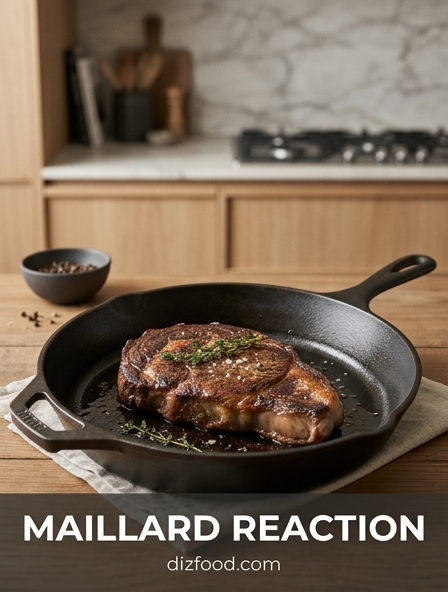
The Maillard reaction is the chemical cornerstone of savory cooking, involving the transformation of amino acids and reducing sugars into complex flavor compounds and brown pigments. This reaction typically begins around 285°F (140°C) but accelerates significantly at higher temperatures. Heat retention is vital here because the moisture on the surface of the food acts as a coolant. As water evaporates, it consumes a massive amount of energy (latent heat of vaporization).
If your pan lacks sufficient heat retention, the energy will be spent purely on boiling off the moisture rather than browning the protein. This results in "steaming" the meat, leaving it grey and flavorless. A high-retention pan provides enough surplus energy to flash-evaporate the surface moisture and immediately begin the browning process. To maximize this effect, always pat your food dry with paper towels before cooking. This reduces the energy load required of the pan, allowing the stored thermal mass to focus entirely on the Maillard reaction, resulting in the rich, umami-heavy crust that characterizes professional-level searing and roasting.
How Pan Thickness Affects Results
Thickness, often referred to as the "gauge" of the cookware, is directly proportional to its thermal performance. A thicker pan base provides a larger buffer against temperature drops. When you place a cold chicken breast into a pan, the metal immediately under the meat loses heat. In a thin pan, this creates a localized "cold spot" that the burner cannot replenish fast enough. In a thick pan, the surrounding hot metal conducts energy toward the cold spot, stabilizing the temperature across the entire surface.
- Thermal Buffer: Thicker walls store more Joules of energy, protecting the cooking process from external variables.
- Evenness: Increased thickness reduces the intensity of hot spots caused by the burner's flame pattern.
- Structural Integrity: Thick-gauge pans are less likely to "bow" or warp when exposed to rapid temperature changes.
For high-heat applications like pan-frying or searing, a thickness of at least 3.0mm to 5.0mm is recommended for stainless steel or aluminum. Cast iron is naturally thick due to its casting process, which is why it remains the gold standard for heat retention. While thicker pans take longer to reach the desired temperature, the consistency and quality of the sear they produce are significantly superior to their thinner counterparts.
Avoiding Temperature Drops During Frying
The primary enemy of a crisp, golden fry is a sudden drop in oil temperature. When cold or room-temperature ingredients are submerged in hot oil, the oil's temperature can plummet by 50°F or more. If the temperature falls below the optimal range (typically 350°F to 375°F), the food will absorb excess oil before the exterior can dehydrate and crisp, leading to a greasy final product. Maintaining heat retention during this process requires a combination of high-volume oil and heavy-duty cookware.
- Cook in Batches: Never crowd the pan; adding too much food at once overwhelms the stored energy.
- Use Heavy Cookware: A cast iron Dutch oven holds its heat better than a thin stainless pot, helping the oil recover faster.
- Monitor Recovery Time: Allow the oil to return to its target temperature between every batch.
By using a vessel with high thermal mass, you provide a stabilizing force that resists the cooling effect of the food. The metal walls of the pot act as a secondary heat source for the oil, ensuring that the "dip" is minimized and the recovery time is as short as possible. This is why professional deep fryers use large reservoirs of oil and heavy heating elements to maintain equilibrium.
Maintaining Surface Heat Consistency
Surface heat consistency is the ability of a pan to maintain a uniform temperature across its entire diameter. Without this, you encounter "hot spots" where food burns and "cold spots" where food sticks or remains undercooked. Heat retention plays a silent but vital role in this balance. While thermal conductivity (how fast heat moves) is often credited for evenness, retention ensures that once a temperature is reached, it stays there regardless of where the food is placed.
Materials like aluminum and copper are excellent at spreading heat, but they require a thick layer to provide the retention necessary for a consistent cooking surface. In contrast, cast iron has poor conductivity, which often leads to a hot spot directly over the flame. However, because it retains heat so well, a long preheat allows the energy to eventually spread and lock in, creating a very stable surface. To maintain consistency, match the pan size to the burner size as closely as possible. Using a massive skillet on a tiny burner will always result in a temperature gradient, no matter the pan's material. A well-retained surface allows for predictable results, ensuring that the third pancake cooks exactly like the first.
The Role of Oil in Heat Distribution
Oil is often viewed solely as a non-stick agent, but in the realm of heat retention, it serves as a critical thermal bridge. Metal surfaces, no matter how smooth they appear, are filled with microscopic peaks and valleys. When food is placed on a dry pan, air-which is a terrible conductor of heat-fills these gaps, leading to uneven energy transfer. Oil fills these microscopic voids, creating a continuous medium through which heat can flow from the pan's thermal mass into the food.
| Oil Type | Smoke Point | Thermal Stability |
|---|---|---|
| Avocado Oil | 520°F | Very High |
| Grapeseed Oil | 420°F | Moderate |
| Peanut Oil | 450°F | High |
| Extra Virgin Olive Oil | 375°F | Low |
The choice of oil must align with the intended heat levels. If the oil breaks down (smokes) before the pan's thermal mass is fully utilized, the flavor will be compromised. A high smoke point oil allows you to push the pan to the high temperatures necessary for a Maillard-driven sear. Furthermore, the oil helps distribute the heat more evenly across the surface of the food, ensuring that even irregular shapes receive consistent energy contact from the stored heat of the cookware.
Why Cast Iron Excels at Retention
Cast iron is the quintessential material for heat retention due to its unique physical properties. Unlike stainless steel or aluminum, cast iron is quite brittle and less conductive, but its density and high volumetric heat capacity allow it to store an immense amount of energy. Once a cast iron skillet is hot, it stays hot. This is why it is the preferred choice for searing steaks or baking cornbread; it provides a "steady" heat that is not easily disrupted by the introduction of cold ingredients.
Furthermore, cast iron has high emissivity, meaning it radiates heat beyond the surface of the metal. While a stainless steel pan primarily heats what it touches, a hot cast iron pan radiates heat upward, cooking the food not just through conduction but also through radiant energy. This helps in cooking thicker cuts of meat more evenly. Although it takes longer to heat up and longer to cool down, this "thermal momentum" makes it incredibly forgiving for high-heat techniques. Once seasoned, the carbonized oil layer also aids in heat transfer and provides a natural non-stick surface, making it the most efficient heat-retention tool in the modern kitchen.
Troubleshooting Weak Searing Performance
If your food is failing to develop a proper crust, the issue is almost certainly related to a lack of retained heat or excessive moisture. Weak searing results in "grey meat," which occurs when the surface temperature of the pan drops below the threshold of the Maillard reaction. This is a common problem when using thin pans or failing to allow for a proper recovery time between batches. To diagnose and fix these issues, consider the following checklist:
- Excess Moisture: Are you drying the protein? Surface water must evaporate before browning can begin.
- Pan Crowding: Are you cooking too much at once? This "quenches" the pan's thermal energy instantly.
- Insufficient Preheating: Did you wait for the oil to shimmer, or did you add the food too early?
- Material Choice: Is the pan too thin? Thin aluminum or cheap steel cannot store enough energy for a heavy sear.
- Temperature Setting: Are you cooking on too low a flame for the mass of the pan?
To improve results, try using a heavier skillet and reducing the amount of food you cook at one time. Focus on the "sizzle" sound; if the sizzle dies down shortly after adding the food, your pan has lost its thermal edge, and you need to increase your preheat time or reduce your batch size.

Comments