
When it comes to setting the perfect table, understanding the distinct roles of a steak knife versus a butter knife is key to a seamless dining experience. While the steak knife is your go-to powerhouse for precision cutting through tough proteins with its sharp, often serrated edge, the butter knife takes a gentler approach, featuring a blunt, rounded blade specifically designed for smooth spreading and effortless portioning of condiments. Choosing the right tool not only preserves your dinnerware but also elevates the texture and presentation of your meal, ensuring every bite is handled with the exact level of force or finesse it deserves.
| Feature | Steak Knife | Butter Knife |
|---|---|---|
| Primary Purpose | Slicing cooked meats and fibrous proteins | Spreading butter, jams, and soft toppings |
| Blade Edge | Serrated or ultra-sharp straight edge | Dull, smooth, and non-tapered |
| Tip Shape | Pointed (for piercing and detail cutting) | Rounded/Blunt (for scooping and safety) |
| Cutting Power | High; designed to saw through muscle fiber | None; intended for gliding over surfaces |
| Typical Length | 8 to 9 inches | 5 to 7 inches |
| Table Etiquette | Placed to the right of the dinner plate | Placed on the bread plate or far right |
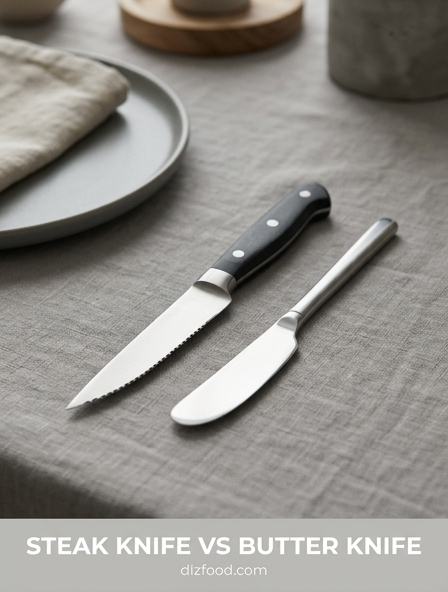
Defining the Steak Knife and the Butter Knife
In the culinary world, the steak knife and the butter knife represent two opposite ends of the functional spectrum. The steak knife is a specialized tool designed primarily for the consumption of cooked proteins. It features a sharp, often pointed blade specifically engineered to slice through the dense fibers of beef, pork, and poultry without tearing the meat. Historically, steak knives evolved from the basic utility knives that diners once carried themselves, eventually becoming a standard part of high-end cutlery sets to ensure that guests could enjoy premium cuts of meat with ease and precision.
Conversely, the butter knife-often referred to as a master butter knife or a butter spreader depending on its specific shape-is a blunt-edged utensil intended for the application of soft spreads. Its design prioritizes safety and smoothness over cutting power. The butter knife typically lacks a sharp point, featuring a rounded or "paddle" tip to prevent it from piercing through delicate bread or rolls while spreading butter, jams, or soft cheeses. While the steak knife is an aggressive tool meant for the main course, the butter knife is a communal or individual accessory used for appetizers and side dishes. Understanding these definitions is essential for any host looking to provide the correct tools for a balanced and functional dining experience.
Key Design Differences Serrated vs Rounded Blades
The most immediate visual and functional distinction between these two knives lies in their blade geometry. Steak knives are frequently categorized by their edge type: serrated, straight-edged, or a hybrid of the two. Serrated steak knives feature small, saw-like teeth that are ideal for gripping the tough exterior of a crusty steak or a fibrous piece of meat. Straight-edged steak knives, while requiring more frequent sharpening, offer a cleaner cut that does not shred the protein's internal structure. In both cases, the blade is usually five to six inches long with a sharp point intended for detail work around bones.
Butter knives, by contrast, possess a completely smooth, dull edge that is incapable of slicing through meat. The blade is generally shorter and wider, designed to hold a significant amount of spreadable material. A key design feature is the rounded tip, which serves a specific purpose: it allows the user to scrape the bottom of a butter dish efficiently and prevents the knife from snagging on the soft crumb of freshly baked bread. The following table highlights the primary physical differences:
| Feature | Steak Knife | Butter Knife |
|---|---|---|
| Edge Type | Serrated or Sharp Straight | Smooth and Dull |
| Tip Shape | Pointed | Rounded or Scalloped |
| Blade Width | Narrow | Wide and Flat |
| Primary Material | High-Carbon Stainless Steel | Stainless Steel or Silver |
Primary Functions and Cutting Power Comparison
The primary function of a steak knife is the mechanical separation of muscle tissue. When a diner uses a steak knife, they are applying downward pressure combined with a sawing motion to overcome the resistance of cooked meat fibers. Because steak can be tough, particularly with cuts like flank or skirt steak, the knife must maintain its edge to ensure the diner does not have to struggle. A high-quality steak knife acts as an extension of the hand, providing the leverage necessary to navigate through fat, gristle, and bone-in portions without slipping or requiring excessive force.
The butter knife's function is almost entirely focused on transfer and distribution rather than separation. It is used to move a pat of butter from a communal dish to a personal bread plate, and then to spread that butter evenly across a surface. Because its "cutting power" is virtually non-existent, it is safe for children to use and is the only knife typically allowed to remain on a bread plate throughout the meal. While a steak knife is a tool of precision and power, the butter knife is a tool of convenience and grace. Using a steak knife to spread butter would likely result in the bread being torn to pieces, while using a butter knife to cut a steak would be an impossible task that could lead to frustration and a messy plate.
Material Quality and Handle Construction Details
The construction of a steak knife often mirrors that of a chef's knife, utilizing high-carbon stainless steel to ensure the blade remains sharp and resistant to corrosion. Many premium steak knives feature a "full tang," meaning the metal of the blade extends all the way through the handle. This provides balance and durability, ensuring the knife doesn't snap under the pressure of cutting a thick ribeye. Handles are typically made from dense materials such as:
- Polyoxymethylene (POM) for professional durability and dishwasher resistance.
- Hardwoods like Walnut or Pakkawood for aesthetic appeal and a comfortable grip.
- Stainless steel for a modern, seamless look that is easy to sanitize.
Butter knives are often constructed with less emphasis on metallurgical hardness and more on decorative appeal. Since they do not require a sharp edge, they are frequently made from standard 18/10 stainless steel, silver plate, or even sterling silver in formal sets. The handles are often lighter and more ornamental, as they do not need to withstand the same mechanical stress as a steak knife. In many flatware sets, the butter knife is forged as a single piece of metal, whereas the steak knife is often a multi-piece assembly involving rivets and separate handle scales to accommodate the ergonomic needs of heavy cutting.
Table Setting Etiquette and Proper Knife Placement
In formal dining, the placement of knives is dictated by strict etiquette rules designed to guide the diner through the courses. The steak knife is traditionally placed to the right of the dinner plate, with the sharp edge of the blade facing inward toward the china. If multiple knives are present for different courses, they are used from the outside in. The steak knife is usually the largest and most robust knife on the right side, positioned closest to the plate or second to it, depending on when the meat course is served.
The butter knife follows a completely different set of rules. It is almost never placed on the right side of the main plate. Instead, it is placed on the bread and butter plate, which sits to the upper left of the main setting. Proper etiquette dictates that the butter knife be laid diagonally across the top edge of the bread plate, with the handle pointing toward the diner's right hand and the blade facing down. During a meal, the butter knife should remain on the bread plate and never be placed on the tablecloth once it has been used. Adhering to these placements ensures a clutter-free environment and signals to the service staff which courses have been completed.
The Impact of Blade Sharpness on Food Texture
The sharpness of a steak knife has a profound impact on the sensory experience of eating. A dull knife requires the diner to "saw" aggressively, which compresses the meat and forces out the internal juices. This leads to a drier, less flavorful bite. A truly sharp steak knife glides through the fibers, preserving the structural integrity of the steak and keeping the moisture trapped within each slice. This is why many enthusiasts prefer straight-edged steak knives; they offer a surgical precision that leaves the surface of the meat smooth and visually appealing.
With a butter knife, the lack of sharpness is actually a benefit to the texture of the bread. If one were to use a sharp knife to spread cold butter, the point would likely dig into the bread, creating holes and ruining the texture. The wide, dull surface of the butter knife allows for "glide," enabling the user to apply a thin, even layer of spread without disturbing the delicate crumb of a roll or the crispy crust of a baguette. In this context, "sharpness" is the enemy of the perfect toast. The design ensures that the spread remains on the surface, allowing for a consistent ratio of butter to bread in every mouthful.
Durability and Long Term Maintenance Requirements
Maintaining a set of steak knives requires a commitment to edge retention. Serrated steak knives are notoriously difficult for the home cook to sharpen, often requiring professional service or specialized tapered sharpening rods to hone each individual tooth. Straight-edge steak knives are easier to maintain using a standard whetstone or electric sharpener, but they require more frequent attention to remain effective. Because they are used against ceramic or porcelain plates-surfaces that are harder than steel-the edges of steak knives dull much faster than kitchen prep knives. To preserve their life, they should ideally be hand-washed and dried immediately to prevent pitting.
Butter knives are remarkably low-maintenance. Because they never encounter hard surfaces or tough materials, their "edge" never needs to be sharpened. The primary concern for butter knife maintenance is the preservation of the finish. For stainless steel versions, this simply means avoiding abrasive cleaners that might scratch the polished surface. For silver or silver-plated butter knives, regular polishing is required to remove tarnish caused by oxidation. Unlike steak knives, butter knives are generally safe for the dishwasher, as there is no sharp edge to be damaged by the high-heat cycles or the movement of the rack, making them one of the most durable items in a flatware drawer.
Safety Tips for Handling Sharp vs Blunt Knives
Safety protocols vary significantly between these two tools due to their different risk profiles. When handling steak knives, the primary danger is the sharp point and the serrated edge, which can cause deep lacerations if the knife slips during use. Diners should always cut away from their body and keep their fingers well clear of the blade's path. When cleaning steak knives, it is vital to never leave them submerged in soapy water where they cannot be seen, as this is a common cause of kitchen injuries. Instead, they should be cleaned individually and placed in a knife block or a dedicated tray rather than a loose utensil drawer.
While butter knives are significantly safer, they still require respect to prevent minor accidents. The most common risk with a butter knife is using it for tasks it wasn't designed for, such as prying open a container or using it as a makeshift screwdriver, which can lead to the knife snapping or the user's hand slipping onto the thin metal. For families with children, the butter knife is often the "training knife" used to teach basic cutting motions. The following list outlines standard safety practices:
- Never use a steak knife to spread soft condiments.
- Always carry steak knives with the point facing downward.
- Store steak knives in a block to protect the edge and your hands.
- Avoid using butter knives as prying tools.
- Ensure steak knife handles are dry to maintain a secure grip.
How to Choose the Best Knife for Each Course
Selecting the right knife for a specific course is a matter of matching the tool's physical properties to the food's resistance. For a bread course or a side of dinner rolls, the butter knife is the mandatory choice. Its wide blade is also suitable for soft appetizers like pâté, hummus, or tapenade. If the meal includes a salad with large leaves, a standard dinner knife-which is slightly sharper than a butter knife but duller than a steak knife-is usually provided. However, the steak knife should only appear when the main protein is served. If the main course is a soft fish or a pasta dish, a steak knife is unnecessary and would be considered an etiquette error.
When hosting, consider the "toughness" of the dish. A tenderloin steak might be soft enough for a standard dinner knife, but providing a steak knife is a courtesy that ensures the guest doesn't have to struggle. For a charcuterie board, you should provide a mix of tools:
- Small butter knives for soft bries and goat cheeses.
- A pointed steak knife or cheese knife for hard cheddars or cured salamis.
- Individual butter spreaders for each guest to avoid cross-contamination.
Final Comparison of Steak Knife vs Butter Knife Utility
The steak knife and the butter knife serve as perfect examples of specialized design in the kitchen. One is built for the aggressive task of slicing through protein, utilizing hardened steel and sharp edges to ensure a clean culinary experience. The other is a gentle tool of distribution, designed for soft textures and refined table manners. While they are both technically "knives," their roles are so distinct that they are virtually never interchangeable. Using a butter knife for a steak is a recipe for frustration, while using a steak knife for butter is an unnecessary risk to both the diner and the dinnerware.
In summary, a well-equipped kitchen requires both. The steak knife provides the power and precision needed for the main event of a meal, while the butter knife adds the finishing touch to bread and appetizers. Investing in high-quality versions of both ensures that every stage of the dining experience, from the first roll to the last bite of steak, is handled with the appropriate tool. Ultimately, the utility of these knives is defined by their relationship to food texture; as long as we continue to eat both tough proteins and soft spreads, these two distinct knives will remain essential staples of the modern table setting.



Comments