
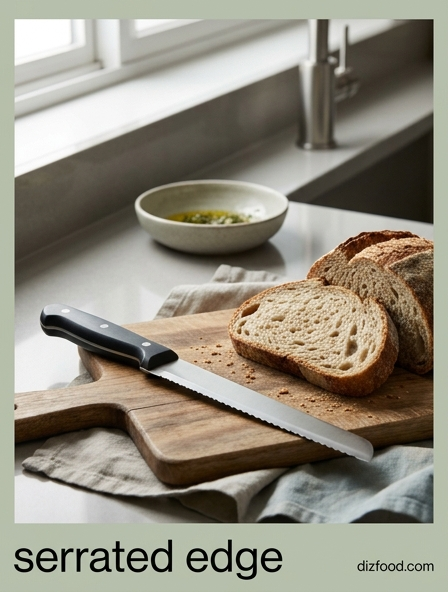
Understanding Serrated Blade Mechanics
The fundamental mechanics of a serrated blade revolve around the distribution of pressure across a series of pointed teeth. Unlike a straight edge, which requires a uniform downward force to sever fibers, a serrated knife utilizes its peaks to concentrate energy onto minute contact points. This design allows the blade to puncture tough or slick surfaces that would otherwise cause a standard edge to deflect. The recessed areas between the teeth, known as gullets, serve as reservoirs for material, preventing the blade from binding during deep cuts.
| Component | Function |
|---|---|
| Pointed Teeth | Pierces tough outer skins and crusts. |
| Gullets | Clears debris and reduces total surface friction. |
| Bevel Side | Usually single-beveled to allow for easier sharpening. |
Because the actual cutting edges are protected within these scalloped recesses, they rarely make direct contact with the cutting board. This geometric advantage preserves the sharpness of the internal curves, ensuring the knife remains functional even after extensive use on abrasive surfaces. This makes the serrated edge a specialized tool for structural integrity.
Serrated vs Straight Edge Meat Slicing
Choosing the correct edge for meat preparation depends entirely on the physical state and texture of the protein. Straight edges are generally preferred for raw, boneless proteins where a clean, surgical separation of muscle fibers is required. However, once meat is cooked, particularly when it has developed a bark or crust, the serrated edge becomes superior. The "bite" of the serrations allows the chef to navigate through polymerized fats and charred exteriors without crushing the tender interior of the roast.
- Straight Edge: Best for raw sashimi, trimming silver skin, and dicing fat.
- Serrated Edge: Ideal for crusty roasts, fibrous briskets, and soft-skinned sausages.
- Maintenance: Straight edges require frequent honing; serrated edges retain "toothiness" longer.
A straight blade relies on a push-cut or pull-cut motion that can compress delicate cooked fibers, leading to juice loss. Conversely, the serrated edge uses a mechanical sawing action that preserves the internal moisture by slicing through the fibers with minimal downward pressure. This distinction is critical for maintaining the aesthetic and sensory quality of premium meat cuts during final presentation.
Mastering the Sawing Motion for Precision
To achieve the best results with a serrated blade, one must abandon the heavy downward pressure common with chef's knives. Precision in serrated slicing comes from a deliberate, elongated sawing motion. This technique allows the teeth to engage with the meat's surface progressively, using the full length of the blade to do the work. The user should focus on light, rhythmic strokes, allowing the knife to sink into the protein under its own weight. This prevents the "shredding" effect often associated with improper serrated use.
Proper technique involves starting the cut at the heel of the knife and pulling back with a long, smooth stroke. As the blade moves, the serrations act like a miniature saw, creating a path for the rest of the metal to follow. If the meat begins to tear, it is usually a sign that the strokes are too short or the downward pressure is too aggressive. By maintaining a steady horizontal movement, the chef ensures that the serrations cleanly sever the connective tissues and muscle fibers, resulting in a professional-grade slice that looks as good as it tastes.
The Science of Scalloped Edges and Clean Cuts
Scalloped serrations are a specific variation of the serrated edge characterized by rounded, wavy teeth rather than sharp, triangular points. This design is rooted in fluid dynamics and material science, aiming to reduce the tearing of delicate fibers. When a scalloped edge enters meat, the rounded teeth distribute the cutting force over a slightly wider area than pointed serrations. This results in a cut that is significantly smoother, mimicking the finish of a straight edge while retaining the high-friction capabilities of a saw.
- Surface Tension: Scallops break the surface tension of cooked fats more gently.
- Fiber Alignment: The rounded peaks guide the blade between muscle bundles.
- Cleaning: Scalloped edges are less likely to trap food particles than jagged teeth.
This scientific approach to blade geometry is particularly useful for meats with high moisture content. The valleys of the scallops create small air pockets during the slicing process, which prevents the meat from vacuum-sealing itself to the side of the blade. This reduction in "drag" ensures that each slice falls away cleanly from the main roast, maintaining the structural integrity of the protein.
Best Meats for Serrated Knife Performance
Not every protein requires the aggressive grip of a serrated blade, but certain meats are practically impossible to slice cleanly without one. The best candidates are those with a significant contrast between their exterior and interior textures. For example, a slow-smoked brisket with a thick, peppery bark requires serrations to penetrate the crust without squeezing out the rendered fat and juices. Similarly, a glazed ham with a sticky, caramelized surface can cause a straight blade to slip, leading to uneven and dangerous cuts.
- Prime Rib: The outer fat cap and crust benefit from the serrated bite.
- Roasted Poultry: Slicing through crispy skin without detaching it from the meat.
- Cured Salamis: Navigating the tough casing of fermented sausages.
- Crusty Porchetta: Breaking through the hardened pork skin (crackling).
When dealing with these specific items, the serrated edge acts as a stabilizer. It anchors the blade into the meat immediately upon contact, providing the chef with greater control over the thickness and angle of the slice. For high-volume carving stations, the serrated knife is the undisputed tool of choice for these complex textures.
Maintaining Edge Retention in Heavy Use
One of the primary advantages of serrated knives in a kitchen environment is their exceptional edge retention. Because the recessed gullets of the blade are shielded from the abrasive surface of cutting boards, the actual cutting edges stay sharp for months, or even years, longer than their straight-edged counterparts. However, heavy use on dense meats will eventually dull the points of the teeth. Maintaining these knives requires a different approach than standard sharpening, involving specialized ceramic rods that fit into the individual serrations.
In a professional setting, edge retention is critical for efficiency. A serrated knife that is well-maintained can handle hundreds of pounds of protein before requiring significant service. To extend the life of the edge, it is important to avoid cutting through bone or frozen materials, which can chip the delicate teeth. Regular cleaning to remove acidic fats and salts also prevents microscopic pitting of the steel. While they do not need the daily honing that a chef's knife requires, a periodic touch-up of each individual scallop ensures that the knife continues to bite into tough surfaces with minimal effort.
Reducing Friction During Dense Meat Slicing
Friction is the enemy of a clean slice, particularly when working with dense, cold, or highly marbled meats. As a blade passes through protein, the surface area of the knife creates resistance, which can lead to tearing and uneven slices. Serrated blades naturally mitigate this issue through their unique geometry. By reducing the amount of metal that is in constant contact with the meat at any given second, the serrations lower the overall friction coefficient of the tool.
| Factor | Serrated Benefit |
|---|---|
| Contact Area | Only the peaks touch the meat initially, reducing drag. |
| Air Pockets | Gullets trap air, preventing the meat from sticking to the blade. |
| Heat Build-up | Lower friction means less heat, preserving the meat's cold-chain integrity. |
This reduction in friction is especially noticeable when slicing through dense items like chilled pâté or thick-cut bacon. The serrations allow the blade to "glide" through the fat layers rather than getting stuck in the sticky lipids. This ensures a more fluid motion and a more consistent output in high-speed kitchen environments.
Protecting Delicate Proteins with Micro-Teeth
While serrated blades are often viewed as "aggressive" tools, knives with micro-serrations are actually incredibly gentle on delicate proteins. Micro-teeth are tiny, almost invisible serrations that provide just enough grip to slice through soft tissues without the need for the heavy pressure that causes bruising. This is particularly useful for fish and very tender cooked meats where the internal structure is fragile. The micro-teeth act like a precision saw, separating fibers at a molecular level with minimal displacement.
Using a micro-serrated blade on delicate proteins prevents the "smearing" of fats and the compression of muscle cells. For example, when slicing a tenderloin that has been cooked sous-vide, a straight edge might crush the perfectly uniform cells, whereas micro-serrations will bypass the resistance of the outer sear and slide through the interior. This protection of the protein's structural integrity is vital for high-end plating. By utilizing the mechanical advantage of the teeth, the chef can produce paper-thin slices of even the most fragile meats, ensuring that the texture remains exactly as intended during the cooking process.
Essential Serrated Tools for Every Kitchen
A well-equipped kitchen should feature several types of serrated tools, each designed for specific meat-handling tasks. While many people associate serrations only with bread knives, the variety of "toothed" blades extends much further. Understanding the specific application of each tool allows for safer and more efficient prep work. From the long, flexible blades used for carving large roasts to the small, nimble knives used for cured meats, each has a role in the culinary workflow.
- The Offset Serrated Knife: Protects knuckles while slicing sandwiches or flat roasts.
- The Slicing/Carving Serrated Knife: Features a long, thin profile for uniform slices of ham or turkey.
- The Utility Serrated Knife: A multipurpose tool for small proteins like sausages or dried meats.
- Serrated Steak Knives: Designed for the diner to cut through cooked steaks on ceramic plates without dulling.
Each of these tools utilizes the serrated edge to overcome different obstacles. The carving knife focuses on length for single-stroke slices, while the steak knife focuses on durability against hard surfaces. Investing in a variety of these tools ensures that the kitchen can handle any protein texture, from the softest fish to the hardest cured salami.
Achieving Consistent Thickness with Serrated Blades
Consistency is the hallmark of professional meat service, and serrated blades are excellent for maintaining uniform thickness across multiple slices. The key to this consistency lies in the "tracking" ability of the serrations. Once the teeth have engaged with the meat and established a groove, the blade naturally wants to follow that path. This makes it much easier to maintain a straight vertical line compared to a straight edge, which can "walk" or veer to the side if the meat has varying densities.
To maximize this effect, the chef should use their non-dominant hand as a guide (using the "claw" grip) and ensure that the first "bite" of the serrations is perfectly aligned. Because the saw-like motion requires less downward force, there is less chance of the blade slipping or the meat shifting mid-cut. For items like roast beef or ham, where thin, uniform slices are required for sandwiches or platters, the serrated blade provides a level of mechanical reliability that is difficult to match with a standard chef's knife. By focusing on steady, horizontal strokes, any cook can produce slices of identical thickness, ensuring even cooking and professional presentation.




Comments