
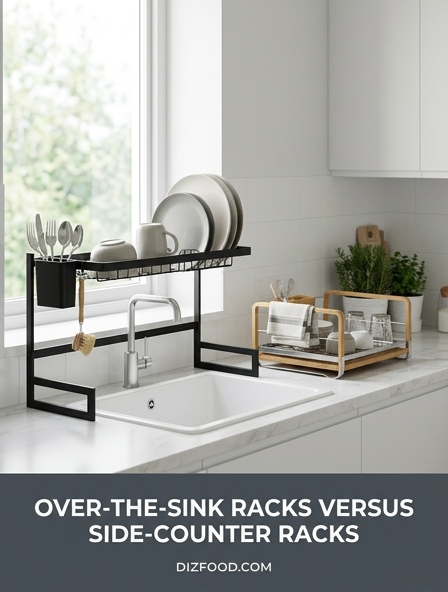
If your kitchen counters currently feel more like a cluttered storage unit than a meal prep station, choosing the right drying architecture is the fastest way to reclaim your workspace. While traditional side-counter racks offer familiar, easy-access stability, they inevitably sacrifice precious horizontal "real estate" that could be used for chopping and cooking. In contrast, over-the-sink racks capitalize on underutilized vertical air space, allowing water to drip directly into the drain while keeping your surfaces completely clear. Whether you're a minimalist living in a compact apartment or a home chef needing every square inch of marble, understanding the trade-offs between vertical elevation and classic countertop placement is key to streamlining your kitchen's workflow.
| Feature | Over-The-Sink Racks | Side-Counter Racks |
|---|---|---|
| Space Efficiency | Maximum; utilizes vertical air space. | Low; occupies 2-4 sq. ft. of counter. |
| Drainage System | Gravity-fed; drips directly into basin. | Requires sloped tray or manual emptying. |
| Capacity | High; multi-tier shelving for bulk items. | Moderate; limited by horizontal footprint. |
| Installation | Needs faucet height & cabinet clearance. | Plug-and-play; fits any flat surface. |
| Ergonomics | Items at eye level; reduces leaning. | Waist-level; familiar but requires reaching. |
| Stability | Suction-cup feet; depends on width fit. | High center of gravity; very sturdy. |
Maximizing Small Kitchen Space with Over-The-Sink Racks
In compact urban apartments and galley-style kitchens, counter space is the most valuable real estate. The over-the-sink rack capitalizes on the "dead space" directly above the faucet, transforming an otherwise unused area into a high-functioning storage hub. By elevating the dish-drying process, homeowners can reclaim several square feet of countertop that would otherwise be occupied by a traditional drying mat or bulky plastic tray. This allows for more efficient meal preparation and a less cluttered visual environment, which is essential for maintaining sanity in small living quarters.
Beyond simply holding plates, these vertical structures often incorporate multi-functional components that consolidate various kitchen tools into one footprint. The architectural advantage of the over-the-sink model is its ability to utilize height rather than width, making it a favorite for those who prioritize minimalist design. When every inch counts, shifting the drying load upward prevents the "cramped" feeling often associated with heavy dish usage. Key spatial benefits include:
- Clearance of primary prep zones for cutting boards and appliances.
- Consolidation of cleaning supplies, sponges, and dish soap in elevated baskets.
- Elimination of the need for secondary drying mats on the counter.
- Improved accessibility to frequently used items without opening cabinets.
The strategic placement of these racks also encourages a "wash-and-place" workflow, where the user never has to turn away from the sink to organize clean items. This streamlined motion not only saves time but also prevents water from dripping onto the floor or peripheral surfaces, keeping the limited workspace dry and hygienic.
The Efficiency of Natural Drainage in Dish Drying
One of the primary frustrations with traditional dish drying is the management of runoff water. Over-the-sink racks solve this problem through the simple application of gravity. Because the rack sits directly over the basin, every drop of water from freshly rinsed plates, glasses, and utensils falls straight into the drain. This eliminates the need for plastic drainage trays that often accumulate stagnant water, which can lead to unsightly hard water stains and unpleasant odors if not cleaned daily.
In contrast, side-counter racks rely on slanted boards or internal channels to direct water toward the sink. While effective, these systems often fail if the rack is not perfectly leveled or if the drainage lip does not extend far enough over the sink edge. The over-the-sink method provides a more foolproof solution, ensuring that the surrounding countertop remains bone-dry. This natural drainage efficiency significantly reduces the post-dishwashing cleanup routine, as there are no soggy towels to replace or trays to scrub.
The following table compares the drainage characteristics of both styles:
| Feature | Over-The-Sink Rack | Side-Counter Rack |
|---|---|---|
| Drainage Path | Direct vertical drop into basin | Lateral flow via tray/spout |
| Residual Moisture | Minimal to none on counters | Common under the tray |
| Maintenance | Very low; self-draining | Requires frequent tray cleaning |
| Risk of Leaks | Zero risk to countertops | Possible if spout is misaligned |
Side-Counter Racks and Countertop Stability Advantages
While vertical racks offer space-saving benefits, the traditional side-counter rack remains a staple due to its superior stability and lower center of gravity. These models sit flush against the countertop, distributing the weight of heavy stoneware, cast iron skillets, and large ceramic platters across a broad, flat base. For households that frequently use heavy-duty cookware, the structural integrity of a side-counter rack provides a sense of security that elevated models may struggle to match. There is no risk of the unit becoming top-heavy or swaying when a heavy pot is placed on the top tier.
Furthermore, side-counter racks are not limited by the dimensions of the sink or the height of the faucet. Over-the-sink models require precise measurements and can sometimes interfere with window views or low-hanging cabinetry. Side-counter models offer "plug-and-play" simplicity; they can be moved to any flat surface, including kitchen islands or utility carts, depending on the current needs of the cook. This mobility is particularly useful during large gatherings where the sink area needs to remain clear for constant rinsing while the drying occurs elsewhere.
The stability is often reinforced by non-slip rubber feet and a weighted chassis, making them resilient against accidental bumps. In busy households with children or pets, the lower profile of a counter rack minimizes the chance of a catastrophic spill or a rack tipping over. This grounded design ensures that even the most delicate glassware remains safe and stationary throughout the drying process.
Vertical Storage Solutions for Modern Kitchens
Modern kitchen design increasingly favors verticality to combat the footprint of growing appliance collections. Over-the-sink racks are the epitome of this trend, often featuring modular attachments that extend several feet above the faucet. These racks are not merely for drying; they serve as comprehensive storage systems. By utilizing tiers, users can categorize items by frequency of use or by type-placing plates on the bottom for easy access and less-used serving bowls on the upper levels. This organized approach mimics the efficiency of a professional kitchen line.
The aesthetic of these vertical systems often leans toward industrial or contemporary, featuring matte black finishes or brushed stainless steel. This turns a utilitarian object into a design statement that complements modern hardware. Beyond the aesthetic, the functional versatility is enhanced by specialized hooks and side-carriages. A typical vertical setup might include:
- Dedicated knife blocks that keep sharp blades out of the way.
- Chopping board holders that allow boards to air dry upright.
- Hanging hooks for ladles, spatulas, and whisks.
- Space dishes out to ensure air can reach the center of the rack.
- Empty the rack as soon as dishes are dry to allow the frame itself to dry.
- For side-counter models, choose a rack with a removable tray for easy deep-cleaning in the dishwasher.
- Ensure the over-the-sink rack does not sit too close to the wall, which can trap steam and lead to wall moisture issues.
- Joint Construction: Welded joints are generally stronger than bolted or snap-together pieces.
- Finish: Look for powder-coated or electroplated finishes to prevent rust.
- Leg Design: U-shaped or H-shaped legs on over-the-sink models offer the best weight distribution.
- Tray Quality: On side-counter models, thick, flexible plastic is less likely to crack than rigid, thin plastic.
- Reduction in lower back strain from eliminating side-to-side twisting.
- Improved visibility of items, reducing the need to lean forward to find space for a glass.
- Easier reach for cleaning tools, which are stored at a more accessible height.
- Minimized dripping on the floor, which reduces the risk of slips and the need for frequent mopping.
- 360-degree rotating drainage spouts to fit any sink orientation.
- Removable or adjustable wine glass holders with protective coatings.
- Expandable base trays for extra-large pots and pans.
- Interchangeable accessory bins for different types of cutlery.
- Total linear inches of plate slots (look for 15+ slots).
- Depth of the bowl section to ensure stability for stacked mixing bowls.
- Availability of a dedicated area for heavy cookware.
- Ease of access to the sink for the next "load" of dirty dishes.
-
This vertical integration ensures that every tool has a specific home, reducing the time spent rummaging through cluttered drawers. For those who enjoy an "open-shelf" look, these racks provide a similar vibe while maintaining the practical necessity of a drying area. By keeping everything in sight and within reach, the kitchen becomes a more ergonomic and visually organized space.
Managing Moisture and Mold Prevention Between Styles
Moisture management is the most critical factor in choosing a dish rack, as poor airflow and standing water are the primary catalysts for mold and mildew growth. Over-the-sink racks excel in this category due to 360-degree air circulation. Because the dishes are elevated and often surrounded by open space, air can move freely around every surface, significantly accelerating evaporation. This rapid drying time is not just a convenience; it is a hygienic advantage that prevents the "musty" smell often associated with damp kitchens.
Side-counter racks, particularly those with solid plastic walls or deep trays, can create micro-environments of high humidity. If the drainage tray does not have a steep enough pitch, water can pool in corners, leading to the formation of a slimy biofilm. To prevent this, users of side-counter models must be diligent about wiping down the tray and the underside of the rack weekly. However, many high-end side-counter models now feature anti-microbial coatings and innovative spout systems to mitigate these risks.
To maximize hygiene regardless of the style, consider these practices:
Weight Capacity and Durability Comparison
The durability of a dish rack is determined by its material composition and its structural engineering. Over-the-sink racks are typically constructed from heavy-duty stainless steel-often 304 grade-to resist the constant exposure to humidity and the stress of suspension. Because they must span the width of the sink, their weight capacity is often a point of concern. Most high-quality models are rated to hold between 40 and 80 pounds, which is more than enough for a standard set of dishes, but users must be wary of cheaper, thin-walled aluminum versions that may sag over time.
Side-counter racks, by virtue of sitting on a solid surface, have a much higher theoretical weight limit. They are not prone to "bending" because the countertop provides continuous support. However, they are more frequently made from a mix of materials, including plastic and wood, which may not have the same lifespan as an all-steel over-the-sink unit. Plastic can become brittle and crack, while wood can rot if not treated with water-resistant oils. For those seeking a "buy it for life" product, a solid stainless steel construction is the gold standard for either style.
When evaluating durability, consider the following factors:
Ergonomic Benefits of Above-Sink Dish Storage
Ergonomics in the kitchen is often overlooked until back or neck pain sets in. The over-the-sink rack offers a significant ergonomic advantage by placing the drying area at or near eye level. This minimizes the need for repetitive bending or twisting toward the side counter while holding wet, slippery items. By keeping the workflow centered in front of the user, the over-the-sink model supports a more neutral spinal position. This is particularly beneficial for taller individuals who often find themselves hunching over standard-height countertops.
Furthermore, the "lift and place" motion required for an over-the-sink rack is often more natural than the "twist and reach" motion of a side-counter setup. For people with limited mobility or arthritis, reducing the degree of torso rotation during a chore as frequent as dishwashing can make a substantial difference in daily comfort. The accessibility of the utensils and sponges at chest height also means less strain on the shoulders compared to reaching into deep, low-profile racks.
Key ergonomic improvements provided by vertical racks include:
Versatility and Customization of Side-Counter Models
Side-counter racks win the prize for versatility, as they are not constrained by the specific geometry of the sink and faucet. Many modern side-counter models are designed with a modular or "expandable" footprint. For instance, some racks can slide open to double their drying capacity when hosting guests and then retract to a smaller size for daily use. This flexibility is a major advantage for households with fluctuating dish volumes. Additionally, because they don't block the area above the sink, they allow for unobstructed access to the window or backsplashes, which many users prefer for aesthetic reasons.
Customization in side-counter models often extends to the placement of the drainage spout and the configuration of the internal compartments. Many units allow you to move the utensil holder to any side of the rack or adjust the height of the cup tines. This allows the user to tailor the rack to their specific kitchen layout and dishware collection. The variety of materials also allows for more decor-matching opportunities; a bamboo side rack might perfectly complement a farmhouse kitchen, whereas a sleek white plastic model fits a minimalist scandi-style room.
Common customizable features of side-counter racks include:
Choosing the Best Layout for High-Volume Dishwashing
For large families or those who enjoy elaborate cooking, the volume of dishes can quickly overwhelm a single rack. In these scenarios, the choice between over-the-sink and side-counter models often comes down to throughput. An over-the-sink rack is excellent for continuous washing because it keeps the basin area clear for more dishes, but it can be limited by the vertical clearance of the room. If the rack is too high, it becomes difficult to reach; if it is too low, it can feel claustrophobic while washing. High-volume users should look for double-tiered over-the-sink models that maximize the vertical stack.
Alternatively, a side-counter rack is often better for drying large, heavy items like stockpots and baking sheets that might be too wide or heavy for a vertical rack's top shelf. In a truly high-volume kitchen, the best solution might actually be a combination of both or a very large, two-tiered side-counter model that offers a massive surface area. Managing a high volume of dishes requires a strategy for air circulation and stability, as overloaded racks are the leading cause of broken glassware.
Consider this checklist for high-volume needs:
Ultimately, the layout must prevent a "bottleneck" at the sink, ensuring that as soon as one item is washed, there is a secure, clear spot for it to land without having to rearrange the entire rack.
Final Verdict on Over-The-Sink Versus Side-Counter Racks
Choosing between an over-the-sink rack and a side-counter model ultimately depends on your kitchen's architecture and your personal dishwashing habits. The over-the-sink rack is the undisputed champion for small-space living and hygiene. Its ability to drain directly into the sink and its utilization of vertical space make it a revolutionary tool for those struggling with cluttered countertops. It is the ideal choice for modernists and those who prioritize ergonomic design and ease of maintenance.
On the other hand, the side-counter rack is the reliable workhorse of the traditional kitchen. Its stability, portability, and high weight capacity make it the better choice for those who cook with heavy materials and have ample counter space to spare. It offers more flexibility in terms of where it can be placed and can be easily tucked away or moved when not in use. For users who find the over-the-sink structures visually overwhelming or physically obstructive, the low-profile side rack remains the superior option.
In summary, the over-the-sink model is about innovation and space-saving, while the side-counter model is about stability and versatility. Assess your sink measurements, the height of your cabinets, and the types of dishes you use most frequently. If you have the clearance, an over-the-sink rack will likely change your kitchen experience for the better by freeing up your workspace. If you have heavy stoneware and a large kitchen island, a high-quality side-counter rack will provide the sturdy, flexible service you need for years to come.


Comments