
Choosing between gel detergent packs and compressed powder tablets often comes down to balancing convenience with specific cleaning needs. Gel packs excel at quick dissolution and pre-treating stuck-on messes with liquid enzymes, making them the go-to for shorter cycles where you need instant action without the risk of undissolved residue. Conversely, compressed powder tablets are the heavy lifters for tough, dried-on grease and hard water minerals, typically offering a more eco-friendly profile and better cost-per-load value. Whether you prioritize a spot-free shine on delicate glassware or deep-scrubbing grit for baked-on lasagna pans, understanding how these formulas interact with your dishwasher's temperature and water hardness is the secret to a perfect, effortless clean every time.
| Feature | Gel Detergent Packs | Compressed Powder Tablets |
|---|---|---|
| Best For | Short cycles & delicate glassware | Heavy grease & baked-on food |
| Dissolution Speed | Rapid; works in cool/quick wash | Slower; requires high heat (120°F+) |
| Hard Water | Moderate; may leave spots | Superior; contains mineral chelators |
| Abrasiveness | Low; gentle on patterns/finishes | Higher; better for physical scrubbing |
| Storage Stability | Prone to leaking or sticking together | Highly stable; long shelf life |
| Eco-Footprint | Higher (PVA plastic/bulky tubs) | Lower (Minimal paper packaging) |
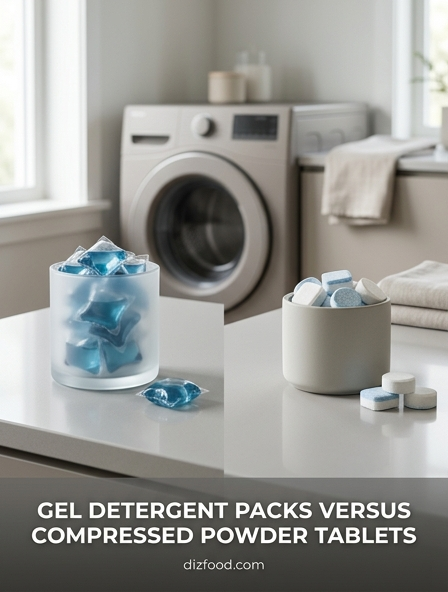
Gel Detergent Packs vs Compressed Powder Tablets Efficiency
The efficiency of kitchen detergents is often measured by their ability to provide a seamless user experience while delivering consistent cleaning results. Gel detergent packs have revolutionized kitchen maintenance by offering a pre-measured, "drop-and-go" solution that eliminates the need for measuring cups and the associated spills. These packs contain concentrated liquid surfactants encased in a water-soluble film, designed to rupture immediately upon contact with water. This rapid deployment ensures that the cleaning agents are active from the very beginning of the wash cycle, which is particularly beneficial for shorter cleaning programs often used for lightly soiled kitchenware.
In contrast, compressed powder tablets offer a different type of efficiency rooted in their multi-stage release capabilities. Because powder can be compressed into various layers with different densities, manufacturers can engineer these tablets to release specific chemicals at precise intervals during a cycle. For example, a tablet might feature a rapid-dissolve outer layer for the pre-wash, followed by a dense core that survives until the main wash phase. This architectural advantage allows for a sophisticated cleaning profile that single-phase gel packs struggle to replicate. However, tablets may require more mechanical action to break down completely compared to their liquid counterparts.
- Pre-measured doses eliminate user error and product wastage.
- Gel packs provide immediate chemical activation for rapid cycles.
- Compressed tablets allow for sequential release of specialized cleaning agents.
- Both formats reduce the physical footprint of detergent storage in the kitchen.
Cleaning Power Comparison for Tough Stains
When tackling the rigorous demands of kitchen sanitation, such as baked-on proteins, dried starches, and heavy grease, the chemical composition of the detergent is paramount. Compressed powder tablets generally hold the upper hand when it comes to abrasive cleaning and bleaching capabilities. Most tablets contain sodium percarbonate, a solid form of hydrogen peroxide, which is highly effective at oxidizing organic stains like tea, coffee, and fruit juices. The granular nature of the powder also provides a slight mechanical scrubbing effect during the early stages of the wash, helping to dislodge stubborn food particles from ceramic and glass surfaces.
Gel detergent packs, while lacking the bleaching power of powders, excel in grease emulsification. The liquid surfactants found in gel packs are highly concentrated and designed to surround fat molecules, lifting them away from surfaces and keeping them suspended in the wash water. This makes gel packs particularly effective for cleaning greasy ventilation filters, oily plastic containers, and frying pans. Many modern gel formulations also incorporate specialized enzymes, such as proteases and amylases, which remain highly stable in liquid form and effectively "digest" food residues. To better understand the performance differences, consider the following comparison:
| Stain Type | Gel Pack Performance | Powder Tablet Performance |
|---|---|---|
| Heavy Grease/Oils | Excellent | Good |
| Tea and Coffee Tannins | Fair | Excellent |
| Dried-on Starches | Good | Excellent |
| Protein Residues | Excellent | Good |
Dissolvability Rates in Cold Water Cycles
As modern kitchens move toward energy-efficient practices, the use of cold water cycles has become more prevalent. This shift places significant pressure on the dissolvability of detergent formats. Gel detergent packs are inherently advantaged in this environment because they contain liquid active ingredients that are already in a state of solution. The thin Polyvinyl Alcohol (PVA) film used to encapsulate the gel is engineered to dissolve rapidly even in temperatures as low as 60 degrees Fahrenheit. This ensures that the detergent is fully integrated into the water before the first rinse, preventing the common issue of undissolved detergent clinging to dishes or the interior of the machine.
Compressed powder tablets face a greater challenge in cold water. The binding agents used to keep the tablet structural can sometimes resist breakdown in low-energy cycles, leading to "clumping" or the tablet remaining partially intact in the detergent dispenser. If the water does not reach a sufficient temperature to break the chemical bonds of the compressed granules, the cleaning efficacy is significantly neutralized, and the machine may require an additional rinse to remove gritty residue. Manufacturers have attempted to mitigate this by creating "fast-dissolve" tablets with looser compression, but these are often more fragile and prone to breaking in the package. Users prioritizing cold-water settings typically find that liquid-based gel packs provide a more reliable and residue-free result.
Cost Per Load Price Analysis
The financial commitment of kitchen detergents is a primary concern for most households, and there is a distinct pricing gap between gel packs and compressed powder tablets. Generally, compressed powder tablets are the more economical choice. The manufacturing process for powder is less complex than the precision engineering required to encapsulate liquids in moisture-sensitive films. Additionally, powder is denser and less expensive to ship, as it does not contain the water weight associated with liquid gels. When purchased in bulk, powder tablets can cost significantly less per load, making them the preferred option for high-frequency users who prioritize budget over specific feature sets.
Gel detergent packs are positioned as a premium product, and their price reflects the convenience and advanced chemistry they offer. The multi-chamber designs often seen in gel packs-which keep incompatible liquid ingredients separate until the wash begins-require specialized production lines, which adds to the retail cost. Furthermore, the specialized films used to ensure they do not leak while remaining water-soluble are expensive components. While the price per load is higher, some users justify the cost by citing the reduced need for secondary additives like rinse aids, which are often integrated into the high-end gel formulas. However, for a straightforward cleaning task, the cost-to-benefit ratio usually leans in favor of the compressed tablet.
Environmental Impact and Packaging Sustainability
Sustainability in the kitchen has become a focal point for product development, and both formats have unique environmental profiles. Compressed powder tablets are widely considered more eco-friendly due to their packaging flexibility. They are frequently sold in recyclable cardboard boxes or minimal plastic pouches, significantly reducing the volume of waste generated. Because they are dry and stable, they do not require the heavy plastic containers used for traditional liquid detergents. Furthermore, many powder tablets are formulated without the need for complex plastic films, though some are individually wrapped in plastic that must be removed and discarded, which can be a drawback.
Gel detergent packs present a more complex environmental narrative. The "plastic" film surrounding the gel is actually Polyvinyl Alcohol (PVA), which is designed to be biodegradable and water-soluble. However, there is ongoing scientific debate regarding the completeness of this biodegradation in wastewater treatment plants, with some studies suggesting that micro-polymers may persist in the environment. Additionally, gel packs are almost always sold in heavy-duty plastic tubs or thick, multi-layered "stand-up" pouches to protect them from ambient moisture, which can lead to premature melting. This creates a larger volume of non-biodegradable packaging waste. Users looking to minimize their plastic footprint often gravitate toward the traditional powder format packaged in compostable or highly recyclable materials.
Machine Health and Residue Prevention
The long-term health of kitchen appliances, particularly dishwashers and laundry machines located in the kitchen, depends heavily on the type of detergent used. One of the primary concerns with compressed powder tablets is the potential for limescale and undissolved grit to accumulate in the internal plumbing and filters. If a tablet does not dissolve fully, the remaining particles can settle in the "sump" of the machine or clog the spray arms, eventually leading to reduced water pressure and mechanical strain. However, the alkaline nature of many powders can actually help to strip away existing fatty deposits within the machine, providing a secondary cleaning benefit for the appliance itself.
Gel packs are generally kinder to the mechanical components of the machine because they contain no solid particulates that could cause blockages. They move through the system smoothly and are easily flushed away during the rinse cycle. However, gel packs can sometimes contribute to a "sludge" or biofilm buildup if used exclusively in low-temperature cycles over a long period. This occurs because the liquid surfactants and fats can coat the outer drum or pipes, providing a medium for bacteria to grow. To maintain machine health when using gel packs, it is recommended to perform a high-temperature maintenance wash periodically. When considering machine longevity, the following factors are key:
- Powders are better at preventing limescale buildup in hard water areas.
- Gels reduce the risk of mechanical blockages in spray arms and filters.
- Tablets require higher heat to ensure no gritty residue remains on heating elements.
- Both formats benefit from monthly "clean-out" cycles using specialized machine cleaners.
Ingredient Concentration and Chemical Profiles
The chemistry of kitchen cleaning is a balance between pH levels, enzymatic activity, and surfactant power. Compressed powder tablets are typically more alkaline, often utilizing sodium carbonate (washing soda) as a primary builder. This high alkalinity is essential for breaking down tough proteins and fats, but it can be harsh on delicate glassware or aluminum items. The dry environment of a tablet also allows for the inclusion of oxygen-based bleaching agents, which remain stable for years in powder form but would react and lose potency if mixed into a liquid gel. This makes tablets the superior choice for sanitization and removing organic pigments.
Gel packs rely on a concentrated blend of non-ionic surfactants and stabilized enzymes. Because they are liquid, they can incorporate higher concentrations of "wetting agents" that lower the surface tension of water more effectively than powders. This allows the cleaning solution to penetrate into the microscopic pores of plastic containers where odors and stains often hide. However, because liquid formulations are more chemically volatile, they often require more preservatives and stabilizers to ensure the enzymes do not break down the other ingredients while sitting on the shelf. This results in a complex chemical profile that is highly effective at low temperatures but may contain more synthetic "filler" chemicals to maintain stability compared to the relatively simple mineral base of a powder tablet.
Shelf Life and Storage Requirements
Storage conditions in a kitchen-often characterized by high humidity and temperature fluctuations-can significantly affect the performance of detergent packs and tablets. Compressed powder tablets are remarkably shelf-stable. As long as they are kept in a relatively dry environment, they can last for several years without losing their cleaning potency. The primary risk with tablets is moisture absorption, which can cause them to crumble or "effervesce" prematurely, but even a slightly damp tablet will usually still function effectively once placed in the machine.
Gel packs are far more sensitive to their environment. Because the outer film is designed to dissolve in water, high humidity can cause the packs to become "tacky" and fuse together in the container. If a user attempts to pull them apart, the films often rupture, leading to a messy leak that can ruin the entire batch. Furthermore, extreme heat can cause the liquid inside to expand and leak, while extreme cold can cause the ingredients to separate or the film to become brittle and crack. For these reasons, gel packs must be stored in airtight containers and kept away from the underside of sinks where moisture is prevalent. To maximize the life of your detergent, follow these storage steps:
- Store all detergents in a cool, dry cupboard away from direct sunlight.
- Keep gel packs in their original container to maintain the moisture seal.
- Avoid handling gel packs with wet hands to prevent premature film dissolution.
- Ensure the container lid is snapped shut immediately after each use.
High Efficiency Machine Compatibility
High Efficiency (HE) machines are now the standard in modern kitchens, characterized by their use of significantly less water and lower wash temperatures. Both gel packs and compressed tablets are specifically formulated to be compatible with HE standards, but they interact with these machines differently. HE machines require "low-suds" detergents; if a detergent creates too many bubbles, the machine's sensors may trigger extra rinse cycles or even shut down to protect the motor. Gel packs are excellent for HE machines because their liquid surfactants are engineered to be highly active without creating excessive foam, ensuring the machine operates within its designed parameters.
Compressed tablets are also HE-compatible, but their success depends on the machine's ability to move the tablet out of the dispenser. Some HE machines use so little water during the initial fill that they struggle to wash a heavy tablet out of the tray and into the drum. For this reason, many tablet manufacturers recommend placing the tablet directly in the bottom of the machine rather than in the dispenser drawer. This ensures the tablet is submerged in what little water is available, allowing it to begin the dissolution process immediately. While both formats work well, gel packs offer a slight advantage in terms of "plug-and-play" compatibility with the low-water sensors of the latest high-end kitchen appliances.
The Final Verdict on Modern Laundry Formats
The choice between gel detergent packs and compressed powder tablets ultimately depends on the specific priorities of the household and the conditions of the kitchen environment. There is no single "better" format; rather, there is a better format for specific tasks. For those who prioritize maximum convenience, frequently run cold or quick cycles, and deal with heavy grease, the gel detergent pack is the clear winner. Its ability to dissolve instantly and provide high-surfactant cleaning makes it ideal for the fast-paced modern lifestyle where time and energy efficiency are at a premium.
On the other hand, the compressed powder tablet remains the champion for the budget-conscious and environmentally-minded consumer. Its superior ability to remove tough stains like tea and coffee, combined with its longer shelf life and typically more sustainable packaging, makes it a powerhouse for heavy-duty kitchen cleaning. If you live in an area with hard water, the mineral-based builders in powder tablets will also provide a better finish on glassware by preventing spots. Many households find that the best approach is to keep both on hand: using gel packs for daily, light cleaning and powder tablets for intensive, high-temperature sanitation cycles. By matching the detergent format to the specific cleaning challenge, you can ensure both the cleanliness of your kitchenware and the longevity of your appliances.



Comments