
Choosing between a drawer-style dishwasher and a traditional drop-door model often comes down to how you prioritize ergonomics versus raw capacity in your daily routine. If you're looking for a seamless kitchen cleanup that saves your back, drawer models allow for waist-high loading and the flexibility to run small, eco-friendly loads in one drawer while the other is being filled. Conversely, the classic drop-door dishwasher remains the powerhouse for large families, offering a cavernous interior that accommodates oversized pots and tall platters with ease. While drawers provide a modern, integrated aesthetic that blends perfectly with cabinetry, the time-tested drop-door design typically offers higher spray pressure and more straightforward loading for heavy-duty cleaning tasks.
| Feature | Drawer Style Dishwashers | Drop-Door Models |
|---|---|---|
| Ergonomics | Waist-high access; no deep bending required. | Traditional low-profile loading; requires bending. |
| Capacity | Approx. 7 place settings per drawer; limited height. | 12-16 place settings; fits tall items/large pots. |
| Efficiency | High; allows for small, independent "half" loads. | Best when fully loaded; "half-load" modes vary. |
| Design | Seamless "furniture" look; fits standard drawers. | Classic look; available in panel-ready or stainless. |
| Cleaning Power | Excellent for glassware/daily dishes; gentler. | High-pressure jets; superior for baked-on grime. |
| Price Range | Premium ($1,200 - $1,800+). | Budget to Luxury ($500 - $2,000+). |
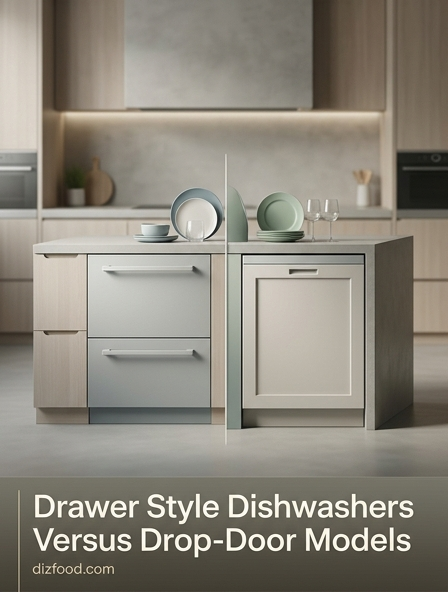
Comparing Drawer Dishwashers and Drop Door Designs
The fundamental choice between drawer dishwashers and traditional drop-door models often defines the workflow and layout of a modern kitchen. A drawer dishwasher operates on a horizontal sliding mechanism, allowing the user to pull the wash tub out like a standard cabinetry drawer. This design is relatively modern and caters to specific lifestyle needs, such as small households or homes that entertain frequently. In contrast, the drop-door design is the time-tested standard, featuring a front-loading door that hinges at the bottom and swings downward to rest parallel with the floor. This configuration provides a flat surface for sliding out racks, which has been the baseline for kitchen ergonomics for decades.
When evaluating these two designs, the primary consideration is the method of interaction. Drawer units are often sold as single or double configurations. A double-drawer unit occupies the same footprint as a standard dishwasher but provides two independent wash zones. This allows for simultaneous cycles with different settings, such as a heavy-duty cycle for pots in one drawer and a delicate cycle for glassware in the other. Drop-door models, however, offer a unified internal cavity. This singular, large space is generally more conducive to cleaning oversized items that require significant vertical or horizontal clearance. While the drop-door model is seen as the heavy-duty workhorse of the kitchen, the drawer model is praised for its modularity and the ability to run smaller, more frequent loads without wasting water or energy.
Ergonomic Benefits of Single and Double Dish Drawers
Ergonomics play a vital role in kitchen design, particularly for individuals with mobility issues or those who wish to age in place. Drawer dishwashers provide a significant advantage in this area because they require minimal bending. A top drawer in a double-unit configuration or a single drawer installed at waist height allows the user to load and unload dishes while standing perfectly upright. This eliminates the repetitive strain on the lower back that is commonly associated with the deep reach required by drop-door models. For many homeowners, the convenience of reaching directly into a drawer is a luxury that transforms the daily chore of cleaning into a seamless task.
- Reduced physical strain by eliminating the need to crouch or bend to reach the bottom rack.
- Adjustable installation heights for single units, making them ideal for custom-designed accessible kitchens.
- The ability to use the top drawer for daily items while reserving the bottom drawer for less frequent needs.
- Easier access for individuals using wheelchairs or walkers, as the drawer pulls directly toward the user.
- Minimal footprint when open, preventing the blocking of walkways during the loading process.
Furthermore, the double-drawer system allows for a "load as you go" lifestyle. Instead of letting dishes pile up in the sink until a large machine is full, users can run a single drawer as soon as it is occupied. This keeps the kitchen cleaner and reduces the physical weight of the loads being handled at any one time. The sliding motion of the drawers is typically engineered with high-quality glides, ensuring that even when fully loaded with heavy ceramic plates, the effort required to open the unit is negligible.
Traditional Drop Door Dishwasher Capacity and Loading Perks
While drawer units offer modularity, the traditional drop-door dishwasher remains the champion of sheer volume and internal flexibility. The primary perk of a drop-door model is its large, open vat. Because it does not require a structural partition between the top and bottom sections, it can accommodate tall stockpots, large cookie sheets, and oversized serving platters that simply would not fit in a standard dishwasher drawer. Modern drop-door designs have further enhanced this capacity through the inclusion of a third rack, usually located at the very top, which provides a dedicated space for cutlery and small utensils, freeing up the bottom rack for more bulky items.
Loading a drop-door dishwasher is also a highly organized process thanks to sophisticated racking systems. Most mid-to-high-end models feature foldable tines, adjustable-height middle racks, and dedicated spray zones for stuck-on food. These features allow the user to customize the interior layout based on the specific needs of the meal. For a large family or someone who hosts dinner parties, the ability to fit 14 to 16 place settings into a single cycle is a significant efficiency gain. The drop-door itself also provides a stable platform where the bottom rack can be fully extended out into the room, giving the user 360-degree access to the basket, which simplifies the process of organizing heavy plates and bowls.
Space Saving Solutions for Small Kitchen Layouts
In compact living environments such as urban apartments, tiny homes, or secondary suites, every inch of floor space is critical. This is where the choice between a drawer and a drop-door model becomes a strategic decision regarding spatial flow. A traditional drop-door unit requires a significant amount of clearance in front of the appliance to allow the door to swing down fully. In a narrow galley kitchen, an open dishwasher door can effectively block all traffic through the room. Drawer dishwashers mitigate this issue because they only extend as far as the user needs them to, and single-drawer units can be integrated into cabinetry where a full-sized appliance would be impossible.
| Feature | Single Drawer Unit | Standard Drop Door |
|---|---|---|
| Vertical Space | Requires only 16-18 inches | Requires 34 inches |
| Clearance Needs | Minimal; slides out partially | Significant; swings down fully |
| Cabinet Integration | Can be placed under cooktops | Requires full floor-to-counter gap |
| Ideal For | Studio apartments & wet bars | Full-sized family homes |
For those looking to maximize storage, a single drawer dishwasher allows for extra drawer or cabinet space directly beneath the unit. This is particularly useful in "zone-based" kitchen designs where a dishwasher might be placed near a prep station or a coffee bar rather than in the primary cleanup zone. By choosing a drawer model, homeowners can maintain a more open feel in the kitchen, as the appliance does not dominate the floor plan when in use. Additionally, the ability to install a dishwasher in a non-traditional location helps in creating a more efficient "work triangle" in unconventional layouts.
Installation Differences Between Drawer and Standard Units
The installation process for these two types of appliances varies significantly, largely due to their plumbing and structural requirements. A standard drop-door dishwasher is a self-contained box that slides into a 24-inch wide cavity. It connects to a single water inlet and a single drain hose. Because the unit sits on the floor, it is relatively easy to level using adjustable legs. Most contractors and DIY enthusiasts are familiar with this setup, making the labor costs for installation generally lower and the process more straightforward.
Drawer dishwashers, especially double units, present a more complex installation scenario. While they fit into the same 24-inch wide opening, they often require a more precise cabinetry finish to ensure the drawers sit flush with the surrounding panels. From a plumbing perspective, a double-drawer unit is essentially two separate machines. It usually requires a "Y" splitter for the water intake and a specialized drainage manifold to handle the discharge from both tubs simultaneously. If you are installing a single drawer at waist height, the cabinetry must be structurally reinforced to support the weight of the water and dishes without the benefit of the unit resting on the kitchen floor. Furthermore, the flexible hoses behind the drawers must be routed carefully to ensure they do not kink or catch as the drawer slides in and out, which requires a higher level of attention to detail during the initial setup.
Energy Efficiency Ratings for Modern Dishwashing Models
In the modern era of sustainable living, energy and water efficiency are top priorities for appliance manufacturers. Both drawer and drop-door models have made significant strides, but they achieve efficiency in different ways. Drawer dishwashers are inherently efficient for small households because of their "half-load" capability. Running a single drawer uses significantly less water and electricity than running a full-sized drop-door unit that is only half-full. This makes drawer models the preferred choice for those who prefer to wash dishes after every meal rather than waiting for a full load to accumulate.
- Single drawer units typically use between 1.5 to 2.5 gallons of water per cycle.
- Standard drop-door Energy Star models use approximately 3 to 4 gallons per cycle.
- Modern sensors in both styles can detect soil levels and adjust water temperature and cycle duration accordingly.
- Eco-modes in drop-door models often use extended drying times without heat to save electricity.
- Double drawers allow for independent energy management, meaning you don't have to heat the water for both tubs if only one is in use.
However, when comparing a fully loaded double-drawer unit against a fully loaded high-efficiency drop-door model, the drop-door unit often wins on sheer efficiency per dish. Because the drop-door model cleans more place settings in one go using a single pump and heating element, the energy cost per plate is usually lower. For a busy household that runs the dishwasher once or twice a day at full capacity, a standard model with a high Energy Star rating remains a very environmentally friendly and cost-effective option.
Cost Analysis of Drawer vs Drop Door Appliances
When analyzing the cost of ownership, there is a clear distinction between these two categories. Traditional drop-door dishwashers benefit from economies of scale. Because they are the industry standard, they are produced in massive quantities by dozens of different brands, which drives the price down. A reliable, mid-range drop-door dishwasher can often be purchased for significantly less than a basic drawer model. Furthermore, because the technology is so common, replacement parts are readily available and generally affordable, and finding a qualified repair technician is rarely a challenge.
Drawer dishwashers are positioned as a premium or niche product. The specialized sliding hardware, independent motor systems for double units, and sophisticated plumbing components result in a higher retail price. It is not uncommon for a high-quality double-drawer unit to cost twice as much as a comparable drop-door model. Maintenance costs also tend to be higher for drawer units; the complex nature of the drawer glides and the flexible hoses means that repairs can be more labor-intensive. However, for some, the long-term value is found in the lifestyle benefits and the potential energy savings of running smaller loads. Homeowners must weigh the higher upfront investment of a drawer model against the ergonomic convenience and the specific aesthetic appeal it brings to a high-end kitchen renovation.
Maintenance and Reliability Comparison for Both Styles
Reliability is often the deciding factor for many consumers when choosing kitchen appliances. Traditional drop-door dishwashers are generally considered more robust over the long term. The simplicity of the hinge and latch mechanism is less prone to failure compared to the complex sliding tracks found in drawer models. In a drop-door unit, the seals are stationary and pressed shut by the door latch, which creates a very reliable watertight environment. If a leak does occur, it is usually easy to identify and fix by replacing the door gasket.
Drawer dishwashers face unique mechanical challenges. Because the entire wash tub moves, the internal hoses and electrical wiring must be designed to flex thousands of times over the life of the appliance. This constant movement can lead to wear and tear that stationary units simply do not experience. Additionally, the seal on a drawer unit often relies on a motor-driven "actuator" that lowers a lid onto the tub or raises the tub against a lid. If this mechanism fails or becomes misaligned, it can lead to leaks or cycle errors. However, proponents of drawer models point out that if one drawer in a double unit requires repair, the other drawer often remains functional, providing a backup system that a single drop-door unit cannot offer. Regular cleaning of the drawer filters and ensuring the tracks are free of debris are essential maintenance steps to ensure the longevity of these specialized appliances.
Aesthetic Integration in Contemporary Kitchen Cabinets
From a design perspective, drawer dishwashers are often favored for their ability to blend seamlessly with kitchen cabinetry. They are frequently designed to be "panel-ready," meaning a custom wooden front that matches the rest of the kitchen drawers can be attached to the appliance. When installed correctly, a drawer dishwasher can be virtually indistinguishable from a standard kitchen drawer, contributing to a clean, minimalist aesthetic. This is particularly popular in modern and transitional kitchen designs where the goal is to hide appliances behind a "furniture-like" facade.
Drop-door models also offer panel-ready options, but the large vertical surface of the door is harder to disguise. Even with a custom panel, the kickplate and the handle often reveal the appliance's location. However, many homeowners prefer the professional look of a stainless steel drop-door dishwasher, viewing it as a statement piece that signals a high-functioning kitchen. Modern drop-door units now often feature top-integrated controls that are hidden when the door is closed, providing a sleek, handle-only look on the front. Ultimately, the choice depends on whether the homeowner wants the dishwasher to be a hidden functional element or a visible part of the kitchen's industrial or professional-grade aesthetic. Drawer units offer a level of "stealth" that drop-door models struggle to match, especially in open-concept living areas where the kitchen is visible from the lounge.
Choosing Between Drawer and Drop Door Dishwashers
Choosing the right dishwasher ultimately depends on a combination of household size, physical needs, and kitchen layout. For a large family that generates a significant volume of dishes and uses large pots and pans daily, the traditional drop-door dishwasher is usually the most practical choice. Its high capacity, lower price point, and proven reliability make it the workhorse of the American kitchen. The drop-door model is also the better option for those who want a straightforward installation and easy access to a wide network of repair services.
On the other hand, the drawer dishwasher is an excellent choice for several specific demographics. It is ideal for empty-nesters or single-person households who don't want to wait days to fill a standard dishwasher. It is also the superior choice for anyone with back pain or mobility issues, as the ergonomic benefits of waist-high loading cannot be overstated. Furthermore, in high-end custom kitchens or small urban spaces, the design flexibility and space-saving nature of drawers provide a level of sophistication that standard models cannot reach. By carefully considering how you cook, how often you entertain, and the physical constraints of your kitchen space, you can select the dishwashing technology that best enhances your daily routine and long-term comfort.





Comments