
Mastering the art of dicing is a fundamental skill that bridges the gap between home cooking and professional culinary precision, yet the approach must shift radically depending on your ingredient's cellular structure. Root vegetables, characterized by dense cellulose and low moisture, require a high-pressure "push-cut" to achieve the sharp, uniform edges necessary for even roasting and structural integrity. Conversely, soft fruits demand a delicate "draw-cut" with minimal downward force to prevent bruising and catastrophic juice loss, ensuring the fruit retains its vibrant texture rather than turning into a puree. By tailoring your knife stroke and tool selection to the specific fiber density of your produce, you can guarantee a perfect mouthfeel that balances crispness in your savories and delicate succulence in your sweets.
| Feature | Root Vegetable Dicing | Soft Fruit Dicing |
|---|---|---|
| Primary Tool | Heavy Chef's Knife or Mandoline | Serrated Knife or Ultra-sharp Paring |
| Cutting Motion | Vertical "Push" or "Chop" | Horizontal "Saw" or "Draw-slice" |
| Cellular Density | High (Lignin & Starch) | Low (Pectin & High Water Content) |
| Texture Objective | Crisp edges; uniform cooking rate | Structural integrity; juice retention |
| Pre-Cut Prep | Squaring off (Creating a flat base) | Chilling (To firm up sugars/flesh) |
| Critical Risk | Knife slipping on hard surfaces | Compression/Maceration (Mushiness) |
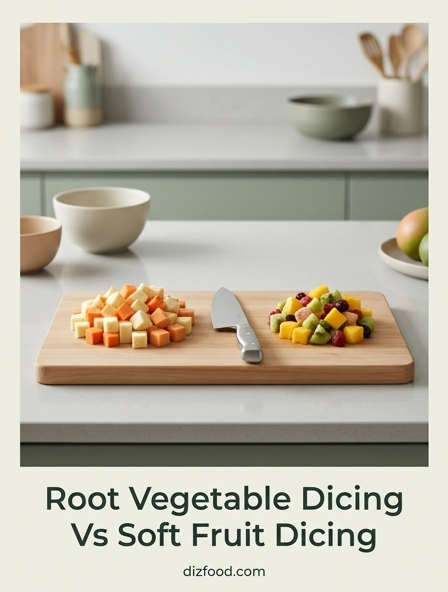
Blade Selection for Hard Roots vs Soft Fruits
The choice of a blade is the most critical decision when transitioning between the dense cellular structure of root vegetables and the delicate, moisture-rich composition of soft fruits. For root vegetables like carrots, parsnips, and rutabagas, a heavy-duty chef's knife or a traditional Santoku is preferred. These knives possess a thicker spine and a weightier profile, providing the necessary heft to drive the edge through fibrous layers without the blade wandering or bending under resistance. A wide blade also allows for better knuckle clearance when working with large, bulky tubers that require significant downward force.
Conversely, soft fruits such as peaches, plums, and tomatoes demand a blade with extreme sharpness and a thinner geometry. A utility knife or a specialized tomato knife with micro-serrations is often the superior choice here. The goal with soft fruit is to break the skin's surface tension without compressing the interior flesh. A thick, heavy blade can act like a wedge, crushing the fruit before the edge even begins to cut. Using a thin-profile blade reduces friction, allowing the steel to glide through the juice-filled cells while maintaining the integrity of the dice.
| Produce Type | Recommended Knife | Key Characteristic |
|---|---|---|
| Root Vegetables | 8-inch Chef's Knife | Thick spine, heavy weight |
| Soft Fruits | Paring or Utility Knife | Thin profile, razor-sharp edge |
| Tough-Skinned Fruit | Serrated Knife | Saw-like teeth for skin grip |
Mastering Knife Pressure for Different Produce Densities
Understanding the physics of pressure is essential for achieving a professional dice. When approaching root vegetables, the chef must utilize a "locomotive" motion-a combination of forward thrust and downward pressure. Because roots are structurally rigid, they can withstand the force required to divide them. The pressure should be concentrated at the heel of the knife where the most leverage exists. If the knife is sharp, the weight of the hand should do most of the work, but a firm, steady push is often required to navigate the dense center of a large sweet potato or beet.
Soft fruits require a complete reversal of this philosophy. Excessive downward pressure is the enemy of a clean fruit dice, as it leads to "bruising" and juice loss. Instead of pushing, the cook must focus on a "drawing" motion, utilizing the full length of the blade. By pulling the knife toward the body with minimal vertical force, the edge slices through the delicate membranes. This technique ensures that the dice remains vibrant and structurally sound. Mastering this light touch involves holding the knife with just enough firmness to guide it, letting the sharpness of the steel perform the separation rather than the muscle of the forearm.
- Roots: Use a rocking motion with consistent downward force.
- Fruits: Use a long, slicing draw with negligible vertical pressure.
- Balance: Maintain a centered center of gravity over the cutting board.
Structural Integrity in Root Vegetable Dicing Techniques
The primary challenge with root vegetables is their irregular, often tapered shapes. To achieve a uniform dice, one must first address the vegetable's structural integrity by creating a stable base. This is done by slicing a thin strip off one side of the root, allowing it to sit flat on the cutting board. Once stabilized, the root is squared off into a rectangular prism. This "wastage" (which should be saved for stocks) is necessary to ensure that every subsequent cube is of equal dimension, which is vital for even cooking times in stews and roasts.
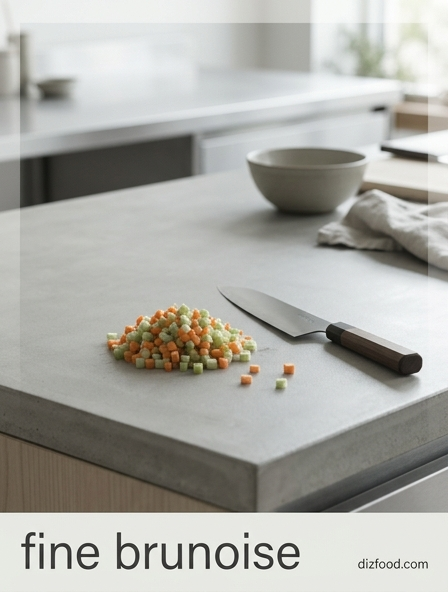
Once the root is squared, it is sliced into "planks" of the desired thickness, then into "batonnet" strips, and finally into cubes. Because roots are so firm, these shapes hold their sharp corners and flat faces throughout the process. This rigidity allows for high-speed dicing because the pieces do not slide or deform under the blade. The structural strength of a potato or turnip means that even a smaller brunoise will maintain its shape when tossed in a hot pan, providing a textural contrast that soft fruits simply cannot replicate under heat.
How to Prevent Bruising When Dicing Soft Fruits
Bruising in soft fruits occurs when the cellular walls are ruptured by blunt force rather than being cleanly severed. To prevent this, the sharpness of the knife is the first line of defense. A dull knife will "smush" the fruit, leading to discoloration and a mushy mouthfeel. Another factor is the temperature of the fruit; slightly chilled fruit is often firmer and easier to dice without bruising than fruit at room temperature. The cold helps stabilize the natural sugars and pectin, providing just enough resistance to the blade to keep the cube intact.
Handling techniques also play a major role in preservation. When dicing a soft fruit like a mango or a ripe pear, the "claw" hand used to stabilize the produce should apply only the lightest touch. Pressing down too hard with the fingertips will leave indentations that turn brown within minutes. Furthermore, the diced pieces should be moved from the cutting board to a bowl using a bench scraper or the flat side of the knife, rather than being scooped up by hand, which can further damage the delicate surfaces. Avoiding overcrowding on the cutting board also ensures that the weight of the fruit doesn't crush the pieces underneath.
- Ensure the knife is honed to a razor edge before starting.
- Chill delicate fruits for 15 minutes prior to dicing.
- Use a "draw-cut" to minimize vertical compression.
- Transfer diced fruit gently using a flat tool.
The Best Knife Grips for Firm Roots and Ripe Fruit
The pinch grip is the universal standard for professional dicing, but its application varies based on the resistance of the food. For firm root vegetables, the pinch grip-where the thumb and index finger grip the bolster of the knife-is combined with a firm wrap of the remaining three fingers around the handle. This provides maximum torque and prevents the knife from twisting if it hits a particularly hard knot in a parsnip. The grip must be secure enough to manage the significant resistance offered by the vegetable's dense starch content.
When dicing ripe fruit, the grip remains a pinch grip but becomes much more fluid. Some chefs find that extending the index finger along the spine of the knife (though generally discouraged for heavy tasks) can provide more "feel" and precision for very soft items like strawberries or kiwi. However, the standard pinch grip usually suffices if the pressure is relaxed. The goal is to maximize tactile feedback; you want to feel the blade's edge as it meets the skin. A looser, more sensitive grip allows the cook to adjust the angle of the blade instantly if the fruit begins to slip or yield unexpectedly, ensuring the cut remains precise without sacrificing the fruit's integrity.
Comparing Precision Dicing for Hard and Soft Foods
Precision in dicing is measured by the uniformity of the cubes, but the methodology differs between hard and soft produce. With hard roots, precision is a matter of geometry. Because the produce is stationary and predictable, the chef can use the "guide hand" to set a rhythm, moving back in exact increments to create perfect 1/4-inch or 1/2-inch cubes. The challenge here is physical endurance and maintaining a consistent angle against the resistance of the vegetable. If the blade tilts even slightly, the resulting cubes will be trapezoidal rather than square.
In contrast, precision dicing for soft foods is a matter of finesse and timing. Soft fruits often have seeds, pits, or varying internal textures (like the difference between the skin and the pulp of a plum) that can deflect the blade. Precision is achieved by slowing down the pace and focusing on the entry point of the knife. While root vegetables allow for a rapid-fire dicing pace, soft fruits require a deliberate, individual approach for each cut. The lack of structural resistance means the fruit can roll or slide easily, so the guide hand must be positioned with extreme care to maintain safety while ensuring each dice is uniform in size and aesthetic appeal.
Essential Tools for Root Vegetables and Delicate Fruits
While the knife is the primary tool, secondary equipment often determines the success of the prep work. For root vegetables, a high-quality Y-peeler is essential to remove thick, earthy skins efficiently. A sturdy wooden or heavy plastic cutting board is also necessary; because of the force used when dicing roots, a lightweight board may slip, creating a safety hazard. Many chefs also utilize a mandoline for the initial "planking" of root vegetables, which guarantees perfectly even thickness before the final dicing with a knife.
For delicate fruits, the toolkit shifts toward tools that minimize handling. A bench scraper is indispensable for moving diced fruit without bruising it. A flexible cutting mat can also be helpful, as it allows the cook to funnel the fruit directly into a bowl. In some cases, a specialized pitter or corer is used before dicing to remove central obstructions without mangling the surrounding flesh. Regardless of the produce, a damp paper towel placed under the cutting board is a universal requirement to ensure a stable, slip-free working surface for both high-pressure and high-finesse tasks.
- Y-Peeler: Best for deep-skinned roots like carrots.
- Mandoline: Provides perfect uniformity for root planks.
- Bench Scraper: Moves delicate fruit without manual compression.
- Honing Steel: Keeps the edge perfectly straight for fruit skins.
Achieving Uniformity Across Various Food Textures
Uniformity is not just about aesthetics; it is about ensuring that every piece of food in the dish cooks at the same rate or provides the same mouthfeel in a raw application. Achieving this across different textures requires a mental adjustment. For roots, uniformity is achieved through "templating." Once you have cut your first "perfect" cube, you use it as a visual guide for the rest of the batch. Because roots do not shrink or expand much before cooking, the raw dice is a very accurate representation of the final product.
Soft fruits present a different challenge because they are often rounded and cannot be "squared off" as easily as a potato without significant waste. To achieve uniformity with a peach or a mango, one must work in sections, following the natural curvature of the fruit while maintaining a consistent thickness in the slices. The irregularity of fruit means that the "outer" dice might have skin while the "inner" dice does not, affecting the visual uniformity. To counter this, many chefs prioritize size over shape when dicing fruit, ensuring that while the pieces might not all be perfect cubes, they all occupy the same approximate volume, leading to a balanced bite in salads or desserts.
Safety Strategies for Dicing Dense and Slippery Produce
Safety in dicing is often a matter of managing the "slip factor." Root vegetables are dangerous because of the force required; if the vegetable rolls or the knife slips, the amount of momentum involved can lead to a deep injury. The primary safety strategy for roots is the "flat base" rule: never cut a vegetable while it is in a position where it can wobble. Additionally, keeping the tip of the knife in contact with the board (the rocking cut) provides an extra point of stability that prevents the blade from skipping off a hard surface.
Soft fruits are dangerous for the opposite reason: they are often slippery due to high juice content. A tomato or a plum can slide out from under the blade with almost zero friction. The "claw" grip is the most important safety measure here, where the fingertips are tucked inward and the knuckles act as a guide for the blade. This protects the soft pads of the fingers from the razor-sharp edge required for fruit. Furthermore, it is essential to keep the cutting board dry. Frequently wiping away excess juice prevents the produce from "hydroplaning" across the board, which is a common cause of accidents when working with summer fruits like watermelon or citrus.
Prep Efficiency for Hearty Roots Versus Summer Fruits
Efficiency in a professional kitchen is built on "mise en place" and logical sequencing. When dicing root vegetables, efficiency is found in batch processing. A chef will peel all the carrots, then square all the carrots, then plank all the carrots, and finally dice them. This repetitive motion allows the muscle memory to take over, increasing speed without sacrificing uniformity. Because roots don't oxidize as quickly as many fruits, they can be prepped well in advance and stored in cold water, making them ideal for high-volume prep sessions.
Soft fruits require a "just-in-time" approach to efficiency. Because they are prone to oxidation, juice loss, and structural collapse, they should be diced as close to service as possible. Efficiency here is found in minimizing the number of cuts. Using the "pit-in" method for mangoes or the "around the core" method for pears allows the chef to extract the maximum amount of usable flesh with the fewest movements. While you cannot "speed-dice" a strawberry with the same reckless abandon as a potato, you can improve efficiency by using the correct specialized tools and ensuring your station is set up to move the finished product immediately into its final container or dish.
| Factor | Root Efficiency | Fruit Efficiency |
|---|---|---|
| Workflow | Batch processing | Individual/Sequential |
| Storage | Store in water (long-term) | Immediate use (short-term) |
| Speed | High (rhythmic) | Moderate (deliberate) |

Comments