
When it comes to culinary precision, the debate between carbon steel and stainless steel knives often boils down to a choice between raw performance and effortless maintenance. Carbon steel is the darling of professional chefs for its ability to take an incredibly fine, "scary sharp" edge that makes intricate prep work feel effortless, though it requires a disciplined care routine to prevent patina and rust. Conversely, stainless steel utilizes chromium to offer a rugged, rust-proof experience that excels in high-volume home kitchens where convenience is king. Deciding which one delivers your perfect edge depends on whether you value the surgical precision of high-carbon alloys or the resilient, low-maintenance longevity of modern stainless compositions.
| Feature | Carbon Steel | Stainless Steel |
|---|---|---|
| Edge Sharpness | Superior; achieves a finer, thinner bevel. | High; but restricted by larger grain size. |
| Edge Retention | Exceptional; holds a "bite" significantly longer. | Moderate; requires more frequent honing. |
| Rust Resistance | Low; develops patina and rust if left wet. | High; chromium content prevents oxidation. |
| Sharpening Ease | High; responds quickly to whetstones. | Difficult; harder alloys can be stubborn. |
| Durability | Brittle; prone to chipping if used on bone. | Tough; higher impact and flex resistance. |
| Maintenance | Demanding; must be dried and oiled regularly. | Minimal; standard washing and drying. |
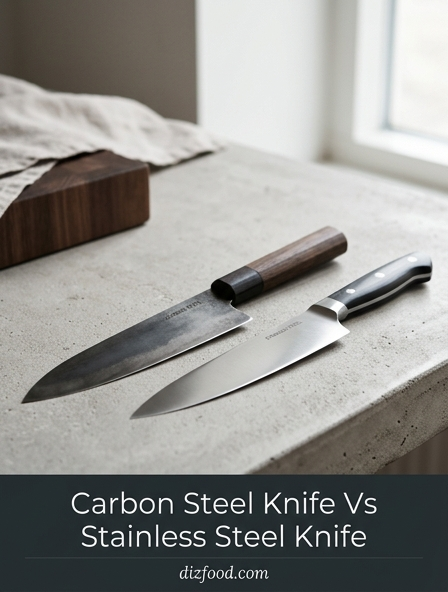
Carbon vs Stainless Steel Metallurgy Basics
The fundamental distinction between carbon steel and stainless steel knives lies in their chemical composition, specifically the presence and concentration of chromium. At its core, carbon steel is an alloy composed primarily of iron and carbon, typically ranging from 0.5% to 1.5% carbon. This simplicity in metallurgy allows for a very fine-grained structure, as there are fewer alloying elements to disrupt the crystalline lattice of the metal. Because it lacks significant additives, carbon steel is highly reactive to its environment, which is the trade-off for its high performance in cutting tasks.
Stainless steel, by contrast, must contain a minimum of 10.5% to 12% chromium to be classified as such. This chromium reacts with oxygen to form a passive, microscopic layer of chromium oxide on the blade's surface, protecting the underlying iron from rust. Modern stainless steels often incorporate additional elements like molybdenum, vanadium, and nickel to enhance specific properties. The following table highlights the typical elemental differences between standard versions of these steels:
| Element | Carbon Steel (e.g., White #2) | Stainless Steel (e.g., VG-10) |
|---|---|---|
| Carbon Content | High (1.0% - 1.2%) | Medium-High (0.95% - 1.05%) |
| Chromium Content | Trace (0% - 0.5%) | High (13% - 15%) |
| Grain Structure | Very Fine | Coarser due to Carbides |
While the addition of chromium provides the essential "stainless" quality, it also results in the formation of large chromium carbides. These carbides are very hard but can make the steel more difficult to sharpen to a laser-like edge compared to the pure, homogenous structure of high-carbon steel.
Edge Retention and Sharpness Comparison
When discussing sharpness, it is important to distinguish between "peak sharpness" and "edge retention." Carbon steel is renowned for its ability to achieve an incredibly fine, acute edge. Because the grain structure is uniform and small, a professional sharpener can hone a carbon steel blade to a microscopic point that is significantly sharper than most stainless equivalents. This makes carbon steel the preferred choice for delicate tasks like slicing sashimi or performing ultra-thin vegetable work where "push-cutting" is the primary technique.
Edge retention, or how long a knife stays sharp during use, depends heavily on the hardness of the steel, measured on the Rockwell Scale (HRC). Carbon steel knives are often heat-treated to higher hardness levels, sometimes reaching 63-66 HRC. This allows them to hold their edge for a long time during clean slicing. However, stainless steel has improved drastically with the advent of "super steels" and powder metallurgy. Modern stainless alloys can now match or exceed the edge retention of traditional carbon steel by utilizing hard carbides that resist abrasive wear.
- Carbon Steel: Higher potential for extreme sharpness; easier to "refresh" with a hone.
- High-End Stainless: Exceptional resistance to abrasive wear; stays "serviceably sharp" for longer periods in high-volume environments.
- Entry-Level Stainless: Generally lower edge retention due to softer heat treatments (54-56 HRC) designed for durability over sharpness.
In a kitchen setting, a carbon steel knife will feel sharper out of the box, but it requires more frequent "touch-ups" on a ceramic rod to maintain that peak performance, whereas a high-quality stainless blade provides a consistent, albeit slightly toothier, edge for a longer duration.
Corrosion Resistance and Rust Prevention
Corrosion resistance is the primary battlefield where stainless steel claims victory. The "stainless" moniker is not a total guarantee against rust, but it provides a massive buffer. The chromium oxide layer acts as a self-healing shield; if the blade is scratched, the chromium reacts with the air to reform the protective barrier. This makes stainless steel the ideal choice for high-moisture environments, busy commercial kitchens, or for home cooks who might leave a knife in the sink for an hour after dinner.
Carbon steel possesses virtually zero inherent corrosion resistance. If left wet or even in a humid environment, a carbon steel blade can begin to develop "red rust" (iron oxide) within minutes. This type of rust is destructive; it pits the metal and can eventually ruin the cutting edge. To prevent this, carbon steel users must adopt a strict workflow of "wipe after every use." This involves keeping a dry towel nearby and ensuring the blade is completely moisture-free before it touches the cutting board again.
Preventative measures for carbon steel include the application of food-grade oils, such as camellia oil or mineral oil, during storage. In professional settings, this requirement for constant vigilance can be a hurdle, whereas stainless steel offers the luxury of negligence. While stainless steel can still suffer from "pitting" if exposed to harsh chemicals or long-term salt exposure, it remains the superior choice for any environment where moisture control is not a top priority.
Maintenance Needs and Patina Development
The maintenance profile of carbon steel is often described as a ritual. Beyond just keeping the blade dry, carbon steel undergoes a chemical transformation known as patina development. As the steel reacts with acids in foods like onions, citrus, and meats, it develops a layer of "stable" oxidation. This patina often appears as shades of blue, grey, or black. Unlike red rust, a patina is beneficial; it acts as a protective layer that actually slows down further reactivity and helps prevent food from sticking to the blade.
Many enthusiasts find the patina to be a badge of honor, reflecting the history of the knife's use. However, for those who prefer their tools to look pristine, the darkening of the blade can be a source of frustration. Stainless steel requires none of this aesthetic management. A stainless blade will look exactly the same after five years of use as it did on day one, provided it is not physically scratched.
- Carbon Steel Maintenance: Requires immediate washing and drying, regular oiling, and "forcing" or managing a patina to prevent harmful rust.
- Stainless Steel Maintenance: Requires standard washing and drying; tolerant of acidic foods and brief periods of moisture.
- Patina Benefits: Creates a non-stick surface over time and provides a unique aesthetic.
Ultimately, carbon steel requires a commitment to the tool that goes beyond its function. If you view a knife as an appliance, stainless is the logical choice. If you view it as a living instrument that evolves with your cooking, carbon steel offers a more rewarding, albeit demanding, experience.
Ease of Sharpening and Honing
One of the most significant advantages of carbon steel is how effortlessly it responds to sharpening stones. Because carbon steel lacks the large, hard chromium carbides found in stainless steel, the metal is much easier to "abrade." A cook can take a dull carbon steel knife and bring it back to a razor edge on a whetstone in a fraction of the time it would take to do the same for a stainless blade. This "grindability" is why carbon steel remains the gold standard for sushi chefs and woodworkers who require frequent, precise sharpening.
Stainless steel, particularly the "tougher" varieties, can be frustrating to sharpen. The same elements that make it resistant to wear also make it resistant to the abrasive action of a whetstone. Furthermore, stainless steel is prone to developing a "burr" or "wire edge" that is difficult to remove. This burr can flip back and forth during sharpening, leading to a knife that feels sharp but loses its edge immediately upon touching a cutting board.
Honing is also different between the two. Carbon steel is often so hard that a traditional ribbed steel honing rod might actually chip the edge. Instead, carbon steel users typically use a ceramic rod or a leather strop to realign the edge. Stainless steel, being generally tougher and more ductile, responds very well to traditional honing steels, which can "roll" the edge back into alignment during a busy shift. For the home cook who only sharpens their knives once a year, the ease of sharpening a carbon steel blade might be the deciding factor in maintaining a truly functional tool.
Blade Toughness and Brittleness Explained
In metallurgy, there is a constant trade-off between hardness and toughness. Hardness refers to the ability to resist deformation (and thus stay sharp), while toughness refers to the ability to resist chipping or breaking under impact. Carbon steel knives, because they are often tempered to very high hardness levels, are notoriously "chippy." If you use a high-carbon Japanese gyuto to cut through a chicken bone or a frozen block of spinach, the edge is likely to crack or chip rather than bend.
Stainless steel is generally engineered with a focus on toughness and durability. Because the metal is slightly "softer" or more ductile, the edge is more likely to "roll" or deform if it hits something hard. While a rolled edge is technically dull, it is much easier to fix with a honing rod than a chip, which requires significant metal removal on a coarse whetstone to repair. This makes stainless steel the "workhorse" choice for tasks that involve high impact or bones.
Western-style stainless knives (like those from Wüsthof or Henckels) are specifically designed for this kind of abuse, featuring a lower HRC (around 56-58) and thicker blade geometry. Carbon steel knives are almost always "lasers"-thin, hard, and fragile. They are precision instruments meant for slicing through soft tissues and vegetables, not for hacking or prying. Understanding this limitation is vital; a carbon steel knife can last a lifetime if used correctly, but it can be destroyed in a single second of misuse on a hard surface or bone.
Professional Use vs Home Kitchen Utility
In the world of professional kitchens, the choice between carbon and stainless often comes down to the volume and type of work being performed. Line cooks and prep cooks in high-volume Western restaurants often prefer stainless steel. In these fast-paced environments, there is rarely time to stop and meticulously dry a knife after every few cuts. Furthermore, the risk of a colleague accidentally grabbing a knife and throwing it into a dishwasher or a sink of soapy water makes the durability of stainless steel a practical necessity.
However, in specialized professional environments, such as high-end sushi bars or traditional Japanese kitchens, carbon steel is the undisputed king. These chefs prioritize the surgical precision of the edge above all else. Because their workflow is already highly disciplined, the maintenance of the blade is integrated into their culinary practice. For these professionals, the time saved during the actual cutting of food-thanks to the extreme sharpness-outweighs the time spent on maintenance.
- Home Kitchen: Stainless steel is recommended for 90% of home cooks. It handles the "start and stop" nature of home cooking where a knife might sit on the board for 20 minutes while the stove is attended to.
- Enthusiast Home Cook: Carbon steel is a great "hobbyist" tool for those who enjoy the process of sharpening and taking care of fine equipment.
- Professional Prep: Stainless (specifically high-end alloys like AEB-L or Ginsan) offers a middle ground of high performance with low maintenance.
Ultimately, the "utility" of a knife is subjective. For some, utility means a tool that never rusts; for others, utility is the ability to shave a hair off an arm before starting a shift.
Cost and Long Term Value Analysis
The price of a knife is influenced more by the craftsmanship, brand, and heat treatment than the raw material cost of the steel itself. However, there are general trends in the market. Mass-produced stainless steel knives are the most affordable option, often costing between $20 and $60. High-end stainless steel knives, especially those using powdered metallurgy, can easily reach $200 to $400. Carbon steel knives occupy a similar premium bracket, as they are often hand-forged by specialized blacksmiths.
When evaluating long-term value, carbon steel often wins for those who are willing to do the maintenance. Because carbon steel is so easy to sharpen, you tend to remove less metal during each sharpening session to achieve a perfect edge. This means a carbon steel knife can technically survive more sharpening cycles over decades than a stainless knife that might require aggressive grinding to fix a stubborn, dull edge.
However, the "value" of stainless steel is found in its insurance against catastrophe. A carbon steel knife that is forgotten in a damp drawer for a month may be rendered useless by deep, structural pitting. A stainless knife in the same condition will likely emerge unscathed. For the average consumer, the value of stainless steel lies in its longevity through neglect. For the expert, the value of carbon steel is found in its performance and the ease with which it can be restored to a factory-new edge even after years of heavy use.
Reactive Metals and Food Flavor Impact
A frequently overlooked aspect of carbon steel is its "reactivity" with food. When a carbon steel blade is new and has not yet developed a stable patina, it can react chemically with acidic ingredients like onions, lemons, and tomatoes. This reaction can lead to two unpleasant outcomes: the food may turn a brownish or greyish color, and a distinct metallic "tinny" taste can be transferred to the ingredients. Onions are particularly notorious for this; a fresh carbon steel blade can turn a white onion slightly blue within seconds of contact.
This reactivity is almost non-existent with stainless steel. Because the chromium layer prevents the iron from interacting with the acids, the flavor and color of the food remain pure. This is why many chefs who use carbon steel for their main "chef knife" will still keep a stainless steel paring knife or utility knife on hand specifically for slicing lemons or garnishes where presentation and flavor purity are paramount.
It is worth noting that as a carbon steel knife develops a thick, dark patina, this reactivity significantly diminishes. A well-seasoned carbon steel knife will have very little impact on flavor or color. However, the initial "break-in" period can be off-putting for those sensitive to metallic tastes. If you do a lot of light-colored, acidic prep-such as dicing onions for a raw garnish or slicing fruit-a stainless steel blade is the safer bet to ensure the sensory quality of your ingredients is not compromised.
Final Verdict for Your Cutting Style
Choosing between carbon steel and stainless steel depends entirely on your personality as a cook and your willingness to maintain your tools. Neither is objectively "better," but one will certainly be better for your specific kitchen habits. If you value convenience, durability, and a clean aesthetic, stainless steel is the modern solution that eliminates the stress of maintenance. If you value the highest possible performance, ease of sharpening, and the "soul" of a tool that changes over time, carbon steel is the traditionalist's choice.
| Choose Carbon Steel If... | Choose Stainless Steel If... |
|---|---|
| You enjoy the ritual of sharpening on whetstones. | You want a knife that can be put away wet without worry. |
| You want the sharpest edge possible for precision cuts. | You share your kitchen with people who might not "baby" your tools. |
| You appreciate the look of an aged, dark patina. | You frequently cut acidic foods like citrus and onions. |
| You are a professional in a specialized, controlled environment. | You need a "workhorse" that can handle tough prep and bones. |
In many modern kitchens, the ideal solution is a hybrid approach. Many cooks find success using a high-quality stainless steel chef's knife for 90% of their daily work, while reserving a carbon steel blade for specialized tasks where sharpness is the limiting factor. Whichever you choose, understanding the metallurgy behind the edge will help you get the most out of your investment and keep your kitchen running smoothly.

Comments