
Choosing the right tool to maintain your kitchen arsenal can be the difference between a frustrating struggle and effortless slicing. When comparing a whetstone versus a pull-through sharpener, you are essentially weighing the precision of traditional craftsmanship against the convenience of modern speed. While pull-through sharpeners offer a "quick fix" for casual home cooks, whetstones remain the gold standard for enthusiasts seeking a razor-sharp, refined edge that preserves the longevity of high-quality steel. Understanding how each method reshapes the bevel and removes metal is crucial for anyone looking to achieve peak cutting performance and ultimate control over their professional or home culinary tools.
| Feature | Whetstone (Water Stone) | Pull-Through Sharpener |
|---|---|---|
| Edge Sharpness | Extreme; can achieve a mirror-polish, hair-shaving edge. | Moderate; creates a "toothy" working edge. |
| Learning Curve | High; requires practice to maintain consistent angles. | Minimal; plug-and-play or simple manual slots. |
| Metal Removal | Controlled; removes only what is necessary for the grit. | Aggressive; often shaves off large amounts of steel. |
| Angle Versatility | Total; adjustable for Japanese (15°) or Western (20°) blades. | Fixed; usually limited to one or two preset angles. |
| Blade Longevity | Excellent; extends knife life through gentle material loss. | Poor; repetitive use can prematurely wear down the blade. |
| Best For | Premium forged cutlery and hobbyist enthusiasts. | Inexpensive utility knives and high-volume convenience. |
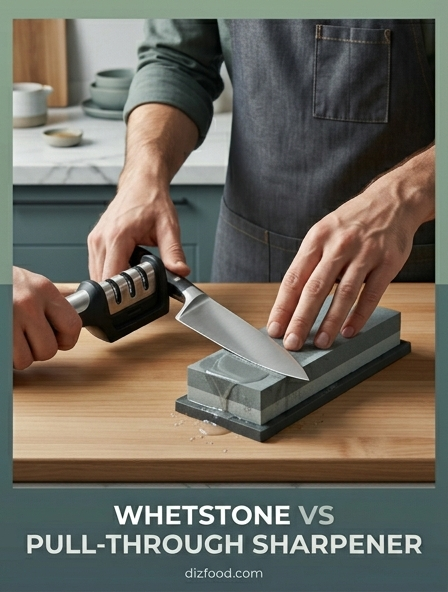
Understanding Whetstones and Pull Through Sharpeners
Maintaining a sharp knife is the cornerstone of kitchen safety and efficiency. To achieve this, two primary tools dominate the market: the traditional whetstone and the modern pull-through sharpener. Whetstones, often referred to as water stones or oil stones, are rectangular blocks of abrasive material. They come in varying grit levels, ranging from coarse surfaces for repairing chips to ultra-fine surfaces for polishing a mirror-like edge. The process involves manually gliding the blade across the lubricated stone at a specific angle to grind and hone the metal.
In contrast, pull-through sharpeners are mechanical devices designed for speed and convenience. These typically feature V-shaped notches containing abrasive wheels or stationary blades made of carbide, ceramic, or diamond-coated steel. The user simply places the knife heel into the notch and pulls the blade toward them. While both tools aim to restore a cutting edge, they operate on different mechanical principles and cater to different levels of culinary expertise. Understanding the composition of these tools is the first step in choosing the right maintenance routine for your cutlery.
- Whetstones: Available in synthetic or natural materials, requiring water or oil as a lubricant.
- Pull-Throughs: Portable, dry-use devices with fixed abrasive stages.
- Diamond Stones: A subset of whetstones that use industrial diamonds for faster metal removal.
- Ceramic Rods: Often found in the final stage of pull-throughs for edge alignment.
Precision Edge Control versus Rapid Maintenance
The primary divide between whetstones and pull-through sharpeners lies in the trade-off between precision and speed. Whetstones offer the user total control over the sharpening angle. A chef can choose to sharpen a delicate Japanese paring knife at a steep 15-degree angle or a robust Western chef's knife at a 20-degree angle. This granularity allows for a customized edge that suits the specific task at hand, whether it is slicing through soft sashimi or breaking down a pumpkin. However, this precision requires a significant time investment, often taking fifteen to thirty minutes to achieve a perfect finish.
Pull-through sharpeners are the antithesis of this methodical approach, prioritizing rapid maintenance above all else. They are designed for the busy home cook who needs a functional edge in seconds rather than minutes. By utilizing fixed guides, these devices remove the guesswork of maintaining a consistent angle, which is the most difficult part of manual sharpening. While they lack the ability to customize the edge, they provide a "working edge" that is sufficient for general kitchen tasks like dicing onions or slicing bread. For many, the ability to sharpen a knife mid-meal preparation without a complex setup makes the pull-through an indispensable tool, even if it lacks the surgical precision of a stone-honed blade.
Metal Removal Rates and Blade Life
One of the most critical factors in knife maintenance is how much metal is removed during each sharpening session. This directly impacts the lifespan of the tool. Pull-through sharpeners, particularly those utilizing tungsten carbide blades, are notoriously aggressive. They work by "shaving" or scraping metal off the sides of the blade to create a new apex. While effective for a quick fix, this process can be uneven and removes significantly more steel than is often necessary. Over years of use, a knife sharpened exclusively with a pull-through may show a visible "smile" or a significant reduction in blade height.
Whetstones allow for a much more conservative approach to metal removal. Because the user can progress through different grit sizes, they only remove as much steel as is required to reach a fresh edge. A fine-grit stone (3000+) polishes the metal rather than grinding it away. This preserves the geometry of the knife and ensures that high-quality cutlery can last for decades or even generations. The following table illustrates the general differences in how these tools affect the physical integrity of the blade over time.
| Feature | Whetstone | Pull-Through |
|---|---|---|
| Abrasive Action | Controlled Grinding/Polishing | Aggressive Scraping |
| Metal Loss | Minimal to Moderate | High |
| Blade Longevity | Extends life through honing | Shortens life through thinning |
| Edge Uniformity | Very High | Variable/Rough |
The Learning Curve of Manual Stone Sharpening
Mastering a whetstone is often compared to learning a musical instrument; it requires patience, practice, and a keen sense of touch. The difficulty lies in maintaining a consistent angle throughout the entire stroke. If the angle wobbles, the user will round over the edge rather than sharpening it. Beginners must learn to feel the "burr"-a microscopic flap of metal that forms on the opposite side of the edge-to know when it is time to flip the knife or move to a finer stone. This tactile feedback is essential for a truly sharp result but can be frustrating for those used to modern, automated gadgets.
- Preparation: Soaking the stone in water (if required) for 10-15 minutes until bubbles stop rising.
- Angle Setting: Establishing a consistent 15 to 20-degree pitch using a guide or muscle memory.
- The Stroke: Applying even pressure while moving the blade in a sweeping motion across the stone.
- Burr Detection: Checking the edge with a fingertip to ensure metal has been properly moved.
- Stropping: Using an ultra-fine grit or a leather strop to remove the final burr for a razor-sharp finish.
Despite the steep learning curve, the rewards are substantial. Once the skill is acquired, the user can restore almost any dull blade to a level of sharpness that exceeds its original factory edge. Furthermore, the process is often described as meditative, providing a deeper connection between the cook and their tools.
Consistent Results with Pull Through Guides
The primary appeal of the pull-through sharpener is its ability to provide consistent results with zero training. For the average consumer, the mechanical guides inside the device act as a foolproof system. By locking the knife into a pre-set channel, the sharpener ensures that the blade hits the abrasive at the exact same angle every time. This eliminates the "human error" factor that plagues novice whetstone users. While a whetstone user might accidentally dull their knife by fluctuating their wrist even by two degrees, the pull-through user is shielded from such mistakes by the plastic housing and fixed internal components.
This consistency is particularly useful for maintaining a fleet of budget-friendly kitchen knives. If you are using standard stainless steel knives found in department store blocks, a pull-through sharpener provides a repeatable, functional edge that is perfectly adequate for home cooking. It democratizes knife maintenance, making it accessible to those who do not have the time or inclination to study the physics of metallurgy. While it may not produce a "scary sharp" edge capable of hair-whittling, it consistently delivers an edge that will easily pass the tomato-slicing test. This reliability makes it the go-to choice for millions of households where utility outweighs the desire for artisanal perfection.
Comparing Sharpness Levels and Edge Geometry
Sharpness is not just about how well a knife cuts, but also about the geometry of the edge. Whetstones create a refined, flat-ground V-edge or even a slightly convex edge depending on the technique used. Because stones allow for progression into grits as high as 8000 or 10,000, the resulting edge is incredibly smooth at a microscopic level. This reduces friction during the cut, allowing the blade to glide through proteins and vegetables with minimal effort. A stone-sharpened edge is a feat of engineering, balancing a thin apex with enough support from the primary bevel to remain durable.
Pull-through sharpeners often create a different kind of sharpness. The aggressive carbide stages tend to leave micro-serrations along the edge. While these tiny teeth are excellent for "biting" into the skin of a bell pepper or a tomato, they are actually a sign of a rougher, less refined edge. This is sometimes called a "toothy" edge. While it feels sharp initially, it lacks the structural integrity of a polished edge and may dull more quickly because the tiny serrations break off during use. Additionally, pull-throughs are generally incapable of thinning the "shoulders" of a knife. As the knife is sharpened repeatedly, the edge gets thicker, eventually making the knife feel dull even if the very tip is sharp, as the thick metal wedge behind the edge creates too much resistance.
Impact on High End Carbon Steel Knives
For owners of high-end Japanese cutlery or bespoke carbon steel knives, the choice of sharpening tool is not just about preference; it is about preservation. High-end knives are often made from very hard, brittle steels (HRC 60+). These blades are designed to hold an extremely thin edge for a long time. However, their hardness makes them susceptible to chipping if subjected to the lateral pressure and harsh scraping of a pull-through sharpener. Using a carbide pull-through on a $300 Blue Super steel knife is a recipe for disaster, as the device can literally rip chunks of metal out of the delicate edge.
- Hardness Issues: Hard steels can shatter or chip in fixed-angle carbide notches.
- Single Bevels: Traditional Japanese knives (like Yanagibas) have a grind on only one side, which pull-throughs will ruin.
- Cladding Protection: Pull-throughs can scratch the beautiful Damascus or hammered (Tsuchime) finishes on expensive knives.
- Heat Friction: Some electric pull-throughs generate heat that can theoretically ruin the temper of the steel.
Whetstones are the only recommended method for high-end knives because they allow the user to treat the steel with the necessary delicacy. The ability to use a "splash and go" or a "soaking stone" allows for a lubricated environment that minimizes heat and maximizes the beauty of the steel's grain. For the enthusiast, the stone is not just a tool, but a way to honor the craftsmanship of the bladesmith.
Versatility for Different Blade Angles
The versatility of a sharpening method is defined by its ability to handle various types of blades. Whetstones are the ultimate versatile tool. Because there are no physical barriers or pre-set slots, a single stone can sharpen a wide variety of items. Beyond the standard chef's knife, stones can be used for scissors, chisels, garden shears, and even straight razors. They can accommodate any angle from the ultra-steep 10-degree angle used for specialized fish slicing to the 25-degree angle found on heavy-duty cleavers. This makes the whetstone a universal solution for any edged tool in the house.
Pull-through sharpeners are significantly more limited. Most are factory-set to a specific angle, usually 20 degrees per side. If you attempt to sharpen a 15-degree Asian-style knife in a 20-degree pull-through, you will effectively "re-bevel" the knife to a thicker, less efficient angle. While some high-end pull-through models now feature adjustable knobs to change the angle, they still cannot handle irregular shapes or single-bevel edges. Furthermore, pull-throughs are generally useless for serrated bread knives, whereas a specialized whetstone or a ceramic slip stone can be used to sharpen each individual serration. For a kitchen with a diverse collection of cutlery, the stone is the only tool that can truly do it all.
Durability and Long Term Tool Cost
When evaluating the cost of sharpening, one must look past the initial purchase price to the long-term value. A high-quality pull-through sharpener typically costs between $20 and $50. However, these devices are essentially disposable. Once the abrasive wheels or carbide inserts wear down, they often cannot be replaced, requiring the user to buy an entirely new unit. Additionally, the aggressive nature of the tool means you will likely have to replace your knives sooner, adding a hidden cost to the "cheap" convenience of the device.
Whetstones require a higher upfront investment. A basic set of two stones (one coarse, one fine) and a flattening plate can cost between $80 and $150. However, a single whetstone can last for years, if not decades, even with regular use. The only maintenance required is occasional "lapping" or flattening to ensure the surface remains level. Because the stones remove so little metal from the knives, the knives themselves last much longer. When calculated over a twenty-year period, the whetstone is almost always the more economical choice. It represents a shift from a "throwaway" culture to a "maintenance" culture, where quality tools are cared for rather than replaced.
Selecting the Best Sharpening Method for You
Choosing between a whetstone and a pull-through sharpener ultimately depends on your priorities, your equipment, and your lifestyle. If you own a set of entry-level stainless steel knives and view cooking as a chore that needs to be completed as quickly as possible, a high-quality pull-through sharpener is likely your best bet. It provides a functional, safe edge with minimal effort and no learning curve. It is far better to have a knife sharpened by a pull-through than to use a dangerously dull knife because you were intimidated by the complexity of a stone.
On the other hand, if you view cooking as a craft and have invested in high-quality cutlery, the whetstone is the superior choice. It offers a level of sharpness and care that a mechanical device simply cannot replicate. To help decide, consider the following criteria:
- Time: Do you have 20 minutes a week for maintenance, or only 20 seconds?
- Knife Value: Are your knives $20 grocery store finds or $200 professional tools?
- Interest Level: Do you enjoy the process of maintenance, or do you want it automated?
- Space: Do you have room to store and use a sharpening station, or do you need a small tool that fits in a drawer?
Regardless of the method you choose, the most important factor is consistency. A dull knife is a dangerous knife, and any method that keeps your blades biting into the food rather than slipping off it is a victory for the home chef.


Comments